Episode Transcript
[00:00:04] Speaker A: You all know I love a story of survival against the odds or even death in intense situations, you know, but like stories where people really struggle against the elements and do their best to try to prolong their lives when everything is stacked against them.
[00:00:20] Speaker B: Isn't. Isn't that every, just every morning though, just a tale of survival against the odds? Every morning the odds are stacked against you in different permutations. You know, the dice get rolled in you every time you dare feed out of bed.
[00:00:43] Speaker C: Mark, I'm a trans woman in America. I have no idea.
[00:00:49] Speaker A: Listen, if waking up every morning is your struggle, Marco, I don't know if you're gonna make it off Everest, to tell you the truth. But you know, there are people like Aaron Ralston, who famously spent six days trapped in a canyon rationing his food and water and waiting for rescue before sawing his own goddamn decomposing arm off with a cheap drugstore multi tool and hiking his own ass out of the canyon. Nice, classic stuff.
Or there's our man. We talked about Mauro Prosperity who got hopelessly lost running the ultra marathon in the Sahara Desert and squished bats to death and drank their blood to survive.
[00:01:25] Speaker B: Yeah. Various Australian mad lads stuck in power tools just grab the nearest pen knife available to them, hack it off, walk
[00:01:34] Speaker C: home, country girls, make do.
[00:01:37] Speaker A: That's right. Or there's Beck Weathers, the Texan doctor who was left for dead on Mount Everest, only to come hobbling up to one of the camps the next day, absolutely riddled with frostbite and having to have multiple body parts, including his nose amputated.
Yes, there are many such stories of people who have kept their wits about them and managed to make it longer than any of us mere mortals likely would in such terrible situations.
This is not one of those stories.
Today I'm going to tell you the story of a group of people in a survival situation who immediately lost their ever loving minds, making a terrible situation a thousand times worse out of pure panic.
[00:02:19] Speaker C: See, those are my favorite guys.
[00:02:23] Speaker A: Yes. You know, there's a place for all of these.
I'm gonna open up. If you could please open your chat. I'm going to send you a little picture here.
And meanwhile, I'd like to give a shout out to our boy Andy for this one as he saw it somewhere, I don't know where, he didn't tell me, but immediately recognized that this is very relevant to my interests.
[00:02:44] Speaker C: Oh yeah.
[00:02:45] Speaker B: Wonderful picture.
[00:02:46] Speaker A: Yes. Today I'm going to tell you the story of the wreck of the Medusa. Or rather the Absolute chaos that ensued after the Medusa wrecked.
Now, would one of you like to describe what you see in that there painting that I've sent you?
[00:03:03] Speaker B: I'll let Gastonas go for it.
[00:03:06] Speaker C: Oh, okay. Oh, fair. I was about to say I'm gonna be talking too much later. So, Mark, this looks like a shipwreck of some sort.
Not a great ship.
[00:03:18] Speaker A: No, not a very good ship.
[00:03:19] Speaker C: Not the best ship.
This looks similar to the one that Grimes and her boyfriend built and tried to launch in the Mississippi River.
[00:03:28] Speaker A: I forgot about that.
[00:03:30] Speaker C: I'm Minneapolitan. We never forget.
Not about that. That shit. Oh, my God.
I'll drop the Star Tribune link for you. In the weave of the dust.
[00:03:39] Speaker A: Beautiful.
[00:03:41] Speaker C: I never will pass that up. But no, this. This looks like a very shitty ship washed ashore. This beautiful sky, like.
[00:03:50] Speaker A: Well, that's true.
[00:03:51] Speaker C: Oh, good. There is a guy being held up near the front of a bunch of bodies.
He looks like he is melanated and he's holding up a red ish flag, I think.
[00:04:09] Speaker A: Yeah, you pretty much got it. You know, you can tell something.
[00:04:12] Speaker C: There's your alt text.
[00:04:13] Speaker A: Yes, there's your alt text for this. Thank you very much.
[00:04:16] Speaker B: Yeah.
[00:04:16] Speaker C: Oh, yeah. And a lot of these dudes are book ass naked anyway.
[00:04:19] Speaker A: A lot of nudity here. A lot of naked, dead, injured people on what's not actually a ship. It's a raft.
[00:04:30] Speaker C: Oh, that's why it looks like that. Okay.
[00:04:32] Speaker A: That's why it looks like that.
This is apparently an extremely famous painting, but I don't know anything about art, but it's called the Raft of the Medusa by French artist Theodore Jerico.
And Jericho was kind of a joag guy in and of himself.
[00:04:55] Speaker C: Cool. Forgive him the name, right?
Hi, guys.
[00:05:00] Speaker A: To be fair, it's spelled with a. It's spelled, spelled G, E, R, I, C, A, U, L, T.
Not like our man over in. Over in the aew.
[00:05:11] Speaker C: Okay, Sorry.
[00:05:13] Speaker A: But the book the Wreck of the Medusa by Jonathan Miles begins with a chapter entitled A Severed Head, which, as you can imagine, immediately piqued my interests.
He goes on to tell the story of Jericho crafting this painting. And it is deeply gross.
It's 1819 in Paris, a relatively mellow time.
Relatively. After an absolute age of bloodshed, including the French Revolution, the reign of Napoleon, exile of Napoleon, the return of Napoleon, the reinstatement of the monarchy, amongst other things.
According to Miles, pretty much everyone had been touched by death and violence. Most adult men had been in some kind of battle. It was an everyday occurrence to see people mutilated by war on the streets and in the cafes in wartime Paris. Bodies floated up the Seine and piled up on its banks. As an English visitor to Paris put it, Paris was, quote, a vast mourning family where three people out of five that one meets are habited in black.
As such, the people of France were not Squeamish, as we 21st century Americans and Brits tend to be.
And that is why it was odd, but not beyond the pale for Theodore Jericho to scuttle through the streets of Paris carrying a muslin bag full of rotting human head which he brought to his flat. Absolutely.
Which was already absolutely bursting with stinking, decomposing body parts.
There he was joined, forgive me, the
[00:06:51] Speaker B: painter of this very image.
[00:06:52] Speaker A: The painter of this image lived in a flat full of body parts.
[00:06:59] Speaker C: Incredible.
[00:07:00] Speaker A: Yes.
Which we'll come back to. But yes. He was joined in this flat by one Alexandre Corriard, who had survived the brutal shipwreck of the Medusa and written one of the two definitive tales of the misadventure.
Equipped with Cairillard's stories and a mountain of body parts. To help make his work more true to reality, Jericho painted the Raft of the Medusa. A portrait of the gruesome events that I will describe.
[00:07:28] Speaker B: I haven't taken it off my screen a single time since you've been talking.
[00:07:31] Speaker A: It's a great painting, isn't it?
[00:07:33] Speaker C: You kind of keep looking at it, right?
[00:07:35] Speaker A: I believe it's in the loose.
[00:07:38] Speaker B: Yeah, rightly so.
You're quite right about the sky.
The beautiful autumnal, kind of burnt looking sky.
Just a teeming mass of bodies, some dead, some clothed, all reaching towards something, all reaching towards the same, you know, some kind of. Is it help? Is it a destination? Are they trying to flag someone, warn someone?
[00:08:09] Speaker A: Right.
[00:08:09] Speaker B: An improvised sail, planks lashed loosely to one another.
And amidst just the time, the chaos on. On what must be like a 10 foot by 10 foot square of lumber with body piled on top, body with blood pooling on the woods. Just one of the figures is just contemplative amidst this fucking chaos.
[00:08:35] Speaker A: Yeah.
[00:08:35] Speaker B: With his arm draped, almost in shock, almost astounded and checked out of what is around him. With his arm just draped across the naked bodies of one of his, one can only assume, former crewmates.
And everyone. There's everyone's. Everyone living seems to have their face away from the viewer.
[00:08:56] Speaker A: Right.
[00:08:57] Speaker B: Which is a wonderful detail.
It's almost a tableau. Right in the middle of a developing situation of mayhem. One can almost hear the waves and the sighs and the screams.
It's wonderful, wonderful, wonderful image.
[00:09:14] Speaker A: Yes, absolutely well described as well. And you know, this is one of the reasons that like amongst the few things of art that I do enjoy and look at regularly, it's usually in maritime museums and of shipwrecks. Because I just always feel like there's like so much humanity in it, like what you've described, you know, like there's few things that are just as like, visceral as the experience of people in absolute desperation in this kind of situation.
[00:09:41] Speaker B: And in the middle of one of the improvised sales is the suggested image of a skull. Yeah, I don't know if you can see the fingers. They're acting as kind of teeth of a jawbone and the, the eye in the hollow of a nose and a mouth there in the middle. Death is right almost figuratively and literally in the center of this entire image. Lovely.
[00:10:00] Speaker A: I hadn't noticed that before, but the moment you said on that, you know, makeshift flag, I was like, oh, it's a skull, huh? Yeah, Very well caught there.
Yeah.
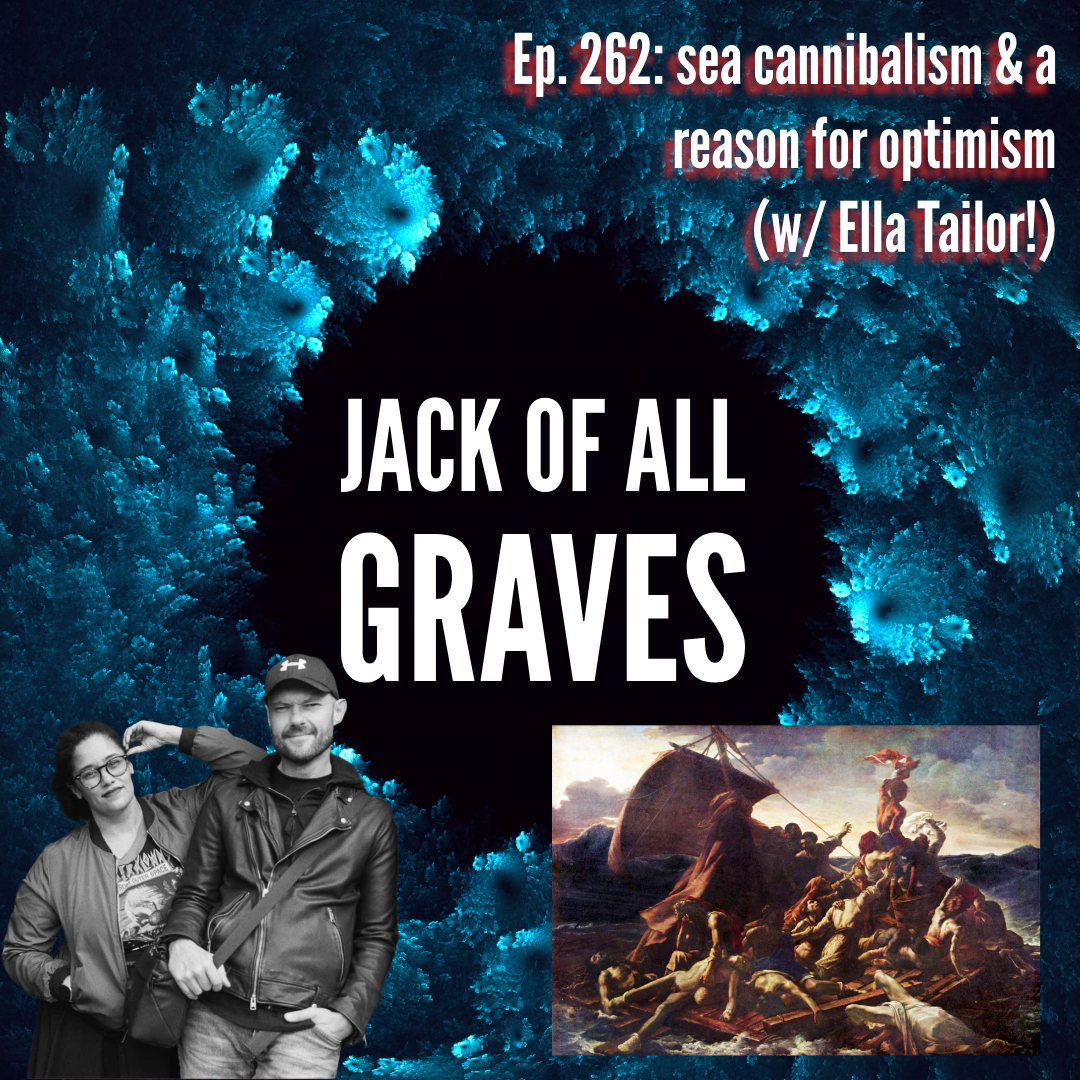
I will link to this. Actually it's already in like the promo image, but I'll link to it as well in the show notes. People can check out this or if you're sitting here right now, like I want to see it. Like I said, it's called the Raft of the Medusa and it's very famous. So if you look up the Raft of the Medusa, you will find it.
But the Medusa, or La Meduse in French, was a French frigate which is just a type of worship. It's not like a single worship like type. It's just a broad category of worship.
It began construction in April of 1807. Designed by Jacques Noel Sanay, she was a top of the line ship, able to carry 44 cannons that could each discharge a four pound shot.
The hull was reinforced with copper to protect it against destructive nuisances like barnacles.
And she set out on her maiden voyage in 1810, an eventful excursion to Batavia marked by high seas pursuit by an English squadron and separation from her convoy.
At this point, as you might know if you've been to the Maritime Museum in London, Mark the Brits, the Dutch and the French.
[00:11:25] Speaker B: What have I done now? What have I done wrong now?
[00:11:27] Speaker A: You've just simply ignored my constant request to take your family to the Maritime Museum.
[00:11:31] Speaker B: Yeah, I think we walked it recently, didn't we?
[00:11:33] Speaker A: And just simply did not go in so annoyed because you went, you went to Greenwich and you went to like the observatory or Whatever. And I was like, you. You can see it. You can see the.
[00:11:42] Speaker B: Oh, we'll go. We'll go for sure.
[00:11:43] Speaker C: We.
[00:11:44] Speaker B: We go to London all the time. It's. It's. It's a. It's a when, not an if.
[00:11:46] Speaker A: Yeah, and it's. It's such a good museum, man. I spent, like, four hours there. It's a delight. But anyway, one of the things that I learned there was the Brits, the Dutch and the French were all battling for naval supremacy and the ability to colonize every thing that they encountered.
Upon arriving in the Dutch East Indies, the Brits immediately surrounded the islands with warships and Batavia run by the French, and the Dutch surrendered.
The Medusa and her sister ship, the Nymph, though. Nymph, though, were able to escape, which gave the frigate a reputation for excellence.
While the rest of the fleet was captured, she was able to give the Brits the slip.
From there, she was sent out to fuck up English merchant ships as they returned home from the Far east, destroying at least a dozen ships between 1812 and 1813.
And then, despite being so incredibly effective, in 1815, for whatever reason, as Napoleon set sail for America, the Medusa was set to be used as a decoy meant to draw English fire, while Napoleon snuck off on another ship, the Saul. I guess they figured, like, the Brits would see this amazing frigate that was so cool and be like, of course he's on that ship. And then he'd sneak away on the other one.
[00:12:59] Speaker C: Have you seen that guy? He's a freaking narcissist.
[00:13:04] Speaker A: Yes. As they say, my God, I kind
[00:13:07] Speaker B: of know this story.
[00:13:09] Speaker A: Oh, really?
[00:13:11] Speaker B: So my current Get Me off to Sleep podcast is the rest is history, right?
[00:13:16] Speaker A: Oh, yeah, sure.
[00:13:16] Speaker B: As I think I might have mentioned over the past couple of weeks, and because it's so good at getting me off to sleep, I. I've heard the first, like, 20 minutes of so many stories, and. And this is one of them, so by all means.
[00:13:31] Speaker A: Nice.
[00:13:31] Speaker B: You know, while I'm in danger of going to sleep.
[00:13:36] Speaker A: Yeah. I'll actually fill in the rest of the story for you. It is funny because I did the same thing last night where I was like, oh. As I. Because I was reading a book on this, and then I was like, oh, I bet the Shipwrecks and Sea Dogs podcast has also done an episode on this. And so I was like, oh, I'll put that on before bed. And it was like, literally, I listened to, like, basically the end of, like, the political stuff, the wars and stuff like that. And then just, like, passed out and didn't get to the rest of it.
So this is mostly from the book and not the podcast, but anyway. So they have Napoleon sneaking off onto the Saul while the Medusa is supposed to lead the Brits away.
It was expected that the Medusa would be able to hold up to the British attack for about three hours, at which point it would be destroyed. But Napoleon would have had enough of a head start to avoid his own destruction by English warships.
This plan never came together, however, as Napoleon surrendered to the Brits on July 14, 1815.
The Medusa was decommissioned and disarmed as a result.
But as the French monarchy returned, the Medusa was repainted, all but 14 of its cannons removed so that there was more space for troops and cargo.
It was. Yeah, right, fine. I guess there's. This whole thing is going to be full of choices that make you go, huh?
Wouldn't have done that.
[00:15:03] Speaker C: It's not like the oceans are battlefields or anything, right?
[00:15:06] Speaker A: Yeah, I'm sure it's going to be okay.
But it was set. It was to set off for Senegal, inexplicably under the command of one Hugue de Roi de Chaumire.
[00:15:18] Speaker B: Oh, bravo.
[00:15:21] Speaker C: I was gonna say that.
[00:15:22] Speaker A: Thank you. Thank you.
Which I will just pronounce very Americanly from this point forward.
But he was a political appointee who hadn't been to sea for almost 25 years. When he was given this position, he was basically given the role as thanks from the Ancien regime, the old regime, obviously, if we remember from high school history, for having stuck by the Crown, which is definitely how you want people in life or death roles to be chosen.
We can. We can see how well that's going for the US Government at the moment when you just put people in charge because you're like, thanks.
[00:16:00] Speaker C: Thanks for the loyalty.
[00:16:01] Speaker A: Thank you.
[00:16:03] Speaker C: Cash. Can you get the eyes back in the skull?
[00:16:06] Speaker A: Just. Just.
Someone on Blue sky said that if you replaced Kash Patel with Aziz Ansari, Trump probably wouldn't notice for a week.
[00:16:16] Speaker C: Holy.
[00:16:20] Speaker A: It's true. It's very true.
But, yes, it was an obligation as far as the Restoration government was concerned. While their broke asses were paying regular enlisted men half pay or just ousting them altogether because they couldn't afford their navy anymore. They had to reward these guys who had, in some cases, even fought for England against the Republican and imperial France.
They were that loyal to the Crown.
[00:16:49] Speaker C: Jesus.
[00:16:50] Speaker A: So you had a whole.
[00:16:53] Speaker C: Could not be me, right?
[00:16:55] Speaker A: Exactly.
Not on your life, homes.
[00:16:58] Speaker C: Yeah.
[00:16:59] Speaker A: As we'll see. Also, could not be Choma Ray, but we'll get there.
You had a whole bunch of young, experienced dudes sidelined with half pay, while these absolute dinosaurs were taking up the best commissions as a thank you gift from. For their loyalty. Whether they. Whether or not they had anything near the experience or knowledge to be effective in these roles, it was very stupid.
As Cap.
As Captain Gal de Touche pointed out, it would have made a lot more sense for them to be rewarded by, quote, pensions, court appointments, and by commands of ships on which, and not by commands of ships on which depend both the lives of men and the honor of the flag. Flag. Which makes sense. You know, give him a pin, give him a little medal or whatever. Put them in charge of like, oh, I'm a diplomat to. Blah, blah, blah.
[00:17:47] Speaker C: Yeah, fine.
[00:17:48] Speaker A: You don't go. Go command this ship.
[00:17:51] Speaker C: Yeah, yeah.
[00:17:53] Speaker A: In the case of Shoma Ray, now in charge of the Medusa, he would have been a fine choice a quarter of a century ago, but a lot of changes in a quarter of a century, not the least of which is our own mental acuity.
And it gets kind of worse with Shamaray, because it's not that he got this jaw, just that he got this job while being way long in the tooth for it. But like I said, it was about loyalty, right? You never turned your back on the French, you know, on the royals, on the Allium regime, and that's why we're rewarding you.
He lied at this, Captain. See, what had happened was In June of 1795, he was part of an EAS of an invasion gone wrong in the peninsula of Kibaron, where most of his peers were executed.
He, however, was like me. I'm not a monarchist. I don't even know what I'm doing here.
And thus, rather than being executed, he was imprisoned.
And eventually he then escaped with the help of sympathetic guards and a local woman named Sophie de Curdu, who he swore he would marry.
[00:19:02] Speaker C: Sure.
[00:19:03] Speaker A: Yeah.
[00:19:03] Speaker C: Spoiler alert that before, right?
[00:19:06] Speaker A: I don't even have to say anything. You're like, come on.
[00:19:11] Speaker C: Rotten record.
[00:19:13] Speaker A: Scratch. Yeah, he. He didn't. He didn't marry Sophie de Cardu. He married a Prussian baroness, also named Sophie. Just to add insult to injury, here,
[00:19:24] Speaker C: he couldn't be bothered to learn a new.
[00:19:26] Speaker A: No, exactly.
Anyway, after his escape, he then fled to England, where he was given a hero's welcome, including the Royal and military order of St. Louis.
He then continued to build a mythology of himself, absolutely loving the attention and praise he Published the story of his bravery and his adventures, reshaping the narrative so that he came out a hero and not a total wormy coward.
As time went on, he would come to leave out of the story Sophie de Cardu altogether, making it his own cunning. That was the means by which he made his escape.
In the story he told. He had ice running through his veins. He could do anything. He was, you know, so quick on his feet.
[00:20:10] Speaker C: I think this guy's Pete Higseth is straight up. Yeah, like I was gonna say. Does he have. Does he have Doyce Volt tattooed on his forearms? Like, what's going on?
[00:20:19] Speaker A: Yeah, there. It's modern analogues for like everybody in this, you know, like, oh yeah, no, we got one of those.
[00:20:25] Speaker C: Maybe I co produce a. We'll get to it, I'm sure. I co produce a politics podcast that Corey has been on. So like I can't help myself.
[00:20:35] Speaker A: It's always there, like, oh no, we've talked about this.
[00:20:38] Speaker C: Whether I like it or not.
[00:20:41] Speaker A: Well, he was awarded the legion of honor and given the command of the frigate on its expedition to Senegal in April of 1816.
As you can imagine, the other offices officers appointed to this convoy that he'd be leading were not pleased.
Not just because he was clearly not prepared for such a voyage, but also because he sucked as a person.
Call it Hegseth, call it right, yeah, exactly. Like, fuck this guy. They touch described his him as quote, snobbish and ill informed when they first met. Which probably is not just Hegseth, but most of the people who are in charge of things right now.
[00:21:20] Speaker C: I'll say a harsh but fair.
[00:21:22] Speaker A: Harsh but fair. Yeah.
And the trip to Senegal could not be a worse trip for an inexperienced captain.
The waters were treacherous with violent currents, and the area wasn't well charted.
And this was especially problematic because the dangers could really sneak up on you.
In a 1789 account, an author told of his observation that the water around the ship seemed to be becoming clearer. And he suggested to the captain that they take a sounding, which means that they should measure the depth of the water. You know, figure out what the going on out there.
[00:21:56] Speaker C: It's like, it looks. I think there's ground coming.
[00:21:58] Speaker A: Yeah, it looks like maybe there's ground.
[00:22:01] Speaker C: Should we coming.
[00:22:02] Speaker A: Should we stick something in there and see what's going on?
[00:22:04] Speaker C: Yeah.
[00:22:05] Speaker A: But the captain was like, what do you mean? We're still 80 leagues from the coast and did not take a sounding.
[00:22:13] Speaker B: Well, I enjoy leagues as a measurement, by the way.
[00:22:16] Speaker A: I know. I just Say that I'm not entirely sure how far that is, but it's feels like a long way around.
[00:22:21] Speaker B: Yeah. See also fathom.
[00:22:23] Speaker A: Fathom. Yeah. That came up in a couple of these. And I was like, I'm not using that because I can't fathom a fathom. I don't know what it is.
[00:22:31] Speaker B: Par. Sex I'm quite a fan of as well. Whenever I hear. I hear a parsec, I'm like, isn't that. No idea.
[00:22:37] Speaker A: Yeah.
[00:22:38] Speaker B: I don't feel colossal though. It feels gigantic.
[00:22:41] Speaker A: Right.
[00:22:41] Speaker C: League common in Europe and Latin America. I guess it's like people regularly use it still. Yeah, it was. Well, yeah, it was. I should say not.
[00:22:52] Speaker A: Okay.
[00:22:53] Speaker C: It's no longer an official unit in okay. Nation.
[00:22:56] Speaker A: I was like, if I go down there, it's gonna be like, oh yeah, that's, you know, 40 leagues away.
[00:23:01] Speaker C: It's different. It's this. I thought I was interesting enough to mention it's different in different countries since the Middle Ages. It can go anywhere from 2.2 kilometers to 7.9.
Yep. Oh, so it could be one. 1.4 miles to 4.9 miles.
[00:23:16] Speaker A: Feels like that should be standard.
[00:23:18] Speaker C: I. I feel like that right now, in this moment is going to lead to problems in your story.
[00:23:23] Speaker A: Right? Yeah.
[00:23:24] Speaker C: What do you mean? It's 80 leagues away. I'm like, that could mean so many. Well, yeah, sure.
[00:23:28] Speaker A: Means it's either 80 kilometers or it's, you know, hundreds of kilometers away. It really depends on who you're asking.
Yeah. Well, it goes without saying the captain was wrong about that. Anyway.
[00:23:42] Speaker C: Yeah.
[00:23:42] Speaker A: And they ended up beached, attacked and captured.
And this was a regular occurrence. Ships regularly wrecked on the sudden shores of Senegal and then found themselves in the Sahara Desert where they were either attacked by moors leagues away.
Yeah. So they were either attacked by moors or were in the Sahara Desert. Neither of these are great outcomes.
This is bananas to me because I've never really. I mean, geography is not my strong suit. We're really dealing with a couple of things, geography and art in this one that are like, not things I know anything about. And so I was like reading this and I'm like, you're telling me the ocean runs up against the Sahara Desert?
[00:24:29] Speaker C: Uh huh.
[00:24:30] Speaker A: What?
[00:24:32] Speaker C: Yeah, there's. There's bumps in between.
[00:24:36] Speaker B: Yeah.
[00:24:37] Speaker A: Like exactly.
[00:24:38] Speaker C: Like there's a little, you know, it's not like right on it.
[00:24:40] Speaker A: Yeah. But it's not gonna, it's not gonna help you anyways. There are in between.
[00:24:45] Speaker C: Yeah. If like you. I'm like, if you Hit the beach. And you're like, all right, well, we gotta find civilization. Let's go inland.
That's dumb.
[00:24:54] Speaker A: The desert.
[00:24:55] Speaker C: That's so dumb.
[00:24:56] Speaker A: Well, and certainly at this point, which we'll get to, like, there's also not really anything there because they haven't colonized it yet. So there's nowhere to go at this point. If you end up in the Sahara
[00:25:09] Speaker C: Desert, even if you stuck to the coasts.
[00:25:11] Speaker A: Yeah. You're not gonna. You're not gonna find anything except maybe some Moors who will capture you. So.
[00:25:17] Speaker C: And. And at this point, we got what? We got French and British here.
[00:25:21] Speaker A: Yeah, we have French, British, maybe the Dutch.
[00:25:24] Speaker C: Oh, the Dutch. Okay. Well, no, no offense, Marco, on account of the proximity, but go Moors.
[00:25:34] Speaker A: Yeah, no, exactly.
Good for her in this discussion.
[00:25:39] Speaker C: Yeah.
[00:25:40] Speaker A: Yes, absolutely.
Yeah. And we'll. Again, we'll get into that as well.
But yeah. So the more experienced officers knew about this through experience and study, but Shomer was not interested in their insights at all.
Still, it was clear that he was, in fact, anxious about the hazards, particularly since the maps that did exist indicated on them that they were flawed and that they should not be relied upon.
In the words of Captain Barbossa, they're more like guidelines.
[00:26:12] Speaker B: Yeah. Yeah.
[00:26:13] Speaker A: And it was important that the crew constantly take their own sounds so that hazards didn't sneak up on them, especially in the particularly dangerous Argam Bank. So. So basically, if you're in this area, you just have to constantly be like, all right, slow it down.
Let's take measures, make sure everything's good, and then we can move on. You can't just, like, the map says to go full speed ahead.
That's not how this works.
[00:26:40] Speaker C: Yeah. Because the underground topography is changing.
[00:26:43] Speaker A: Right. It's changing, and, like, it's not mapped well in the first place.
[00:26:47] Speaker C: You know, dudes rock more dudes rocking.
[00:26:51] Speaker A: Yes.
[00:26:52] Speaker C: Yeah.
[00:26:53] Speaker A: So there's also another issue here. Much like climbers of Everest have a very short window in which they can climb the mountain, or they have to wait till next season.
It was also understood that it was important to get to the coast of Africa in November in order to acclimatize themselves before the onset of the rainy season, which commences at the end of June and lasts until October.
There are a lot of variables involved in nailing the window in which one lands a ship in 1816. And for all his bluster, Chaumerray knew this was going to be real difficult for him.
Now, what business did the French and the English and the Dutch have in Senegal? You might Ask, I wonder, any guesses as to what they had there?
[00:27:42] Speaker C: Nothing good.
[00:27:45] Speaker A: Yeah. The answer is, of course, slaves.
[00:27:49] Speaker C: Yeah. Go, boys.
[00:27:50] Speaker A: Yeah.
Most of what they were doing with West Africa was slavery, considering it a quote, mine of men to exploit.
[00:27:59] Speaker C: I just threw up in my mouth a little.
[00:28:01] Speaker A: Thank you. Yeah.
[00:28:02] Speaker C: That's awesome. Holy crap.
[00:28:04] Speaker A: Yep. At this point, though, England was actually already out of that game, having abolished the trading of enslaved people in 1807. The actual, like, keeping of slaves was, like, 1833 or something like that, but you couldn't trade them.
[00:28:18] Speaker C: We'll give you that one thing.
[00:28:20] Speaker A: Give that one point.
[00:28:20] Speaker C: Hey, you know that thing you help.
Yeah. Like that thing you help start. Thanks for stopping that thing.
[00:28:26] Speaker B: You did right.
[00:28:27] Speaker A: Exactly. But France wasn't there yet. They had not abolished the slave trade, but it became clear to them that if they wanted to hold on to Senegal, they needed to find some other way to establish an actual colony and not just a hub for stealing people.
[00:28:43] Speaker C: Oh, Jesus.
[00:28:44] Speaker A: Yeah.
[00:28:45] Speaker C: I thought I was gonna be the most depressing.
[00:28:48] Speaker A: No, no, no, no, no, no. It's. It's bad. Much like the whites who colonized the United States, France gave land grants to folks who wanted to start a new life in Senegal. To help them to establish their presence there.
Their primary agricultural produce pro productions were growing cotton, cocoa, sugarcane, and most importantly, gum arabic, which had an array of uses, from manufacturing to medicine to candy making.
[00:29:16] Speaker C: I was gonna say it's good for a jewel.
[00:29:18] Speaker A: It's good for a chew.
I was at first like, is this a different thing? Like, do. Did we name gum after it or things like that? No, it's. It's the same thing. It just can do other things. It's like a laxative. It can be used in, like, putting together, in. In manufacture. It's like, has all kinds of different purposes, which, of course. Yeah. You want to control that.
[00:29:41] Speaker C: Yeah.
[00:29:41] Speaker A: You don't want. Yeah. You don't want England or the Dutch to own that.
[00:29:47] Speaker C: You don't want the Dutch owning too much anyway.
[00:29:49] Speaker A: Well, no. Like, in the long history of all of this, like, the important thing to realize is no matter how bad everyone was, the Dutch were worse.
[00:29:57] Speaker C: Yes. Yes.
[00:29:59] Speaker A: The Dutch were an absolute scourge on every single population that they ever came across. And they are lucky that nobody just, like, burned their entire section of the world down, because they are truly horrific.
[00:30:14] Speaker B: And yet, maybe. Maybe I'm just Dutch blind in 2026. Maybe it's just a kind of a narrowness of my field of vision or whatever, but it doesn't feel like they've got as bad a reputation.
[00:30:28] Speaker A: No, it's because they might warrant they lost their colonies earlier, which I think has a lot to do with why we don't think a whole hell of a lot about them.
And so like, for example, as you took my New York tour, like, yeah, we were New Amsterdam. Right. It was that because the Dutch were here and then the Brits came.
The Dutch were like, it's fine, let them have it.
At least the, the Brits who lived here were like, we do not want this fight.
[00:30:59] Speaker C: Or as they say in Dutch, big and naven or whatever. Like, yeah, it's just a big, big navy. Just like large and boat.
[00:31:07] Speaker A: Yeah, right.
I mean, and Britain became such like
[00:31:11] Speaker B: a goodbye Dutch fan base.
[00:31:14] Speaker A: But Britain became such a huge power, like a giant naval power again, which you can see in the Maritime Museum in London, that it did become for a time really hard for them to compete on this grand scale. So the Dutch were kind of first, you know, the Dutch, like the Portuguese too. The Portuguese were terrible and they were everywhere first, but because they then got out colonized by everyone else. Nobody thinks about the Portuguese anymore. Like, no, they really, they really a lot of people. But, oh, this tiny little country nobody thinks about.
[00:31:50] Speaker C: Yeah, when you're, you're like, you're like, no one thinks about it anymore. And I'm just like Japan over here staring.
[00:31:56] Speaker A: Right. Yeah, exactly.
[00:31:57] Speaker C: We remember.
[00:31:58] Speaker A: Yeah. Which again, another one. I mean, when it comes to like Japan and Korea, right? Like how Koreans side eye Japan.
[00:32:07] Speaker C: Yeah. Everyone gets a little imperialism as a tree, right?
[00:32:11] Speaker A: Anytime. Yeah, the imperialism happens. It's never a great thing. And it's just all of us, you know, every country and its indigenous people and whatnot, side eyeing each other for like, you know, what you did.
But yes, the Dutch are amongst the very worst.
[00:32:24] Speaker C: Again, more into what I'll be talking about later, but beautiful.
[00:32:31] Speaker A: So things okay? So, yeah, they're, they're, they're manufactured or they're trying to get this gum arabic and all this stuff. But yeah, as things start to turn real shitty for these people, let us not forget that they were there for slavery and colonization. So, em.
[00:32:49] Speaker C: Yeah, we're good.
[00:32:51] Speaker A: So you've got a dangerous voyage from the outset here with violent and unpredictable seas that are poorly charted and an inexperienced captain who thinks he's above everybody.
Plus all the dudes working under him hate him because while they were getting captured and tortured and whatnot by the British, he off and became a hero while barely seeing any action at all.
Like, you do as you do. They knew he was in his place because he was rich and he was owed a favor, and they didn't respect him at all.
[00:33:21] Speaker C: Cake eaters.
[00:33:23] Speaker A: This means that they started on shaky ground, or seas, as it were.
Thank you.
If there's anything anyone who's ever watched a show or movie about a ship knows, it's that you really want everyone to be on the same team out there.
You don't want a ship full of traumatized, wounded men who hate their commanding officer, squeezed onto a ship for months at a time, stewing in their hatred and distrusting his every decision.
On June 17, the Medusa came moments from scratch, smashing into a reef before violently jerking out of harm's way. An incident that only raised the hostility towards the captain, who was indecisive and often made choices like that at the last minute, right before doom.
[00:34:09] Speaker C: Quote from a crewman. This fucking guy.
[00:34:12] Speaker A: Yeah, straight up. Like, that's kind of the, like, vibe. The entire time that I was reading this book about him was just like, come on, man.
Come on. This fucking guy. Yeah.
It was less than a week later that the captain would fuck up in a way that made him irredeemable in the eyes of many aboard the ship.
[00:34:31] Speaker C: Awesome. Let's go.
[00:34:34] Speaker A: A teenage sailor, 15 years old, slipped off of the ship through a porthole leading to man overboard. Cries now, what would you do if you were the captain of a ship and a child had just fallen into the sea?
[00:34:51] Speaker B: There's a lot. Well, there's a.
It's not that simple, is it? It's not that simple a question.
[00:34:56] Speaker A: Oh, is it not?
[00:34:58] Speaker B: No.
[00:34:59] Speaker A: Why not, Mark?
[00:35:00] Speaker B: Well, how deep is the sea? How fast am I going?
[00:35:04] Speaker A: It's all deep. Just the whole. It's as deep as deep can be.
[00:35:09] Speaker B: Whose child is it?
[00:35:11] Speaker C: Holy fuck, Mark.
[00:35:12] Speaker A: Okay, so you and Shomeire are on the same page here.
[00:35:17] Speaker B: I'm just. What I'm saying is I don't think any of us on this podcast is qualified to judge this guy because we weren't there.
[00:35:28] Speaker C: The war, the wharf defense.
[00:35:30] Speaker A: Yeah, well, thankfully, there were people who were there, and they judge his decisions about this because, listen, you'd slow the boat down, right?
That's what you would do.
[00:35:42] Speaker C: Thank you.
[00:35:43] Speaker B: Thank you.
[00:35:45] Speaker A: And what do you think chivalry didn't do?
[00:35:47] Speaker B: Oh, I see.
[00:35:49] Speaker A: Slow that boat down.
Crewman desperately tried to fish the boy out of the sea, grabbing at his jacket, throwing him a rope, even tying ropes to themselves, and then throwing themselves in the water to try to rescue him.
The sea was too Rough, and it was impossible to hold on.
They tried to signal one of the other boats in the convoy, but it was too far away to be able to hear them.
So then they were like, all right, we'll signal with a cannon.
But none of the 14 remaining cannons was loaded, so they could not do that.
[00:36:22] Speaker C: God.
[00:36:23] Speaker A: Finally, the frigate hove to, which is to say they used the sails to slow it down, and they lowered a skiff with three sailors to go look for him.
Eventually, they had to give up.
Had the ship been slowed immediately when he fell in, they quite likely could have rescued him. It would not have been that big a deal, but simply too much time had passed for the team to keep his head above water in those rough seas.
So obviously people were pretty pissed about that whole situation.
[00:36:55] Speaker C: I don't think this captain is going to be keeping his head above water.
[00:36:58] Speaker A: Yeah, right on top of this.
Shomore seemed to be terrible at navigating, making it nearly impossible for the convoy to follow him.
The captain of the Echo, one of the other ships, noted that what Shomare was doing didn't match the prescribed course that they were supposed to be on.
So he had to just sort of follow what he saw him do as opposed to what he signaled. It's like when you're like, trying to follow someone through traffic who keeps darting through, like, the lights and leaving you behind.
They're just like, I don't know where you're going here.
And so they were just trying their best to like, follow whatever weird pattern he decided to take along the way.
When they compared estimates of their position, they were 6 nautical miles of longitude and 46 nautical miles of latitude apart in their estimations, which is very far to make as a mistake stake.
[00:38:01] Speaker C: That's such a big gap.
[00:38:03] Speaker A: Yeah.
Becoming increasingly isolated and desperate to hide his adequacy, Shomaray put his trust in an ex mariner of dubious repute named Antoine Richefort, who claimed to be an expert on Africa's west coast.
Soon he would completely ignore the advice of his actual officers in favor of Rishore's instruction.
Shomray became so impossible to advise, the officers literally came up with a plan to trick him so that they could get a wider margin of safety and avoid the argam Bank.
At 5am on the morning of July 2, they woke up the captain and told him that a white cloud off in the distance was Cop Blanc, a cape north of the bank of Argam.
[00:38:52] Speaker B: Nice.
[00:38:53] Speaker A: So to avoid the bank, a ship sights that cape, the actual cape, not the cloud, and then continues. 66 miles south by southwest before changing to a south southeast course.
So they figured that by giving him this location, they could account for his abysmal navigation skills, which would likely steer them straight into the bay, the bank of Argan.
This way, he would go a little further, out of the way of the bank of Argan.
Unfortunately for them, Riche4 was an idiot and decided that they should only sail 30 miles after cot Blanc before setting a southeasterly course.
They duped the captain, but the captain wasn't running the ship anymore. Riche 4 was.
So they pranked the wrong guy, essentially.
[00:39:46] Speaker C: Oh, no.
[00:39:48] Speaker A: Yep.
In the morning, the mistake became clear even to those who'd never set foot on a ship before.
They could see that the water had changed color, that there were fish just beneath the surface, that they could see what looked like sand beneath the waves.
There was kelp floating on the surface.
All real obvious signals that they were in shallow water.
[00:40:16] Speaker C: Yeah, you're gonna hit some land there,
[00:40:17] Speaker A: but hit some land. Yeah.
[00:40:20] Speaker C: Oh, yeah.
[00:40:21] Speaker A: Not long after Midway, you have to
[00:40:24] Speaker C: get out and push.
[00:40:33] Speaker A: Not long after midday, soundings confirmed that water was too shallow.
[00:40:39] Speaker C: No, it was too late.
[00:40:41] Speaker A: Yeah.
When your passengers are noticing little fishies.
[00:40:46] Speaker C: Oh, no.
[00:40:46] Speaker A: It's a little too it.
[00:40:48] Speaker C: Oh, no.
[00:40:49] Speaker A: So with a lurch and the roar of breaking ship parts, the Medusa ran aground off the coast of what is now Mauritania in the dreaded bank of Argan.
In classic fashion, There were only six lifeboats aboard the Medusa.
There were nearly 400 passengers.
And while today we're used to the captain and the higher officers going down with the ship, no show, Marais was not about to let that happen.
No, instead, the officers, the captain, the governor Rishore, and a hundred of the upper class passengers would get the lifeboats.
Everyone else, well, they'd build them a raft.
[00:41:37] Speaker C: Oh, no.
[00:41:39] Speaker A: That's right. The officers would build a raft for the remaining 147 men and one woman, most of whom were lower ranking. And that's basically expensive, expendable in the eyes of the asshole captain.
[00:41:52] Speaker C: This guy. Yeah, pretty much this guy.
[00:41:59] Speaker A: They called the raft la Machine, which is really funny to me, because who names a raft in a survival situation?
[00:42:08] Speaker B: Best detail so far. And who did it? And did they have a ceremony, right? Yeah.
[00:42:13] Speaker A: Did they paint it? Did they, you know, break some champagne?
[00:42:16] Speaker C: Yeah. Yeah.
Dudes, once again, continue to rock. Let's go.
[00:42:20] Speaker A: Exactly.
They built it from broken bits of the ship, and it measured 65ft by 23ft.
And of course, it could barely stay afloat.
[00:42:31] Speaker C: I'M looking at this. I'm looking at this, right?
[00:42:33] Speaker A: Look at the painting now.
[00:42:34] Speaker C: Yeah, yeah.
[00:42:36] Speaker A: It's a real Titanic door situation here.
[00:42:39] Speaker C: Yeah,
[00:42:42] Speaker A: yeah. So, yeah, it could barely stay afloat, obviously, and it had no rudder, which meant it had to be towed ashore by the lifeboats. So they basically just put lines on this thing to the lifeboats so that they could, you know, they would row and this thing would be dragged along behind them.
Friends, it was a bad plan.
No, I know. This is a big surprise.
Literally. Literally. As soon as they pulled away from the Medusa, things went haywire.
The sea swelled, causing the raft to lag, and everyone freaked the fuck out.
The people in the lifeboats basically went to hell with these clowns and immediately cut the tow lines that were connecting them to the raft.
Rowing away. Yep. And just leaving them there to figure it out for themselves.
They really Billy Zaned this whole thing.
[00:43:33] Speaker C: Yeah. Holy crap.
[00:43:35] Speaker A: So if we needed any evidence that colonizers are inherently bad people.
Voila.
[00:43:41] Speaker C: Yeah.
[00:43:42] Speaker A: Back on the raft, there was not one single ounce of chill to be found amongst the now abandoned passengers.
Within 24 hours, it was Lord of the Flies meets the crazies out there.
[00:43:54] Speaker C: Oh.
[00:43:56] Speaker A: Two boys threw themselves off the raft to drown.
[00:43:59] Speaker C: Oh.
[00:43:59] Speaker A: People became ravenous with hunger, and in just a day, they were already beginning to go mad.
Obviously, you can't drink seawater.
So many of the soldiers had busted into a barrel of wine and gotten
[00:44:13] Speaker B: absolutely shitfaced, which I see there in the painting.
[00:44:17] Speaker A: Right, yes. That figures into it. And many of these men were ex cons who had been picked specifically for the voyage because they were super violent and would be great for protecting the colony.
[00:44:28] Speaker C: Oh.
[00:44:29] Speaker A: Oops.
They immediately started fighting each other with knives, sabers, and axes.
And the raft became slick with blood, viscera, and teeth.
And the passengers, who weren't actively battling each other, were being trampled and crushed between the boards of the raft.
By the end of the second night, 65 men had died.
[00:44:56] Speaker B: By the end of the second night.
[00:44:58] Speaker A: The second night. Do you see what I mean about how this is, like, the opposite of the survival situation?
[00:45:04] Speaker C: Like, you're really making my job later so much harder. Thank you.
[00:45:13] Speaker A: It's amazing. Yeah.
They. 65 men died after two days on this thing, and the remaining barrels of wine and water had been hurled into the sea.
The next night, more fighting broke out. As the provisions went from scarce to zero, men began began eating the leather from their boots, hats, and belts. They drank urine.
[00:45:36] Speaker B: Yes.
[00:45:37] Speaker C: Probably quicker than they needed to.
[00:45:39] Speaker A: Yeah.
[00:45:40] Speaker B: When there was water Left.
[00:45:41] Speaker C: Yeah. One guy was, like, ready.
[00:45:43] Speaker B: He was ready straight in there.
Could we break out the piss?
[00:45:48] Speaker A: Might as well.
Yeah. That also probably goes for the one guy who tried to literally eat.
[00:45:55] Speaker C: Oh, God. Yeah. No, he'd been thinking about that.
[00:45:57] Speaker A: Yeah. But he couldn't do it. Couldn't. Couldn't choke down.
Gross, man.
What several of them were able to do, though, was carve chunks of flesh from the bountiful dead and feast upon that.
[00:46:14] Speaker B: Good.
[00:46:15] Speaker A: That's right.
See, cannibalism, three days in.
[00:46:21] Speaker C: I mean, come on.
[00:46:25] Speaker A: Every time we talk about stories of cannibalism, it takes a while, right? Like, people have to fight with themselves over, like, the morals of the situation. They have to contend with their religious convictions. They. They're usually weeks into starvation, giving it only when their bodies can't take a single moment more.
[00:46:40] Speaker B: Panicking about the Wendigo when to go at me, Right?
[00:46:43] Speaker A: Yeah. Will the Wendigo come after me?
[00:46:47] Speaker C: I'm starting to think everyone in this painting sucked ass.
[00:46:50] Speaker A: Yeah. It really gives, like, a whole different portrait of this whole thing.
[00:46:54] Speaker B: 3 days Wendigo can't get you at sea.
[00:46:57] Speaker A: Well, I don't know, man.
Three days in, and they're like, let's do this. Let's dig in.
Meanwhile, as I said, they're on the ocean.
[00:47:08] Speaker C: Corey.
[00:47:08] Speaker A: Yeah.
Meanwhile, as I said, they're on the ocean off the coast of a desert, about the most inhospitable landscape you can imagine. In the daytime, it's hot as hell.
At night, it's freezing from the sea breeze.
Also, they're surrounded by sharks that are getting a nice little feast from all the bodies here.
People are tossing themselves into the water day after day and night after night. And in the interest of hoarding what valuable resources they had, you know, their shoe leather and dead person flesh, they would roll wounded passengers into the sea while they were still alive.
Just yeet.
And by day six, there were only 30 of them left on that thing.
On day 13, when the brig Argus from the convoy came upon them, only 15 men were still alive, which is what we're looking at in that painting is the Argus coming. And they're all reaching out towards the Argus coming to rescue them.
[00:48:21] Speaker C: Oh, my God.
[00:48:23] Speaker A: According to the Argo reader quote, strips of human flesh had been hung from lines to dry in the sun on the raft.
[00:48:31] Speaker C: It's a jerky.
[00:48:33] Speaker A: Yeah, a little bit people jerky. Little people. Bill Tongue.
[00:48:38] Speaker C: Good eats.
Oh, God, I'm so sad inside.
Thank you.
[00:48:43] Speaker A: You're welcome. Once rescued, five of the remaining survivors ended up dying and only 10 returned to France alive.
Two survivors, Henry Savigny and Alexander Alexandre Corriard, wrote out narratives of what had happened for the government, which were then leaked to the press and then published in a book called Narrated Narrative of a Voyage to Senegal in 1816. Which sounds more like a cheery little adventure than what it actually is.
[00:49:14] Speaker B: Like a YouTube video.
[00:49:15] Speaker A: Yeah, right, exactly. Hey guys, welcome to my channel.
Thrilled and intrigued Europe while painting Chamoret in a terrible light and showing how insane this practice of giving people commands as a political reward was. So it actually did end up changing the way a lot of this naval hierarchy worked.
[00:49:38] Speaker C: Malarkey.
[00:49:40] Speaker B: And it was a good seafaring term. Malarkey.
[00:49:43] Speaker A: Malarkey. It is a good one.
And it was because of this book that Our painter friend, 25 year old Theodore Jericho, became obsessed with the Medusa. Interviewing survivors and frequenting hospitals and morgues where he would sketch dead and dying people.
[00:49:59] Speaker C: Oh, God.
[00:50:00] Speaker A: In his flat, he would watch the process of decomposition to make sure that he could understand the different colors and textures of death as it happened.
[00:50:08] Speaker C: This dude was so popular, I'm guessing
[00:50:14] Speaker A: gonna say he did not have a girlfriend.
Just a guess.
[00:50:18] Speaker B: But joking aside, look at that painting.
[00:50:22] Speaker A: Well, right, yeah. He completed the 16 foot high, 24 foot wide painting, the Raft of the Medusa in 1819. And it became, as you can imagine, an instant sensation, if a controversial one.
[00:50:35] Speaker C: Oh, so that thing's huge.
[00:50:36] Speaker A: It's enormous. Yes.
[00:50:38] Speaker C: Okay. I've seen, I've seen paint, I've seen artists like in process, spend like a whole, like year.
[00:50:46] Speaker A: Yeah, exactly.
[00:50:47] Speaker C: A whole wall painting before. It's nuts.
[00:50:51] Speaker A: Yeah. This took him essentially like two years to complete.
All in all, and as Argo reader put it, quote, Jericho's painting became a symbol not just of disaster at sea, but of abandonment by the officers, the government and the world.
It was anti colonial. Anti colonialist. And by putting an African man, or melanated man, as you put it, at the apex of the composition, I want to assume. Yeah, no, it carried overt abolitionist symbolism.
Captain De Chaumore was court martialed and found guilty of, quote, incompetent and complacent navigation, as well as abandonment of his passengers.
He dodged the death penalty somehow, but spent three years in prison before living out the rest of his life in his mom's house, disgraced and deep in debt.
And in that way, the story has a happy ending.
[00:51:44] Speaker C: Hag. Seth.
[00:51:46] Speaker A: Yeah.
Lord, I see what you've done for others.
[00:51:49] Speaker C: Yes.
Yeah.
[00:51:53] Speaker A: Thank you, Andy, for bringing that to my Attention.
It was a joy to read the book about and horrify you all with.
[00:52:03] Speaker C: That was fucking harrowing.
[00:52:05] Speaker B: It's a journey. It was a journey. And delivered in your.
In the detail which has become your trademark Corrigan. It's lovely.
[00:52:15] Speaker A: Thank you.
[00:52:17] Speaker B: Yeah. Thanks, Andy, for bringing that painting to my attention. It's captivating.
[00:52:22] Speaker A: Love it.
[00:52:23] Speaker C: It's always sunny on this beach. Like it's.
Every single person in this painting is just a piece of shit.
[00:52:31] Speaker B: Let me quote directly from my notes, if I may.
[00:52:34] Speaker A: Yes, please do.
[00:52:35] Speaker B: Fucking look at these nerds. Oh, mise en scene.
[00:52:39] Speaker A: I don't think anyone has ever said mise en scene in such a horny way before.
[00:52:43] Speaker B: The way I whispered the word sex.
[00:52:44] Speaker C: Cannibal routine.
[00:52:45] Speaker A: Worst comes to worst, Mark, I'm willing to guillotine you for science.
[00:52:49] Speaker B: Thank you. That's really, really sweet. It's cold outside, but my pancreas is talking to me. I'm fucking. I'm gonna leg it.
[00:52:55] Speaker A: You know how I feel about that, Mark?
[00:52:58] Speaker B: I think you feel great about it, such as it is. Listen, friends, welcome. Again, let me ask you. Listening right now, wherever you are or watching or however you choose to interact with and consume this podcast, think about your workplace culture, right? Think about where you work, if indeed you do work.
In so many people every fucking Friday, right?
There are a couple of. There are plenty of workplace phrases which get under my skin, right? There are plenty of workplace phrases which mean nothing and which feel to me as though just a waste of time. Just a verbal dance around nothing. And it.
Sometimes. Most of the time, I can just brush it off. Most of the time, I can just carry on going about my day. But I was. I was in the middle of a run earlier on, and fucking. I don't know where it came from or why, because it was a lovely, lovely, sunny run and I was in the zone and it was great. But for some fucking reason, I started asking myself, I wonder how many times.
I wonder if I could put a figure on the number of times somebody has said to me, happy Friday, right?
[00:54:17] Speaker A: Okay?
[00:54:18] Speaker B: Isn't that fucking nonsensical? Isn't that fucking stupid?
[00:54:21] Speaker A: Why is that nonsensical?
Have a good day. Hey, you.
[00:54:26] Speaker B: No, no, no, no, no, no, no, no, no, right?
Every time.
Every time somebody says to me, happy Friday, do you know what I really hear? Happy one less Friday to go, right? That's why.
[00:54:44] Speaker A: That's an insane way to think about that.
[00:54:46] Speaker B: That's what I really hear. That's what I really read. Happy one less fucking week. To go before your death.
That's what I really fucking hear.
[00:54:57] Speaker C: Oh, Marvin.
[00:54:59] Speaker A: The weirdest they live interpretation.
[00:55:02] Speaker B: And I kept running and I kept going and I kept going and I pulled that thread.
And, you know, whenever you look forward to anything, whether that's a holiday coming up or whether that's Christmas or whether
[00:55:17] Speaker C: that's scared of where this is going,
[00:55:19] Speaker A: you know where this is going, all you're doing is.
[00:55:22] Speaker B: All you're doing is crossing things off, aren't you? Until there's nothing left to look forward to.
All of us, whenever you have a date in the future that you're anticipating and you're moving towards it and it goes, all you're doing is just putting a line through things that lead inevitably to there being nothing left to cross off.
[00:55:41] Speaker A: Off.
[00:55:42] Speaker B: Isn't that so? Don't ever Happy Friday me. Don't ever give me that. Because all you're doing is telling me that I've got one less Friday to go until I die.
[00:55:58] Speaker C: Oh, no.
[00:55:59] Speaker B: So don't ever do it. It's insensitive.
[00:56:05] Speaker A: What can.
I mean, this raises the question for me of what can you say if you're not trying to draw someone's attention to their own mortality? What just said. How do you. How do you go through life without reminding someone that someday they will die?
[00:56:25] Speaker B: Don't. The things that you should stop marking or pretending are special, right? Dates, weekends, or time. It means nothing. It means absolutely nothing. The place,
[00:56:38] Speaker C: it.
[00:56:38] Speaker B: It doesn't mean what people are caught in thinking. It means all you're doing is crossing off all. Every time I look at my watch, every one minute closer, one second closer, closer, closer, closer. It's just coming inexorably.
[00:56:54] Speaker A: Don't you forget about dying.
[00:56:56] Speaker B: Exactly.
[00:56:58] Speaker A: Your friend, death.
[00:56:59] Speaker B: That's exactly it. And that is how I will open us up this week.
[00:57:04] Speaker A: Listen, I want. I have had that thought, okay? I mean, and I regularly have that thought, don't get me wrong. I think it's like a. A common, neurodivergent thought of, like, especially, you know, the ADHD brain doing the kind of thing where it's like, you're always.
You've got like a thousand things going at once, right? And so it's very hard to, like, stay in a moment, which makes it so that, like, a lot of times it's like, yeah, I'm looking forward to this. I'm looking forward to this. But then as soon as you get in the moment, all you're thinking about the fact is, it's gonna end.
[00:57:37] Speaker B: This is not Even a slight exaggeration or podcast talk, this is legitimately true. At some point every Christmas, I will think, I wonder how many more I've got.
Every Christmas that thought will occur to me. And sometimes, sometimes whenever I look upon a full moon, the thought will enter my head. How many more of these will I see?
[00:57:58] Speaker A: Well, see, well, here's my thought though, is like there's yes, that's true. But this can cause you two different ways of looking at it, right? Either, oh fuck, every day I'm one step closer to dying and. And what? Then everything is meaningless. Or ah, fuck, I'm one step closer to dying every day. So this day is glorious that I'm still alive. Thank you.
[00:58:20] Speaker C: Thank you.
[00:58:21] Speaker A: Every day above ground is a good day, right?
[00:58:23] Speaker C: Thank you, Corey. I was gonna say, like there's an opposite end of, of this and it's what I'm here for, right?
[00:58:30] Speaker B: And.
[00:58:30] Speaker C: And it's yeah, it's that like, how many more do you have left this. So it's like you don't know when. When I'm gonna die is none of my business.
[00:58:40] Speaker A: True story.
[00:58:41] Speaker B: It's a coin toss. It's a coin toss how that that will affect me and how it'll.
[00:58:45] Speaker A: On a given day. Yeah, yeah, yeah. Depends on where your mood is.
[00:58:50] Speaker C: Yeah.
[00:58:50] Speaker B: I just. That's. That was that that preoccupied me saying it was something I thought I'd bring in. It was something I thought might be.
[00:58:58] Speaker A: You know, I think when people say Happy Friday, they would say, you know, enjoy the Friday and don't think of it as, you know, one step, one foot in the grave.
[00:59:10] Speaker B: Start opening my Friday emails with one less Friday till you die and see how that, See how long takes people according on to the fact that that's all this. We're saying the same things really.
[00:59:23] Speaker C: I Mark, I feel you. So no like in this specific way because, oh, I don't say good morning anymore. I say morning because. Yeah, I'm not a morning person. So like, I know. Yeah, I'm like, I'm not gonna lie to you.
[00:59:41] Speaker A: Right.
That's fair. I. I mean we all know that I'm the, I'm the bubbly one here, you know, so I'm gonna, I'm gonna keep saying Happy Friday to you and you're just gonna have to take it as it's intended.
[00:59:53] Speaker B: Well, fine, but. But in between your intent and the. My reception is an ocean of ambiguity.
[01:00:07] Speaker A: Ella. Hi.
[01:00:08] Speaker C: Hi.
[01:00:09] Speaker A: Welcome. Welcome.
[01:00:11] Speaker B: It's great to see you. It's great to see you in person. It's Great to meet you.
The girl behind the posts. It's great to meet the face behind the. I will. I'll be cold in the ground. Because before I call him Skeets, but. But it's lovely to meet a fellow blue sky.
[01:00:29] Speaker C: Get over it. They're sky. Well, I will die on that hill.
[01:00:34] Speaker A: Yes. And Ella here, Ella Taylor is the sort of podcast producer extraordinaire of various podcasts out there, including ones that I have guested on. Well, one is defunct now. Monday Night Fake Fights.
[01:00:49] Speaker C: Yes.
[01:00:49] Speaker A: Which is now Wednesday Night Fake Fights.
[01:00:52] Speaker C: Yes.
[01:00:54] Speaker A: This is probably less miserable to watch.
[01:00:56] Speaker C: Holy.
It's the one coming out today as we speak is. It was a rough week in the Aw world.
[01:01:05] Speaker A: But the original. The Monday Night Fake Fights involved watching through old episodes of Nitro and Raw.
[01:01:12] Speaker C: And that was killing me.
[01:01:13] Speaker A: Yeah. Was rough. Rough at the time.
And so Wednesday Night Fake Fights focuses on the current run of the aews.
[01:01:25] Speaker C: It is so much better. Yeah. The Wednesday night show is so much more fun usually. This week was kind of heavy, so we. We had awesome. We had guests for the first time on the Wednesday night.
[01:01:38] Speaker A: Nice.
[01:01:38] Speaker C: Yeah.
Matrix and Mi Amore. Filmmakers and awesome people.
I love Bugs Talking about their movie coming out again. Again, which is premiering at the Seattle International Film Festival.
And the first screening sold out in five hours.
[01:01:58] Speaker A: Oh, wow.
[01:01:59] Speaker B: Okay, tell me the name again. Did you say it was called again again?
[01:02:02] Speaker C: Called again again. Check it out. I'm street teaming for them so hard. Because it's.
[01:02:07] Speaker A: Love it.
[01:02:08] Speaker C: This is what trans people do. There's a handful of us.
[01:02:11] Speaker A: It's true. Yeah.
[01:02:12] Speaker C: And we all make or help make art. You know what I mean? Like that's. I mean, this movie, it's executive produced by Lily Wachowski. So like it's literally nice.
[01:02:22] Speaker A: Okay. I think I did see that come across my Blue sky feed at some point. So. Yes, now that does sound familiar.
[01:02:32] Speaker C: That's what we do. We what? We watch the. The Wednesday nights and we talk about it and occasionally now we decide are gonna have guest hosts again to kind of be like, you know, check it out. Bugs was on the Monday night show. So she reached out and I was like, of course. Please. Yaps and grabs. Let's go.
[01:02:50] Speaker A: Beautiful.
Love it. So if you're interesting or want to get into wrestling, Wednesday Night Fake Fights is a great time. You also do the most important election of our lives.
[01:03:00] Speaker C: I just produced that one. That. That's a hired gig. I help my book it and I help write a little bit and edit and I also.
I edit it's called Here Comes Tomorrow with Josephine Reisman and Becca Petunia, which awesome Queer X Men podcast that I get to hear before anyone else be jealous.
[01:03:25] Speaker A: I. I am. And Josephine Raisman is incredible.
[01:03:29] Speaker C: Oh, I love Josie.
[01:03:30] Speaker A: Josie.
Yeah, she's amazing.
Very funny, very talented writer. Just incredible insights about all the things.
[01:03:39] Speaker C: Yeah. Podcasting rules I get to do. And so many cool things and meet a lot of really cool people, present company included.
[01:03:47] Speaker A: Sucks.
[01:03:48] Speaker C: Yeah. Shocks, Andy.
It's. Yeah. It's not something I ever thought I would get into.
I used to joke about how, like, there's too many CIS white dudes podcasting, but then I flip the gender switch, and it's like, I'm friends.
[01:04:03] Speaker A: All right, I can do it now.
Listen, I will say, though it's funny, you were saying, like, you know, there's a handful of trans people and you all help each other with your art and whatnot, and I will say, blue sky does make it feel that way. That I'm like, I'm pretty sure that every trans person knows each other.
We are not one here.
[01:04:25] Speaker C: We're not a monolith. But there's like, four or five. There's, like, circles, pillar polycules throughout the world. And. And there's some. Some. Yeah. It's six degrees of separation.
[01:04:38] Speaker A: Yeah. Yeah.
[01:04:39] Speaker B: Being Welsh, whenever I mention to somebody that I'm from Wales, they'll go, oh, my cousin's Welsh. Do you know them? No.
[01:04:47] Speaker C: Notice. I've been trying so, so hard to be very particular about hating on the British.
[01:04:52] Speaker A: And thank you.
[01:04:53] Speaker B: I don't think it's gone unnoticed. Thank you. Thank you.
[01:04:57] Speaker C: Quite welcome.
But, yeah, I.
Podcaster lady on the Internet that tries to make jokes and graphic design is my passion. And.
[01:05:09] Speaker A: Yes. Which also.
That's one of my favorite of your endeavors. I have several of your bits of apparel.
[01:05:16] Speaker C: You have too much of my merch.
[01:05:19] Speaker A: You and my friend Bailey.
[01:05:21] Speaker C: Oh, my.
[01:05:22] Speaker A: Oh, really?
[01:05:23] Speaker C: Bailey has something. Bailey, I love you. Bailey took my hyper local hating the mayor of Minneapolis shirt to Korea this week. It sent me pictures. It is international.
[01:05:34] Speaker A: Oh, that's amazing. I love that. Well, that makes me very happy.
So, obviously, I will link to those things in the show notes so you can all check them out afterwards. But, yeah, the. The merch is undeniable.
Where, you know, your cat on me in the prideless riot shirt all the time.
[01:05:53] Speaker C: I can't believe you have my cat Merch. Merch. Not a lot of people have bought that.
[01:05:58] Speaker A: I get comments on it all the time, too. It's very.
[01:06:00] Speaker C: Oh, My God. Well, I can't stress enough that all that started because I was like, what if I just took posts that I giggled at?
Just put them on T shirts.
[01:06:09] Speaker A: Yes.
[01:06:10] Speaker C: And now I like, use it to raise money for rent funds and stuff. Well, again, we'll get to that later.
But yeah, it's, it's, it's a wonderful thing. I, I, when covet hit, I had to switch careers and I picked up a lot of new things. Things and turns out that I'm kind of good at broadcasting and, you know, make people giggle. So that's nice.
[01:06:29] Speaker A: And yeah, that's a very good thing to have going. I like to think that's kind of our thing as well. Like, you know, hey, we make people gig a little bit. Probably cringe sometimes. Yell a lot of different, A lot of different things here.
[01:06:44] Speaker C: Thoughts on cringe? We'll get there. But thank you so much for finally having me.
[01:06:48] Speaker A: Yeah, it's so wonderful. You know, we've been talking about it in DMS and whatnot for a while and then specifically. So last week on the show, Mark horrified everyone.
[01:06:59] Speaker B: Now,
[01:07:01] Speaker A: I already told you, it's not what, what this was about. No, you didn't do anything wrong. You just horrified everyone with.
[01:07:10] Speaker C: Fired me.
[01:07:11] Speaker A: Yeah.
[01:07:11] Speaker B: Okay.
[01:07:11] Speaker A: With a negative outlook for.
[01:07:13] Speaker B: Yeah.
[01:07:14] Speaker A: You know, climate change and things like that, which has been interesting. So you of course brought up the incoming El Nino, which after you talked about it, I know that people have brought it up in the discord. I've seen it in various news things. It seems like it's starting to get a little more like, traction. And picking up like, this is really, like, gonna mess with us, guys. We really need to like, take. Yeah. Like, pay attention to this. Which, you know, in that discussion, I was kind of like, I had asked you, Mark, like, all right, so, like, what, what do we do to prepare? And that's caused me to be thinking a little more about that, not just for this year, but in the long term, how do we prepare for climate disaster?
So I think that's, you know, that's a good thing. It's sort of raising, like, it's always a good thing to raise our anxiety about the climate, I think, because we're not anxious enough about it and things need to change. Which then brought into the sort of conversation about the book that I read by Hope Jaron, the Story of More and kind of her climate optimism, if you will, but more of the kind of idea of like, that we humaned our way into it. We can human our way out of it and what those steps are.
And then I kind of took this perspective that, like, you know, it's hard, but I believe in people movements more than I believe in corporate movements and things like that.
And so Ella and I were talking about this and kind of, you know, her perspective, your perspective on like having hope when you have no right to have hope, basically.
[01:08:49] Speaker C: Yeah. That's a nice way of putting. I slammed into your DMs, like, I'm gonna make Mark have hope.
[01:08:57] Speaker A: Yeah.
[01:08:58] Speaker C: I will make Mark doomless. I swear to God. I've seen some shit. And we're gonna make it.
[01:09:05] Speaker A: Yes.
[01:09:06] Speaker C: Yeah, that was. That's what happened is like, yeah. Busted the door down.
[01:09:10] Speaker A: Yeah.
[01:09:12] Speaker C: Please let me come make you happy somehow. Exactly how I have no right to be this hopeful, but please.
[01:09:18] Speaker A: Yeah. So that's kind of what we're gonna. We're gonna chat about in a little bit, you know. Of course we want to talk about, you know, what we've been. What we've been watching lately, which I know for Marco and I hasn't actually been a whole lot. Well, and Ellie, you were saying not a ton on your. So this will be a quicker one than usual.
[01:09:39] Speaker B: It hasn't been a lot, but at the same time, a show is. Is short in title but long in commitment. You know what I mean? You're watching, I mean, how many. You're watching 12 hours of something as opposed to two hours of something. So, yeah, watching a lot. But it has true, you know, a lot time heavy, but not sort of title heavy, if that makes sense.
[01:10:00] Speaker A: I think that does make sense. Yeah. And we, so we started. You. Mark really wanted to start the pit, but also I had already made him commit to watching a show with me first, which was something very bad is going to happen on Netflix. And so we did watch that one this past week and really enjoyed it.
[01:10:24] Speaker B: Yes.
So I'll get. I'll go through the, the, the graph of my reactions and my emotions to this. Right.
[01:10:33] Speaker A: It's.
[01:10:34] Speaker B: It's always.
I don't enjoy seeing behind the curtain and I don't enjoy the transparency of the paucity of ideas that exists in the creative space that we all share now with our media. Right.
Whenever something hits it as regular as clockwork, you can check your watch. Eighteen months to two years later, you'll get lots more things like.
[01:10:56] Speaker A: Right. Yeah.
[01:10:57] Speaker B: Right.
And because Mike Flanagan ensemble dread infused family dramas are doing well. Oh, look, here's another one that was clearly just rocket shipped into. Promote into production as soon as, you know, Hill House and And, well, especially
[01:11:15] Speaker C: because didn't Flanagan leave Netflix?
[01:11:18] Speaker A: Oh, did he?
[01:11:19] Speaker B: Is that right?
[01:11:20] Speaker C: I'm pretty sure. I'm pretty sure he's no longer doing stuff with Netflixes and doing stuff with Amazon.
[01:11:27] Speaker A: Oh, interesting. Well, yeah, this even has one of the characters who shows up in. In Hill House. And not characters, but actresses who shows up in Hill House and Bly Manor.
What?
[01:11:40] Speaker C: How Universe Girl?
[01:11:43] Speaker A: No, no, no, not in universe. Just one of the actresses. So it even more, you know, pushes in that like this is, you know, based on our flanniverse here, but it does really well with it.
[01:11:55] Speaker B: Yeah. Which isn't to say that it isn't a hell of a good laugh, because it is.
It's.
I disagree on not Corrigan, but I find it impossible to predict, you know?
[01:12:07] Speaker A: Right. And I think I said that to.
Yeah, several times that I was like, you know, normally when we watch things, you're like, all right, when did you know what was going to happen?
[01:12:16] Speaker C: Sure.
[01:12:16] Speaker A: And it was like, even like the second to last one, I was like, how is she gonna get out of this?
I don't know how this is gonna turn around.
Which was very fun.
[01:12:26] Speaker B: For those with no concept of what it is, you have a rapidly paced, you know, very dense yarn about curses and the. The it's generational trauma and, you know, is. Is. Is.
Is love an escape from the fucking horrors that your family hand down for you or is it just another layer of imprisonment, you know?
Well, yeah, right.
But that's told through the tale of, again, a wonderful ensemble cast, lots of whom will be familiar to any. Anyone, you know, genre fans.
It's very.
It doesn't about. With. With the juice. It is very gory. It's got some of the best, like, close up, unflinching gore that I've seen in a. In a TV show for a while. There are.
[01:13:20] Speaker C: Okay, beautiful.
[01:13:23] Speaker B: It doesn't look, you know, when you're expecting it to cut away. Right. It won't show us that. Holy shit.
[01:13:28] Speaker A: No, it will.
[01:13:30] Speaker B: And then it does not cut away.
So for that alone, for the spectacle of it alone, there's a lot of real gnarly bodily horror in this show.
[01:13:42] Speaker C: I don't know if we're a video podcast, but I'm smiling. So.
[01:13:45] Speaker A: Yeah, Elle is in now.
[01:13:49] Speaker C: Yeah, you got me.
[01:13:54] Speaker B: You also, it's got a really.
I'm a sucker for dialogue. You know, I love it when dialogue feels like people actually speak as opposed to how a writer interprets that he thinks people might speak.
This. This sounds for all the World like people talking to people in the most outlandish of circumstances.
[01:14:14] Speaker A: Yeah.
[01:14:14] Speaker B: I didn't find myself questioning the. Its dialogue that feels like something I would hear someone actually say. And then when you throw that into the most fucking outlandish and batshit of circumstances, it really helps it land. It's. What soundtracked immaculately.
It is directed and shot with just some of the things I really, really enjoy in kind of inverse camera angles and weird perspectives and. And you know, where the.
Just disorienting is the way I would describe it.
[01:14:48] Speaker A: Yeah.
[01:14:48] Speaker B: It's a good direction and cinematography that is. Is as disorienting as the subject matter.
I was completely unconvinced going in Corrigan. I won't lie as I often. As I've learned to my benefit. The trick is usually just to trust you. And sometimes you get it right, sometimes.
[01:15:09] Speaker A: Occasionally I get it.
[01:15:11] Speaker B: The times you get it right outweigh the bits you don't.
[01:15:13] Speaker A: Thank you. I appreciate that.
[01:15:15] Speaker C: I have to say, one of the reasons I'm so excited to be here is that I feel like I am the listener. That is almost like it's true.
[01:15:28] Speaker B: So.
[01:15:28] Speaker C: So much of me busting into Corey's DMS is either going, I completely agree with you or I. Yeah, I'm with
[01:15:36] Speaker A: Mark on this one. Yeah.
Yeah. It is very funny those reactions in real time to. To it. Because.
[01:15:46] Speaker C: Yeah, I can't help. I would often wonder if I annoy you, but I'm just like. I'm just like. But you keep responding. So I'm like, yeah, like, listen, it
[01:15:55] Speaker A: may take me three days because I don't look at messages on anything, but I will respond.
[01:15:59] Speaker C: Yeah, exactly. Precisely.
[01:16:01] Speaker A: Precisely.
But yeah, no, it is always very funny and. And it's that like, you know, now you're here and you can just talk straight back.
[01:16:08] Speaker C: Yeah, exactly. No rundown. It just get right.
[01:16:12] Speaker A: But yeah, I would recommend something very bad is going to happen.
It's. It's a good watch. It's on Netflix.
And yeah, it's just. It definitely does what it says in the box. That's for sure.
[01:16:25] Speaker C: Hell yeah. It's my favorite kind of thing.
[01:16:27] Speaker A: Yes. And also one of the things that it does that Marco particularly likes is mid to end episode titles.
[01:16:37] Speaker B: Just the. I knew what you were about to say and my heart leapt.
[01:16:41] Speaker A: Yeah.
[01:16:42] Speaker B: God, I don't know. I wonder why it is that I respond so well to that. Because it doesn't matter what some piece of shit film or show could do. This one. This one simple trick.
[01:16:50] Speaker A: Yes.
[01:16:51] Speaker B: And I will Instantly just fall in love. Just don't show me the title at the beginning. Just chuck it up there like a third of the way through or at the end or do it in response to some dialogue. Just show me the title in massive letters at an unexpected time. Yeah. And I'll go, oh, oh, that's so good. That's so creative and great. Even though I've seen it like a billion times.
[01:17:11] Speaker A: Right.
[01:17:12] Speaker B: I don't care how you do it or who does it. Just don't show me the title at the beginning and I'll really enjoy.
[01:17:17] Speaker A: It's just. It's good because you always kind of forget, you know, and then so when it shows up, like, oh, it's like Jean Parmesan and Arrested Development. Ah, Jean.
And there's my favorite one in it, I think is like, you know, she's like telling the story of how she met her fiance. And it's like mid sentence, she's like. And you know, I was thinking. And it's like something bad is very bad is going to happen. And you can still see her talking behind it. And I'm like, like, you guys, there
[01:17:45] Speaker B: has to be a way. By now I'm sure God forbid that you could train a gen AI on six years of our show and produce
[01:17:54] Speaker A: like the perfect movie.
[01:17:57] Speaker B: Movie or show that I. I could not fail to give five stars to because I'm so easy to please.
[01:18:04] Speaker A: It's true, you do have very specific
[01:18:06] Speaker B: things I like to see.
[01:18:06] Speaker A: And trees shot overhead, car driving.
[01:18:11] Speaker B: But it has to be very specifically from 90 degrees above.
[01:18:14] Speaker A: Right.
[01:18:15] Speaker B: Following a car through a woodland. Yeah, that'll do it.
I enjoy a kind of a do do that very same shot, like over the top of buildings, like, let's start a Candyman. That would do me as well.
The thing with the titles, all of
[01:18:30] Speaker A: those film that could be a play
[01:18:33] Speaker B: just on a stage, set it all in one room.
[01:18:38] Speaker A: Yeah, it is. You do have little tricks, little buttons. Yeah.
And that I think is like pretty much literally all I've watched besides Dateline this week.
[01:18:52] Speaker B: I'd love to know if Dateline is shown on over here anywhere.
[01:18:55] Speaker A: It's got to be somewhere, like on sky or something.
[01:18:58] Speaker B: Just I want to get a taste of what. Of what it is that you love so much.
[01:19:01] Speaker A: Yeah.
[01:19:03] Speaker B: Or maybe if you have an animal vlog over here.
[01:19:05] Speaker A: Yeah. As an avid watcher of your 24 hours in police custody, I feel like you'll at least kind of like get why I watch it. Although I think that's like a little more akin to our 48 hours than to Dateline, but, yeah, I've watched that. Oh, and I also watched like, three quarters of the Yeti last night.
[01:19:22] Speaker B: Yeah.
[01:19:23] Speaker A: Did not finish. It's like, I would have, but then there was, like, something else. Oh. The Nine Inch Nails show at Coachella was on, and I was like, I'm just gonna switch to that instead.
[01:19:33] Speaker C: Yeah, that probably would have won me over.
[01:19:36] Speaker A: Yeah, it's like I don't care enough about this to, like, not just switch to the Coachella performance instead, so.
[01:19:44] Speaker B: Which I still haven't seen. I've listened to the album plenty.
Incredible gym music. That album alone is gonna get me dangerously ripped. Just that. Just those 12 tracks is gonna do more for my musculature than years of creatine and commitment. Just that those 12 tracks are gonna boost my gains.
I will speak on the Pit.
Where are you in proceedings right now? Have you finished?
[01:20:15] Speaker C: I finished. I just finished it. So I will be quiet about season.
[01:20:19] Speaker A: Yeah, no spoilers or anything, because I do want to watch this show.
[01:20:23] Speaker B: Here's what's happened with the Pit, right?
I watched season one and inhaled it over the course of, like, six days, and I didn't realize that there was a season two. I thought I'd have, like, a year to wait. And then I realized, oh, sure, there's a season two. And it was like, Christmas one. You know, one further Christmas, he texted me.
[01:20:41] Speaker A: He was like, there's the second season of the Pit. I was like, isn't that why you were watching it? Because everyone's been talking about it? He's like, no, I thought they were talking about season one.
[01:20:51] Speaker C: Fantastic.
[01:20:52] Speaker B: And I think the highest possible praise I could give, at least to season one of the Pit is that it gave me the same feelings as the first couple of seasons of the Bear did.
Yeah, very much so. Just a close knit group of very, very vulnerable and damaged people doing their very best under very tense circumstances.
I guess that's. That's another one of the buttons I enjoy pushing. I enjoy seeing traumatic people really trying to. To act against the forces that. That are. That are trying to make them do
[01:21:26] Speaker C: the wrong thing, you know, acting against their own trauma.
[01:21:29] Speaker B: Exactly, Exactly.
[01:21:31] Speaker C: Yep.
[01:21:32] Speaker B: That's a very powerful story to me.
And the Pit is great at it. I'm a doctor now, basically.
[01:21:38] Speaker C: Oh, yeah, no, absolutely. I could do so much.
Oh, no, I can do so much now.
[01:21:47] Speaker B: I want to be in a plane where there's an emergency and I want somebody. I want. I want one of the flight attendants to ask over there. Is there a doctor on the plane? I'd be like, no. But I have recently watched the Pit in a very short space of time. And I'll have.
Come on up.
[01:22:00] Speaker C: Let's go, Dr. Robbie. This.
No, that. Oh, is so good. My biggest thing with that is like, it took me forever to get to it and I. When it. When the first season came out, I remember everyone being like, it's the craziest body horror.
[01:22:21] Speaker A: Right? Yeah.
[01:22:25] Speaker C: That they've been. People like, are just like, I can't even stand it.
And I got about a season and a half in and I went, man, I watched too much horror.
[01:22:37] Speaker A: Because this is like, it is not phasing me.
[01:22:39] Speaker C: This is doing nothing for me. When they reset the up degloved foot in the very first episode. Beautiful. But I was just fascinated at how they were doing it. You know what I mean?
[01:22:52] Speaker B: I was just like anatomically fascinated at
[01:22:55] Speaker C: what anatomically fascinating I was. Oh, I guess that was probably. I get people probably. I don't know. I saw terror terrifier too. So like.
Like, you can't. You can't get me. You can't.
There's nothing you can do to me. I haven't done to myself gleefully in an afternoon.
Shudder. You know, like.
[01:23:15] Speaker A: Valid point.
[01:23:16] Speaker C: Yeah.
But yeah, that's.
[01:23:19] Speaker B: It's something else that I've spoken as. And you don't no doubt will have heard me speak to Corey about. I feel the same. Right. I feel bulletproof by now.
You know, a 30 or 40 odd year career of watching horror so that when something does get me, it's instant, instant respect. You fucking got me.
Wow.
[01:23:38] Speaker C: Yes, exactly.
[01:23:40] Speaker B: Plenty of times during. During the pit, I've felt that in much the same way as I said about something very bad is gonna happen. I suspect this will lead in 18 months to a few more kind of 20, 30 years later legacy sequels to beloved 80s and 90s TV shows.
[01:23:57] Speaker A: Fuck it.
[01:23:58] Speaker B: I'm here for the. What would you like to see at a 30 years later show revisited of.
[01:24:03] Speaker C: Not like. Like they like. They like.
[01:24:05] Speaker A: This is not er, but it's er. Yeah, yeah, exactly.
[01:24:08] Speaker B: Exactly.
[01:24:09] Speaker A: That's a really good question.
[01:24:11] Speaker C: Good question.
[01:24:14] Speaker A: Oh, man, that's a. That's a tough one. I don't know why the first thing that popped into my head was Cheers.
Don't know why I was like, definitely Cheers.
[01:24:25] Speaker B: It would be apartments that, wouldn't it? Or it would be a.
[01:24:30] Speaker A: Yeah, because it's like nobody drinks anymore.
[01:24:33] Speaker C: That show existed kind of on Netflix with.
Well, what's Your favorite. Oh, God. What was it called? I can't remember what it was called because they only gave it one season. But it was so good.
[01:24:44] Speaker A: I think I know the one you're
[01:24:45] Speaker C: talking about, but, yeah, that would be Kathy Bates. Right. Like, it would play like the old hippie lady who runs. Runs the dispensary. And, like, every episode there was like a psychedelic cartoon.
So good.
[01:25:00] Speaker A: Yeah. I don't know, though, but it's. You know. But that's like. Cheers is lightning in a bottle. You couldn't really do that. Like, it has to be something like, er. Where it's like the framing device is the thing that's so good.
[01:25:10] Speaker C: And then, like, play with it because.
[01:25:13] Speaker A: Well, that's why. Yeah. Medical dramas and procedurals are like the things they make over and over and over again. Right. Because it's like the idea is there, it's harrowing, there's interpersonal drama, there's like all of this stuff. So it's really about, what do you do with it. And this rebooted in a way that's like, you got your ER, but you also got your 24 and, you know, you've got your. The bear and it's like blending all these things.
[01:25:37] Speaker C: I never watched 24, but the 24 aspect of the Pit really drew me into.
[01:25:43] Speaker A: That was really great.
Mark loved 24 for a while there.
[01:25:48] Speaker B: Ella, 24 was everything to me for just.
It was a very specific period in my life where 24 just was my every waking moment. I wanted to either be talking about watching or discussing 24, the most wonderful show. So influential. So fucking just of its time, you know, it was.
It was incredible.
[01:26:15] Speaker A: I've only seen season three and I imagine you can probably guess why. Mark.
[01:26:23] Speaker B: Is James Badge Dale in it.
[01:26:25] Speaker A: He is.
[01:26:25] Speaker B: There you go. Yeah, yeah.
[01:26:27] Speaker A: But then he dated Kiefer Sutherland's girlfriend, and so Kiefer Sutherland killed him off in the fourth season off screen.
Yeah.
So that's the only bit of. I've seen, but I enjoyed that season.
[01:26:42] Speaker C: Let Mr. Dale do what he.
[01:26:47] Speaker A: He's recovered. He's doing fine.
Yeah. Have you watched anything, Ella, recently?
[01:26:53] Speaker C: The Pit.
The Pit and, oh, the. The remake of Deathstalker.
[01:27:00] Speaker A: Oh, that's right. Yeah. Yeah.
[01:27:03] Speaker C: From the. The folks. The fine folks that made Psycho Gorman.
[01:27:07] Speaker A: I didn't realize it was the same filmmaker.
Stephen Kostanski, I believe.
[01:27:14] Speaker C: I'm not sure. I. I'm. Again, because I'm a fraud. I'm not a professional.
But I tell you what, it's got that vibe.
It's got that vibe of. Of like the swords and sorcery, but with hyper gore. And it just will not take itself seriously. Don't you?
And I. I'm. That's candy to me. That kind of, like, stuff that won't take itself seriously is candy to me. I love pro wrestling. No way.
[01:27:46] Speaker A: Well, yeah, that's a good point.
Yeah.
See, you talking about it this way does make me want to see it more because it is one of those ones that it's like, you know, as the letterboxd reviews and things like that come in and people don't like it, I'm like, my motivation to watch it shrinks. But then, you know, like, I love Psycho Goreman.
So if we're talking in the same vein of that, you know, it's like,
[01:28:10] Speaker C: I would say it's the.
The.
If CIS het men could do camp.
[01:28:19] Speaker A: Okay.
[01:28:20] Speaker C: Does that make sense?
[01:28:21] Speaker B: Yeah, it makes perfect sense.
[01:28:23] Speaker C: Yeah. Yeah. Like, that's what I would call it, what they think camp is. And, like, the closest they're gonna get. Like, it really kind of is. But, like, a very specific. Like, this isn't okay. This could be gayer.
[01:28:33] Speaker B: Yes.
[01:28:34] Speaker C: Basically, it's like, how I felt about it. It's still pretty good, but it could be Garrett.
[01:28:38] Speaker A: So does your camera, like, automatically?
[01:28:41] Speaker C: It does, yeah.
[01:28:43] Speaker A: I was like, what's going on? Is my. Is there something wrong with my brain? Am I hallucinating?
[01:28:49] Speaker C: I don't know why it's doing that.
[01:28:51] Speaker A: It's like, after. Did you. Did you ever play, like, Guitar Hero for too long and then like, after you stop playing, like, you're. Yeah, you're like, everything is moving. Like, that's what it felt like for a second. I was like, are my eyes all right? What's going on here?
It's okay. Now that I know that's what it's doing. I'm not bothered by it, but I.
[01:29:12] Speaker C: It's been catching my eye too. Is that what's going on?
[01:29:17] Speaker A: Yeah.
So with all that said, I don't know if we count those as wrecks or whatever, but that's what we watched of late.
[01:29:26] Speaker B: I'll just. I'll super quickly.
For reasons known only to Sony's marketing department, they're still Evil Dead Burn. The teaser still is not properly on
[01:29:39] Speaker A: the Internet, but yeah, that's so weird.
[01:29:41] Speaker B: Isn't it strange? It does line up with the marketing for Rise in the three months before release was when the marketing really wound, you know, wrapped up.
But there is a cam, phone cam in the cinema version of the Evil Dead burn that. I've been just thirsting for months, and it's fantastic.
[01:30:03] Speaker A: Yeah, I know that Colin went and saw the Mummy. So he saw it in real life. I think maybe Benners might have as well.
You were like, do you want to see the cam version? I was like, I will go to the movie theater and I will see something that it will be in, I'm sure. I mean, I went and saw Yumi in Tuscany yesterday, so they did not put it before that.
But I'm sure something that I'll go to see this week will have it. I'm not. I'm not sure on the Mummy because unlike you folks, like, you know, I enjoy gore and things like that to a certain extent. But as we keep on talking about, I also am very likely to cover my eyes. And I feel like as I get older, the more I'm, like, squeamish about it as opposed to when I was younger.
And so, like, with the Mummy, what'd you say?
[01:30:52] Speaker C: Exact opposite.
To have a hard time with all kinds of horror. And then around about 2020, I was just like, you know, nothing. Nothing scary anymore.
[01:31:04] Speaker A: Yeah, it's. I think that, like. And not to be, like, weird and dark about it, but I think I saw too much real violence and that made it so I don't enjoy, like, the fake violence as much anymore.
And so, like, yeah, I think it's. It's kind of one or the other. It's either like, it clicks in something and you're like, well, now, like, how can I be, like, you know, phased when I've seen, like, real horror all over the place, or I've seen too much real horror and now I can't stand to watch it. I think it's like, those are the two horror fan.
[01:31:36] Speaker B: As you'll know from my perspective. I just. I adore the craft and.
[01:31:40] Speaker A: Yeah, right.
[01:31:40] Speaker B: That goes into it, which I do
[01:31:42] Speaker A: try to, like, place myself in. Like. Like, if I were Mark, I'd be thinking about how they did this and, like, nope, nope. Too grossed out.
[01:31:50] Speaker B: But all of which is to say, you know, you could. What? I. I suspect when you do finally catch the Evil Dead Burn teaser, you won't even know what you're seeing until a few seconds, and you won't even realize that. That it is what it is.
But it is full of detail.
It gives just.
Just this wonderful kind of. Of hint to your palette of what kind of taste and flavor the film is gonna have.
And just your eyes are everywhere across the frame. It's gonna be Mayhem. That film is going to be absolute chaos. Ah, I cannot wait.
[01:32:25] Speaker A: Yeah. Oh, I was gonna say, though, that's why, like, I'm not sure if I'm gonna see the mummy or not, because I need, like, people, basically. I need people to report on, like, exactly. Or I'll just look at the IMDb Parents Guide. Because I'm like, like, are there. Is there going to be fingernail issues? It feels like a movie where there's going to be fingernails.
[01:32:42] Speaker B: Yeah.
[01:32:42] Speaker A: And that's not a fan of that.
[01:32:45] Speaker C: That's a rough one.
[01:32:46] Speaker A: That's. That's like, really. My. My, like, biggest hang up is if I think that there's going to be fingernail gore, I will literally not watch a movie.
Like, I just. I can't do that. That one thing more than anything else.
Nail core is not for me.
But I'm sure I will see some sort of horror that will have.
Have this play before it instead of watching the cam version. Or I'll just be surprised when the movie comes out. Yeah, we'll see. One way or another.
So listen, Ella, I just feel like we just got to wind you up and let you go. You have a plan here to try to bring our Marco into the idea that humans can save ourselves.
And I'm interested to hear. It's like one last chug of coffee. Like. All right, here we go.
[01:33:34] Speaker B: Preface this right, if I may, with just recapping my experience during our episode on prison. Abolitionism. Right.
[01:33:47] Speaker C: Yes.
[01:33:49] Speaker B: In that.
[01:33:50] Speaker C: Very involved. It's like a precursor episode to this one.
[01:33:53] Speaker B: Good, good.
There was not a single thing that came out of our guest's mouth or mind that I disagreed with or that I couldn't grasp.
A lot of stuff that hit home and a lot of stuff that I want. I wanted something practical. I wanted steps towards a reality where things are different as opposed to an idea that a different world is possible. Lots of things are possible. Doesn't mean they're never gonna fucking happen.
[01:34:30] Speaker A: Well, and she did give a lot of steps to it, to be fair. There were many, many impractical steps.
[01:34:35] Speaker C: Well, in that case, Mark, I'll say this.
I'm gonna have more, like, examples of real world things.
Probably some of them I won't because I can't and. Or won't or talk about it or it's not mine to talk about sort of thing. I did put an ask out to some folks if being like, hey, you know, if you're comfortable with me, you're comfortable sharing or comfortable with, you know, me, have bringing this into. To my mindset, going into this and that kind of thing.
But, yeah, no, I, I don't know. I get what you're saying. I, I. And I. I listened to that episode, and I was like, absolutely. But the whole time I was listening at episode two, and you're like, I don't know, but what do we do? And I'm like, we're.
That episode came out while I was living in the middle of this, and it's still going on, but, like, in the middle of the beginning of this, and the whole time I was going like, we're doing it right now.
[01:35:40] Speaker A: Yeah. And to be clear, for those that don't know you, you live in Minneapolis.
[01:35:44] Speaker C: Yeah, so I'm getting.
[01:35:45] Speaker A: Yeah, yeah.
[01:35:47] Speaker C: So. Hi, I'm Ella. I live in Minneapolis. I've been here for, like, 10 years, and, God, I've seen some.
I am not anyone cool. I am not anyone famous or like, you know, I. If you ever call me a thought leader, I will go out back and.
And end it all. All that. That is not why I'm here. I make goofs on the Internet.
[01:36:17] Speaker B: Right.
[01:36:18] Speaker C: Yeah. I'm just a lady. I wasn't nearly as active during all this as I would have liked to have been because my life was in a pretty rough place.
[01:36:26] Speaker A: Right.
[01:36:27] Speaker C: Directly before and during and now of this occupation. So, like, I became one of many, many people. Many people who were doing the best they. They could to show up how they could.
And that is very important.
[01:36:46] Speaker A: And just in case, like, people also, since we do have kind of an international fan base as well, this is where ice came and was again.
[01:36:54] Speaker C: Yeah, I'm sorry, I'm getting a long way around.
[01:36:58] Speaker A: Okay, yeah, yeah. For your context. Yeah.
[01:37:02] Speaker C: Not the first, not the last, but with the. Probably the biggest direct surge that they've done during all of this happened in Minneapolis and St. Paul and, and the whole state, really, Everyone says Minneapolis. And it's like, yeah, no, but it really was.
It was everywhere. And the resistance was everywhere. Like, in small. Everyone talks about, okay, well, you got. The Twin Cities are super blue, but everything else is super red. And I'm like, generally, yes. But also, all those super red places were ready to throw down for their name.
[01:37:41] Speaker A: Yes.
[01:37:42] Speaker C: This is what I'm talking about.
The, the lines that, that, that they drew to keep us separated went away for. For the most part, in a lot of ways. Not all of them, sure. But it is the kind of thing, you know, I think back to, oh, these boys. So Minneapolis, St. Paul is the Twin Cities, like University Minnesota campus.
And like a while, a while ago, because, like I said that we weren't the first. Before us, it was Chicago. Before that it was la.
And they had.
[01:38:17] Speaker B: No.
[01:38:18] Speaker C: They hit LA hard at. Naturally, we got it because of a grifter on the Internet coming after our Somalia neighbors. And he can eat, so I won't even say his name because it doesn't matter.
He moved on to worse things.
[01:38:35] Speaker A: So, of course, yeah, they always do.
[01:38:36] Speaker C: They always do.
But he got enough attention to. To give us the worst couple months of our life and also kind of the best mark. So what I get to is. So, yeah, so, like, that. That's the context is that I live.
You know, we'll get to it. But like, I. I live very near where a lot of this went down. Now.
I have lived near where other tragedies have gone down. The police have killed people, like on my block, like my neighbors. I just gunned my neighbors down for. For having a drink on. On the corner and mourning his sister who just died across the country. They. They decided he looks close enough to someone we want to with, and he ran away because he was upset and great drunk and had a gun and they just shot him for it. So rest in Peace, Thurman Blevins Jr.
Yes, I. We've seen a lot of this. George Floyd, obviously, like, we've seen a lot of this.
So when this happened, it wasn't new to all of us.
So to get back to my notes here because, like, yeah, so, like, regardless of the humbleness of, like, the common Minnesotan.
[01:40:01] Speaker A: Right.
[01:40:02] Speaker C: I will tell you, there are heroes there here. Like, a lot of them. I am not one of them.
I just. I just boost rent funds. I make T shirts about how much the mayor sucks, and I use that money to send to rent funds.
I only make my own rent through the grace of wonderful people on the Internet. Mutual aid is mutual. More on that later.
At one point, I held on to this job that I hated, basically because it was the middle of this occupation and I was often the only white person in the building. And I wanted.
So I would get up every day during all of this and just kind of go to work, assuming I might get arrested.
[01:40:45] Speaker B: Like.
[01:40:47] Speaker C: And that is the mentality of everyone I know.
There was no just going to work.
That's the best way to describe it. They were everywhere.
And like, during George Floyd and stuff, there was National Guard everywhere. So again, we recognized this. It was just different pigs in different suits.
[01:41:08] Speaker A: Yeah.
[01:41:09] Speaker C: You know, but it was different this time in that the callousness like, oh, my God.
And, yeah, well, we'll get there. But needless to say, like, yeah, I wanted to. To be there to get between them and their prey.
[01:41:28] Speaker A: Right.
[01:41:28] Speaker C: Everyone can do something. Everyone can do more.
Even if you're doing something, you can do more.
So, like, I just want to tell you about what I've learned from those heroes that do exist and the neighbors that make what they do possible.
First, I want to acknowledge real quickly, I'm not gonna do what you think I'm gonna do.
I ain't that kind of white liberal. That being said, I was like, all
[01:41:53] Speaker A: right, let's do this.
Land acknowledgment. Let's go.
[01:41:56] Speaker C: No, no.
I do want to acknowledge some heroes that made. Made the. What the world saw us do here completely possible. The first of which is the American Indian Movement, of course.
[01:42:06] Speaker A: Yeah.
[01:42:06] Speaker C: Which was founded half a century ago on Franklin Avenue, a few blocks of that away.
[01:42:11] Speaker A: Wow.
[01:42:12] Speaker C: Yeah. In, like, a neighborhood over from me. So, like, aimed at a lot of stuff, but, like, the most pertinence to this is they did the patrols on the south side similar to what the Black Panthers were doing across the country. In the same type of frame, too. Really? So, like, community safety patrols by the community, for the community. No pigs needed.
[01:42:31] Speaker A: Right.
[01:42:32] Speaker C: In 2026, during the occupation, AIM patrols returned to the street.
[01:42:38] Speaker A: Oh, wow.
[01:42:38] Speaker C: We knew what. They knew what to do. Like, we. That's what I'm talking about. We knew what to do.
I want to acknowledge the black leaders of the abolition movement in the Twin Cities and beyond that have moved. Mountains have been fighting this fight longer than a lot of us have been alive. Have taught me and teach me so much. Just being lucky enough to live here every day.
When I. When what happened to Junior happened, a protest erupted outside our. Our front door.
And, like, wearing a lot of lessons that night.
Things that'll stick with you also, especially to black women for being a miracle workers.
Also, almost. Almost guaranteed to complement my outfit when I'm scooting through the south,
[01:43:27] Speaker A: which is a very important service as well.
[01:43:30] Speaker C: Oh, my God. All the love.
Yes. Gender euphoria all the time. So, like, I want to also acknowledge the Sharps and the Sharpies and the decades and decades of dedicated anarchists and as they. Fascists in the Twin Cities. They were. They were doing this before. It was cool.
Yeah. Like, hell, yes. And, of course, naturally, organized labor. More on that later.
And, of course, the two most famous heroes. We've kind of talked about one of them already.
As much as I'd Rather it not be true.
The mother and poet Renee Nicole Good and the VA nurse Alex Preddy, gunned down for doing what any good person would do. About four blocks from my apartment, I. When I left to work that day, I was heading out to pick up a lift and I heard police sirens.
And I kind of didn't think about it because, you know.
[01:44:33] Speaker A: Right. I'm sure it was pretty common at that point.
[01:44:35] Speaker C: Well, yeah. And also, I'm paying attention for whistles at this point. You're paying attention. Tension to hear whistles and. And.
[01:44:43] Speaker A: Right.
[01:44:43] Speaker C: Car honks not the. The pigs are getting. Whatever the pigs are doing. And I was like, whatever they're doing, they're not helping. But okay, whatever. When I got to work, I realized that what I was hearing was them responding to Alex Pretty. Getting shot, which. That was a hell of a day.
[01:44:59] Speaker A: Yeah.
[01:45:00] Speaker C: But. Yeah, like that. That more than anything, I just want to be like that. That's.
Yeah. And speaking of those. We lost it. That often doesn't get remembered. Victor Manuel Diaz is a Minnesotan from Nicaragua that was stolen from us by ICE and he eventually died in custody.
[01:45:17] Speaker A: Yeah.
[01:45:17] Speaker C: The official narrative being a suicide, which I and many others say. Sure, Jan.
[01:45:23] Speaker A: Right. Yeah, of course.
[01:45:25] Speaker C: Sure. Yeah. Yeah. And this is casserole, not hot dish. So.
[01:45:29] Speaker B: Yeah.
[01:45:31] Speaker C: So all the. All that.
[01:45:32] Speaker A: I mean, even if, you know, it's. It's not really like. It doesn't look great if people are killing themselves in custody either. I mean.
[01:45:39] Speaker B: Yeah.
[01:45:39] Speaker C: Yeah. Like, how. How is it that bad? And I'm. That's. One of our neighbors will never give back. And none of this cannot stress enough.
None of this is over until all our neighbors are back and we. We are stuck to that.
Like. Like they. Yeah, that.
So all that sadness aside, getting to more sadness.
I promise you this ends with less doom. But these are the things that are.
They're things that are of Minnesota, but they're not uniquely Minnesotan.
That's what I want to get across. Like, I assure you that something like this exists near you.
[01:46:20] Speaker A: Right.
[01:46:20] Speaker C: Like everywhere, but under the things I've seen and why. I think, Mark, that you should feel a little bit better. Better just even. Just a little bit better about humanity. I'll take that.
There are things that I've probably missed when putting all this together.
Even more importantly, there's more that was done and is being done that I will not ever know or want to know about.
[01:46:43] Speaker A: Yeah.
[01:46:43] Speaker C: Tell you what.
So that being said, from here on out, I kind of just have a grab bag of things I Was like, this would be good to ring. Feel free to interject with any thoughts, feelings.
How are you doing right now, Mark? Are you nice and doomy and gloomy?
[01:47:03] Speaker B: I.
Without. I'm all I can. All I can be is honest on this cast. Right. It's the only thing I can do. I don't like Myers, so thank you. And, and I'm all. I'm. I'm.
When it comes to the doom. If you were to point at the scale from the sad face to the green smiley face, I'm always at about an eight, unfortunately. But I learn I can't, I can't be bringing this into conversations with my family or my colleagues.
[01:47:33] Speaker A: Right.
[01:47:33] Speaker B: So I learned, I learned.
[01:47:35] Speaker C: Yeah.
[01:47:35] Speaker B: To simply push it down.
And that isn't, that isn't always effective. I, you know, as Corrigan knows, I'm very susceptible. My emotions are always all over the place. I don't seem to have a middle ground. I'm always either super, super up or super, super down.
And I've come to suspect that is because I'm always trying to suppress.
[01:48:00] Speaker C: Yeah, yeah.
[01:48:02] Speaker B: The, the gloom.
[01:48:03] Speaker A: Yeah.
[01:48:04] Speaker B: I'm always trying to push it down somehow.
Well, that's as honest as I can be.
[01:48:10] Speaker C: There you go. Well, the best I'm hoping to do it is get, give, give you some good hopeful stuff to put on top to push that right on.
[01:48:21] Speaker A: Right to work on moving down the scale a little bit.
[01:48:23] Speaker C: Right on down with some good, good juicy stuff on top. Lots of rainbows, unicorns.
Ice, Ice guys falling on the ice. That was.
[01:48:33] Speaker A: I always love that.
[01:48:34] Speaker C: Yeah, well, I will never get sick of seeing those guys eat.
So. Speaking of ice guys eating, I just have two lists here. I have the horrors and the response.
[01:48:48] Speaker A: Love that level list.
[01:48:49] Speaker C: Right. First on the horrors, roving gains of thug chuds.
Oh boy, that sucked. They were literally everywhere. You could not go somewhere.
[01:49:03] Speaker A: These are the, the ice agents.
[01:49:04] Speaker C: The ice agents and, and, and cpb. And because it's not just ice, it's. It's custom board which is.
[01:49:10] Speaker A: Yeah. Customs and border patrol.
[01:49:12] Speaker C: It's Bortech, which is like the, the worst of the worst.
Bortac are, are sociopaths. Bortech are serial killers with, with badges.
[01:49:23] Speaker A: Oh, yikes.
[01:49:25] Speaker C: Gosh, I hope the feds never listen to this, but love you.
That's just how I feel. I would say, you know, prove it if, if I'm wrong, prove it because everything it's. This is evidence based. So like not really great folks. And of course MPD is just helping them random smash and Grabs of people. They would just randomly grab people at literally anyone brown or accented anything. They would take people out of cars and then just abandon the vehicles, things like that. So.
Oh, that sucks. What are some of the responses just to that stuff, though?
Some stuff that we got from Chicago. The whistles.
The whistles came from Chicago. And let me tell you, the whistles work.
[01:50:17] Speaker A: That's. See, I appreciate you saying that because there was definitely so much, so many attempts to be like, oh, don't do that. That's actually bad.
You might. They work traumatize people or whatever.
[01:50:30] Speaker C: Well, they.
[01:50:30] Speaker B: Were they in the.
In the. In the. The video from Wisconsin that was, you know, that made it around globally. Those whistles were ever present, we could hear them loud and clear across the planet.
[01:50:43] Speaker C: Oh, yeah, yeah. No, absolutely. And. And they were everywhere.
Like, absolutely. Three, Three whistles to let people know that ice is in the area. And then constant. 1. If something's going down. Because if something's going down, this is other part of the response.
And this is probably like one of the biggest things. This was the first thing that made me go, holy, we're gonna win.
So quickly it became that if you heard whistles and. And honks everyone, I'm pouring out of their homes.
[01:51:24] Speaker B: And.
[01:51:24] Speaker C: And that's the difference because I've been at this a while as far as trying to help people who aren't being helped by. Who should be helping them.
You know, like, I'm usually houseless. Outreach and things like that is that like, there's not a lot of us, you know, the burnout. That's why it never goes anywhere, because the sheer numbers. These guys pissed off fucking everybody. They drive like fucking assholes because they're taught to. Because they're taught to drive. Like they're in a war zone.
[01:51:56] Speaker A: Right?
[01:51:57] Speaker C: They're all like, the ones who are senior officers are fascists and have been for a long time. The new guys are neo fascists, which are just fascists who are more incompetent, which I think maybe that's better. No, no.
[01:52:13] Speaker A: Yeah.
[01:52:14] Speaker C: So, like, oh, my God. Jesus Christ. And they're everywhere like goddamn cockroaches. But we.
It's like watching white blood cells attack a. A virus. You know what I mean?
It just a swarm. They could get nothing done. We had the response time down to like, less than two minutes.
The only way. The only way that's possible is because everybody's in on it. Yeah, I don't think I have it near me, but I. I'm, you know, speak for Myself in all of this. And I, you know, have heard other people say, my whistle will never leave my land. I feel like that's never leaving Keychain ever again. I'm. You know, we don't. None of us leave the house without them. You go to businesses, cafes, and there's bowls of them.
[01:53:09] Speaker A: Wow.
[01:53:10] Speaker C: These 3D printed whistles that people all around the country will just 3D print and mass and. Yeah, and they're everywhere.
Everywhere and free. No, like, like, it's like, you know, you imagine like your wartime, like, handing out the guns, but it's just happening.
[01:53:31] Speaker A: Right?
[01:53:32] Speaker C: Have a whistle. Have a whistle and a Sambusa and you're gonna, like. Because that's how we are. Like, like, oh, my God. So like, yeah, they're everywhere because they worked. And like, that's it. And that leads to other stuff. You get the roving patrols in ICE watch and hyper local organizing to the point where, like, there's, there's like neighborhood signal chats that are down to like, the block.
And all of a sudden all these people are talking together. And all of a sudden this is what I mean when I say I can't help but have hope. It's like we people who have been working towards like, defunding and abolition of police have been fighting this for like, a long time and been going just. We just don't have the people.
And then all of a sudden it just, just the, the, the, the. The wind change. Like, I could see the flag change.
And all of a sudden it's just like, oh, we got holy. Everybody, everybody. Everyone's down. And all of a sudden all that decades of isolationism that America has. Has put on itself went away. And we're all neighbors again.
And it happened all at once because it had to, because they were.
Yeah, they're taking our neighbors.
They're taking white people and doing God knows what to them.
[01:54:57] Speaker A: Right? Yeah. And like, genuinely nobody is safe.
[01:55:00] Speaker C: No one. That's the thing. No one was safe. And you still had people who were like, well, no, it's. We're safe. We're fine. And then they shot Renee.
Then it's like, guess what? They're coming for the white women too.
[01:55:14] Speaker A: Yeah.
[01:55:15] Speaker C: And that's.
People were signing up for patrol and a lot already.
Renee was a patroller.
That's what they were doing. They were. They had just dropped their kids off and. And her and her wife were like, just kind of stopping to observe because, like, that's just. It became part of everyday life, right?
[01:55:38] Speaker A: Yeah.
[01:55:38] Speaker C: And that, that's what led to them getting killed. So like. Or her getting killed. Everything else. So, like.
Yeah, so like that's what you're doing. So you would think.
And this is, this is the beginning of the turnaround a little bit. Like, although there's more horrors. Yeah, you, you, you would think. Like, like your gut tells you. The doom brain. My doom brain for sure tells you.
And everything that I've seen tells me not to trust the white liberal.
You know what I mean? And that like, if they shoot a white woman in the face, the white women are gonna go back inside.
[01:56:18] Speaker A: Right? Yeah.
[01:56:19] Speaker C: Yeah. No.
[01:56:22] Speaker A: Yeah. That's not what they did.
[01:56:23] Speaker C: No, no. Within hours, they, they. There wait. It was something like 300 more people signed up to be. To replace her. It was literally a hydra situation.
[01:56:33] Speaker A: Yeah.
[01:56:34] Speaker C: They. They cut her down and. And hundreds grew in her place. It said, no way. Not in my. Not my town. Not Minnesota. No. We take care of our neighbors, like, right. And the, the level. Oh my. This is the angriest you've ever seen in Minnesota.
This is not an angry people, like, they don't swear. Holy.
[01:56:56] Speaker A: There's a phrase people use, you know, for those of you not familiar. Minnesota, nice.
[01:57:02] Speaker C: Which is just a nice, nice way of saying passive aggressive as.
But it's absolutely true. The way I think of is, you know, all this is going down because then it ramps up, you know, because that's how war happens. It's escalation. They killed one of us. We didn't back down.
We just have. There's more people patrolling the street and they can't get any peace. They can't sleep. They can't. Because there's noise demonstrations at the. The hotels that they're staying at.
[01:57:30] Speaker A: I love that. That's one of my favorite things is, you know, just tormenting the ice agents where they sleep. I think that's just such a brilliant tactic.
[01:57:39] Speaker C: You know what happened when. When they decided that they're like, okay, well, we're going to switch around to different hotels downtown so that they won't know where we're at.
So there was like two or three weeks where I was like scooting and biking around downtown, just getting back and forth, and every block or so there's just a crust punk on a drum set every, like all through downtown at all hours.
It's like, oh, you don't know what hotel you're going to be at. All right, we're going to be. We're going to have every one making as much noise as possible. And if we see you Come in and out of here. We know who to call all.
[01:58:22] Speaker A: Yeah.
[01:58:22] Speaker C: Like that sort of thing. And I know for a fact because I knew people who worked in the hotels that by the end of that these guys were not. They were the. The saddest fascists you could ever imagine that I say follow your leaders. So like it didn't go well. So like it wasn't going well for the fascists. And then like Jake Lane showed up up a January 6th here. This is another one. This is another one that's part. It's a horrors. But the response too.
[01:58:53] Speaker A: Yeah.
[01:58:54] Speaker C: Is heartening. It's heartening because. Oh it's not. Not my gay ass. But this showed up thinking he was going to counter protest all of us.
And he shows up like in a flag vest and.
[01:59:09] Speaker A: And yeah. He looked like such a doofus cosplaying.
[01:59:12] Speaker C: Oh my God. And like like so it's him. And like maybe I think it was like 20 or 30 guys who didn't last very long and just like 3, 4, 5,000 at least. Like people showed up and like it was literally Mark. It was terrible. Like Pete. It was terrifying to kind of watch. Like people were going to this guy up.
[01:59:36] Speaker B: Yeah.
[01:59:36] Speaker A: Yeah.
[01:59:37] Speaker C: To the point where a black. Black dude and like I think it was like a trans woman. I forget like the like these people who. Who you would think you like I say that to say you would think would not be on the side of the white supremacist.
[01:59:52] Speaker A: Right, right. Yeah.
[01:59:54] Speaker C: But again the humanity and this is what I'm talking about.
[02:00:00] Speaker A: Yeah. They kind of basically walked him out. Like here you go. Here's your car. Get the out of here.
[02:00:05] Speaker C: But first they got locked up in charge a window.
[02:00:08] Speaker A: Yeah.
[02:00:09] Speaker C: And they were tried. They would. But these people were keep. These people who were showed up as part of the crowd were keeping people off of this.
[02:00:16] Speaker A: Yeah.
[02:00:17] Speaker C: Because they're like, hey, hey. It's one thing to like we're not going to kill the right. I'm sitting there.
[02:00:22] Speaker A: He deserves it. But
[02:00:26] Speaker C: like no, but no. It. It might the one I bring this up because we're talking about like the Minnesotan thing of like how angry people were. One of the best things I heard during all this is this guy's out of bullhorning. It's like, okay, I have here the Quran and my. I'm going. My plan is to light this on fire.
And like you got people like, you know, phones out recording this and live stream it. And you just hear on the live stream from someone right by him going I Don't plan on living. Let you do that.
I love that Minnesotan for I'm gonna end you if you try to do that.
[02:01:12] Speaker A: That's so good.
[02:01:13] Speaker C: That's.
[02:01:14] Speaker A: That should be a T shirt if it's not already, right?
[02:01:16] Speaker C: Things like. And it's things like that, that, like the sheer numbers that you don't, you don't think are there because they keep us so separated, right? Until something like this happens. And you can't, like, you literally can't. You have to all of a sudden be neighbors again, right? When that happens, I don't know because, like, I'm not a God type person. I'm witchy, but like, you know, so. And I'm not like a fate or anything or. Anyway, I don't believe in the inherent good or evil or person, but I will say I believe in the will to survive.
[02:01:59] Speaker A: Yeah, that's a good one.
[02:02:01] Speaker C: And I, I think that, that we are inherently a group species.
Do better when we're all together and we do better when everyone does better. Like, everyone does better by. By that. That's, you know, like, like I'm a Minnesota and I'm up the Wellstone quote. Hey, there you go.
Get my car taken away. But, you know, this is what we started to find more examples, right? So like, people would get. People would get picked up by ice, taken in knowing that they can't hold them because they're just grabbing people en masse. The point is the chaos.
And then you would have like protests at the building that they're using, which is an old concentration camp, literally.
Because if you can't get any more on the nose. And yes, Americans, we had those first.
[02:02:53] Speaker A: We have done that on Joag. Yes.
[02:02:55] Speaker C: Yeah, yeah, we'll say y' all done that. Yeah, we had those first. This was one of them.
So people would be like protesting there. And there's a story of this, this woman who. I think it. I forget how it goes. I read it in the Tribune. Unfortunately, that's a different show.
And basically like, there she was, like going to pick up her, her kid, I think, at a protest, and next thing you know, like, she can't find him. And then she finds her kid walking up with this person who has like no jacket on. It's like super cold and has like, nothing. I'm like, what's going on? I just found her wandering in the woods.
And they realize that they're just releasing people in the middle of the night with no jacket, no phone, no anything out into the negative 30 degrees weather right so naturally, this mother said, well, that won't do.
Oh, gosh, no. Get the hot chocolate. You know, and like, next thing you know, Safe Haven, Minneap, Minnesota is born.
[02:03:58] Speaker B: And.
[02:03:59] Speaker C: And it, and it exists because that's all these people do now is there. They have someone posted up outside Whipple with hot chocolate and.
[02:04:08] Speaker A: Wow.
[02:04:10] Speaker C: At all hours just in case they try to kill someone like that. Because, well, they.
I think because of Safe Haven, they managed not to kill anyone that way here.
But they did get one in, I think, New York. I can't remember.
[02:04:23] Speaker A: There's been several of these that have popped up around the country. Yeah. That they just release people into places and then they just die because they have nowhere to go.
[02:04:33] Speaker C: Yep. So nuts.
[02:04:36] Speaker A: Yeah.
[02:04:39] Speaker B: It's a lovely perspective. I mean, it seems as though you've seen in more detail than you ever would have probably wished to, but
[02:04:53] Speaker C: the
[02:04:53] Speaker B: real, real kind of irl evidence of the, the, the tendency of people to
[02:05:00] Speaker C: coalesce when they actually absolutely have to. Yeah. And that's why when I hear the climate dooming, I'm like, yes, absolutely. And again, don't get me wrong, the next 10 years are crucial and are gonna suck. They're gonna suck so hard. But if there are humans, there are hope.
Yeah, there's humans, there is hope because we, we don't do this. We do not give up.
And like in fascism, like, it's everywhere, but also, we don't do that for long. Fascism only ends one way, right?
[02:05:36] Speaker A: Yeah.
[02:05:37] Speaker C: Google Mussolini. Yeah. Because, you know, again, Feds, I love you.
It's not tenable.
[02:05:45] Speaker B: The perspective is, is that. That is. Ella, that is exactly what I am hoping.
What you're talking about, what you've been talking about over the, the kind of. The past half hour is, is exactly what I've been hop. Hoping to see. And we don't have, we don't have a kind of a. A version here yet of, of what you have in ice.
And there are, there are, if things go as bad as it feels as though they might over here in the next kind of three, four, five years, there are parties who are kind of knocking on the door of power over here who want that, who want the same for us that you have there, who want the same health care that, that you have there to. To become institutionalized here that want the same, that are using the same kind of language here that your leaders, they use about, you know, anyone. What's the word? You beautifully put her on? Mellor.
What did you say?
[02:06:50] Speaker A: You said melanated.
[02:06:51] Speaker C: Melanated.
[02:06:52] Speaker B: Melanated.
[02:06:53] Speaker C: Yeah. No, if you're melanated, you're down. Yeah. Like.
[02:06:55] Speaker B: Yes, exactly. Exactly. Exactly.
[02:06:57] Speaker C: No. Well, it's a global far right power grab. That's why it's all. It's a network of guys.
But they're. What's great about that, to hold up the hope.
Their, their literal proof of concept of how they could make the fascism work just lost so hard.
Orban, Victor Orban, Hungary.
[02:07:18] Speaker B: Of course I was gonna mention it. Yes, yes.
[02:07:19] Speaker C: Yeah. He was the, the. The proof of concept and he got right.
Because it's not tenable.
[02:07:29] Speaker B: Yes. As you've rightly said, past a certain point, it's. Fascism only goes one way there. Like you said, Mussolini, Stalin, you know what I mean?
Saddam Hussein, you don't exit past a certain point.
[02:07:45] Speaker C: We don't like. We don't like to be ruled.
[02:07:48] Speaker A: No. Yeah.
[02:07:49] Speaker C: And what we have landed on here is what we are starting. People around here are call neighborism.
And I love that because as the old earner Christian, I'm over here going like that's just anarchy. But if it's a less scary.
[02:08:02] Speaker A: Right, but yeah, exactly. If people are like, you're doing the
[02:08:05] Speaker C: work and everyone's doing the. Where people are doing people's laundry because they can't leave the house.
Whole networks of people are delivering groceries.
People I used to work with community kitchen, have grocery funds and rent. Really? Everyone has a rent relief fund. My friend Ashley started a website called I Stand with Minnesota or I Stand Minnesota or whatever. Stand with Minnesota. That's it.
That is like a place to aggregate all of these needs and connect people and has raised really millions of dollars.
[02:08:38] Speaker A: Wow.
[02:08:38] Speaker C: All that came together just on blue sky.
Literally. So to that I will wrap up here that all that to say that no one is saving us like that. That's the lesson that we have all learned. No one's got us but us. And to that I say start now. Because they're losing.
[02:09:01] Speaker A: Right?
[02:09:02] Speaker C: They are. They are on the back, back foot right now. So hard.
So meet your neighbors, organize.
[02:09:09] Speaker A: Yes. Oh my God, yes.
[02:09:11] Speaker C: Subverting the stereotypes of people that move like me. If you're frustrated with your elected officials and you have the means and the ability to do so, run for something.
This is all hands on deck. The system is dying. We don't have to do anything. It's. They're killing themselves.
[02:09:28] Speaker A: True.
[02:09:29] Speaker C: Who would you rather have as a device Doula for the American experiment? Experiment? Civil servants that have the people's best interests at heart or what we have now, which is like decades of career politicians are stripping the machine for copper.
[02:09:42] Speaker B: Right?
[02:09:42] Speaker A: Yeah, that's a really good point.
[02:09:44] Speaker C: Yeah. So, like, if you don't know what to do, talk to the people that have been working towards defunding and abolishment of police.
They will know how to organize against ice. Because. And I cannot stress enough stuff. It's the same thing.
It's all the same thing. And the people who want climate change to keep happening and want us to not do anything are the people who are paying the cops to kill you because they realize that, that, that they don't have the numbers.
[02:10:15] Speaker A: Right.
[02:10:15] Speaker C: Everyone is goes. I like it when the people around me are happy when I have clean water.
You know what I mean? There's. There's more of us than there are of them.
[02:10:25] Speaker A: I think that's exactly it is. You know, at the end of the day, like I said, I don't have hope for like corporations or whatever, but there are far more of us than there are of them. And that ultimately small and people are.
And that with all of these kinds of examples that you've given, it just shows that, like, in a pinch, you know, when people realize like fully how like that the, The. The thing is at the door. Right. You know, it's at the gate. They mobilize and. And we want people to mobilize before it's at the gate. Right. You know, like, ideally that's.
But when.
[02:11:00] Speaker C: But when it's at the gate, people will do it.
[02:11:04] Speaker A: Right. And I think that's my.
Yeah, that's kind of my thought process with. It's like all of that stuff.
[02:11:10] Speaker C: Yeah. So, like, you know, don't be afraid. Like, a better world is possible. We are birthing it. Right, right. The now be angry instead.
You know, don't. Don't give in to doom. Give into hope.
You know, they have a base that's getting smaller every day that they realize that when the plants don't grow, they can't eat a flag, you know, and like, that's a. I'm big deal. Because we, like I said it was everybody and we. It became a big tent. There's a lot of people who would consider themselves conservatives who went, this ain't right. Yeah, real fast too. Like, faster than you would thought. We're just like, this ain't right. And you know, statistically, anyone listening to this podcast, you have neighbors everywhere.
That's why I leave you.
That's what we learned. We have neighbors everywhere. And with that, please have hope because we got us.
But that means you. I mean, like, that. Yes, buddy. If you can do it, whatever it is, you can do something.
[02:12:07] Speaker A: Love that.
[02:12:08] Speaker C: Yeah. All right.
[02:12:09] Speaker B: Go to bed, Ella. Thank you. Thank you.
Thank you for the.
Thank you for the shot in the arm, the kick up the butt. And there's a little bit.
[02:12:17] Speaker C: Like I said.
Yeah, no, like, I'm not trying to be mean. I just heard y' all having a bad time. I was like, I want to hug you all.
I just want to come here and hug you both and be like, it's gonna be okay. We got this.
[02:12:28] Speaker A: Yes.
[02:12:29] Speaker C: Absolutely sucked, but, like, everything got taken care of. Everyone's. Most people's rent got paid. I'm talking millions of dollars of rent.
[02:12:40] Speaker A: Yeah, we watched.
[02:12:42] Speaker C: I watched a billionaire pay people's rent.
[02:12:47] Speaker A: Imagine.
[02:12:48] Speaker C: Never in my life would have thought
[02:12:50] Speaker A: better things are possible. Thank you so much for giving us those, you know. Yeah. Just examples, real life examples of people doing the work across the aisle, across whatever boundaries. You know, neighbors. Neighbors is the word that you hear the people in Minnesota use all the time. And I think it's one that we all need to use more.
[02:13:08] Speaker C: You know, it's replaced, comrade. It's gender control. It doesn't have the weird cringe.
[02:13:14] Speaker A: Yes.
[02:13:16] Speaker C: Ice. Hello and goodbye. And everyone's a neighbor,
[02:13:20] Speaker A: so. To all of our neighbors. Yeah. They're so glad to have you, Ella. To all of our neighbors.
Ice.
[02:13:27] Speaker C: And stay safe always.