Episode Transcript
[00:00:04] Speaker A: Isn't it lovely when there's consensus Corrigan, don't you think? Isn't it lovely when there's agreement? There's so much, there's so much polarization in the world, isn't there? Don't you think?
[00:00:14] Speaker B: Sure, yeah.
[00:00:16] Speaker A: You know, can't argue with that.
Left versus right, blue versus red, Brexit remain.
There's just, there's so much conflict.
Isn't it fucking just such a treat, such a change, such a refreshing breath of fresh air to find some consensus, something that people can fucking agree on at last, don't you think?
[00:00:42] Speaker B: I feel like there's a big caveat coming to this.
[00:00:47] Speaker A: Well, I have been quite deep, deep recently into a subreddit, right, that is simply called collapse.
[00:01:01] Speaker B: Oh, oh, no, right, yeah, I'm gonna
[00:01:04] Speaker A: send you something right now.
I'm gonna send you a picture, all right?
Just. I'm gonna warn our listeners. Also ahead, this is gonna be an opening where Marco tries to do science.
Okay.
[00:01:22] Speaker B: Oh, boy.
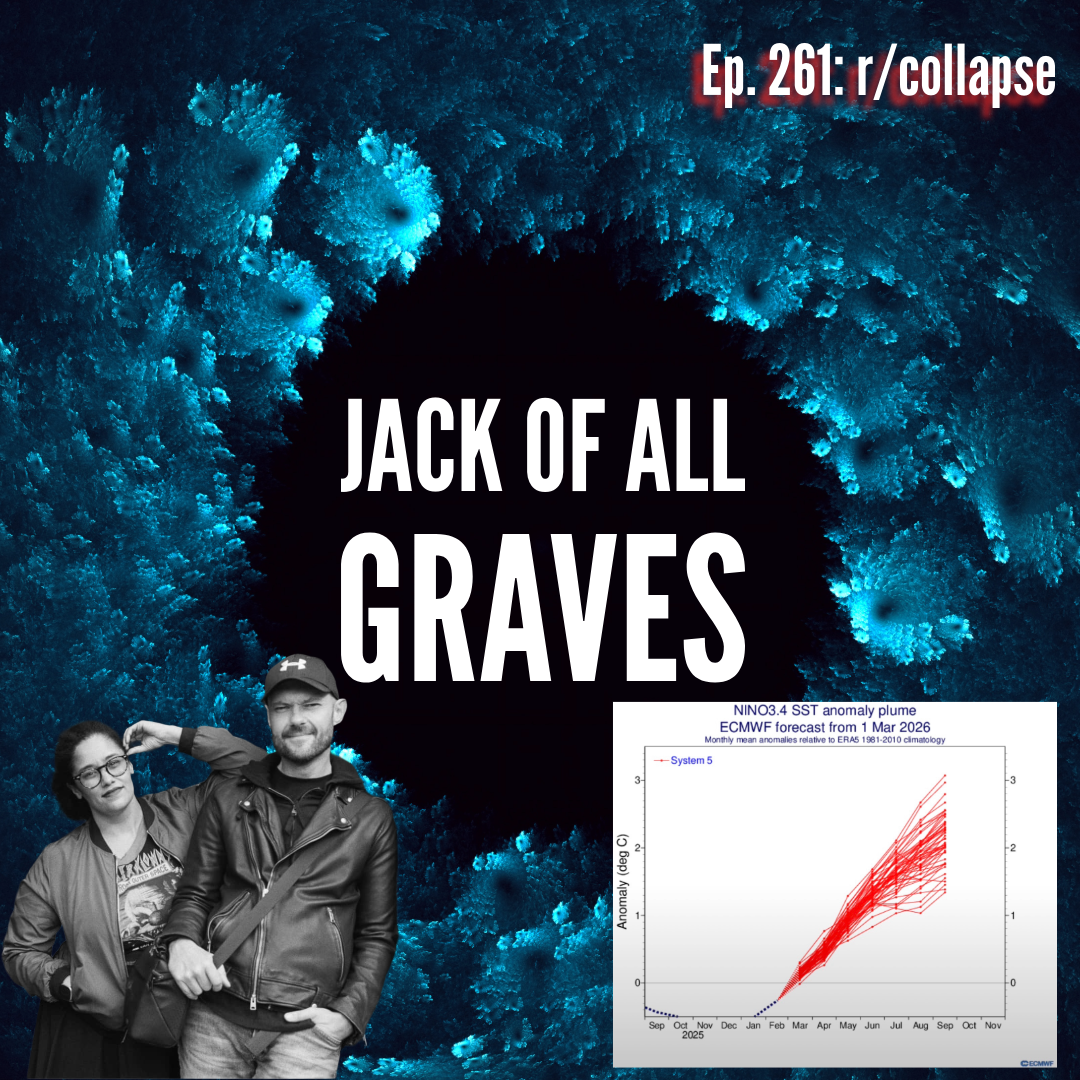
[00:01:23] Speaker A: Eileen, prepare your notepad, prepare your wither, prepare, you know, your frustrated rubbing of your head and maybe shaking your head a little bit and going, oh, fuck. I'm gonna try my best to fucking fathom the science out here. Right, okay. But I'm gonna just send you an image, so check your signal and take a little look at what I've just sent you. Right?
[00:01:48] Speaker B: Okay. It's a chart. It's a chart of some kind graph, isn't it? It's a. Yeah, a graph. I feel like I just learned the name of this kind of graph the other day, but I've already forgotten it.
[00:02:00] Speaker A: Oh, okay.
[00:02:00] Speaker B: Oh, I don't, I don't know. I. As soon as the, like, math term
[00:02:04] Speaker A: enters my head, it instantly leaves your head much. I relate, I relate. I don't remember shit about shit.
[00:02:11] Speaker B: I feel like I want to say it's like a spray graph or something like that. Like it is what it looks like.
[00:02:17] Speaker A: Well, I tell you what, before. Tell you what, before we go into what the graph is right, and what it means, why don't I tell you a little bit about who made it right?
[00:02:29] Speaker B: Sure, love to hear it.
[00:02:33] Speaker A: The eminent British comedian. Some call him the best stand up comedian of all time. And I tend to agree with them. Stuart Lee, he once said, you can prove anything with facts, can't you?
Or maybe that was, maybe that was his partner, Richard Herring.
But, but let me tell you about this graph, right? This graph is from a organization called the ecmwf that is the European center for Medium Range Weather. Forecasts. Okay, okay.
[00:03:06] Speaker B: They just decided that R was too many letters.
[00:03:10] Speaker A: Just, it's the ecmwa.
[00:03:12] Speaker B: It's like you gotta draw the line somewhere.
[00:03:16] Speaker A: I, I understand, but just take it at face value. The European center for Medium.
[00:03:21] Speaker B: I'm accepting medium range weather forecast.
[00:03:24] Speaker A: Now, these guys are based quite close to where I currently sit. They're based in Reading In England, about 30 miles away from where we currently, where I currently speak to you. Right, okay. Now while they're based in Britain, they aren't entirely just a British organization. They have 35 member countries.
Right.
They are in the realm of meteorology, in the realm of climate science and weather pattern prediction. They are pretty much the fucking gold standard.
[00:04:01] Speaker B: Right, okay.
So this is a legit organization.
[00:04:05] Speaker A: Look them up. I encourage you wholly to look them up because I certainly fucking have. And when, when meteorologists bicker about models and they do, they, the, the, the, the ECMWF usually takes it. Right, okay. In forecasting terms, they just refer to this, this organization as the Euro, right? As they know the Euro is telling us this, the Euro is telling us that that is how fucking embedded the European center for Medium Range Weather Forecasts is as the benchmark of climate prediction.
[00:04:44] Speaker B: Yeah, honestly, I think that they talk about that sometimes. Like just on our news, they talk about the Euro model and there's one that we have, and I don't know
[00:04:53] Speaker A: what that's called, but that's, that's what they're referring to when they say the Euro model. That is what they are referring to.
So this isn't, this isn't like a, like a crank in his fucking shed.
[00:05:05] Speaker B: Right, Right.
[00:05:06] Speaker A: This is, this is as close as you can get to the most credible climate forecasting system on the fucking globe.
[00:05:14] Speaker B: Right, okay.
[00:05:16] Speaker A: And what you're seeing on that chart, well, have a, take a little look at it visually. Just describe it for me, if you don't mind.
[00:05:28] Speaker B: It's a chart with a lot of red lines on it.
[00:05:31] Speaker A: Yeah.
[00:05:31] Speaker B: The left side says anomaly degrees Celsius 0123.
[00:05:36] Speaker A: Yeah.
[00:05:37] Speaker B: And then the bottom is 2025 September through, I guess, 2026. November would be my guess.
[00:05:44] Speaker A: Yeah. Correct, correct, correct.
[00:05:46] Speaker B: So that bottom axis, it's showing these red dots and lines as going way the fuck up.
[00:05:55] Speaker A: That's right.
[00:05:55] Speaker B: Three degrees Celsius.
[00:05:57] Speaker A: That's right, that's right. Beautifully, beautifully, beautifully described. So across the bottom line, the X axis for the mathematicians among us, that is time, that represents time. And the Y axis along the vertical is temperature.
[00:06:17] Speaker B: Right.
[00:06:17] Speaker A: Now the temperature axis specifically is how many degrees above or below normal the surface of a very particular stretch of the Pacific Ocean is running.
[00:06:36] Speaker B: Okay, Right. Yes. And I see at the top now that it says monthly mean anomalies relative to Era 5, 1981-2010 climatology.
[00:06:45] Speaker A: Correct.
Okay, now back to the ECMWF. Right?
[00:06:52] Speaker B: Yes.
[00:06:53] Speaker A: When they are building their forecasts, they don't just.
They don't just run the model once and show you that one line, because as you can see on that graph, there is a. There are dozens of Real bunch of them, dozens of lines. And each one of those lines represents deliberate kind of variations in the out, in the outcomes, in the conditions, you know, factors that they've added in because the climate is a chaotic system.
[00:07:23] Speaker B: Sure.
[00:07:23] Speaker A: Right. Think about Dr. Ian Malcolm, right? This is. There's, there's so much that can change the outcomes of your experiments.
So each one of these models that they've run, each one of these experiments, each ones of these predictions that they've run, produces one of those red lines. Okay.
[00:07:48] Speaker B: Okay.
[00:07:49] Speaker A: But what do you notice about the basic trajectory of all of those red lines?
[00:07:54] Speaker B: Up, up.
It is going up, up, up. Yeah.
[00:08:01] Speaker A: So when you see none of those are dropping, when you see that spread of that many lines all pointing in that same direction, which is precisely what you see on that chart right there. That model has been run in dozens of different ways, but it arrived at the same fucking basic conclusion. Right?
[00:08:22] Speaker B: Hmm.
[00:08:25] Speaker A: What do you know about El Nino?
[00:08:30] Speaker B: It's some sort of weather system caused by warm currents or something like that. I don't know. There's an El Nino and a La Nina and I can never remember which one is which. But both of them make a mess of the weather, Right?
[00:08:45] Speaker A: I, I hope you. I would. You would know more about that because I know very little about it. But here's what I do know about it, right? It's a.
[00:08:51] Speaker B: Okay.
[00:08:52] Speaker A: Part of the Pacific Ocean.
Known as El Nino, which is a kind of a weather phase in a larger kind of rhythm, a larger kind of planetary kind of ebb and flow known as the El Nino Southern Oscillation. That is when the surface of the central and eastern Pacific warms around and beyond its usual limits, a degree, maybe two.
[00:09:30] Speaker B: Okay. I was on the right track.
[00:09:31] Speaker A: You were, you were.
[00:09:32] Speaker B: But do you, do you get this on your side?
[00:09:36] Speaker A: Well, how do you mean?
[00:09:37] Speaker B: I guess not, huh? Like you don't get. Do you get El Nino over there?
[00:09:41] Speaker A: Well, if you look at that fucking graph, we're about to.
[00:09:46] Speaker B: Okay, interesting. But you. This is not A thing that you have been dealing with, like, this is a new idea to you.
[00:09:52] Speaker A: Um, isn't something that we worry about.
[00:09:59] Speaker B: Yeah, like, that's what I mean. Like, if you ask anyone in America about El Nino, or at least on the coasts about El Nino, I wouldn't say.
We all know what.
[00:10:08] Speaker A: This is common knowledge over here. No, maybe not.
[00:10:10] Speaker B: Okay, got it. Yeah.
[00:10:12] Speaker A: But to talk a little bit more about El Nino, that. That the heat that it generates in that particular part of the Pacific.
With the atmosphere, right.
The warmer it gets, it bends thermal streams, it redistributes rainfall, it redistributes pressure, drought, across the entire planet, Right?
[00:10:46] Speaker B: Yep.
[00:10:47] Speaker A: And it doesn't, you know, it isn't that it influences the weather. It can fucking literally change it. It can distort it.
[00:10:56] Speaker B: Right.
[00:10:57] Speaker A: And as you rightly pointed out, there's a kind of an opposite side to El Nino called La Nina, the cooling phase.
[00:11:06] Speaker B: Right.
[00:11:07] Speaker A: Where things settle, neutral conditions kind of reassert themselves.
And in that data, there are signals incontrovertible at this point, that something pretty fucking major is building and is building now, like, soon as fuck.
[00:11:34] Speaker B: Right?
Yeah.
[00:11:38] Speaker A: And it isn't just that one organization, the weather organization that I spoke about, right. The ecmwf. It isn't just them predicting this either.
There are lots of other.
There are lots of other climate organizations that are backing this up. NOAA is the American National Oceanic Noah Atmospheric Administration. Noaa.
[00:12:04] Speaker B: Yes, yes. They're where all of our weather.
[00:12:08] Speaker A: There you go. Fantastic.
[00:12:10] Speaker B: Famously, that Trump is largely defunded.
[00:12:13] Speaker A: Oh, well, that's terrific, isn't it?
Throw in the Australian Bureau of Meteorology, right?
Australia gets absolutely fucking fisted by El Nino events on the reg. Okay.
The Japanese Meteorological Agency also run their own models. So does our own UK Met Office.
[00:12:36] Speaker B: Sure.
[00:12:37] Speaker A: And then you've got the wmo, The World Meteorological Organization collects and synthesizes all of that stuff into a single consensus picture. And the direction of travel across all of those fucking agencies is consistent.
The ocean and the atmospheric conditions that precede El Nino development are in place right now.
None of these fucking organizations are looking at that model in the Pacific and denying what is going on. There's no one saying there's nothing to see here now.
[00:13:18] Speaker B: So just as like to I guess, sort of clarify, because El Nino's not rare.
[00:13:26] Speaker A: Nope.
[00:13:26] Speaker B: Happens all the time. Right. Which is, you know, we get those conditions quite a bit.
So what distinguishes what they're talking about here, okay, from normal El Nino conditions?
[00:13:41] Speaker A: What a fantastic fucking question.
[00:13:44] Speaker B: Thank you.
[00:13:45] Speaker A: So the two Most intense El Nino events in recent memory have been in 97, 98 and 2015 16.
[00:14:03] Speaker B: Right, yeah, I remember the 97, 98, 1 knocked our power out for two weeks.
[00:14:08] Speaker A: Oh, there you go, that's fun.
[00:14:11] Speaker B: I had just moved to California.
[00:14:13] Speaker A: Yeah.
[00:14:13] Speaker B: And was like, the fuck is this shit?
[00:14:14] Speaker A: Yeah. And I remember 2015, 16 very, very well.
I, you know, we couldn't, we couldn't sleep, we couldn't get. It was, it was fucking horrible.
[00:14:25] Speaker B: Oh yeah, that's right.
[00:14:27] Speaker A: And both of those events, 97, 98 and 16 to 15, both completely obliterated global temperature records at the time.
[00:14:35] Speaker B: Right, right, yeah.
[00:14:37] Speaker A: 2015, 2016 was rated, quote, very strong. That Central Pacific anomaly was around 2 degrees.
[00:14:48] Speaker B: Okay, right now I'm starting to see,
[00:14:51] Speaker A: is it starting to land?
[00:14:53] Speaker B: Yes.
[00:14:54] Speaker A: And that event around 2 degrees led to mass coral bleaching events that completely fucked the Great Barrier Reef.
[00:15:05] Speaker B: Right.
[00:15:06] Speaker A: Severe droughts across southern Africa, Southeast Asia, obliterated harvesters harvests, humanitarian crises.
South American catastrophic flooding across South America, the southern United States with the knock on effect lasting for years.
[00:15:26] Speaker B: Right, yeah.
[00:15:28] Speaker A: That one, the one that we just spoke about there, 2015, 16, climate scientists referred to it as historically exceptional. Right. Made headlines around the world.
And that was roughly 2 degrees of anomaly. That chart you were looking at is forecasting two and a half to three.
[00:15:50] Speaker B: Yeah. To even a little over three in,
[00:15:52] Speaker A: in some data simulations.
[00:15:56] Speaker B: Yeah. Right, yeah.
[00:15:59] Speaker A: Now, in the interests of optimism, sure. There's always an element of uncertainty.
[00:16:08] Speaker B: Right.
[00:16:10] Speaker A: I read that there is a phenomenon in kind of climate prediction science known as the, the spring predictability barrier. So when you're making forecasts before April, and that one, by the way, that chart right There comes from the 1st of March.
[00:16:29] Speaker B: Yes.
[00:16:30] Speaker A: There is an element of unpredictability before April. So we're kind of at that little window now.
But in practicality we can be pretty fucking certain that something is developing.
[00:16:44] Speaker B: Right.
[00:16:44] Speaker A: The signal is consistent and there is consensus enough across credible rock solid meteorological boards across the world to indicate that that question is something fucking big on the horizon has a very, very clear answer. The only question really is just how fucking harsh it's going to get.
[00:17:12] Speaker B: Right.
[00:17:12] Speaker A: And the difference between a strong El Nino event and a three fucking degree El Nino event like the one you can see on that chart there is very, very significant in terms of real world impact.
[00:17:28] Speaker B: Go on.
[00:17:30] Speaker A: Even at the lower end of what that chart is forecasting, even if it comes in as below the kind of mean estimate.
[00:17:40] Speaker B: Yeah.
[00:17:42] Speaker A: It is indicating to us that 2027 is going to be the warmest year in recorded human history.
[00:17:55] Speaker B: Don't love that.
[00:17:56] Speaker A: Right?
[00:17:56] Speaker B: Yeah. Not a fan of that news.
[00:18:01] Speaker A: The real escalation, as you can see on that chart, the real escalation begins in the spring of this year.
Accelerating, accelerating astronomically through the summer and peaking somewhere in August to October. Do you see that on the chart?
[00:18:17] Speaker B: Yeah.
[00:18:18] Speaker A: But hey, that's also, that's also hurricane season.
[00:18:25] Speaker B: Sure is, yes.
[00:18:26] Speaker A: Yeah.
[00:18:27] Speaker B: Mm.
[00:18:31] Speaker A: So if you've got a 3 degree El Nino event, super fucking turbo boosting Pacific storm systems.
[00:18:42] Speaker B: Yeah.
[00:18:44] Speaker A: Then you're adding a colossal El Nino event on top of the warmest fucking baseline temperatures in human history.
Corrigan listeners.
The events stack up. That is the mechanism behind ridiculous temperature records.
[00:19:04] Speaker B: Yeah.
[00:19:04] Speaker A: 2023 and 2024 are already the two hottest years ever recorded.
[00:19:10] Speaker B: Yeah.
[00:19:11] Speaker A: And if this one pans out the way that fucking graph you're looking at says it will, then 2026, 2027 is going to surpass them both.
[00:19:26] Speaker B: Yeah. Which I mean already, listen, today it's April 13, 77 degrees. So tomorrow is supposed to be like 87, which I think they said is the. Going to surpass the record which was set in 1945 for the hottest ever recorded on this date. And we keep on having those. So the idea that that's gonna be the case is certainly not far fetched practical terms.
[00:19:51] Speaker A: Right.
So taking it off the graph, we are talking about unreal. Severe drought conditions across Australia, across southern Africa, across Southeast Asia.
Destruction of agricultural seasons. Just forget the concept of an agricultural season.
Water supplies, climate, migration of people.
Flooding. South American flooding, you know, the United States, Southern United States. Floods, reef ecosystems which do not come back.
Ecosystems which took fucking thousands of years to grow and form.
And look at where the fucking economy is. Food price instability.
[00:20:39] Speaker B: Right? Yeah. It's the worst possible time politically for this to occur.
[00:20:45] Speaker A: For this to happen.
Supply chains, oil and fuel and fertilizer crises thanks to the current state of play in Iran.
[00:20:57] Speaker B: Yeah.
[00:20:59] Speaker A: So this, I'm afraid, is not one that I'm gonna end with. A little funny. Ha. Kind of, buddy.
[00:21:09] Speaker B: Yeah. Yeah.
[00:21:11] Speaker A: When we said catastrophic and a half years ago, that we, we are your front fucking seat to the end times.
This is act fucking one, Right. It is fucking happening. This is not conspiracy. This is not speculation. This isn't, this isn't us fucking catastrophizing. Right. For entertainment.
[00:21:33] Speaker B: Yeah.
[00:21:34] Speaker A: This is, this is the, this is our mission to fucking talk about this stuff.
The physical world over the next 18 months. Over the next 18 months, thanks to what that graph is showing you is going to be a fucking shit show.
[00:21:51] Speaker B: Yeah. And I, I was watching a climate show on PBS before I went to bed last night and gave myself anxiety dreams all night long. Yeah, but you know, the, I guess a question I have for you is, what does this change for you? Like, will you do anything to prepare for this? Because it's coming, right? Like this is happening.
Will you do anything to prepare for it?
[00:22:17] Speaker A: Me personally or me? Britain?
[00:22:20] Speaker B: Yes, you. No, you actively, you know.
[00:22:23] Speaker A: Okay, that's, that's such a fucking fantastic question. Because even though every year the same thing happens, it gets too hot, I can't sleep, I go insane, the anxiety comes. La la la la la. Yeah, I'm buying a decent ass fucking fan. I'm buying a decent ass indoor air conditioner.
But, but, but I asked Corey, what is there to do in the face of that?
What is it?
[00:22:51] Speaker B: I mean, I think about, you know, kind of, for lack of a better word, prep. Prepping, right? Because you're talking about things like water shortages and electricity and, you know, you know, the way that inflation is working. They said on the news earlier today that compared to this time last year, the average American family is paying $232 more for just like going to the grocery store for like the exact same items that they were getting last year.
[00:23:24] Speaker A: Radio 4 tells us, Radio 4 told me today that with oil prices and fuel prices as they currently are, and a UK family is already paying an extra £500 a year, right? Simply doing exactly the same things they do now, the exact same things don't get any worse.
[00:23:43] Speaker B: Right.
And so, you know, my thought process here is like, are we being irresponsible if we don't prepare for certain elements of this, like making sure that, you know, we have water in case of, you know, some sort of emergency generators, but getting food just so that if, you know, inflation shoots up more, you know, do we have canned goods around so that, you know, we can afford to, to eat if things, you know, get worse than they are? Like, I feel like one of the things that we struggle with as people who live comfortably as like middle class people in areas that haven't yet experienced the extremes that some other places do. Like, I lived in California for a long time and as we've talked about, it's been in mega drought for like 20 years.
But we don't necessarily feel that, you know, we can't water our lawns and things like that. Whereas, like when I was living in South Africa, if you were taking a shower, it would Turn off.
[00:24:45] Speaker A: Yeah.
[00:24:46] Speaker B: If you had used up your like, quota for the day, right, like you would be covered in soap and the shower would stop and you're done, you know, And I think that kind of thing doesn't necessarily reach us as much. And so we are unprepared for those basic things that like, we should all have ready in case of these kinds of emergencies.
[00:25:12] Speaker A: When I was, when I was putting this together today and over the last few days and thinking this through and realizing how very, very bulletproof and watertight, no pun intended, this evidence seems to be and the agencies that it's coming from, I am fucking astounded and incredulous that it is not being talked about. There are a couple of articles on the Guardian, there are articles on that Reddit, the collapse forum on Reddit that I, that I speak about.
[00:25:43] Speaker B: Yeah, we've really like started ignoring this over the past several years.
[00:25:49] Speaker A: You know, they were, they were, there was a time when, you know, 1.5 degrees was, was seen as, oh, deadly.
[00:25:56] Speaker B: That's it. Yeah, we're done for then.
[00:25:58] Speaker A: 2 degrees now they're like, now nobody's fucking talking at all.
[00:26:02] Speaker B: Right?
Like, we were cooked when Obama said that about like, you know, his daughter coming to him and being like, I'm worried we're not going to make 1.5 degrees. And he was like, well, it might be 2.5 or 3, but we will turn things around. Like, no, that's not, we cannot be that complacent.
[00:26:21] Speaker A: That is very much what we have.
[00:26:22] Speaker B: Are you serious?
Yeah.
And that's, I don't know, I think, I think there's such like, stigma around the idea of like preppers because they're usually like right wing weakers. But again, I ask who, like, want to be sovereign citizens and stuff like that.
[00:26:38] Speaker A: You can prep, you can make a fucking bug out bag and you can prep for a fucking civil war or an invasion or something like that. But how the fuck do you prep for, for the planet deciding it wants you gone?
[00:26:50] Speaker B: Well, right. What I'm saying is though, is like to an extent there is, there are things that we can do to prevent, you know, immediately getting wiped out by things. But I don't think that we, I think we try not to be, we try not to panic, you know, like, oh, I'm not gonna be, I'm not gonna be a weirdo. I'm not gonna go like store a cache of shit or whatever. But it's like if things are hundreds of dollars more this year than they were last year, imagine Worldwide climate catastrophe. You know, imagine no growing seasons.
What are you gonna do if you, if you literally, you cannot go to the store and buy a tomato? Like, what do you, what are you going to do? And I think we need to start like being like actually thinking about that shit. Like on a very practical level, what are you going to do?
Because this stuff is coming and no one's doing anything about it.
[00:27:49] Speaker A: Layer that onto the fucking hold the grip and the tightening grip that populism now has on our countries, right. This, the climate migration which is coming, right. Feels to me to be handing right wing parties and right wing populists victories.
[00:28:14] Speaker B: Right.
[00:28:17] Speaker A: These people are coming over here in small boats, right? You know what I mean?
It's us versus them. It's this versus that.
[00:28:27] Speaker B: I mean, to be fair, that doesn't seem to really be working, right.
It seems like people are not falling for that to the degree that they were even two, three years ago.
[00:28:40] Speaker A: The polls over here say something very different.
[00:28:43] Speaker B: Really?
[00:28:43] Speaker A: Oh, for sure.
[00:28:46] Speaker B: Interesting.
[00:28:47] Speaker A: Why I don't have a poll in front of me right now, but our current government, labor, is, is what is fascinating to me. Right. In such a very, very short space of time, like three years, British politics has moved from a very much a two horse race to three, four, five. Right.
And our current governing party is, is trailing in polling behind Reform, behind the Green Party, interestingly.
[00:29:18] Speaker B: Right. That was one of the things I was saying is like, you are getting more people who are going for like the Greens. It's not necessarily that everyone's going from labor to Reform.
[00:29:26] Speaker A: No, no. Well, a lot, a lot of people are actually, surely.
[00:29:30] Speaker B: But you know, it's almost a lateral move at this point.
[00:29:33] Speaker A: That's. But the point I'm making is.
Yeah, this.
Oh, man, I'm super scared.
[00:29:44] Speaker B: We're just in the worst place.
[00:29:46] Speaker A: This is the worst fucking time for this to happen. Yes. This was the one thing we didn't want to happen.
Let me quote directly from my notes, if I may.
[00:29:57] Speaker B: Yes, please do.
[00:29:59] Speaker A: Fucking look at these nerds. Oh, mise en scene.
[00:30:02] Speaker B: I don't think anyone has ever said mise en scene in such a horny way before.
[00:30:06] Speaker A: The way I whispered the word sex cannibal recently.
[00:30:09] Speaker B: Worst comes to worst. Mark, I'm willing to guillotine you for science.
[00:30:13] Speaker A: Thank you. That's really, really sweet. It's cold outside, but my pancreas is talking to me. I'm fucking. I'm gonna leg it.
[00:30:19] Speaker B: You know how I feel about that, Mark?
[00:30:21] Speaker A: I think you feel great about it.
I remember Talking several episodes, for several episodes, for several months, probably years back in our, in the early days of our podcast that individual comfort is, is, is so high right now. Individual, yes, individual well being and convenience is so, you know, things are things. Things are more convenient and accessible than ever. Things come to your door. Everything comes to your screen.
Everything you want is a clickety, clickety click away.
So the impetus maybe that breaking down is what will galvanize.
[00:31:02] Speaker B: Yes, this is exactly what I was saying. Like, it's just we haven't felt the true burn of this in, you know, rich countries because that kind of stuff hasn't broken down the way that it, it hasn't in other places. And I feel like, you know, we're not ready.
[00:31:22] Speaker A: We're not ready. Although, weirdly, I do feel better for having gotten that off my chest because I've been stewing on that for days.
Listeners and Corrigan, if, if, if you really, really feel too good about yourselves and you're having fun, go to R Collapse on Reddit and you'll have just a really, really bad time. You'll really, really thank me.
[00:31:48] Speaker B: On the other end of that, I want to recommend a book actually, and this is one I recommend to you too, Marco, because sometimes the climate books that I read, you're like, please don't send those to me because they cause me to spiral with anxiety.
And so a good chunk of the time I just keep my climate books to myself.
But I read one just a week or two ago that I think may be my favorite climate book that I have ever read. And it was a total chance that I came across this.
It was because I was like scrolling through books or audio books to read while playing through death's door for the millionth time.
Don't start.
So I was scrolling through these books and came across one.
You heard me.
You fuck off. Don't get the discord started.
[00:32:54] Speaker A: I really enjoy a casual fuck off, fuck off. It's really funny. I enjoy those fuck off.
[00:33:01] Speaker B: But the author is one of my blue sky mutuals and I did not realize she was an author.
[00:33:07] Speaker A: Oh, is that right?
[00:33:07] Speaker B: So I was like, I was like, oh, Hope Jaron. I know her, I'll check out her book. So the book is called the Story of How We Got to Climate Change and Where to Go From Here.
And I loved this for a couple of reasons. For one, the idea of like, how we got to climate change, right? So she's basically going through the, our like history of the past 150 years or whatever that brought us to this place, right?
And one of the great things about doing that is that you realize if we humaned ourselves into this, we can human ourselves out, right? Everything that she talks about, you go, well, you could fix that.
That's a thing that we could actively do something about, right?
And a lot of that has to do with us.
And one of the things that I hate is that like, there's kind of become this much like people misuse the. Like, there's no ethical consumption under capitalism to mean, like, fuck it, I just, yeah, buy whatever exploitative shit I want or things like that. Like, that's not what that means.
Right?
But people will use the fact that corporations are responsible for more of climate change than we are to go then. Thus I don't need to do anything about this, right? Like, why should I care about my personal.
[00:34:33] Speaker A: Which is a frame of mind that I have found myself in previously, right?
[00:34:37] Speaker B: Yeah.
[00:34:38] Speaker A: And whether misguided or not, it just, it feels like a piece of gigantic sleight of hand that the onus is placed on the individual to bag their fucking recycling. You know what I mean?
[00:34:49] Speaker B: Right? And in cases like that, 100% agree. Like, we know recycling doesn't do a whole fuck ton when it comes down to it. What would make a difference? Not buying so much? Yes, that would make a difference. Right? Like, and so throughout this, she's basically making the point that like, a good chunk of the stuff that has gotten us here is about our consumerism and is about our comfort and that those corporations are feeding into our.
Our comfort and our consumerism.
Why do we need a bajillion things made out of plastic? Why do we need temu? Why do we need to fill up junkyards with, you know, fast fashion and things like that? Corporations wouldn't do it if we didn't buy it, right? And she really goes through exactly why
[00:35:39] Speaker A: the fuck do you think AI is such a thing right now?
[00:35:42] Speaker B: Right? You know, like, and why it's, it's tanking too, right? It's like the only reason it exists is because these corporations bought it and now we're not using it and they're. It's getting pulled from things and they're trying to figure out what the fuck can we do with it. That's a great example of, like, when the demand's not there, the shit collapses.
And so she's, you know, obviously not saying, like, you know, the corporations aren't at fault here. You need to be entirely responsible for this. At the same time, she really does gives you this Sort of hopeful sense of like, our demand can be changed much easier than the corporate activities can be changed. Right. As long as we keep buying, as long as we keep going into that system, then yeah, of course, of course they're never going to fix anything about it. But take like, what they're calling the ozempic economy right now, right?
Companies are changing everything that they sell in the store because people don't eat anymore. And they realize they cannot get you to buy the same shit that you did. And so grocery aisles look completely different than they did a year ago because there's the understanding that people don't eat.
And so you need to. This is, I think it was the news said one in five people in America are on a GLP1. One in 20% of people, right? Yes. One in five people are on a GLP1. 20% of people being on a GLP1 has changed what appears in our supermarkets.
Think about that. On the scale of our demand for the comforts that we have. And the thing that I find hopeful about this is that I don't believe that we can get spontaneous movements from corporations to fix anything. I do believe you can change the mindsets of humans and make them do things differently.
[00:37:49] Speaker A: What you have just told me has rocked me. I am, I'm.
I'm taking a second to just pass what you've just said. So the uptake of the substance has led to in no fucking time at all.
You know, a year, maybe a year.
[00:38:10] Speaker B: Mm.
[00:38:11] Speaker A: The uptake in people of the substance has changed the way that retail itself is designed, laid out and executed across a fucking global superpower like America.
[00:38:25] Speaker B: Yep. People have done that.
[00:38:27] Speaker A: Crazy habits have done that.
[00:38:29] Speaker B: Yes, exactly.
That's, that's, to me, just a huge sign of how much our consumer activity actively shapes corporate practices.
Because we look at everything like, oh, we can't do anything about it. 20% of people have changed the grocery store.
That's enough said to me.
[00:38:53] Speaker A: You've got to give the people what they want.
[00:38:56] Speaker B: Right?
And if all we demand is, you know, easy, quick, cheap, you know, disposable, then that is what they're going to continue to give us.
But I think, you know, people can change that mindset, right? And movements can arise around that. The problem is, like, a lot of times those are corporate led movements. So it's just telling you to buy a different thing instead of don't buy anything, which is, you know, more. What we need to be doing is stop, stop buying shit.
[00:39:34] Speaker A: I'm there once again, you know what I mean you've, you've, you've hit my problem with that.
People could do that, but it ain't happening.
[00:39:44] Speaker B: But social pressure is a thing, right? Like that's the thing that's important to realize about it is social pressure exists and is important. If you make something cool and popular, people will do it.
Which is why greenwashing was successful all this time, right? Like people want to feel like they're making a difference, but the propaganda that they're getting is telling them so it just means buy this other thing instead of the thing you were buying already.
[00:40:13] Speaker A: Have I spoken about care washing on here before? Have I spoken about how repugnant I find care washing?
[00:40:18] Speaker B: What's care washing?
[00:40:20] Speaker A: Ah, man, you know, we. Capitalism is, is really looking into the dark corners now for. To find bits. Incremental gains, right? To find incremental ways to expand all of the tried and traditional stuff, the initiatification, making things smaller, making them more expensive. That's all kind of been done.
They're reaching the limits of what people can will stomach in terms of the size of versus what they pay for.
Keep an eye out for this friends.
And you Corrigan, the company I work for are doing this and I'm not gonna fucking endanger myself by speaking too, too hard about that, right?
But there are products and one of them is a, is a chocolate brand in the uk, right?
And they have an advertising campaign currently where.
Picture the scene. You've got a guy and he is in his 70s and he must be in his late 70s and he's obviously in the mid to advanced stages of a degenerative brain condition. He's got dementia, maybe he's got Alzheimer's and he's in a.
[00:41:30] Speaker B: Might have mentioned.
[00:41:30] Speaker A: And he's in a care home.
He's in a care home and his daughter comes to visit him and he doesn't rec. He doesn't recognize her. Hi.
And she, she pushes a bar of chocolate at him and goes, there you go. And he, and he looks at the chocolate and it's as though his eyes clear for a moment and he goes, I remember my daughter used to bring me these.
And she goes, that's right, dad.
Right?
And then they go show you the logo with the, you know, the number for dementia care UK or whatever. And it's fucking repulsive to me. It is repugnant to me.
Yeah.
[00:42:10] Speaker B: And you're. Yeah, it is, it's the same exact kind of thing as the greenwashing thing. It's like, you know, oh, we're Directing you towards, like, organizations that are doing the work and all this stuff. And it's like, that's not.
When it comes down to it, with these kinds of things, we need to not buy shit.
That's really what it is. And so I recommend. Obviously she goes into this a lot more deeply than I do, but, you know, that's kind of one of the things I took from it is kind of. She gives the steps of how we got here. Right. And as she does so, you can see in your mind exactly how we get back out of that.
And I think that's something that is really kind of nice to see.
[00:42:55] Speaker A: Well, that's certainly something I'll read.
I'll level with you.
[00:42:58] Speaker B: The Story of Mor.
[00:42:59] Speaker A: I didn't finish the Heat Will Kill youl first because I simply didn't. I could not hack it. I could not take it.
[00:43:04] Speaker B: Yeah, that's one of the ones that I have recommended to you. And you were like, please don't.
[00:43:11] Speaker A: No, don't tell me to read shit like this. Not only did you recommend that book to me, you recommended to me at probably the lowest possible point of my life.
Right. Tell you what, Mark, you know, you're struggling really badly on a few fronts here. Let's read this book about how you're gonna burn to death along with the rest.
[00:43:29] Speaker B: It was a. Yeah. A miscalculation of our, you know, listen, we have a shared interest and wouldn't you like to read this book? No, this will not do that to you. This one feels much more sort of tangible and at least, you know, gives you.
If it's. It's not a solve. And she doesn't claim it's a solve, it's a step. Right.
And one that is extremely important and may be forced upon us by market conditions and things like that as well. If, you know, we don't have access to all of the things that we're used to having all of our comforts and stuff like that. We may be living a low consumption life anyway.
[00:44:11] Speaker A: True.
[00:44:13] Speaker B: Well, not the idea of being intentional about that.
[00:44:16] Speaker A: Tug myself off publicly on the cast. But I have canceled.
[00:44:19] Speaker B: No, you shouldn't do that.
[00:44:21] Speaker A: Amazon is gone. I've canceled Prime. Amazon are fucking out of my life.
[00:44:25] Speaker B: Yeah.
[00:44:26] Speaker A: Fuck out of here.
All of my books come locally. All of my products come locally. I.
We had ants. The ants are back in our kitchen. Right? The ants are back.
[00:44:37] Speaker B: Yeah.
[00:44:37] Speaker A: And my first instinct was, ah. I got the traps I got from Amazon work last night. Whoa, whoa, whoa, whoa, whoa. They probably sell those in a Fucking shop in town.
[00:44:45] Speaker B: Yeah, just go to the store.
[00:44:46] Speaker A: So I did, right? And it's, it's, it's a habit now.
Prime can go fuck itself. Amazon can go fuck itself. I'm buying shit from them again.
I've taken a step at least.
[00:45:00] Speaker B: Yeah, absolutely. I think that's just. It also causes you to prioritize a bit more because you will not buy certain things if you can't immediately click it and have it come. Right. Like there's certain things that you will prioritize and things you're gonna be like. I don't really need that if it means you're gonna have to drive 5 minutes to go get is a really good way of controlling our consumption.
[00:45:26] Speaker A: Oh, and I'll tell you what, I will keep plugging Cole's Books in Bicester until I fucking. I'm cold in the ground. They are the best bookshop. I'm sure they're not as good as Gibson's.
From Gibson's Books. I'm sure there's a discount code if you're a Joe Ag listener, but Cole's Books in Bista is incredible, man. All right? Yeah, you pay a couple of quid more than you would on Amazon, but every single book, book is hand wrapped and they throw in some bookmarks in there and the people there are just beautiful.
It. I think, I think you can gauge the quality of a town based on the quality of their bookshop. And Cole's Books is an absolute fucking Mecca. I love it there. And you're never gonna listen to Jack of all Graves Cole's Books. You don't even know we exist, but I fucking shop at you all the time when I fucking love you.
[00:46:22] Speaker B: Here, here.
So with all that said, hi.
[00:46:26] Speaker A: Hi there.
[00:46:26] Speaker B: Hello.
[00:46:27] Speaker A: Hello.
[00:46:28] Speaker B: Welcome, friends.
Hope you're good. Hope you're, you know, not underwater.
[00:46:34] Speaker A: Yeah, well, if. If you were good 46 minutes ago, you fucking probably ain't now. But hey, it is what it is,
[00:46:42] Speaker B: is what it is.
You know, you knew what, what podcast you turned on, but you turned because you love us and you did it anyway.
[00:46:51] Speaker A: We're your besties.
[00:46:53] Speaker B: That's right. You know it. Yeah.
And we're gonna. We're trying to do a little easy breezy thing. Marco's gotta get up early in the morning. Yesterday we were both just like catatonic and so that's why we did not record. We were simply just out down for the count.
[00:47:12] Speaker A: Limbs of lead, blood of mercury just absolutely ruined. And I know I'm gonna be tomorrow. And I know I'M gonna be on Wednesday as well. So let's get this nice and breezy, fun episode.
[00:47:25] Speaker B: Let me tell you though, this is another thing as we, as we stare down the end of the world.
Volunteering is the best. You know, doing something that like benefits your community and stuff like that is a good way, I think, to stave off a little bit of the dread.
And so as you know, I like to volunteer at my local history center, the History museum, Montclair History Center.
And normally that entails, you know, usually selling tickets and gift shop things to people who come in and telling them about the museum and whatnot, striking up conversations with people who come in there.
But they have a not natural native garden there. So, you know, there's like a big movement to plant native stuff that, you know, rewilding.
[00:48:14] Speaker A: Is that what you're talking about?
[00:48:16] Speaker B: Yeah, rewilding, that kind of thing. Basically. Because, you know, lawns are not natural and they require, they're very resource. Yeah, yours definitely isn't.
But even a regular non toxic lawn, you know, is very resource intensive and often are toxic. You know, to keep a green growing lawn you need a lot of water, you, you're probably going to use pesticides, all that kind of stuff. And so there's a lot of movements to like get back to using native plants that grow at certain times of the year and things like that instead of trying to make something work on a lawn where it's not supposed to be.
And so the museum has this whole native plants garden you can walk through and all of that. But of course this is a place that has a winter where we had blizzards and things like that. So it's just like crushed and everything's dead and all that stuff right now.
So they had, they asked for volunteers to come and like work on getting it back in shape for the spring so everything can grow again. And so me and Kia went and we spent yesterday morning just like pulling down fences they'd put up for deer because the deer come in anyway and you know, mulching paths and all that kind of stuff. And at the end of this, so
[00:49:32] Speaker A: happy in the photos, the two of you looked like you were having a fucking whale of a time.
[00:49:35] Speaker B: We were having a blast. There was a hawk watching us the whole time. There's a farm cat. Yeah, this hawk, it started in one tree and then we're like, oh, it left. And then we looked over and it was just sitting in another tree the whole time.
Just Watched this whole thing go down.
[00:49:49] Speaker A: It's really waiting for you to die so it could feast on you.
[00:49:51] Speaker B: Yeah, right, yeah. Eyeing the cat or whatever, Kyo did say he saw a squirrel corpse. So the hawk was eating fine carrion.
But when we left, like, we could see what we'd done. You know, you look at this and it's like there's this beautiful path that Kyo and I made with wheelbarrow and rakes and there's, you know, you have this open spot, it's all weeded and all that kind of stuff.
[00:50:16] Speaker A: And it's just two years back, I volunteered, planted a load of trees with the local council, and every time I
[00:50:22] Speaker B: drive past now, you get to see them all the time.
[00:50:24] Speaker A: My fucking trees. They're my trees.
[00:50:26] Speaker B: Yes. So listen, that's my. Aside from reading that book, my other thing this week. Now that we filled you with dread, go do something in your community and work that dread off.
[00:50:39] Speaker A: Work off the dread. That's fantastic.
[00:50:40] Speaker B: Work off the dread.
[00:50:43] Speaker A: I just want to just mention achievement. I did a. I recorded my personal best for 10k on Saturday and it felt fucking amazing.
[00:50:49] Speaker B: Yeah, you did.
[00:50:50] Speaker A: Felt absolutely fucking amazing.
[00:50:53] Speaker B: And I watched the entire video while I was grading papers. I did. Yeah. This is. It's so funny because you were like, look, I did this. And every time you send me something like, you don't have to watch it, but, you know, I'm like, oh, well. What I normally put on when I am grading papers is a guy walking around London. Oh, well, a guy running.
Sure. The only difference is your breathing was a little more, you know, obtrusive than the walking.
[00:51:22] Speaker A: Well, Obviously I've got AirPods in, so I can't hear myself breathe. But. But listeners, what I've worked out how to do is to map the telemetry data from my Apple Watch over the video of the fucking head cam that I wear. And it is accurate to the meter, so I can see at precise points during the run what my heart rate was, my elevation, how far I'd come, the time it had taken me. My speed. It is so fucking interesting.
So I'm gonna be doing that all the time now.
[00:51:54] Speaker B: Yes. Did you go back and see what the guy said that I pointed out in there?
[00:51:59] Speaker A: Oh, no, I didn't.
[00:52:01] Speaker B: Walked by.
[00:52:02] Speaker A: I didn't. What did you hear him say?
[00:52:05] Speaker B: It sounded like he said what? I sent it to you.
[00:52:08] Speaker A: I think you heard him say nice cheeks.
[00:52:10] Speaker B: Yeah, it sounded like he said like, nice cheeks, bro. And I was like, is that what he.
This guy said? But you were like, I was wearing earbuds. I have no idea.
[00:52:20] Speaker A: Nice cheeks, bro. Well, he's. I mean, he's right.
[00:52:24] Speaker B: Well, sure, you know it's right, but he shouldn't say it.
[00:52:30] Speaker A: I.
I don't mind being objectified.
I'm perfectly fine.
[00:52:35] Speaker B: Different. It's different for men.
[00:52:38] Speaker A: Patriarchy.
[00:52:38] Speaker B: He was, like, walking with his friends.
Yeah, maybe. Maybe he was saying something to his friend and it just sounded like he was addressing you. But I was like. I, like, went back and played it again. I was like. What did he just say?
[00:52:50] Speaker A: His cheeks broke. What could he have been saying?
[00:52:53] Speaker B: I know you'll have to go back and look. I gave you a timestamp.
[00:52:55] Speaker A: Yeah, you did. I will, I will, I will. I'll work it out. I'll work it out.
[00:52:58] Speaker B: Come on back. And if anyone else wants, you know, for background while you're working, he does have that on his YouTube so you can listen to him breathe heavily. Yep. And get catcalled by local men.
[00:53:09] Speaker A: A lot of fun.
A lot of fun. Let me see what else has been going on. My boy turned 15. My big boy. My big boy Peter turned 15 years old. He's now.
[00:53:20] Speaker B: That's like a full teenager. Like 14's like a practice teenager.
[00:53:24] Speaker A: Yeah.
[00:53:24] Speaker B: Like 15's like.
[00:53:26] Speaker A: He's. That's like a clear foot.
[00:53:28] Speaker B: Can he drive soon?
[00:53:29] Speaker A: Clear foot and a half taller than me.
[00:53:32] Speaker B: Not a foot and a half.
[00:53:33] Speaker A: He's a fucking absolute, just huge colossus of a boy.
[00:53:41] Speaker B: He's got your. Your long neck.
[00:53:44] Speaker A: He does that.
[00:53:44] Speaker B: That adds a lot of.
[00:53:45] Speaker A: Yes, he does.
[00:53:46] Speaker B: Length.
[00:53:47] Speaker A: But do you know what? Do you know what? I'm. I'm. I'm. I'm the. Look, I'm the proudest parent that exists. Right? My fucking. Oh, God, I love it. I love every fucking minute of it. And his.
He has picked up the gym behavior from me. Goes to the gym all the fucking time.
[00:54:04] Speaker B: Really? Does he go to your gym?
[00:54:06] Speaker A: No, he goes. If you're under 16, you have to go to the Bicester Leisure center and you can have, like, slots that you have to.
As soon as he gets. As soon as he hits 16, he can go whenever. But he's. He's picked up a really fucking positive wholesome behavior from me, and I could not be prouder.
[00:54:22] Speaker B: Nice. Look at that.
[00:54:23] Speaker A: Isn't that good?
[00:54:25] Speaker B: Look at that. That's a great thing to pass down. Not like alcoholism.
[00:54:29] Speaker A: Yeah. Or watching gore videos. Oh, gore videos. Watched a Hum Dinger last week. Did I tell you about this? Did I tell about the kid from Poland?
[00:54:38] Speaker B: Was it the one you tried? You Tried to send me, but it didn't work.
[00:54:41] Speaker A: Yeah.
Whoa.
[00:54:44] Speaker B: This is all.
There's all these times, like, so you had sent me that, and then, like, shortly thereafter, you sent me like, you were like, do you want to see a video? And I was like, I don't know. What is it? And then you were like, oh, it's my family at the Cadbury factory.
Okay, well, I don't know. Is it going to be a wholesome family trip or a kid hacking his grandparents to death?
[00:55:12] Speaker A: Yeah. This one from Poland. Honestly, I've never seen anything like.
Is it. Is exactly that a kid just takes a hammer and an axe to his grandparents and films the entire.
[00:55:23] Speaker B: Are they sleeping?
[00:55:24] Speaker A: Well, they. They are, but the Chinese fucking finish with them. They. They.
Oh, man.
[00:55:30] Speaker B: You know that my question in, like, because, like, in America, people just shoot each other with guns, right?
[00:55:35] Speaker A: Yeah.
[00:55:36] Speaker B: This is always my thing with like, you know, axes or knives or things like that is like, how do you. How do you axe murder people or whatever? Don't they, like.
Yep, Bob.
[00:55:47] Speaker A: Yes, they do. They.
[00:55:47] Speaker B: Bob, get out of the way.
[00:55:49] Speaker A: I. Listen, I apologize for the graphic description here, listeners. And, and I will once again try and explain this. I can't. I. I don't do this every day. Right. It's not like I wake up in the morning with my cereal and watch gore videos, but in the same way as somebody who has climbed Everest will tell you, because it's there.
Right?
I almost.
I almost. I almost like to push what I can handle. I almost like to push what I'm capable of viewing.
And, you know, if you're hacking a tree, sometimes the axe will get stuck and you have to physically yank it out.
[00:56:25] Speaker B: Right.
[00:56:26] Speaker A: Just that there's one point where the downswing is so.
[00:56:30] Speaker B: Well, that's why I remember when I. I told you about the axe murder story for one of my cold opens. And that was why he used the back of the axe.
[00:56:38] Speaker A: Yeah.
[00:56:39] Speaker B: Because if he used the front, it would get stuck in people's skulls and whatnot.
[00:56:42] Speaker A: Well, that is what happened with this kid's grandma. He had to like, yank the fucking axe out. Taking. And your head kind of jerks up and he keeps on.
[00:56:49] Speaker B: And why was. Did. Why did he record, like, what was the. Is there any story that went along with the video?
[00:56:56] Speaker A: The context is completely missing to me, but it's. It's. Whoa.
It's in. In a. In a gore and gore adjacent lifetime.
It's one of. One of the. One of it stands out there. It's out on its own it's intense.
[00:57:15] Speaker B: Well, there you go.
Peter will not be watching that. Maybe Owen, but not Peter.
[00:57:21] Speaker A: Well, let me tell you about that. All right, so let's. Let's segue into movies, shall we?
[00:57:24] Speaker B: Yeah, yeah, we might as well.
[00:57:26] Speaker A: What is one of the things that I love about the most about parenting? It's watching classic movies with the boys, right?
And Owen is 12, and for his entire life, he has been listening to me bang the fuck on about robocop and about how it is the greatest movie ever made. And he's seen me get fucking RoboCop Inc. And he's seen me posing with Dr. Peter Weller, and he's seen me watching fucking hours worth of documentaries about RoboCop and hear me talk about RoboCop. And he associates me very much with RoboCop being a part of my personality, which it is, right?
[00:58:03] Speaker B: Yes, definitely. And that is a special interest if I ever saw one.
[00:58:07] Speaker A: And it's shorts weather. And he looked at my tattoo last week and he went, dad, am I old enough to watch RoboCop? And I went, nope.
So we did.
[00:58:16] Speaker B: You checked with the Discord first, you know.
[00:58:18] Speaker A: Yes, I did. I'm not a monster.
Yeah, so we did. And crushingly, he was nonplussed.
Do you know what he said? Needs more gory.
[00:58:32] Speaker B: What do you say?
[00:58:32] Speaker A: He said it should be more gory.
Felt like it wasn't gory enough. So,
[00:58:39] Speaker B: man, oh, man, that's a. I love this because, you know, this is a constant thing we've talked about. We've made our column system and things like that. Like, all right, what is. Obviously for most of us who grew up in the 80s and 90s, we know that we watched horror things too early, right? Like, we're like, there probably should have been some guardrails on that stuff. But then it's like, all right, well, now, as you're raising your children, like, how do you know at what point they're ready for something like this? And so this whole time you've been like, are they ready for Robocop? Are you ready? And he gets to 12 and, like, it's too late. He's, you know, so he's seen too much.
[00:59:16] Speaker A: I think we are due a rethinking of the columns, right, based on recent experiences.
And I. I believe now that the right hand column, it's kind of like the Overton window, isn't it?
[00:59:30] Speaker B: Right. Yeah, it's shifting.
[00:59:32] Speaker A: I now feel that the Right hand column should be reserved for movies that will damage, not necessarily nigh unwatchable Yeah, I.
I am right now looking at my shelf and looking at my. My Arrow video special edition of Henry portrayed of a ser. That's right for me. Now that is the right column.
Right?
[00:59:54] Speaker B: That's a. That's a funny one because, you know, my sort of take on that is it plays like a corny 80s PSA, but with graphic violence. I'm like, I don't know if I would put one there. Aside from. Obviously I don't like it. You know, I don't like the content of it, but it doesn't seem like.
I don't think that would destroy Owen.
[01:00:13] Speaker A: I feel it would because I've seen it plenty of times. And I think now the right column, rather than it being content, is more about intent.
I think movies like Henry are designed to harm the viewer. Almost.
[01:00:33] Speaker B: Right.
[01:00:34] Speaker A: Do you understand what I mean by that? Not through. Not through, you know, elaborate Grand Guignol gore. Not through fucking, you know, injury detail,
[01:00:44] Speaker B: but they are soaking into your skin.
[01:00:47] Speaker A: Mean spirited movies. I think that is the right column. Now. Movies that are intended to leave you. That's solid than you were when you showed up.
[01:00:57] Speaker B: Yeah. That's fair.
That's a fair thought.
[01:01:00] Speaker A: Yeah.
Yeah.
[01:01:02] Speaker B: Interesting. Yeah. Something to. Something to retool, I suppose.
[01:01:06] Speaker A: Maybe one for this. Maybe one for this Halloween. We'll redux.
[01:01:09] Speaker B: We'll go back.
[01:01:11] Speaker A: Three column horror system. Redux.
[01:01:14] Speaker B: Yes.
But it's interesting because I was telling you, one of the things, and I've said this before, one of the things that I love so much about this podcast is that over the past five and a half years of us doing this, I've become like, just completely unprecious about, like, people not agreeing with me on movies and things like that. Right. And being able to just kind of like, talk about why and things like that, you know? Right. Like there's. There's a few exceptions here and there.
[01:01:49] Speaker A: You know, strong opinions loosely held.
[01:01:52] Speaker B: Right. Strong opinions loosely held. Totally. Like.
And a thing that I notice is that, like, this is not the case for most people.
And I see this happen a lot on Blue sky where people like, their mental health is wrapped up in how like an AEW storyline plays out or that people feel the same way that they do about a movie or a TV show or things like that. And they get so upset. People block each other over their opinions about things that are like friends, not like randos. Like, of course, block any rando naturally. But people get so upset about differences of opinion.
And I was saying to you earlier that like, a lot of times I'll have conversations with people on Blue sky about, like, something that I liked and they didn't, or vice versa. And someone will inevitably jump in at the end and be like, wow, that was a really nice conversation, you know, like, yeah. Cuz it doesn't fucking matter.
You know, like, oh, we think differently about, you know, a film.
Who cares? And you just went through this with your, your kid, showing him, you know, the movie that is your personality.
[01:03:06] Speaker A: Yes.
[01:03:07] Speaker B: And he gave it three stars.
[01:03:09] Speaker A: Yes.
[01:03:11] Speaker B: And I just feel like this is a thing that I, like, want to impart on people, you know, like, if you've been listening to this podcast for all of these years, you have listened to us bicker about things all the time and then immediately, like, start talking about something stupid.
[01:03:30] Speaker A: Yeah. Right.
[01:03:31] Speaker B: Afterwards, like, we forget as soon as the episode is over that we were arguing about it.
[01:03:37] Speaker A: I've learned the best.
The, the best. And really, the only sensible way, the only sensible conclusion to a, a difference of opinion on a piece of art is, okay, yeah, that's fine then that's the only. That's the only way to end it all.
[01:03:53] Speaker B: Right. Right. Like, well, like two weeks ago when I was like, oh, crime 101. I love it so much. And you were like, did not like it. And I was like, oh, I think I gave you the wrong expectation of it. Yeah, probably move on.
Fair enough. Onward, you know, whatever. Like, it's just a thing that I think that, like, I would love for people to.
To take from this podcast is like a little less of. I connect it to like, the idea of rejection, sensitive dysphoria. You do you know that concept?
[01:04:23] Speaker A: Oh, I suffer from it badly.
[01:04:26] Speaker B: Yes. As most neurodivergent people do. Right. Like, any form of criticism is like someone like, tearing your soul from your body and you just avoid it.
[01:04:37] Speaker A: Not across all areas. I mean.
[01:04:39] Speaker B: Right, Exactly. It's not necessarily plenty about me that
[01:04:41] Speaker A: you can criticize and I simply won't give a fuck. But.
[01:04:44] Speaker B: Yeah, right.
[01:04:45] Speaker A: I find it in a professional setting, if I, If I come under criticism in a professional setting, I. I am inconsolable. I am wounded.
[01:04:52] Speaker B: Yeah, right. Yeah. This is. I figured out a long time ago, like, reading student reviews or whatever is like, like it's not going to help me. And the only thing it's gonna do is when I get to the one kid who hates me, I'm gonna be like, just despondent, you know, so I just don't bother reading them because I'm not gonna gain anything from it, you know, so like this kind of thing. And I think like a lot of times that happens to people whose like, special interest is film and, or wrestling or TV or whatever the case may be is. It's like it becomes any sort of criticism.
It's like painful, you know, I. It's like you're, You're. You don't like something about me.
[01:05:33] Speaker A: Yeah.
[01:05:33] Speaker B: If you don't like that I liked. Right.
[01:05:36] Speaker A: Are.
[01:05:36] Speaker B: You're saying I have bad taste when you don't like this movie that I like or whatever, you know, And I just, I think people need to like to chill on that. Like, that's something. Listen, if you enjoy having the conversation, like me and Marco do have the conversation, talk about it. If it causes you like mental distress, like, do what I do with like one battle after another. Marco and I don't talk about it. And I have it muted on Blue Sky.
Easy peasy.
[01:06:12] Speaker A: Just like I said. In the same way that my boys have picked up personality traits from me, I've picked up phrase from them, which I am. I've worked into my everyday lexicon. Cory.
[01:06:23] Speaker B: Oh, no.
[01:06:24] Speaker A: It's not that deep.
[01:06:25] Speaker B: It's not that deep.
It's not that deep, folks. If Mark's son can reject RoboCop. Yep. It's not that.
[01:06:34] Speaker A: And he. And he remains to this day my son and I haven't filled out the paperwork. He remains my son. It ain't that deep.
[01:06:40] Speaker B: It's your son.
This rift will not. Will not last through dinner. You know, so that's my wisdom for this week. But what else have you watched, Marco?
[01:06:51] Speaker A: Okay, so you and I had cause to get into a hyper fixation of mine this week, didn't we?
[01:07:00] Speaker B: Did we?
[01:07:01] Speaker A: Yeah. So what was that?
Every so often from where it comes, I cannot even speculate. But I am seized with the urge to watch a particular movie. Right. And I.
I wanted to go back to Twin Peaks. I wanted to go back to Twin Peaks because I learned of a cut that I hadn't seen before of Fire Walk With Me. Right?
[01:07:26] Speaker B: Oh, that's right. Yeah.
[01:07:27] Speaker A: There is a which.
[01:07:29] Speaker B: For the record, Marco has banned me from watching because he knows I'm going to hate it.
[01:07:33] Speaker A: It's. It. It deals with topics which you will.
[01:07:37] Speaker B: Which I do not enjoy.
[01:07:38] Speaker A: Which you will. You will. You will viscerally react badly to. You'll have a bad time. I, on the other hand, adore it.
And there's a cut out there, which is a fan edit that takes all of the footage which was cut for running time from a separate release Known as the Missing Pieces. Edits it into the main movie and adds a few transitions here and there and is spectacular. It's three and a quarter hours long.
It's known as Fire Walk With Me. The Blue Rose. Cut. I watched it over two sittings and was.
Was left changed, right.
[01:08:22] Speaker B: Nice.
[01:08:23] Speaker A: Corrie.
No one has ever, ever done it like Lynch.
No one's ever fucking done it like him. And no one's ever gonna do it like him again. And that isn't just.
That ain't. That ain't a boomer fucking talking. Those are the fucking. That's just the way it is. No one does it like him.
No one can take.
What if you were to just watch 10 minutes of that film in isolation? You may as well be watching like an amer. A soap opera. Right?
[01:08:58] Speaker B: Yeah.
[01:08:59] Speaker A: Days of Our Lives or whatever the fuck you call it. Or, you know, I mean.
[01:09:02] Speaker B: Yeah, that's what Twin Peaks is like, an isolation. Yeah. Just generally.
[01:09:05] Speaker A: Yes, it is, you know, but every second, and I'm not even exaggerating when I say this, every single second, every soundtrack cue, every performance, every angle, the jarring, the juxtaposition between the fucking surrealist humor and the dread, the surface level of this story of drug abuse and sexual abuse in small town America.
The paranormal, the unknowable and the terrifying just.
They don't even fit together. And the fact that they don't fit together, the fact that there's so many jagged edges.
No one has ever done it like that before.
And there is in the entire three and a quarter hour fucking piece, right? There's one shot, one.
So in. Again, in isolation, such a pedestrian shot. Laura Palmer is walking into her home and there's a shot from her front doorway of the archway through to her dining room, right?
And there's no one there in that shot. There is no one in the shot. And the shot lingers there for maybe 2, 3 seconds until the camera just moves maybe 6 inches to the right and we can see Leland at the kitchen table and the entire fucking vibe changes just in the space of a couple of fucking seconds. It is incredible what he achieves in just a few seconds of footage. Just one tiny fucking camera movement that tells an hour's worth of story. It is.
It is incredible.
No one's ever done it like him and he is sorely missed. And if I keep talking about it, I'll just connect and I'll start to cry.
[01:11:07] Speaker B: So, yeah, let's.
We won't set you off again, but is this accessible to like anybody how do. How do people get this version of Fire Walk With Me?
[01:11:19] Speaker A: Yeah. Or you just Google Blue Rose cut. It's on the Internet Archive.
[01:11:24] Speaker B: Ah, nice Internet Archive. Always a.
[01:11:27] Speaker A: Yes.
[01:11:27] Speaker B: Good spot.
[01:11:28] Speaker A: Yep. It's. It's right there. It's on the Internet. And it's just made me. It's. It's just made me want to go straight back into the show.
And it fills in a lot of stuff from David Bowie. Bowie's part in it is beefed up. You see more of Chris Isaac. Weirdly, you see more of Kiefer Sutherland. All of these fantastic performers who you completely forget were a part of the Twin Peaks universe.
[01:11:52] Speaker B: Speaking of Kiefer Sutherland.
[01:11:54] Speaker A: Yeah.
[01:11:58] Speaker B: I mean. No, no, no. Keo and I went to see the Lost Boys on Broadway. Oh. So the other day.
[01:12:05] Speaker A: Yes.
[01:12:06] Speaker B: Which was super fun. Produced by Patrick Wilson.
It's still in previews, so they're working out some of the kinks and stuff like that. Apparently they're, like, cutting songs left and right and all this stuff and.
But it was a lot of fun.
[01:12:20] Speaker A: Turn off the dark kind of way. Nobody's done it.
[01:12:22] Speaker B: Not like that. Okay, yeah, not that kind of thing. But there's all kinds of cool acrobatics and stuff like that in it. Like the coolest flying I think I've ever seen in a.
In a Broadway show, which is very fun. Lots of flying vampires, really good music.
The guy who plays David, just. Kiefer Sutherland's character is phenomenal. Just as mesmerizing as a vampire should be, where it's like you just can't stop watching him every time he is on stage. Really good. If you're coming to vampires.
[01:12:56] Speaker A: You don't like vampires.
[01:12:57] Speaker B: I don't. And also, so I was like, you know what? I'm. I'm feeling like maybe this will cause me to revisit Lost Boys and like it more, you know, I was like, I had such a good time with this.
Maybe I need to, you know, revisit Lost Boys.
[01:13:15] Speaker A: You're about to enter your vampire era.
[01:13:17] Speaker B: I am not, as it turns out. So Kyo couldn't remember, like, anything about Lost Boys. You know, I kept on mentioning things. He was like, I don't. I don't remember that. So the Latours, when they came for the meetup, they brought, like, a stack of DVDs that they were like, oh, maybe you can, like, give them away at some point or whatever. And of course, I immediately forgot about them, but one of them was a Blu Ray of Lost Boys. So we popped that in the other night. And no, I think worse after seeing the musical because it, like, more you realize how much it's just like, a loose connection of, like, scenes and not, like, a fully developed movie. And they had to add so much to the musical to, like, make the story make sense. Because so much of Lost Boys is just like. Like, guys running from place to place going, woo.
And, like, laughing and like, that's. Listen, it's like there's no character development in that movie.
[01:14:13] Speaker A: Just to at all exemplify and illustrate the conversation we just had. I do not agree in the slightest.
[01:14:20] Speaker B: Oh, man. We were both like, yeah, this is. This is not a movie. Like, if. And the thing is, like, off. Gargi have not.
It's one of those ones that I'm like, if I had seen it when I was, you know, a child.
[01:14:35] Speaker A: Yep.
[01:14:36] Speaker B: I'm like, I can see how this would have been, like, the coolest and most stylish thing going. I didn't see it till I was like, 25.
And so it has zero nostalgia. No sense of, like, these are, like, cool, hip guys. It's just like. It's just kind of going from, like, scene to scene, and that's it. Like, it doesn't have a thread.
It's just scenes.
And boy, it was. It was rough.
So, yeah, did not.
Did not enjoy. I'm sorry. I was too old when I saw this movie to appreciate what it does. You know, people.
[01:15:14] Speaker A: Michael's vampirism getting kind of more and more advanced throughout the film.
You know, him starting to float to the ceiling. And, you know, it's like, literally, who cares? Frog Brothers getting involved on the. You know, them taking out the others in the nest, then the fucking.
[01:15:30] Speaker B: It would be interesting if you knew a thing about. I think the Frog brothers are definitely the most, like. And the brother are the most developed part of the whole thing. Corey Haim, Corey Feldman and whoever that other guy is, like, they're the only ones that, like, you really get any character building something. Patrick with something.
[01:15:47] Speaker A: Patrick. Jason. Patrick.
[01:15:49] Speaker B: That's the main guy.
[01:15:52] Speaker A: Michael.
[01:15:52] Speaker B: Michael, yeah.
Yeah. He's. That's. There is just nothing for him to do in that movie at all. Like, it's just so wild to me.
[01:16:04] Speaker A: Okay.
[01:16:05] Speaker B: Anyway, so go see the Broadway show if you are in town, though, because it. Yeah, it pulls all those sort of threads out. You get more of like, I will
[01:16:15] Speaker A: ask the questions that Ben has asked on the discord. Is Sax guy in the show?
[01:16:21] Speaker B: Sure is.
[01:16:22] Speaker A: And is Cry Little Sister in the show?
[01:16:25] Speaker B: No. When it Comes to Broadway versions of things, you rarely get, like the actual songs because, you know, rights and shit like that. But they do a pretty good job of replacing that with some iconic stuff.
So they make all the vampires into like a rock band. And that's part of how they kind of. Oh, God, glamour everyone.
No, it works very well. It works very well. It's not like we will like, they're not the whole time like performing or whatever. It's like.
[01:16:55] Speaker A: But that's kind of how you Horrific. Oh, no, it's great.
[01:16:59] Speaker B: You would love it. It's great.
But that's like the kind of thing that they have is a song called I have to have you, which is what like brings. Like, you get to like, see why anyone would be interested in these guys.
[01:17:14] Speaker A: I never have I gone from. Oh, that sounds cool. To fuck that so quickly. As in one sense. Yeah, the vampires, they're banned.
[01:17:24] Speaker B: It works very well. It makes a lot more sense than the movie and makes you understand why people would be into them. Like I said, the. The guy who's like the singer, David, he is so charismatic. And I'm like, I'd go see these guys if they were a real band.
Which apparently the music is all by like an actual band. So that is probably part of it too. But yeah, wonderful. Really fun on that action.
[01:17:51] Speaker A: To continue my. With. I mentioned Hyper Fixation a while back. Right. We also watched Leatherface Texas.
[01:17:59] Speaker B: That was kind of my three.
[01:18:01] Speaker A: Right.
[01:18:02] Speaker B: Yeah. I asked you if you would watch the McConaughey one with me and you said no.
And then I was like, okay, well, I don't think I've seen the Vigo one.
And it turned out I had. I'd just forgotten it completely.
[01:18:14] Speaker A: Yeah, you're with me. In fact.
[01:18:16] Speaker B: Yes. We watched it together and it wasn't even like, oh, it was five years ago. It was like 2024. Yeah, I just forgot about it.
[01:18:24] Speaker A: But it was a thrill. It was a thrill. And I managed to source us the restored version, the non theatrical.
[01:18:32] Speaker B: This was the most fun thing about it.
[01:18:33] Speaker A: Yeah.
Viewers who don't. Sorry. Listeners who don't know this. I am just so fascinated. And I take such joy in comparing different edits, different cuts of movies, seconds of footage that were trimmed and for what reason? Seconds of scenes that were restored and for what reason? For what market, for what territory? To meet a rating or to satisfy a censor in a different country.
And.
[01:19:06] Speaker B: And you're encyclopedic about it. You know, we. We did this with Terminator 2 as well. I Believe.
And it's like, oh, this, this, you know, literally like half a second to a second clip. And Mark's like, that was. That's not in the other version. You know, it's incredible to watch something like that with you.
[01:19:27] Speaker A: I'm delighted to hear that. Thank you. But what fascinates me about that one in particular, about Texas 3 in particular, is that none of the restored footage is particularly graphic. None of it is particularly graphic.
[01:19:40] Speaker B: Yeah.
[01:19:42] Speaker A: But I think I'm right in saying that the. The vibe of censorship back then wasn't to remove necessarily graphic gore shots, but more to remove any sustained scenes of terror, sadistic joy in violence, of characters being tortured and inflicting terror. Exactly, exactly, exactly. And the scene where the most of the cuts are. And it has been absolutely butchered. The theatrical release is just a chop shop, a mess.
All of which just to remove half a second here, half a second there of one of the family taking pleasure in the violence.
[01:20:26] Speaker B: Just a little too much joy.
[01:20:27] Speaker A: Yeah. And one of the family in Texas three is a little girl. And any scenes of her taking part in the violence in the house are completely excised.
Yeah. But it's again, fascinating to me that even with that stuff restored, Texas 3 is still clearly a movie which is a victim of. Of the censor. Even with all the stuff put back in, you can tell that there's so much left out.
[01:20:55] Speaker B: Right.
[01:20:55] Speaker A: And it does suffer for it. I still have a very, very soft spot for Texas 3. I still, you know, it's. It's. It's. I. I think of it as the new line. Texas.
[01:21:06] Speaker B: Right.
[01:21:06] Speaker A: You know, if. If. If Texas was ever to go commercial, that's how. That's the timeline that if. If that movie had been a huge success, that's where it would have gone. It's also fantastic because it's one of those movies, which is another lost art that I haven't spoken about in a while, that had a trailer that was filmed specifically for the trailer. None of the footage from the trailer of Texas 3 appears in the film. Like Terminator 2. Like Spider Man. They made their own little mini movie. Mini promo.
Have you seen the trailer for Texas 3?
[01:21:41] Speaker B: No. Is it on YouTube?
[01:21:42] Speaker A: Oh, God. It is. Corrigan.
[01:21:45] Speaker B: Okay.
[01:21:47] Speaker A: Corrigan.
[01:21:48] Speaker B: I like that emphasis.
[01:21:50] Speaker A: Corrigan. Right.
The trailer for Texas Chainsaw Massacre 3 is a play, Believe this. Believe this or not, and this sounds absurd, just vocalizing this. It is a play on the Arthurian legend of the lady from the lake lifting Excalibur out of the lake. Right.
[01:22:08] Speaker B: Okay.
[01:22:09] Speaker A: Only Excalibur is that huge chrome chainsaw rising from a lake being held by Leatherface.
[01:22:18] Speaker B: Amazing.
[01:22:19] Speaker A: Incredible.
What the fuck? Like, what a choice.
[01:22:24] Speaker B: Okay, I will look that up.
[01:22:25] Speaker A: You ought to.
[01:22:29] Speaker B: And that's, you know, just a plug there is the reason that I was even going through that is because I was listening to Hell Rankers and they did all of the Texas Chainsaw Massacre movies.
[01:22:42] Speaker A: Yes.
[01:22:42] Speaker B: And so I was like.
I was like. I have not seen. I thought I hadn't seen two of them. I only haven't seen one of them.
I still haven't seen it yet. The McConaughey and Zellweger one.
[01:22:53] Speaker A: Okay.
You are what you are.
[01:22:56] Speaker B: Agree that you will watch with me.
[01:22:58] Speaker A: Okay.
[01:22:58] Speaker B: You said it. I have it in text that you said that you would watch me. So.
I have gone to the movie theater a couple times, and two of those times saw movies that were very similar to one another.
Ready or not to Here I come. And they will kill you.
[01:23:21] Speaker A: Okay.
[01:23:22] Speaker B: Both of these movies came out the same week and they are both about a woman reunited with a younger sister that they abandoned in their youth due to sort of troubled youth times.
They are reunited and then have to save said sister from an inept satanic cabal that is trying to kill them, which is kind of wild. Like, that's a very specific storyline to have two films come out in the same week. And I have to say, I love Ready or Not with my whole soul, but I thought they Will Kill youl was the better of those two.
[01:24:01] Speaker A: It's very interesting films. That's quite the opposite of what a lot of other people are telling me about. They will kill you. A lot of people saying it's a shitter.
[01:24:11] Speaker B: Oh, it's so much fun.
It's just fun. It is dumb violence.
Lots of it. Just go, go, go, go. With little sort of nods to kind of old kung fu movies and things like that as well. But it's just about a woman who just fucks up a whole bunch of cult members.
But those cult members are immortal, so.
Yeah. So it adds a real layer of difficulty to the attempt to beat them.
[01:24:44] Speaker A: Okay. Sounds like something that should have Dan Watson in it.
Dan Stevens.
[01:24:49] Speaker B: Sorry, Dan Stevens. It does feel very Dan Stevens esque.
[01:24:53] Speaker A: Dan Watson.
Watson.
[01:24:55] Speaker B: I don't know a Dan Watson. That one does not sound familiar to me.
But yeah, it's just. It's, you know, like 80, 86 minutes or something like that of just someone doing lots of violence very quickly.
And that's like, that's it. If that's what you want out of the movie. Great. And one of the things that I think makes it work better than Ready or Not two is Ready or Not two has a lot of drama in it between the two sisters.
Which one of my, like, pet peeves in survival situations. You know, this is why I don't like the Descent either is like, litigating drama while people are trying to kill you, right? Like, I'm like, you would not, like, take 10 minutes to, like, fight out your youth.
[01:25:41] Speaker A: It's a trope, isn't it? You know, like, very tropey.
[01:25:44] Speaker B: And it's one of my least favorite tropes. And that is throughout all of Ready or Not two, it's just constant bickering between these two people. They can't get along. They are literally going to get shot. They're handcuffed together. But it's like, one will stop in the middle of an open field to, like, be mad at the other.
[01:26:01] Speaker A: You're always mom's favorite, right?
[01:26:04] Speaker B: Like, stop. That's. I just. Just keep it moving, you know, and they will kill you. Does not do that. They have, like, a brief scene where they, like, rehash things. You get a little flashback, bam, they keep going, and that's it. And you know, and I felt with Ready or Not too, like, it felt a lot like they were kind of trying to re hash the charm of the first one.
[01:26:27] Speaker A: Because the first one.
[01:26:27] Speaker B: So you have, like, characters. It's so charming.
And that's the thing about the first one is, like, as much as, like, the. The family are villains, you're delighted every time you see them because they're gonna do something funny or stupid or, you know, whatever the case may be, a guy sitting on the toilet trying to figure out how to use his crossbow or whatever, you know, like, very dumb things, Accidentally shooting the maid or, you know, all these kinds of silly things. And then in Ready or Not two, it's like they try to relive that, but it doesn't have any of the charm of that. It just feels like they're trying to cop. Like, remember how they were really hapless in the first one?
These ones are also hapless.
And Sean had a seat. Listen. Very hot, but too evil.
Like, where you're like, he's so sadistic in it and so evil and cruel that I was like, yeah, it's not fun. Anytime he is on screen just like that, that man is going to, like, do something truly horrific.
[01:27:30] Speaker A: It's a stealer. I'm certainly gonna watch it. I'M not gonna pay a red cent.
[01:27:34] Speaker B: Yeah, Yeah. I just think like it's a, there are people who are like, oh, it's even better than the first one. And I just feel like you gotta temper your expectations if that's what you're, what you're thinking. It is not better than the first one.
Whether or not you like it more than they will kill you depends on what you're looking for.
But I just felt like it was, yeah, didn't have the charm of the first one.
[01:27:57] Speaker A: I would speak briefly on project Hail Mary.
[01:28:01] Speaker B: Yes, yes. You had a four star with a caveat or caveats.
[01:28:05] Speaker A: Four stars. Because it is undeniably a great film, right?
[01:28:09] Speaker B: Yes.
[01:28:10] Speaker A: That is not up for debate. It is a, it is a beautifully written, beautifully pitched, just a really tight, well made, just great, full of turns. I, I, Are we able to spoil. It's been out long enough. Can we talk details?
[01:28:28] Speaker B: No.
[01:28:29] Speaker A: Okay, okay.
But I gotta tell you, motherfucker, this is a film that does not know when to end.
[01:28:39] Speaker B: Right?
[01:28:40] Speaker A: It's got, it's got Return of the King syndrome. That film, that film ended at least three fucking times.
Just end when your film is fucking finished. Finish.
[01:28:53] Speaker B: I disagree on this one where, yeah, I was very glad with the multi part ending of this one where I'm with you on Return of the King, don't get me wrong. But on this one I was, I felt like, yes, this is, this is what I wanted. We actually Kyo and I talked about that on the way out. Like, yeah, they nailed, they nailed ending this.
[01:29:14] Speaker A: And also for a film with such a prodigious running time.
[01:29:19] Speaker B: Mm.
[01:29:20] Speaker A: You can't hand wave as much as that film does, right?
[01:29:24] Speaker B: Oh, again, I disagree on that. I love a hand waving. I don't want to know how anything works.
[01:29:29] Speaker A: But that isn't, that isn't quite it.
I'm not going into spoiler tale for you, but there's, there's one piece of big jeopardy happens when something on the ship goes wrong and blows up when it shouldn't. Right?
And then an hour later, what felt to me like an hour later, cute, friendly alien goes, but what about the thing that went wrong? And Ryan goes and goes, ah, that's fixed, don't worry about it. That's literally what he said. That's literally, ah, that's fixed, don't worry about it. What this film's fucking, this is a six hour long fucking film. You can't be doing that.
You can't.
[01:30:06] Speaker B: Honestly made no difference to me.
[01:30:07] Speaker A: You can't Hand wave something like that, and then have four endings. That is some bullshit.
But again, if that feels like I'm being hypercritical, I am. Because it is undeniably a very good movie. And you have to hold it to high standards, but you can't. Yeah, you can't place your characters in jeopardy in such a major way and then just instantly reverse that jeopardy in the space of a couple of lines. You can't do that. Sorry. And I. And I.
At that point, I kind of thought you just lost half a star. And talking about it right now, I wish I'd given it three and a half, because that is egregious. Egregious.
[01:30:42] Speaker B: That's more. Yeah. See, because I do not enjoy sci fi. I'm always, like, very happy when they hand wave something like that. I'm like, I don't give a fuck what you did to me.
[01:30:53] Speaker A: It's not even a sci fi thing
[01:30:55] Speaker B: as long as it's fixed.
[01:30:55] Speaker A: It's not even. Let's say you were watching Fast and Furious, right?
And one of fucking. I've never seen a single one of them, but one of Vin Diesel tires. I know.
[01:31:03] Speaker B: This is going to be interesting, right?
[01:31:05] Speaker A: Vin Diesel broke a wheel and couldn't complete the heist, right?
[01:31:10] Speaker B: Sure.
[01:31:10] Speaker A: If 10. If 10 minutes later he got back in the car and drove off. And the guy, Paul Walker says to him, but what about the tire? And they went, I fixed it.
You'd be like, what? When?
[01:31:21] Speaker B: Probably would not question it. Well, I never want things explained. It's just kind of my. My thing is because I tune things out so much that, you know, I just. I get what you're saying. Don't get me wrong here. It's just for me, the less they explain something, the better.
I don't. And that was one of the things I actually really liked about Project Hail Mary was that, like, for all the science. Y sciency. Sciencey and stuff, like, one of the reasons I liked it so much is that it does not attempt to explain anything to me.
[01:31:51] Speaker A: Right. There's gonna come a time in the future, right, Corrigan?
There's gonna come a time in the future where I'm gonna. That line. I'm gonna use that fucking line back at you. The less they explain something, the better. I'm gonna make sure you remember you said that one day, right?
[01:32:08] Speaker B: Okay. Yeah.
I mean, this is the thing I'm notorious for. Everyone always makes fun of me about it because it's why I don't watch, like, spy movies or things like that. Is I'm like, they explain too much and I lose interest and then I don't listen.
[01:32:22] Speaker A: Yeah, I don't need to know our fucking, you know, the fucking jet propulsion space engines. I don't need to know how it works. But I. You could at least have given me a fucking 10 second montage of a spacewalk of him fixing the fucking engine.
Like I said, it's a nine hour film. You could have done that.
[01:32:42] Speaker B: That's fair. Hey, that's definitely fair. I don't even remember this, so it clearly did not bother me as much.
[01:32:49] Speaker A: Bothered the shit out of me.
[01:32:54] Speaker B: I finally got around to watching, so I canceled Shudder. I don't know if this is the case over there, but it has. I think it may be just, you know, since AMC bought it or whatever, that there's just like never anything good on it anymore.
And they've gotten rid of so much of the content that I really liked on it over the years. And so I finally was like, you know what?
I'm done with Shudder. And.
But before I quit, I finally watched the Vortalock, which is a French yes movie, I'm sure. Yeah, like, I'm sure you can visualize the COVID or whatever, the guy with like the powdered face and the wig and all that kind of stuff. And then like a yes. Vampirey guy feeding off of him.
[01:33:39] Speaker A: You're in your vampire era and you just don't know it yet.
[01:33:42] Speaker B: I'm in my vampire.
[01:33:43] Speaker A: You just haven't faced up to it yet.
[01:33:45] Speaker B: It's. So I. I put it that I was like, it feels like something that I would have watched lying at the end of my mother's bed while she worked on an art project in 1992. Like, it feels like from that era of like weird shit she'd watch from BBC and things like that. Like the old Narnia stuff like that. Like, you know, it was. I can't remember what it's shot on, but, you know, it has a very grainy look to it.
And it's about this, this guy who's like a, you know, nobility of some kind of. But he has gotten lost and he shows up at these people's house and it's kind of in the middle of some sort of big war that's going on. And he is accepted into their homes before he can like go off and get back to wherever he's supposed to go. But there is this sort of father figure that they're all talking about that they. That looms large and he has sort of snuck off to go fight in the battle, even though he's old and infirm. And he comes back a horrible changed creature, the Vordalak.
And it is. He's a puppet.
The father, the Vordalak is a puppet.
And it's horrifying and unsettling and he's so cruel and everything about it, it just. Yeah. Deeply unsettling film on every level. Super recommend.
[01:35:10] Speaker A: It very interesting to me that you've cancelled the shudder.
[01:35:14] Speaker B: It's got nothing on it anymore.
It is, it's like D. I was like the last days I was going through it was like the top 10 things that people are watching on it all had like one to two skulls in rating on them. They're just everything they put out right now is terrible. And they've gotten rid of all the content that they had before and maybe most of the stuff that they.
[01:35:39] Speaker A: It might be a regional thing because I. I'm sure it makes a difference.
I.
[01:35:44] Speaker B: On a lot of the stuff that they do have that I would watch is on other streaming services.
I was like, yeah, they are. They're corporate owned now. They're not a little.
The little streaming service that could be independent service. Yeah, right. And it like deeply shows, unfortunately. I was like, so Colin uses my shutter for screaming chats.
And so I was like, alright, I'm getting rid of it but I'm gonna get AMC because it has shudder on it and then it has other stuff but then I can't get it shutter. It doesn't work on any of my devices.
I was like, oh, I left him at C a little bit there.
So now I just don't have that.
[01:36:28] Speaker A: Okay.
[01:36:28] Speaker B: But we also watched together Punishment Park.
[01:36:35] Speaker A: Yeah, let's end on Punishment Park. A. Yeah, A movie that hitherto completely unknownst to me. I'd never hear to this fucking film.
[01:36:45] Speaker B: Yeah, it'd been on my watch list for a minute but it was one of those things where like someone else watched it and it like brought it back up and I was like, what
[01:36:52] Speaker A: are we talking, 71?
[01:36:55] Speaker B: Yeah, it's like, yeah, 71. Really early 70s.
[01:36:58] Speaker A: So contextualize this for me in terms of US history. How far away from Vietnam are we here?
[01:37:04] Speaker B: I mean, during.
[01:37:06] Speaker A: Okay, yeah.
[01:37:08] Speaker B: Which is like, yeah, this is, you know, basically this is kind of a. An untelevised running man kind of situation in which these anti war protesters are taken before. Like a kangaroo court. Yeah, yeah, kangaroo court. Good way of putting it.
Where they are like put on trial for their anti war sentiments and you know, called dangerous for These things and basically like terrorists and they choose at the end of this court when they get their sentencing that either they can take their jail sentence which are just insanely long.
[01:37:49] Speaker A: Hundred years dungeon.
[01:37:50] Speaker B: Yeah, yeah, exactly. Just things that they would die in jail or they can go to Punishment park, which is like the desert.
[01:38:02] Speaker A: Yeah. A trek through miles of unforgiving open desert to reach some arbitrary spot.
[01:38:10] Speaker B: Right. And they're not supposed to be caught by guards while they're out there or the game is over for them.
[01:38:18] Speaker A: Which in itself is very subversive for 71. I, I believe I'm right in saying. And it's, it's, it's a mockumentary is what it is. It's filmed documentary style in a very convincing, so convincing. I, I, I believe you could have told someone at the time that you were seeing some leaked fucking, you know, behind the scenes footage that was never meant to see the light of day. And you could buy that it is
[01:38:51] Speaker B: very particularly the courtroom scenes.
[01:38:53] Speaker A: Yeah, yeah, yeah, yeah, yeah, yeah.
[01:38:55] Speaker B: Extremely real.
[01:38:56] Speaker A: Yes.
[01:38:56] Speaker B: It's hard to believe that these people are acting and they're like non actors too. So these are like, you know, not trained people. They're just mad.
[01:39:05] Speaker A: Yeah, it's incredible. A fantastic recommendation.
Really, really, really hit home. I didn't know that.
Well yeah, that's a stretch. But I, I didn't know movies like that from that fucking time period existed.
[01:39:21] Speaker B: Right.
[01:39:21] Speaker A: You know, I didn't.
[01:39:22] Speaker B: Yeah. I mean it's kind of like if you think about like what you think of as like a 60s movie.
[01:39:26] Speaker A: Yeah.
[01:39:27] Speaker B: And then 1971. To slide into something like this, it feels like a huge leap in terms
[01:39:33] Speaker A: of, particularly when you know those people air quotes on trial are objectors, artists, journalists, writers, thinkers.
And you know, the film is completely explicit in telling us that the government is targeting these fucking people, is targeting free thinkers with the most inhumane, unusual and cruel punishments behind closed doors. You know.
[01:40:09] Speaker B: And it's got this frame of like it's BBC documentarians coming in. So this outside, outside view rendition, Is
[01:40:16] Speaker A: that the term rendition of innocent people?
[01:40:19] Speaker B: Oh yeah.
[01:40:22] Speaker A: Almost like you would think of as a, in modern day terms like in Guantanamo, some kind of fucking behind closed doors, you know, foreign fucking American embassy territory where rules don't fucking apply. It's super relevant. I found it.
[01:40:41] Speaker B: Yeah. Very, very same movie now basically.
[01:40:44] Speaker A: Yeah.
Great. Wreck Punishment Park. Please, please, please take a look. I never heard of it. And if you haven't just in 2026 hits, man, it hits really hard.
[01:40:57] Speaker B: Yes, absolutely.
So with all of that said yes.
What do you say, Marco?
[01:41:04] Speaker A: What do I say? I don't know. I got. I got nothing to take us out on. I got. There's no word to positivity, right?
[01:41:11] Speaker B: I know we did a terrible job of, like, you know, going out on a high note or anything. Here's this, like, terrible movie about, like, the murder of protesters that's really relevant today. Anyway, stay spooky, friends.
[01:41:23] Speaker A: Long term forecast, it's gonna be hot. Stay spooky, Sa.