Episode Transcript
[00:00:04] Well, hello there friends. Corrigan here, freshly back in the US of A. After a magical trip to London to break bread with our Joag family on Marco's side of the pond, we had a wonderful weekend of adventures culminating in what was meant to be a live recording. We'd then post here in our feed and while we did in fact do a live show, it was not in fact recording.
[00:00:27] Upon attempting to check the footage, we realized there was not any footage to check.
[00:00:33] So unfortunately we cannot bring you the recording from that night. And since Marco has gone on vacation with his family, we also cannot reenact it.
[00:00:41] But I'm going to tell you the story I told to our lovely guests that night anyway, if that's alright.
[00:00:47] So let's get into it. You've heard of America's Great Lakes, right?
[00:00:52] So, so I looked it up. The biggest lake in the UK is Lake Windermere, which is 11 miles long and about 1 mile wide at its widest.
[00:01:03] So at its widest spot you could see across it basically.
[00:01:09] And I'm going to go ahead and guess that it will not surprise you that the Great Lakes are quite a bit bigger than that.
[00:01:16] The largest of them, Lake Superior, is actually the largest lake in the whole ass world at 31,700 square miles in area.
[00:01:25] In other words, it's about 350 miles long and a max of 160 miles in width.
[00:01:33] Just for a little context there, the entire UK is about 300 miles across at its widest point. So Lake Superior is longer than the United Kingdom is wide.
[00:01:46] The third largest great lake, Lake Michigan, which we'll be discussing today, is also longer than the width of the UK. Coming in at 307 miles long and 118 miles wide.
[00:01:58] When you're visiting one of these lakes, they feel like an ocean.
[00:02:03] They impact the weather for the entire region. Truly incredible geographic features. 10 out of 10.
[00:02:10] Unless of course you are one of the many, many, many maritime crews who have met disaster on these enormous bodies of water.
[00:02:19] Some 6 to 10,000 ships are estimated to have been taken by the Great lakes, killing some 30,000 Mariners.
[00:02:26] Most of these shipwrecks have never even been found.
[00:02:29] The Great Lakes are graveyards full of secrets. We'll never know what happened to most of those who've perished there.
[00:02:35] But we do know some.
[00:02:39] Perhaps it's because there are so many horrific incidents on the Great Lakes that this one has fallen somewhat into obscurity. But it's still somewhat baffling that we don't hear about it.
[00:02:48] Because Friends, what if I told you that there was a wreck on Lake Michigan just three years after the sinking of the Titanic that actually killed more passengers than that most famous of maritime disasters.
[00:03:02] But on this ship There were no J.J. astors, no Isidor Strausses, no Benjamin Guggenheims, just a bunch of regular working class holidaymakers loaded onto a mixed use vessel that was clearly a disaster waiting to happen, but which by the forces of capitalism was made more and more dangerous until the very foreseeable and inevitable tragedy that befell it before it even left the dock on July 24, 1915.
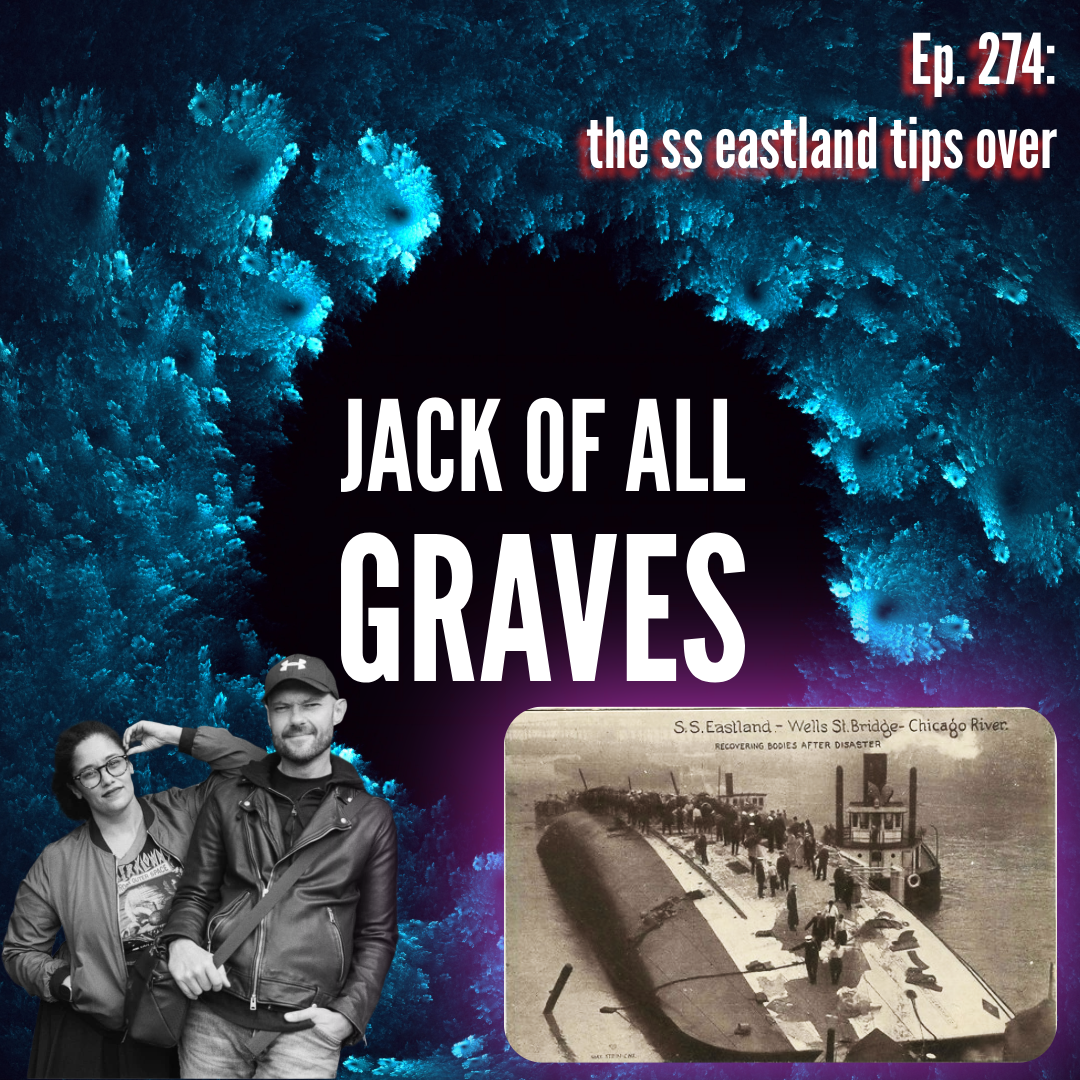
[00:03:28] Today I'm going to tell you the very stupid and terrible story of the SS Eastland.
[00:03:35] So let me first tell you a little bit about the ship itself.
[00:03:39] Owned by the St. Joseph Chicago Steamship Company, the SS Eastland was launched in 1903, meant to be a cargo and a passenger vessel that could also move real quick. In its initial design it was meant to carry 650 passengers and a haul of produce.
[00:03:56] But in 1913 the ship received a major overhaul and was retrofitted to be able to carry 2,500 people.
[00:04:03] And now if you're going gee, from 650 passengers to 2,500 seems like kind of a big leap. You would be absolutely correct.
[00:04:13] Too big a leap, I'd be willing to say.
[00:04:17] The ship was built with shallow draft to enter shallow ports.
[00:04:21] And draft basically refers to how much ship is under the water.
[00:04:26] Normally having a deeper draft, AKA more boat under the water compensates for a tall ship, but it creates draft which makes the ship slower.
[00:04:38] To make it faster, they cut the draft in two, leaving only 30% of the ship's hull under the waterline.
[00:04:47] They also shortened its length by 60ft and added a passenger deck, making it a thin top heavy ship.
[00:04:56] Now what do you imagine might be the result of building a ship that is very tall, very narrow and has a very shallow draft?
[00:05:05] If you said this ship be tilting, you're correct because it was listing.
[00:05:12] That is to say, if you're not up on the ol boat lingo, it would sway from side to side. Not in the normal way a ship sways with the movement of the water, but more, you know, tipping over.
[00:05:23] This became a sort of quirk that amused passengers. The boat would start listening and you'd hear people be like woo.
[00:05:30] Like they were on Big Thunder Mountain or something.
[00:05:34] But in reality this meant they were constantly trying to balance this dumbass ship to make it less hazardous.
[00:05:40] The ship operated using ballast tanks to try to mitigate that tipping.
[00:05:45] According to the Smithsonian. One of the key components of a boat's stability is called metacentric height.
[00:05:53] Floating objects are like an upside down pendulum with a center of gravity and the ability to roll or heel to either side before righting itself.
[00:06:02] The distance between fully upright and the maximum heel, the point beyond which it will capsize, is its metacentric height.
[00:06:10] For the Eastland, which carried a variable number of passengers, it should have had a metacentric height somewhere between two to four feet when it was fully loaded.
[00:06:19] Among the many insane changes to the Eastland in the days, months and years leading up to July 24, 1915, its metacentric height had been reduced to 4 inches.
[00:06:33] As transportation historian George W. Hilton wrote, quote, it was said of her that she behaved like a bicycle, being unstable when loading or unloading, but stable when underway.
[00:06:44] And because safety inspectors only monitored what the ship was like when it was moving and didn't give a shit how it acted when it was being loaded up, they were like, no prob, fully safe.
[00:06:55] As is always the case, though people warned them.
[00:06:59] As Marco colorfully put it in a recent episode, health and safety regulations are built on the bones of the dead.
[00:07:07] Or as people without his eloquence generally put it, regulations are written in blood.
[00:07:13] Despite being told this shit was going to sink by experts in the field, the owners of the Eastland took out a half page ad in the Cleveland Plain dealer offering a $5,000 reward to any that will bring forth a naval engineer, a marine architect, a shipbuilder, or anyone qualified to pass judgment on the merits of a ship who will say that the steamer Eastland is not a seaworthy ship or that she would not ride out any storm or weather, any condition that can arise on either lake or ocean.
[00:07:44] And frankly, I don't know why no one took them up on that offer, because it would have been easy fucking money.
[00:07:51] The problem is, when you've got a boat, we're listing all over the place as one of its cute little quirks. People don't necessarily notice when it's gone from haha, that's quirky to holy God, this is about to become a devastating disaster.
[00:08:05] And ironically, safety measures put in after the Titanic disaster might have been the nail in the coffin.
[00:08:13] Famously, the lifeboat situation was not great on the Titanic.
[00:08:19] Not only did they not have enough of them, but a misunderstanding of the captain's instructions to load women and children into them first led to second officer Charles Lightoller allowing only women and children into the boats, which meant that he lowered a bunch of the lifeboats only half full rather than letting any men onto them, making the passenger to boat ratio even worse and leading to a fuckton of fully preventable deaths.
[00:08:43] In the wake of this, new rules were instated regarding the amount of lifeboats required on any vessel carrying passengers.
[00:08:50] President Woodrow Wilson signed into law the La Follette Seamens act in March of 1915, requiring lifeboats to be able to hold at least 75% of the passengers aboard any vessel.
[00:09:02] And that is all good and well most of the time, but the Eastland was very much not built for this.
[00:09:11] Remember we got this very shallow draft and a tall thin ship that already lists side to side. If you look at it wrong, it had been designed to carry a grand total of six lifeboats.
[00:09:23] In the wake of this new regulation, it was now carrying 11 lifeboats and 37 life rafts.
[00:09:30] And lest we think, oh that doesn't sound like such a big deal, we're not talking about little blow up rafts like you take to the beach.
[00:09:37] Each of these rafts weighed half a ton and then they also had 2,750 life jackets which each weighed around six pounds.
[00:09:49] So that's seven tons of life jackets.
[00:09:52] I'm not going to do all the math of how much the lifeboats, rafts and lifejackets added because just trying to figure out how much life jackets weighed nearly confounded my skills. But suffice it to say it's way, way, way too much to add to this already built wrong ship.
[00:10:09] Further, they did not do any tests to see what impact this would have on the stability of the boat. They just loaded up with a bunch of lifeboats and hoped for the best.
[00:10:20] Maybe it was just a matter of time and this all would have happened anyway. But the addition of these lifeboats and life jackets in the wake of the law, meant to make water travel safer, may have been the straw that broke the Eastlands back.
[00:10:35] So now you know about the ship, let's talk about what actually happened on July 24, 1915.
[00:10:42] It was a lovely summer day in Chicago and at 6am the dock filled with some 7,300 people, at least 2,500 of which were there to board the Eastland, which would take them to various spots along the shores of Lake Michigan where they would picnic and bathe and make merry.
[00:10:59] Amongst those people were employees of the Western Electric Company boarding the ship for their annual picnic. It was all a cheery affair. There were bands playing, spirits were high, passengers flooded onto the ship. And while it's not confirmed, some have said that a Photographer wished to take a picture. And perhaps for that reason, the passengers all lined up on one side of the boat, causing the first list of the day.
[00:11:23] At the same time, engineer Joseph Erickson opened up one of those ballast tanks to stabilize the ship, and it instantly made things worse.
[00:11:33] The ship immediately tipped all the way the over.
[00:11:39] Mind you, the crew had not even boarded the ship yet. And it said that many of them immediately jumped back onto the dock when this thing started rolling. Knowing that a disaster was occurring, A witness named Jack Wood Woodford told the herald and examiner, quote, movement caught my eye. I looked across the river. As I watched in disoriented stupefaction, a steamer large as an ocean liner slowly turned over on its side as though it were a whale going to take a nap.
[00:12:07] I didn't believe a huge steamer had done this before. My eyes lashed to a dock in perfectly calm water in excellent weather, with no explosion, no fire, nothing. I thought I'd gone crazy.
[00:12:20] The chaos was immediate.
[00:12:22] Keep in mind the boat had not yet gotten out into open water. It was sitting at the dock, which you might assume would be the safest place it could possibly be.
[00:12:31] Boat starts tipping, no prob.
[00:12:33] Hop off.
[00:12:35] It didn't work out that way.
[00:12:38] The boat rolled onto its side so quickly that there was no time to launch any of those bajillion tons of lifeboats or hand out life vests. And it's 1915. People are fully clothed. A good chunk of them probably couldn't swim.
[00:12:53] Not that the situation really afforded them a chance anyway.
[00:12:56] Without any kind of flotation device, they were already doomed.
[00:13:01] Some passengers were lucky enough to manage to climb over the starboard railing and walk across the hull to safety when the boat first tipped over, suffering neither a scratch nor a soggy sock in the incident.
[00:13:12] Others, as reporter Harlan Babcock wrote, were hurled off the deck like so many ants being brushed from a table.
[00:13:20] He continued. In an instant, the surface of the river was black with struggling, crying, frightened, drowning humanity. We infants floated about like corks.
[00:13:32] Now, keep in mind, as I said, the dock was absolutely bustling at this point. And among the regular crowd going about business, there were certainly people who had just watched their relatives get on the eastland, which was now half capsized with its port side under 20ft of water.
[00:13:47] By the way, there are plenty of pictures of this online if you would like to google it. But I will say there's also a lot of corpses if you look up those pictures. So just, you know, a little bit of caution.
[00:13:59] You might see some of those dead infants if you do.
[00:14:03] But anyway, people ran to help witnesses describing the air filling with the horrific and unending sound of the screams of hundreds of people in the water begging for their lives.
[00:14:13] It is said, though once again it cannot be fully confirmed, that one man was about to drown himself in the river when he heard the commotion and instead ran to assist in the Eastland rescue efforts, saving himself as he saved others.
[00:14:28] Which is a pretty good story. I don't know if it's true, but since this is all just so dark, I figured I'd include that little tidbit and we can make it our headcanon. How's that sound?
[00:14:39] Anyway? People tossed whatever they could into the water for people to hold onto and use as flotation devices, but watched as parents lost hold of their children who sunk in the brown water.
[00:14:50] The screaming could be heard from blocks away.
[00:14:53] A nurse who'd been on a trolley nearby jumped onto the back of an ambulance and arrived at the shore to see that people were struggling in the water, clustered so thickly that they covered the surface of the river. The screaming was the most horrible of all.
[00:15:09] At the riverfront she saw people being dragged from the ship, covered in blood.
[00:15:13] Many of them had had to break glass and portholes to get through again, though those were the lucky ones because there were passenger cabins on the side of the boat that had been submerged and many passengers had simply drowned in those cabins, the water rushing in so fast and completely there was no way for them to get out at all.
[00:15:36] The boat had tipped over around 7:30am and by 8am pretty much anyone who would survive had already been pulled out of the water.
[00:15:46] From that point forward, while they didn't necessarily know it for sure yet, the rescue effort had become a recovery effort.
[00:15:55] It took till noon to reach those portside cabins which were full of the bodies of women and children.
[00:16:02] Families of the passengers began arriving to look for their loved ones. Word had gotten back to those related to the Western Electric workers on their way to the picnic.
[00:16:10] So they waited and waited, and for many of them, they waited in vain.
[00:16:15] The city had to bring out a big net to put in the water to keep the bodies from drifting out into the lake.
[00:16:22] The 2nd Regiment army, not too far from the docks, was turned into a temporary morgue where the bodies were lined up in rows of 85 for identification.
[00:16:31] Around midnight, they began letting families in, 20 at a time, to search for the bodies of loved ones.
[00:16:37] Naturally, some looky loos came in just to gawk, and some shitheads robbed the Corpses of jewelry and valuables as well.
[00:16:46] Largely though, the armory was filled with grieving families who had started their days seeing off cheerful crowds on the dock and were ending it, combing through the dead bodies of those happy holidayers.
[00:16:58] The disaster hit the hardest amongst the working class. Polish, Czechs and Hungarians. In Chicago, when all was said and done, 844 passengers had died just 20ft from shore.
[00:17:13] The Lusitania, which had sunk only months before, had a total a death toll of 785 passengers and the Titanic 829. Though including crew of course, more died in total. But passenger wise, the Eastman saw more deaths than either of those huge maritime disasters that we still talk about to this day.
[00:17:34] According to the Smithsonian, 70% of those passengers were under the age of 25.
[00:17:40] Two hundred and thirty of the dead passengers were teenagers, 38 were children and 22 entire families were wiped out the next day. There were so many funerals held in Chicago they ran out of hearses.
[00:17:56] And of course, much like when I talked about the SS Morrow Castle, drawing lots of onlookers who just wanted to see the site of all this death and destruction, it's esteemed estimated that half a million people came to see the wrecked Eastland, with local boats charging folks 10 to 15 cents to do a little float on past it.
[00:18:16] And you know, I get it, I would probably want to see it too. I think I would probably just feel bad about it and not actually do it, you know what I mean?
[00:18:26] In the wake of this tragedy, blame immediately fell on the crew, specifically the captain, Harry Peterson, and the chief engineer, Joseph Erickson, whose shifting of the ballot seemed to have caused the tip over.
[00:18:38] Ultimately, Erickson ended up taking the heat. But it was 24 years of litigation to get there and he actually died before the proceedings were over.
[00:18:48] He was represented by early celebrity lawyer Clarence Darrow, who concluded, as I think most of us probably would, that Erickson was a convenient fall guy.
[00:18:58] The owners of the boat were never charged with a crime and were not found legally to be negligent.
[00:19:04] It wasn't their fault. The boat was a top heavy disaster. They blamed the Titanic safety measures. If only they hadn't had to make the boat safe, everything would have been totes fine. The Eastland would be happily rocking back and forth like a poorly constructed country fair county fair ride to the delight of passengers for decades to come.
[00:19:26] The poet Carl Sandberg wrote, quote, I see a dozen Eastlands every morning on my way to work and a dozen more going home at night.
[00:19:36] In other words, what had happened here was indicative of the carelessness with which lower classes were treated in Chicago and indeed in the United States.
[00:19:44] Safety regulations and basic common sense were completely ignored in order to shove as many working class folks onto the boat as possible, making it a ticking time bomb.
[00:19:54] And of course, when it comes to placing blame, the corporations got off scot free.
[00:20:00] The Eastland, not actually destroyed in this event, was pulled out of the water and converted into a naval gunboat, having been renamed the Willamette.
[00:20:08] And Portlanders listening. Don't freak out at me for pronunciation. It's spelled with an I, not an A.
[00:20:15] Willamette.
[00:20:16] It was used in training of sailors for several years before actually being recommissioned in June of 1920.
[00:20:24] It was manned by Gunner's Mate Jo Sabin, who was known for having fired the first American cannon in World War I.
[00:20:31] The Willamette would go on to be charged with sinking the captured German U boat UC 97 off the coast of Highland Park, Illinois.
[00:20:39] This fucking ship continued sailing as a naval ship until 1945, and nowhere in anything I read did it say that it received anything more than repairs. As far as I can tell, it wasn't redesigned. This thing even brought President Franklin D. Roosevelt on a fishing vacation in 1943.
[00:20:59] So I don't know guys, maybe it was the damn Titanic that was to blame for the sinking of the Eastland. And the moral of the story is Deregulation.
[00:21:06] Yes, that's it. Deregulate all the things and finally we'll be safe.
[00:21:12] The end.
[00:21:15] That that was sarcasm by the.