Episode Transcript
[00:00:03] Speaker A: I went on a trip this week. Not. Not in a lucidogenic sense. Not in a Timothy Leary kind of sense. No, no, no, no, no.
[00:00:12] Speaker B: Okay.
[00:00:12] Speaker A: Certainly not.
[00:00:13] Speaker B: You are still dropped in, if you will.
[00:00:16] Speaker A: Very much so.
I went on a family trip. My family and I took a trip. My family and I went on.
[00:00:22] Speaker B: Well, you know, Timothy Leary did say you should trip with your family.
[00:00:25] Speaker A: I can think of nothing worse than.
[00:00:28] Speaker B: Fair enough. Go on.
[00:00:30] Speaker A: Laura would have me tidying.
[00:00:34] Speaker B: The worst trip known to man.
[00:00:36] Speaker A: Tortuous.
However, I digress. My family and I went to. We. Every year, we take a trip into London. We stay over and we visit the theater and we do a few museums. A little city trip into London every year. And we love it. We absolutely love it. It's become something of a. It's a good tradition of ours, right?
It is. It's wholesome.
By.
I mean, Peter's 15, Owens 12, and they've already seen more of the city and of the world.
[00:01:07] Speaker B: Yeah.
[00:01:08] Speaker A: Laura had. And I had up until our twenties, you know.
[00:01:11] Speaker B: Right.
[00:01:13] Speaker A: We. And we enjoy that. We. We occasionally remind ourselves of that. That we're doing our very best to give them a broader experience of life than we were gifted when we grew up, you know.
[00:01:24] Speaker B: Yeah. It's a beautiful thing.
[00:01:25] Speaker A: It is a beautiful thing.
But one of the. One of the. One of the places that we took in this time was the Imperial War Museum.
[00:01:38] Speaker B: That's right, yes.
Yeah. Despite my many attempts to get you to the Maritime Museum, this time it was the Imperial War Museum. Corrigan, how was this chosen? I'm just curious. Like, it's not your point, but I'm just very curious as to how this one became the thing.
[00:01:53] Speaker A: A lot of factors, a lot of variables, a lot of vectors.
We look at where we're staying.
[00:02:01] Speaker B: Sure.
[00:02:01] Speaker A: Where the theater is.
[00:02:03] Speaker B: Yeah. Where we're reaching, what's in between those two things. Exactly.
[00:02:06] Speaker A: And we kind of, you know, we grid it out and we look at it and we calculate wind speeds.
[00:02:13] Speaker B: Right.
[00:02:14] Speaker A: Local crime rates, health care, sanity, sanitation, and things like that, and we make a plan. And in the plan this time was the Imperial War Museum. And Corgan. I got to tell you about this place.
[00:02:27] Speaker B: Please do.
[00:02:29] Speaker A: It was quite something. It was. It was quite something. It. Well, I learned a lot.
You start in the. You start in the days of empire.
[00:02:42] Speaker B: Right. I was gonna say, like. I mean, I can make assumptions about what the gist of this museum is, but what is the gist of this museum?
[00:02:53] Speaker A: It is an educational journey which encompasses the fall of the British Empire or The kind of decay then of the British Empire.
Okay. Leading into World War I, the hinterland between it and then World War II and kind of kind of taking us up to the mid-80s, post kind of cold war in the UK and the threat of nuclear conflict.
[00:03:24] Speaker B: So it kind of swerves like the actual imperial times of England. It's, it's.
[00:03:33] Speaker A: Yeah. The journey starts.
[00:03:34] Speaker B: The end of empire.
[00:03:35] Speaker A: Yeah. In the dying days of British Empire.
I'll be honest with you. Maybe I missed it, maybe I missed it, but I didn't catch any condemnation of empire as a concept.
[00:03:48] Speaker B: Right. Like, it feels like if you're starting at the end of it, you can kind of like not worry about it.
It's fine. It's over. Anyway, there was. Listen, let's not talk about it.
[00:03:58] Speaker A: I am not for a second for even a suggestion, dressing down the experience of the Imperial War Museum because it was fantastic.
[00:04:07] Speaker B: Yeah. It sounds like you had a great time.
[00:04:09] Speaker A: But the more I think of it, I did not catch any explicit condemnations of global empire building. I didn't catch any. Maybe they were there, sure. Maybe I missed it, but I didn't catch any of those.
Come on. But what, I mean, right in the middle of the end to end journey, there's a they in as much as one can it retained and protected space for the Holocaust. Right in the middle. Right.
In a space where photography is, Is explicitly forbidden.
[00:04:49] Speaker B: Yeah.
[00:04:52] Speaker A: In a space that is out with the rest of the, of the museum, away from retail and away from, you know, charity. It's, it's very much got its own space within it all.
And really you, you, you, you emerge in a very, very different headspace than you than you were in going in very much.
But what I really took away, what inspired and I have not been able to get out of my mind since is what I'm going to talk about this week in this little section, this little opportunity, this little, this little niche of privilege I have here to talk to you every week as I talk to our listeners.
[00:05:41] Speaker B: Yeah.
[00:05:41] Speaker A: And I think the best way I can introduce this topic is just to go back, back, back, back, back.
What if I, what if I, what if I invited you just to super briefly come to ancient India with me? Right.
[00:05:56] Speaker B: All right.
[00:05:57] Speaker A: It's all about. Oh, man. Sorry to have to say this, but it's all you. This is going to make Sense in about 15, 20 minutes, but it's all about flaps, flaps, flaps, flaps, flappy flaps, flaps.
[00:06:11] Speaker B: Okay, Fl.
[00:06:13] Speaker A: What if I introduce you to a ancient Indian medic surgeon by the name of sushruta.
[00:06:24] Speaker B: When we say ancient India, like around when are we talking?
[00:06:28] Speaker A: 600 BC Sanskrit is.
[00:06:29] Speaker B: The line is ancient.
[00:06:30] Speaker A: Yes.
[00:06:31] Speaker B: Okay.
[00:06:32] Speaker A: Super, super, super old times.
And sushruta is widely considered to be the earliest documented reconstructive surgeon.
[00:06:48] Speaker B: What.
[00:06:49] Speaker A: What if I fucking told you that.
[00:06:51] Speaker B: Okay, you have my attention, sir.
[00:06:53] Speaker A: Yeah, fucking right. You didn't see that kind of video.
[00:06:56] Speaker B: Boom.
[00:06:59] Speaker A: His.
His text. The Sushruta Samhita.
What if I told you that in the Vedic period of 600 BC in ancient India, crime was met with mutilation?
Ooh, right.
So if you were an adulterer, if you were treasonous, you would be punished by facial mutilation, namely cutting off of your nose.
Nose amputation was a common punishment of the time in ancient India.
[00:07:43] Speaker B: And see, I had the immediate.
Like the original version of the Aladdin song in my. You know, where they cut off your ear if they don't like your face. This is worse.
[00:07:54] Speaker A: This is. Well, this is. This is nature.
[00:07:56] Speaker B: Cut off your nose.
[00:07:57] Speaker A: They would cut off your fucking nose, I guess, despite your face.
[00:08:02] Speaker B: Well, there we go. Is that where that comes from?
[00:08:04] Speaker A: Maybe it is.
[00:08:06] Speaker B: Did we just stumble upon something here?
[00:08:10] Speaker A: Fuck.
[00:08:10] Speaker B: Huh?
[00:08:11] Speaker A: But.
[00:08:11] Speaker B: Okay, go on.
[00:08:12] Speaker A: So it's all about flaps, right? Because his technique, primitive though it was.
Fuck, was he onto something. He would rebuild noses by grafting, almost cutting a flap of skin from the cheek or elsewhere on the face and rotating, almost twisting it into place to cover the. The yawning kind of chasm where someone's nose would be. Right. And this is a technique which caught on, migrated.
Right, The Indian kind of Sushiruta's flap method, I guess you might call it, for our purposes here.
[00:08:55] Speaker B: Yeah, I mean it's probably not what like historians or medical professionals call it, but yeah, we'll call it.
[00:09:01] Speaker A: That's what it is. Flap magic.
[00:09:04] Speaker B: Flap magic. Yes, you could.
[00:09:07] Speaker A: It reached Europe, it reached Italy, it could be traced back to the 1700s, late 1700s, 1790s, a.
A cart driver by the name of Kawasji was punished by sultan forces by having his nose cut off. Had it reconstructed using that method, the Indian method, and that was noted and written about in a British magazine and kick started European innovation and interest taking it to Italy right in the 16th century, in Renaissance Italy, where we were
[00:09:49] Speaker B: in 1790 before we're in the 16th
[00:09:52] Speaker A: century, which is the 1700s now in Italy.
[00:09:55] Speaker B: No, that's 18th century.
[00:09:59] Speaker A: Well, I'm going to Italy in 1597.
[00:10:02] Speaker B: Okay. Yeah, since the 1500 before. Oh, okay. You're Good. Because I was like, wait, you were in 1790?
And then you said. And then 16th century is subjective. You threw me.
[00:10:14] Speaker A: You know, everything is a long time when you got your nose cut off, Corrigan.
[00:10:18] Speaker B: Well, that's a really good point. I hadn't thought about it that way. Right, go on.
[00:10:27] Speaker A: The Indian method evolves. It is improved.
A surgeon in Italy, a guy by the name of Gaspare Tagliacozzi. Yeah.
[00:10:37] Speaker B: Okay.
[00:10:38] Speaker A: Formalized refines, improves Sushruta's method by using skin from the patient's arm.
[00:10:46] Speaker B: Sure.
[00:10:47] Speaker A: He publishes this in a book of his, Decaturum Cherugia, which is known to be the first ever tome entirely dedicated to reconstructive plastic surgery.
[00:11:00] Speaker B: And this is in the 1500s.
[00:11:03] Speaker A: 1597 was when that book was published.
Right.
[00:11:07] Speaker B: That's wild. Yeah.
[00:11:09] Speaker A: In Dr. Tagliacozzi's own words, quoted from that tome, restore, rebuild and make whole those parts which nature hath given up, but which fortune hath taken away.
[00:11:27] Speaker B: Hmm, interesting.
[00:11:30] Speaker A: Those parts which nature hath given, but which fortune hath taken away. I misread that. Which nature. So nature gives you a nose, fortune takes it away.
It fixes you up, my friend.
Yeah, but here's the thing. Here's the thing. Here's the thing.
After the death of Tagliacozzi, the reconstructive surgery rate of improvement and pace and progress kind of stalled, Right?
Few different reasons for this. The Church had a lot to do with it. Treating it with some suspicion.
[00:12:05] Speaker B: Imagine.
You mean a scientific and medical breakthrough was hindered by the Church being, like, too spooky.
[00:12:14] Speaker A: But, Corrigan, listen to this. Also, the process itself was fucking hellacious.
Tagaqotsi was taking skin from patient's arm, but the arm would have to be strapped to the patient's face so that the blood vessels would remain connected.
Patients would have their arm up, strapped to their face, often for weeks, while the flap.
[00:12:39] Speaker B: Oh, wow.
[00:12:40] Speaker A: Yeah. Healed. Or took the graft, grew in place on the face.
[00:12:47] Speaker B: Oh, that's really interesting because it's like the. From the descriptions that you had given until that point, it's like. I mean, that's. That's what we do. You have that. You have your little patch on your arm.
[00:12:59] Speaker A: Very much. I was about to say, what we are talking about here is early forms of skin graft. And I'm walking around one of these fuckers. A huge.
[00:13:06] Speaker B: Exactly.
[00:13:07] Speaker A: Well, I say huge. I mean, it. It. I barely notice it now, but I was painfully conscious of it growing up as a teenage.
[00:13:14] Speaker B: Right.
[00:13:15] Speaker A: A large kind of maybe 8 inch portion of my upper chest is covered in skin grafts from a burn I sustained as a kid. This is due to the work of Sushruta, Dr. Tagliacozzi. These are the innovators.
[00:13:29] Speaker B: And that's incredible. But also, then you add, like, it.
Because it feels like you're like, so what's changed? Oh, they didn't have to, like, they took the hair, the skin from your leg. Right.
[00:13:41] Speaker A: And that's why my upper leg. Yes.
[00:13:43] Speaker B: Yeah, that's why it kind of got hairy or whatever.
It got older, but, like, they didn't have to, like, attach your leg to your chest.
[00:13:52] Speaker A: Whereas in those days, they did. If I was taking a skin graft from my arm, my arm would have to be strapped and held to my face for weeks while the healing process took place.
[00:14:02] Speaker B: And so did it sort of grow together? Is that.
[00:14:07] Speaker A: We'll get there.
[00:14:08] Speaker B: Oh, okay, Gotcha.
Sock it to me. I'm invested.
[00:14:12] Speaker A: So I left the Imperial War Museum with a question in my mind.
Is war almost a catalyst for surgical reconstructive improvement?
[00:14:31] Speaker B: Sure, yeah.
[00:14:33] Speaker A: And I really think.
I genuinely think there's a case to be made.
The war has spurred on the field of facial reconstructive surgery.
[00:14:48] Speaker B: Yeah, I think. I think you're 100%.
[00:14:50] Speaker A: There are cases, right? There are cases throughout fucking history.
In.
There's a French military surgeon in the 16th century, Ambroise Par, who developed and improved wound techniques from battlefield injuries, the American Civil War.
Field triage nursery. And doctor working in the filthiest of field conditions, pushing sterilization techniques forward, surgical techniques forward.
It's almost kind of.
There's a lyric, an alkaline trio lyric. I'm sure they didn't come up with this, but it's where I remember it from. People learn quicker on fire. Right.
When you are under pressure, when you are at scale, when you are.
[00:15:45] Speaker B: I mean, that's that phrase, right? Trial by fire.
[00:15:47] Speaker A: There you go. There you fucking go.
[00:15:51] Speaker B: And this is just to. Not to sidetrack for a long time, but, I mean, I watch a show called tasting history on YouTube and it's where he'll, like, make a recipe from history and then he'll talk about, like, the times and what spawned it and things like, oh, it's wonderful.
And, you know, maybe something to watch with the. With Owen or something like that. But great little show. And one of the ones. I mean, a lot of the ones that he does have to do with war.
And, like, a lot of food that we eat now comes from stuff that was made Specifically for war. And it may even be repurposed, but it's made for war. Same with technology.
Technology that we use is often pioneered for war medicine.
[00:16:37] Speaker A: Surgery for killing, then it will be right.
[00:16:40] Speaker B: Or like in the case of reconstructive surgery, healing, like bouncing back from these things or sustaining people. Like he did one with like Salisbury steak or he did one with like these chocolate bars, things like that. That like the chocolate bars weren't meant to taste good, but they were like just a ton of calories to shove into your face at once, you know, like these kinds of innovations are often made because war is one of those things that like necessitates us. Like dealing with people who are hungry, people who are injured, people who are sick.
[00:17:12] Speaker A: Yes, yes.
[00:17:13] Speaker B: You know, people who are more powerful. All kinds of things.
Our technology in pretty much every field is going to just jump forward as a result.
[00:17:22] Speaker A: You can you. I think of it as intense pressurized R and D on live subjects.
[00:17:32] Speaker B: Exactly.
[00:17:33] Speaker A: Does that sound about right? It's. Yeah, you know, just live data, live test cases coming in thick and fast, fucking bleeding from arteries and needing you to fucking come up with something, you know?
[00:17:46] Speaker B: Yeah, exactly that.
[00:17:49] Speaker A: So let's jump to the First World War.
[00:17:55] Speaker B: Yes.
[00:17:55] Speaker A: Right.
[00:17:56] Speaker B: And I'm just curious, are you going to talk about the photo that. The photos that spawned this.
[00:18:00] Speaker A: Oh, well, I am, I am, yes. I don't have the very photos, but all you got to do is.
[00:18:06] Speaker B: I was just interested because this was. I asked you about this. You sent me a bunch of pictures.
Okay. From the museum.
[00:18:13] Speaker A: You get a technique that I'm going to focus on shortly.
[00:18:15] Speaker B: Okay, good. I've got a live video. We are going to get to this, right?
[00:18:18] Speaker A: We'll get there. Listen, now you know how I feel. Yes,
[00:18:23] Speaker B: Yeah, I know too much because you've. You've introduced something that I'm like. Wait, okay, wait, hold on.
[00:18:27] Speaker A: I mean, you can testify that, you know, it's true what I say. I've been thinking about this for days.
[00:18:33] Speaker B: It's true. Yes.
[00:18:34] Speaker A: I really have. I've been thinking about this really been days.
[00:18:36] Speaker B: Man cooking up there. So take me to World War I.
[00:18:39] Speaker A: Consider trench warfare for me. Right.
[00:18:42] Speaker B: I don't like to, but I will do that for you.
[00:18:44] Speaker A: Awful.
[00:18:45] Speaker B: Me? Yeah.
[00:18:46] Speaker A: Absolutely awful. But what have you got there? In trench warfare, you've got long, interminable stretches of time where brand new killing technology is being employed. Machine guns, shrapnel, ordinance, gas. Gas.
And what is the chief part of a soldier's body that is exposed during trench Warfare. It's the fucking head and face.
[00:19:16] Speaker B: Right.
[00:19:17] Speaker A: What are you aiming at? You're aiming at somebody's fucking face. So obscene and horrific though it is, facial injury was super popular.
[00:19:31] Speaker B: Popular feels like the wrong word for that. Common maybe.
[00:19:34] Speaker A: There we go. Common.
It was really spelled out in the war museum, right. That soldiers and commanding the class. Commanding class, generals and so on, had no fucking idea what they were dealing with. When it comes to automatic and machine weaponry.
[00:19:58] Speaker B: Right. Yeah. Whole new ball game.
[00:20:00] Speaker A: An American surgeon by the name of Fred Albee is quoted as saying, we failed to understand the menace of the machine gun.
Allied strategy was still walk towards the enemy as a group.
[00:20:16] Speaker B: Right. Yeah.
[00:20:17] Speaker A: Right.
[00:20:18] Speaker B: We're just gonna line up and we're
[00:20:19] Speaker A: gonna, you know, and if you, and you know, if you're brave, you'll make it.
Right. Even though those guys are mincing you with, with machine guns that you have never come across before.
[00:20:33] Speaker B: Exactly. Because as we talked about, like what, two weeks ago or whatever, when it came to Andrew Jackson and dueling and stuff like that, it's like the man survived, you know, 100 plus duels. But it's because the weapons just like missed most of the time and didn't do a whole lot of damage. They were not ages to reload doing this. Yeah. When we talk about, you know, Civil War, things like that, and people just like marching towards each other and shooting, you had. You actually stood a fairly good chance of surviving.
[00:21:03] Speaker A: Yeah. If you duck around a little bit, dodging, weave.
[00:21:05] Speaker B: Yeah, Right. A little. Do a little dodge and bob, weave and there you go. Not so much In World War I,
[00:21:12] Speaker A: no noses blown off, jaws, tongues, eyes, faces just obliterated.
[00:21:21] Speaker B: Yeah.
[00:21:24] Speaker A: And the earlier, early, early on in that, that period, First World War, field surgeons were just stitching wounds up, trying to close up gaps and scar tissue would just pull faces into. Just in some of the, like, some of the photos that I've sent you, just that's how people would have to live their lives with missing, huge missing components of their face.
[00:21:51] Speaker B: Yeah.
[00:21:51] Speaker A: By the end of the First World War, some 280,000 men from across Europe. Right. France, Germany and Britain alone had suffered some form of facial trauma.
[00:22:04] Speaker B: Wild.
[00:22:05] Speaker A: 280,000 men.
[00:22:07] Speaker B: It's interesting because I just read a few months ago this book called the Titanic Survivors Book Club.
And it takes place obviously after the sinking of the Titanic, but what comes very soon after the sinking of the titanic.
World War I.
[00:22:22] Speaker A: Yes.
[00:22:23] Speaker B: And it takes place in France. And this is one of the things it talks about is, you know, as this War goes on that when you're walking around Paris, you're seeing tons of guys who look like this. Just shit blown apart, barely pieced together, stuff like that, that. It was like French people were just, like, deeply acquainted with death and disfigurement because these guys were coming back from the war, and everywhere you looked, that was what people looked like.
[00:22:52] Speaker A: And into this comes, in 1915, a doctor by the name of Harold Gillies.
Right.
[00:23:02] Speaker B: Okay.
[00:23:03] Speaker A: A New Zealander by birth, studied in London and Cambridge, and in 1915, he was a volunteer in France with the Red Cross. Right, okay. And he watched dentists at work drilling splints into Jaws.
He witnessed in Paris early skin grafting techniques on cancer sufferers, tumor sufferers.
And he became a specialist in reconstructive surgery, opened up a.
A dedicated kind of facial unit at a military hospital over here in Cambridgeshire, and pioneered some disciplines and some tenets which stay true to this day. Things like, when you're replacing tissue, always quote, never replace, like, with. Unlike, make sure you're using skin of similar texture and color, trying to line bones and tendons where you can. So anatomically things look as close to approximating how they did before an injury.
And he pioneered a procedure called the tube pedicle.
P E, D, I, C. Pedal.
[00:24:37] Speaker B: Yeah.
[00:24:37] Speaker A: Tube pedicle. Pedicle. P E, D, I, C, L, E.
Tube. Okay. The tube pedicle. Let me just see if I can find a little picture of a tube pedicle for you.
[00:24:49] Speaker B: I'm already, like, trying to do, like, a little, like, etymology situation on here. Like, ped. Like foot icle.
Like a foot tentacle. What is this?
What is this gonna be?
[00:25:01] Speaker A: This is a perfect, perfect, perfect picture.
If you would go to your signal, please, and for the benefit of the audience, please describe what you see there.
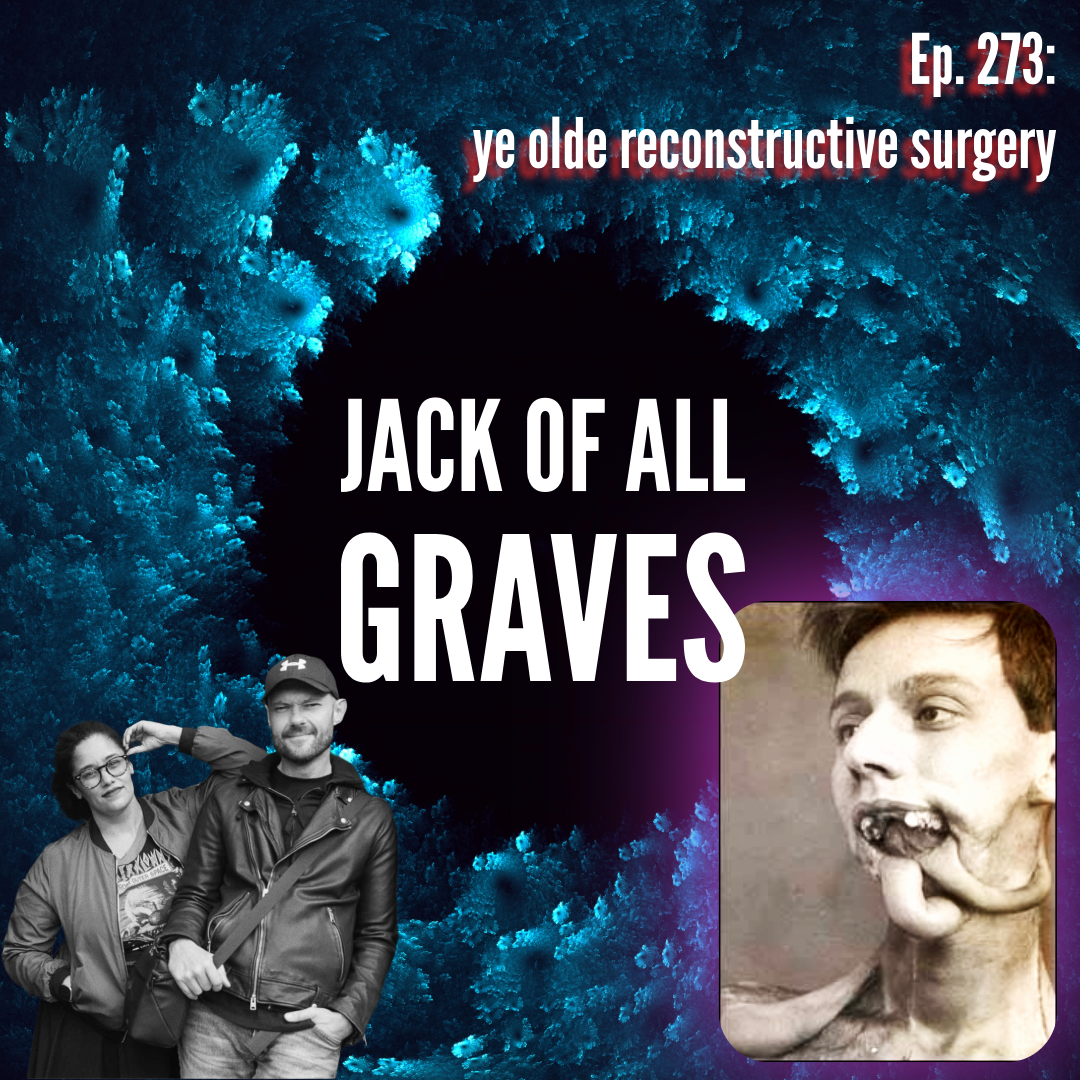
[00:25:14] Speaker B: Yes. Oh, my goodness. Okay, there's a fella who's clearly had some sort of severe trauma on the lower half of his face.
The bottom jaw is gone. Yeah. He's still got kind of a little bit of the top, but the bottom is completely gone. And he has tubes of flesh. It looks like that have. I mean, this looks like something from one of those, like, websites that do, like, fake.
You know, like something you'd see in formaldehyde or something like that, you know,
[00:25:47] Speaker A: some kind of museum of curiosities.
[00:25:49] Speaker B: Yeah, like, he's got little, like, tentacle things coming out of his mouth and sort of wrapping around, like, to the base or like. Like to the base of his skull. The top of his neck, by the look.
[00:26:02] Speaker A: What he has, Corrigan, is a series of tube pedicles. And I followed it up with another one there.
[00:26:08] Speaker B: Yeah, you have a series of photos of a guy that would be like comical if we weren't talking about what the, like, actual thing is here. So this guy has a similar sort of tentacle thing which covers where presumably his nose used to be and isn't anymore. And then it's attached sort of to his wrist, which he's holding up.
[00:26:27] Speaker A: Yeah.
[00:26:28] Speaker B: At his, like, chest level.
[00:26:31] Speaker A: So you might reasonably as. Did I look at those pics and wonder what the fuck kind of technique this is. Yes, I see. I see nothing comical in these at all. Where if I didn't know that these were surgical photos of men in a healing process, I would think that this was something maybe out of. Out of Clive Barker or Lovecraft.
[00:26:54] Speaker B: Sure. Well, it's because he looks like he's smiling and, like, has like a proboscis.
[00:27:00] Speaker A: Oh, the second guy. The second guy is very much smiling.
[00:27:02] Speaker B: Yeah, yeah, the second guy, not the first one, the guy with the series of photos looks like he's having a good time.
[00:27:09] Speaker A: He does, actually, and good for him because he is the recipient of a tube pedicle. And I'm going to explain to you how this works. Right.
[00:27:17] Speaker B: So please do.
[00:27:18] Speaker A: I have a piece of paper here. I'm holding a loft, a piece of blank A4 paper that I've pulled from the family printer and I have a scissors here. Right.
And this is the tube pedicle process, as I understand it. Imagine for me, if you will, that this sheet of paper represents the skin of, for example, my chest. Right.
[00:27:36] Speaker B: Okay.
[00:27:37] Speaker A: Now what the tube pedicle involves is the cutting like so, of two incisions.
Uh huh, Right.
[00:27:52] Speaker B: Yes.
[00:27:53] Speaker A: So there's my chest skin, Right?
[00:27:56] Speaker B: Yes.
[00:27:57] Speaker A: Incisions. Then there on the top, like so.
Right.
[00:28:03] Speaker B: All right, so two. Two incisions going vertically and then at the top of those vertical incisions, two horizontal.
[00:28:10] Speaker A: Correct. Now sort of.
[00:28:12] Speaker B: Yeah, perpendicular.
[00:28:13] Speaker A: We are in the era before antibiotics. Keep this in mind.
[00:28:18] Speaker B: Yes. Right.
[00:28:19] Speaker A: So what happens is this flap, it's all about flaps. This flap of skin is lifted.
[00:28:24] Speaker B: The central flap, whilst still attached to
[00:28:28] Speaker A: the rest of my skin, it is then twisted like so. Right, yeah. And the raw end is folded inwards into a tube.
[00:28:41] Speaker B: Okay.
[00:28:42] Speaker A: So the healthy skin is on the outside and the open end is then grafted, stitched where it is required. On my face.
[00:28:52] Speaker B: Uh huh.
[00:28:53] Speaker A: Whilst still attached to the other part of my body. The tube does not open on both ends.
Right, Right, Yeah. Now, bit by bit, the fucking tube is. Then when it heals, is walked further up my body and attached there.
[00:29:17] Speaker B: Huh.
[00:29:17] Speaker A: Then when it heals further, it's attached closer to the wound site.
[00:29:21] Speaker B: Yeah.
[00:29:22] Speaker A: And walked closer and closer to the wound where finally the tube is cut and the remaining chunk of skin is fashioned into a new nose or ear or jaw.
Wow.
Can you fucking get your head around that?
[00:29:43] Speaker B: No, not entirely. Like, for one, stuff like this is bananas to me that someone would, like, think of it because this is such a wild process.
And so the point of this is to keep it, like the blood flow. Is that the idea of this until it heal.
[00:30:04] Speaker A: What we have now in medicine that we didn't have then was advances in. And I've seen the word, but I can't remember. I apologize.
Connecting arteries, blood vessels to a skin graft to keep it alive, which didn't exist back then. So the skin literally had to remain attached to the patient at all times
[00:30:26] Speaker B: to keep it sort of itself.
[00:30:27] Speaker A: Exactly. Until it grew on.
[00:30:30] Speaker B: So it's. It's healing itself, essentially.
[00:30:32] Speaker A: Exactly.
[00:30:33] Speaker B: You know, it's a process of using the body to heal a new nose onto you and then once it has done so, shaping it exactly this.
[00:30:41] Speaker A: So when the live tube. When the live tube pedicle has been walked, as they call it, across the body enough that it's almost entirely at the target site, be that your jaw, your nose, your ear, your mouth, whatever.
The tube is then unrolled and stitched and shaped and crafted to replace missing facial features.
[00:31:04] Speaker B: Wow. And how long did this process take?
[00:31:07] Speaker A: Weeks, maybe months.
[00:31:09] Speaker B: Well, yeah, I mean, it seems. It seems like it would take a really long time.
[00:31:14] Speaker A: Pretty mad.
All the way from Italy and ancient India, where your arm would have to be strapped permanently to your face for a period of weeks while you would heal.
We now are at a place where they can form a tube, a closed tube, remaining sterile in the best case scenario, and the tube can be walked across your body and molded and healed.
Is that not the most fucking wild thing you've ever heard?
[00:31:45] Speaker B: Yeah, I mean, it's. It's incredible to think of, like. I mean, if that was a thing that you were experiencing, the amount also that you're putting yourself through to, like, get this reconstruction right. To be able to have some semblance of. Because, I mean, to a degree, I'm sure there's, like, you're trying to keep this, the space clean and stuff like that. If you don't have a nose, stuff can get in there. You do want to have Something over it, but they could just, you know, take what you have and try to stitch it closed as much as possible. I once saw a guy in a Starbucks who didn't have a nose.
[00:32:16] Speaker A: Is that right?
[00:32:17] Speaker B: Yeah, it was just like, how do you smell two holes?
But I'm tss. He sneezed, Mark, he sneezed. And it was troubling, we'll tell you that.
But like, you know, so you could do the bare minimum of this, but like the degree to which you would put yourself through this entire like weeks to months long process, to be able to like just have like something akin to your face back is, is such an interesting element of this. It's like the psychology of it too. Right. Of course, on top of all of this technological, all these technological moves forward and things like that, it's so much of the recovery from war is a psychological part of it and doing this is certainly an element of that.
[00:33:03] Speaker A: Well, what if I, and I'll bring this to a close just by zapping us forward a little bit to World War II.
[00:33:12] Speaker B: Sure.
[00:33:13] Speaker A: Where the nature of a lot of these injuries evolved.
[00:33:20] Speaker B: Sure.
[00:33:21] Speaker A: The nature of war, while, yes, there was still a lot of land based, hand to hand, gun to gun fighting, but aviation warfare was, you know, way more common. You had fuel tanks of airplanes rupturing, catching fire, high fucking octane jet fuel pilots, you know, who had moved their facial protection or their goggles up to look through smoke, flash burns, right. Eyes, ears, eyelids, noses fucking gone skin, kind of clawed hands.
And that was where the facial and bodily reconstruction had to then kind of evolve. And incredibly, incredibly, it was Gilly's cousin, a guy by the name of Archibald McIndoe, who advanced, pushed that discipline forward in World War II into a more like you said there, a psychological kind of social rehabilitation space in hell. Corey. This is so affecting to me. In 1941, right in Ward 3, which was the space in the, I, I, I believe I'm right in saying it was a hospital in Sussex, a Queen Victoria hospital in Sussex.
39 airmen formed, all of whom had massive facial damage.
Tube pedicles were on the cutting edge of facial reconstruction surgery. They formed a fucking almost like a self help group calling themselves the Guinea Pig Club.
Oh, gosh, incredible stuff.
To be a member, you had to be air crew allied soldier. You had to have undergone at least two major surgical procedures.
[00:35:29] Speaker B: Wow.
[00:35:29] Speaker A: And by the 1940s, by 45, actually by 1945, there were 649 men across the allied nations who were members of the guinea pig club.
They it was Gilles's cousin who encouraged them. They were allowed to drink on the wards in their hometowns. The doctors would visit and encourage pubs to. To welcome these men in and not to stare and not to talk.
[00:35:59] Speaker B: Right.
[00:35:59] Speaker A: To.
He had encouraged these men to, while on the hospital, to wear their uniforms as opposed to gowns, you know, feel
[00:36:07] Speaker B: a little bit like normal.
[00:36:09] Speaker A: Exactly. All about kind of reclaiming their identity as opposed to just merely patching up fucking holes in their face, you know?
[00:36:18] Speaker B: Right, yeah.
[00:36:19] Speaker A: And the club, the Guinea Pig Club, still had meetings up until the early 2000s. I think it was 2006 or thereabouts that they had their final meeting of people who survived World War II through the facial surgery that was pioneered there.
[00:36:34] Speaker B: That's pretty incredible.
[00:36:34] Speaker A: Is that not the most incredible thing?
[00:36:36] Speaker B: And that's the kind of thing that you. You like to hear about. You know, there's so much, like, horrific stuff when it comes to mental health and the aftermath of World War II that the repercussions of which we are still dealing with in the form of boomers and the idea of, like, someone who was not only trying to medically solve this problem, but was like, this is only part of it.
[00:37:04] Speaker A: Yes.
[00:37:05] Speaker B: You know, this is not the whole story on top of this. Like, we can't. We can't fully fix these people. But what we need is socially to welcome these people as if they're, you know, they are just as valuable as they were before. Get them in a place where they feel good about themselves, put them in their uniform. Don't make them feel like they're, you know, just patience freaks, all that.
[00:37:28] Speaker A: Right. It's a story of reclamation.
The Guinea Pig club continued until 2007. Right.
And the last surviving member died in 2023 at the age of 101.
[00:37:42] Speaker B: That's bonkers. And just think about that. Like, who's to say what, without both the, like, social, psychological elements of that club and the medical jumps forward of having at least two surgeries per the club rules. Like, if that guy would have made it this long, you know, so it's phenomenal.
[00:38:03] Speaker A: These are the thoughts that I was left with after a visit to the Imperial War Museum. Incredible stuff. And once again, I'm delighted to have the privilege and the space to think and talk these thoughts out loud because it, I don't know, it helps. It gives them space, you know, I
[00:38:19] Speaker B: look forward to info dumping about tube pedicles to someone in the near future.
[00:38:25] Speaker A: Let me quote directly from my notes, if I may. Yes, please do fucking look at These nerds. Oh, mise en scene.
[00:38:32] Speaker B: I don't think anyone has ever said mise en scene in such a horny way before.
[00:38:36] Speaker A: The way I whispered the word sex.
[00:38:38] Speaker B: Cannibal received worst comes to worst. Mark, I'm willing to guillotine you for science.
[00:38:42] Speaker A: Thank you. That's really, really sweet. It's cold outside, but my pancreas is talking to me. I'm fucking. I'm gonna leg it.
[00:38:49] Speaker B: You know how I feel about that, Mark?
[00:38:51] Speaker A: I think you feel great about it.
Okay, listen, hey, everyone, let's not fuck around. We're gonna start this week's episode with a shout out.
Oh, we are just straight away, just gonna give a shout out right here to.
He's a big fan of the show. Big listener. Christopher Phillips, who was sentenced today in Merthyr Tydville. A guy from Porthcall who was arrested earlier this year. Chris had been keeping his mother in the freezer in his house since 2023.
Case has been big in the news today.
You know, he's made the national news cycle.
[00:39:38] Speaker B: They arrested him.
[00:39:40] Speaker A: He was sentenced today.
[00:39:42] Speaker B: Sentenced?
[00:39:43] Speaker A: Oh, yeah, he got. He got. He got prison time. He was.
He was given some time in prison. Some lovely details here.
[00:39:52] Speaker B: Yeah, tell me about it. He's like, did he kill. I'm. What do you sentence someone for when they keep their mom around? Did he kill her?
[00:39:58] Speaker A: The cause of her death was impossible to ascertain. They don't know how she died. She was in her 80s.
[00:40:05] Speaker B: Yeah. So she died.
[00:40:07] Speaker A: She died. And immediately, like the next day after she died.
Sorry. Two days. Two days after her death, Chris goes to AO.com, an electronics retailer, and buys a chest freezer. Oh, yep. Puts the freezer in the dining room, wraps her in a tiger print blanket and puts her in the fucking freezer.
[00:40:30] Speaker B: Right, sure.
[00:40:32] Speaker A: And continues.
Well, look, here's the thing, right?
Chris in court is saying about how he didn't want to let her go. Right?
[00:40:45] Speaker B: Yeah.
[00:40:46] Speaker A: He's got men. He's got developmental issues. He's got learning difficulties. He would hold her hand, right. He moved his bed downstairs out of the fridge. Yeah, yeah, Just hanging out the fridge. He would. He moved his bed downstairs and essentially lived with that fucking freezer for years, right? For.
[00:41:01] Speaker B: And they put him in jail.
[00:41:03] Speaker A: They did put him in jail, Corrigan. Because he also claimed 78 grand on her pension.
[00:41:11] Speaker B: Oh, right, okay. Fraud.
[00:41:13] Speaker A: He also claimed her benefits.
78,190 quid.
He carried on collecting her prescriptions, cost of living payments, winter fuel payments.
[00:41:27] Speaker B: Buddy, I was on your side. For a bit there it was. I was. I was sad for you, Chris.
[00:41:34] Speaker A: His defense says he. He would talk to her as if she was still alive. He would sit next to her, they would talk about Coronation Street. He would hold her hand, and he also claimed 78 grand over the few years. So, I don't know,
[00:41:48] Speaker B: it'd be one thing like, you know, the checks are coming, like, what are you. What are you gonna do? But if, like, you have. There's, like, a process, and you're still, like, going through the process of maintaining this pension or whatever, that's like, okay, the charge.
[00:42:02] Speaker A: I don't think it was fraud that he was imprisoned for.
Failure to lawfully and decently bury a deceased. That is a crime.
[00:42:15] Speaker B: Okay. I can, like, accept that, sure.
[00:42:19] Speaker A: Well, good.
[00:42:20] Speaker B: But it's a crime.
It is a crime.
[00:42:22] Speaker A: Doesn't matter if you accept it.
[00:42:23] Speaker B: We'll get into that. But at the same time, like, that, like, I get being arrested for, like, the fraud for, you know, the money situation. But, like, if this guy is Norman Bates in this whole thing, what did they do with Norman Bates in 1960?
[00:42:41] Speaker A: That's a great point.
[00:42:42] Speaker B: They institutionalized the guy. You know, like, this is, he needs help situation. If he was watching Coronation street with his dead mother, hand in hand, you know.
[00:42:56] Speaker A: But did he, though?
[00:42:59] Speaker B: Well, I mean, there's no way to prove one way or another if that's what he was doing. But I'm just saying, I. I think.
I think it makes perfect sense to, you know, prosecute for fraud or whatever. But if you're on just being like, you didn't dispose of the body, because, listen, if he does have mental illness.
[00:43:19] Speaker A: Yeah. So much lovely detail in this film. So much lovely detail. When.
When they opened the freezer, there were flowers and a birthday card on top of her. A birthday card, see, signed, from Christopher and the family dog.
[00:43:35] Speaker B: The dog.
Was the dog alive?
[00:43:37] Speaker A: I don't. Unconfirmed.
[00:43:40] Speaker B: Okay. I'm. This is what I'm saying. That's not. That's not regular guy behavior.
[00:43:47] Speaker A: Yes.
[00:43:48] Speaker B: You know, I'm. I'm inclined to believe him, that he just wanted to keep his mom in that sense.
[00:43:56] Speaker A: Wow.
[00:43:56] Speaker B: Case I say free him or, like, you know, in. Into the custody of a. Of someone who keeps.
[00:44:04] Speaker A: He got two. He got two ears. I think, on balance, that seems fair.
[00:44:10] Speaker B: Free Chris.
[00:44:11] Speaker A: But anyway, Chris. No, not Free Chris.
[00:44:14] Speaker B: Free Chris. You heard me.
[00:44:16] Speaker A: If you're listening tonight, Christopher, this one is for you.
[00:44:20] Speaker B: Here, here.
[00:44:21] Speaker A: Anyway, welcome Jackal Graves.
Hey. Bit of a short one this week because I'm gonna see you in a couple days.
[00:44:28] Speaker B: It's true. I'm on my way.
[00:44:31] Speaker A: Yeah,
[00:44:34] Speaker B: my app, my United app, you know, as I've showed you several times, this little countdown as you're getting closer. But we've reached the point where the app doesn't show me a countdown. It shows me, like, my boarding information and things like that. It's like, here's where the. The closest lounge is. Here's your seat, you know, here's your meal.
It's. It's real chimes.
[00:44:58] Speaker A: Do you know what movies you're gonna get?
[00:45:01] Speaker B: I of course looked.
[00:45:02] Speaker A: You should watch the Odyssey again.
[00:45:05] Speaker B: They don't put that on the plane
[00:45:06] Speaker A: yet, but they're not. Is it too early?
[00:45:10] Speaker B: It's like, still making a billion dollars right now. They are not putting it on the plane a week later.
[00:45:17] Speaker A: That insane back of a plane seat aspect ratio would really do it justice.
[00:45:22] Speaker B: I. Someday I will watch it. I mean, because I have, like the Polaris seats and they have the nice big screen.
I might just watch the. The last time. Not the last time, but one of the last times that I was on one of these, I watched Conclave with, like, the nice headphones that they give you there. And I was like, this is a whole new. I've watched that movie three times already. I might do it a fourth on the plane.
[00:45:45] Speaker A: Great movie.
[00:45:46] Speaker B: We'll see. But I get into. I've been in, like, food shows mode. Like the last one and we went to Hawaii. I watched this show called. I think it's called Knife's Edge, and I believe it's on Netflix for other food inclined people. And it is. It's really cool. It follows restaurants as they try to get a Michelin star.
And it's, you know, the whole process of, like, how they go about it and then, like, waiting for, like, the call or the email and then going to the ceremony, if they do get that caller email, also being there when they find out they're not going to be a part of it.
You know, seeing them win, seeing them lose.
Fascinating show that I highly recommend.
[00:46:33] Speaker A: Knife Edge, you say?
[00:46:35] Speaker B: Yeah, I think it's called Knife's Edge. Yeah.
[00:46:36] Speaker A: Okay. Again, it feels like one that I would recommend to Owen. I would never watch that, but Owen, I think, would love it.
[00:46:41] Speaker B: Well, and also, like, the host of it, who's. He's not really in it much, but he is a YouTuber, so Owen may have seen him before. He's.
I can't remember what the show is called, but it's a British British guy, looks like a model and he does food vlogs. So Owen may already know who he is.
[00:47:00] Speaker A: Yeah, I guarantee it. Owen will know who he is. But let me know, let me know. I'll recommend that to my mini me.
[00:47:07] Speaker B: Yes, we hope you're all your mischievous mini me.
[00:47:10] Speaker A: We have. Corrie and I have planned Friday and Saturday with a military precision Every.
Every stroke of the clock. Every. Every tick of the. Of the. The second hand.
[00:47:22] Speaker B: Yeah. Friends, let me tell you, planning something with Mark is the funniest thing on earth because we have such different ways of going about these kinds of things. Where it's like, you know, I'll be like, oh, we'll pull this up. And he's like, oh, why? We'll figure it out. I'm like, no, no, that's not how that works. Please pull up, pull up the map and let's figure out how we're gonna get from point A to point B or things like that.
And so it's a hilarious sort of back and forth of different planning styles when it comes to this whole thing. But I'm feeling really good about it.
Marco, you fit in contact with the
[00:47:59] Speaker A: venue, makes us great.
[00:48:01] Speaker B: Exactly. It's our balance, you know?
[00:48:03] Speaker A: Yes.
[00:48:04] Speaker B: And it should be really fun. So if you are in the London area and haven't committed one way or another, hey, come stop by.
[00:48:14] Speaker A: It's happening.
[00:48:15] Speaker B: I've. We've posted the packet on all of the socials and whatnot. There is one change because the. The movie theater that we were going to on Friday night normally plays a whole bunch of like, cool indie flicks, stuff like that. It's only playing Spider man on Friday.
[00:48:32] Speaker A: Yeah, just a little. Little independent, scrappy, little indie.
[00:48:38] Speaker B: And we were looking at other theaters and it was like, oh, they're playing Spider man in the Odyssey.
Cool. But we found one that is playing the Invite and is closer to where we're going to the Absinthe bar and dinner and all that kind of stuff. So obviously we'll work it out when we get there. But if you have. Not if you're like, I don't know, I don't know these people, whatever, it's gonna be fucking cool and you should come. Brienne is coming from the United States all the way from California, which is insane.
[00:49:07] Speaker A: Talk about just. What's the word? Impulsive decision making. I just love it.
[00:49:13] Speaker B: Yeah, the best kind.
Because California is a lot farther from England than New Jersey is. So it is a big commitment.
[00:49:21] Speaker A: I'm fanning myself a little bit here
[00:49:23] Speaker B: right because, yeah, you're.
[00:49:25] Speaker A: You know when you see photos of like people who've been found in their. In their. In their house like a month after they've died, I feel like that.
Right. I feel like I've bobbed to the surface in a swamp. That's how I feel.
[00:49:42] Speaker B: Nice.
[00:49:43] Speaker A: I am.
And elsewhere in the country, it's a. It's beautiful, it's lovely. Kind of 20, 21. It's been 33 all day.
[00:49:52] Speaker B: You're kind of like inland. Yeah.
[00:49:55] Speaker A: Right in the middle of the country. Right.
[00:49:59] Speaker B: So you got like no sea breezes, nothing to cool you down, no mountain pass or anything like that. You're just sitting in it. In the hot box.
[00:50:09] Speaker A: Yeah, that's right.
[00:50:12] Speaker B: I'm sorry. Yeah. This whole time poor Marco has been suffering.
But thank you for sticking it out.
[00:50:19] Speaker A: That's cool. It's what we're born to do, isn't it? To suffer?
[00:50:23] Speaker B: Sure.
[00:50:24] Speaker A: We can talk a little bit about Spidey if you'd like, because I've seen it.
[00:50:27] Speaker B: Okay, well, should we just jump right into what we watch? Like we said, we're doing a little bit truncated because we're getting ready for.
[00:50:33] Speaker A: Mmm.
[00:50:34] Speaker B: Getting ready to go Tabora.
[00:50:35] Speaker A: We'll start by talking. Speaking of. I always tell myself that I'm not a musicals guy, right? That I fucking.
[00:50:42] Speaker B: I know. It's hilarious to me.
[00:50:45] Speaker A: Musical theater people wind me up and they do.
[00:50:48] Speaker B: Well, that's fair because musical theater people are terrible. But terrible musicals are great listeners.
[00:50:55] Speaker A: Listeners notwithstanding. If you're a Joag listener, then you are exempt from that. And I. And I.
[00:51:00] Speaker B: Well, no, I think we both say this from positions of having been theater kids.
[00:51:04] Speaker A: Exactly.
Some of my best friends. Etc. Etc. My sister in law is a kid and you know, if there are exceptions to every rule, of course. But by and large musical theater people do. Sun Jail. Sun jail.
However, every time I leave a musical. Fuck, I'm on cloud nine, man. That shit's.
[00:51:25] Speaker B: Yeah, you always have a great time.
[00:51:26] Speaker A: Yeah. And such was the way it. Beetlejuice last week.
[00:51:30] Speaker B: Love that show.
[00:51:31] Speaker A: God damn, Corrigan.
When did you see it?
[00:51:37] Speaker B: I saw it. So it had. Initially I was supposed to see it and then it closed and then they brought it back with the original cast and I saw it in that window where they had brought it back. So it was like 20, 20, 22 maybe in that vicinity.
[00:51:56] Speaker A: I wonder if we had any cast members in common.
[00:52:00] Speaker B: Probably not, I would imagine, because it's still. It still shows here and.
[00:52:04] Speaker A: Oh, does it? Right.
[00:52:06] Speaker B: The two leads from it have Moved on since then.
[00:52:08] Speaker A: Fine. Okay, okay.
[00:52:10] Speaker B: One of them's in the. The Beetlejuice guy is in Schmigadoon now.
[00:52:14] Speaker A: Okay, well, my, My. My biggest takeaway is what a complicated show that must be backstage, right?
[00:52:27] Speaker B: Yeah.
[00:52:27] Speaker A: Some 200 separate special effects, huge fucking puppets explosions, the most elaborate set changes and sleight of hand and trickery and fucking people flying and floating and vanishing and this, that and the other thing, you know, it's fucking a lot.
[00:52:47] Speaker B: And then on top of it, a lot of like, winging lines and stuff like that too, to sort of bring things up to pop culture.
[00:52:54] Speaker A: Yeah, yeah, yeah, yeah. That's. That's why I asked when you saw it, because, you know, a lot of topical kind of comedy inserted into it. I.
Man, it managed somehow to be just a complete and utter fucking sensory annihilation for me. And I loved it. Right. It was a phenomenal two and a half hours. It just skipped by.
It's super funny. It. The. The music is fantastic. The performances were absolutely incredible, and it. But at the same time, it. It just leaves you spent.
[00:53:27] Speaker B: Oh, absolutely.
[00:53:28] Speaker A: There is just a barrage and onslaught, like walking into machine gun fire. Beetlejuice, the musical.
[00:53:36] Speaker B: Yeah, I remember, like, the theater that that is in is like over like a mall or something like that on Broadway. And there's like these escalators going down and I genuinely remember being almost just like spaced out, like, you know, thousand yard stare going down the escalator. Yes, yes, yes.
[00:53:55] Speaker A: It leaves you with. With PTSD show and a half. Beetlejuice shocked.
But again, incredible. Incredible. Just the most unsubtle piece of theater.
Tonally.
Absolutely in keeping with the movie.
I don't know.
This, this. This might sound ridiculous, but compared to the show, Beetlejuice as a movie is very subtle.
Yeah, obviously it's part of the format, but Beetlejuice in and of himself is written more like the mask, something like a Jim Carrey character, as opposed to a kind of a creepy weirdo. He's more of just this relentless, always dialed up to 12, force of nature.
And I found that maybe a little bit tiring. I found. I found Beetlejuice a bit of one note, whereas I. I see shades of gray in that film, despite how garish it can be. I see a lot of.
I see a lot of.
I find a lot of cracks in that film that I can fall into. I love its depiction of death for the dead. I love its depiction of right and wrong, you know, hell versus whatever passes for heaven, purgatory. I love the Beetlejuice's ideas of what comes after, I find.
[00:55:24] Speaker B: Yeah, very much so.
[00:55:24] Speaker A: And I think a lot of that is lost in the show. But that's.
[00:55:27] Speaker B: Yeah, I think that's true.
[00:55:28] Speaker A: That's the West End. That's Broadway. You know what I'm saying?
[00:55:31] Speaker B: Right. Yeah. Bigger and bigger. You know, not necessarily going for those.
Those nuances, but, yeah, it's a super fun show.
[00:55:42] Speaker A: Is so delicious.
[00:55:44] Speaker B: Yeah, I know.
I'm aware of this.
I've only been telling you this for six years.
I also went to a musical, but on the big screen.
I went and saw Hadestown, the musical, which I saw on Broadway in 2019, and just like, changed my life immediately. I watched it just. Oh, yeah, absolutely. They extended the run in the theaters. It was only supposed to be for, like, a few days. And they've extended it because it's done so well. Hadestown is incredible.
And getting to see it, like, I've listened to the soundtrack a million times since seeing it on Broadway, but getting to actually then see with the original cast on. In the movie was just next level. I mean, I just, like, sobbed through the whole thing.
I just love this show so much.
It was such a great time. If you've never seen Hadestown, you gotta go check that out on the. On the big screen or when it inevitably comes to, like, Disney plus or wherever they put it.
Watch this show. It's so good. The guy who plays Hades is in a boot because he, like, had a surgery, and he manages to, like, incorporate the boot into, like, his physicality in the show to the point where it's like. It almost looks like it's supposed to be there, you know, like.
Right. Just incredible stuff. Patrick Page, everybody. It's. Man, just go see Hadestown. It is delightful, friends.
[00:57:24] Speaker A: Very nice.
[00:57:25] Speaker B: I don't think also, if you. Well, you probably won't.
But one of my favorite things that show is that it is based on Greek myth.
And so theoretically, you should know the ending of it by now. But a good chunk of the audience doesn't.
And it's beautiful that it captures this in the show.
At the end of it, there's always just like a huge gasp from the art, from the audience. And you can hear it in the pro shot of it. And it's so perfect. Just hearing it's very special. Very authentic reaction.
[00:58:05] Speaker A: Very, very special. Very special.
Something you can't manufacture. Something you can't. Exactly, you know, something you can't.
Something you can't fucking mine for profit.
[00:58:16] Speaker B: Right.
[00:58:17] Speaker A: Moments like that, collective experiences like that remain apart from Capitalism, they remain impossible to conflate or lie about or manufacture.
You can certainly make someone pay to get there, but that's the one moment where the art has to fucking do the talking.
Exactly. That's what you. That's what the journey is all about. That's what you're paying for. That's what you're striving to create those moments. And it's.
[00:58:44] Speaker B: Yeah.
[00:58:45] Speaker A: A lot of weirdos in the audience for Beetlejuice. A whole lot of weirdos.
[00:58:49] Speaker B: A lot of people dress up for Beetlejuice.
[00:58:52] Speaker A: Okay. I can imagine. Yes. I didn't notice.
[00:58:55] Speaker B: Maybe you didn't. There's not, like, dress up, like fancy, but dress up in, like, stripes. Things like that. Beetlejuice esque.
[00:59:02] Speaker A: Yes.
[00:59:03] Speaker B: Things.
And I say when we did see this In 2019, there was a weird Facebook glitch that, for whatever reason, Kyo had posted a picture of, like, Beetlejuice on the wall. You know, like the word Beetlejuice.
[00:59:17] Speaker A: Yeah.
[00:59:18] Speaker B: But it did three slides of Beetlejuice. So just said Beetlejuice, Beetlejuice, Beetlejuice.
When you went through his.
His Instagram, we're like, that is the greatest cat glitch.
[00:59:31] Speaker A: Very cool.
[00:59:31] Speaker B: That has ever happened.
[00:59:33] Speaker A: Very cool.
[00:59:34] Speaker B: Yep.
What else do you watch?
[00:59:37] Speaker A: I can consult my letterbox. Let me do that.
[00:59:40] Speaker B: Yeah, well, I consulted your letterbox, and the only thing you had on there was Spider man, if that helps.
[00:59:45] Speaker A: Then let us talk of Spider Man. Do you have any that you'd like to talk about?
[00:59:49] Speaker B: Yeah, well, the. The only other thing that I watched was I saw that you or Al had gotten is God is on the Plex.
[00:59:59] Speaker A: That was me, which.
[01:00:00] Speaker B: That was you. Okay. I wanted to see that so bad when it was in theaters, but the showings. It was only in theaters for, like, a week, and the showings were all at 7:00pm or 9:30pm and Lord knows I don't go anywhere that late. I am well ready for bed. That's jeopardy time and then bedtime.
So I missed it in the theaters and was glad that you got it on the Plex, although I feel like I need to rent it or something to support it.
[01:00:28] Speaker A: I agree. Yes. I agree. I agree. It's when I don't feel comfortable with just stealing.
[01:00:33] Speaker B: Yeah, no, I definitely will rent it or maybe even buy it because it is such a unique movie.
[01:00:42] Speaker A: Have you watched it then?
[01:00:43] Speaker B: Yeah, that's what I watched.
[01:00:44] Speaker A: Okay. I'm very keen to not hear this because I want to see it very bad.
[01:00:47] Speaker B: Well, I'm not gonna tell you, like, what happens in it or anything like that. Just to say it's a really unique movie, a very black movie, which I absolutely love.
You know, as a lot of people have pointed out, it has this, you know, just interesting, chaotic vibe that you only get in a first feature, you know, where it's not polished by a whole bunch of people in a studio and all this kind of stuff, making it into what they want to be sellable. Like, it's very much like this is her vision brought to life as she wanted it to be.
And the performances in it are absolutely fantastic.
Sterling K. Brown terrified me to my very soul in this movie, which I did not know was possible because Sterling K. Brown is like the most charming, handsome guy out there.
And it's like, oh, he's fucking frightening.
I cannot say enough. Watch is. God is. It's so good.
[01:01:47] Speaker A: Fantastic.
I'm just wondering when I'll get the chance to see it. All I know is I will.
[01:01:52] Speaker B: Yeah. Worth your time.
[01:01:54] Speaker A: It isn't. I've got. It isn't one that I want to kind of background. It's one that I want to kind of.
[01:01:59] Speaker B: No, absolutely not. Yeah, you gotta watch it. It's not long.
It's. Yeah. Gets to its points real fast.
And another thing people point out is it really does it kind of in the. In the theme of other things that are going, right. It feels like a Greek tragedy written in a black southern gothic.
[01:02:23] Speaker A: Sold. Sold. Sold. Sold. Yeah, sold.
[01:02:26] Speaker B: So Spider Man. Yes, I'm seeing tomorrow.
[01:02:29] Speaker A: So what I will say is that again, whilst we were walking from the theater back to the hotel last week, our walk took us through Leicester Square, right?
And this was Wednesday 29th July, the release date of Spider Man. Brand new day, right?
And we are on the back of. Of the cinemas and there's a crowd and there's a cordon. There's like a metal kind of cordon. There are security guards and there are people carriers driving in and out. And there are people all of a sudden, as me and Laura, no one walk past.
[01:03:03] Speaker B: What's a people carrier?
[01:03:04] Speaker A: Oh, a van. Like a. Like a pot van.
Black windows, you know.
And as we're walking past this crowd, everyone starts screaming and phone fucking flashes start going off and we're all like, fuck is this? Laura asks one of the security guards, who's this?
I goes, oh, Tom Holland, Zendaya.
We missed them. No big deal moment.
[01:03:28] Speaker B: Oh, man, you could have been right there.
[01:03:30] Speaker A: We missed them by literally, we walked past them coming out of the premiere of Spider man. No Way Home.
[01:03:35] Speaker B: Wild.
[01:03:36] Speaker A: I might have said.
[01:03:37] Speaker B: That's so crazy.
[01:03:38] Speaker A: Isn't it? Just nuts. Just blundered past this happening.
[01:03:42] Speaker B: Yeah.
I mean, it seems like such a. That area. It feels like you can't help but, like, if there's a premiere, just stumble on.
[01:03:49] Speaker A: It'll be such a busy. Yeah, that's where it is. Yes.
[01:03:52] Speaker B: Section where it's like. I feel like, you know, when you have a premiere that's in Hollywood, you can't do that because it's like they shut down the whole, like, block. You know, there's. There's not, like. Because that's like. It's kind of like a.
I don't know. How do you describe that area? But it's like you can't. You can't close everything around that.
Yeah, right.
There's. You could not pull that off. And so it's. You would never, like, stumble upon them coming out of the Los Angeles Spider man premiere. You'd kind of like. You'd see that coming from half a mile away.
[01:04:27] Speaker A: Very fun. As was.
[01:04:29] Speaker B: So fun.
[01:04:30] Speaker A: As was the movie.
[01:04:31] Speaker B: Good.
[01:04:32] Speaker A: To the point where it leads me to ask, are we back? Are we back?
We may be back.
[01:04:38] Speaker B: I mean, it's. It's a tough question because it's like, you know, they. Oh, you hit me with a good one. Are you gonna disappoint me with what it follows up with?
[01:04:47] Speaker A: Bang on. I'm not saying you'll notice. I didn't say we are back.
[01:04:51] Speaker B: Right. Yeah. Very much a question.
[01:04:53] Speaker A: It leads me to ask, are we back? We may be back.
[01:04:58] Speaker B: Mm.
[01:04:58] Speaker A: That's all I'll say.
[01:04:59] Speaker B: Yeah.
[01:05:00] Speaker A: Because what we have here is an actual fucking movie.
Right?
[01:05:07] Speaker B: That's nice. Yep.
[01:05:09] Speaker A: Capital A, capital M. This is an actual movie. This is a. Hey, if I'm watching a movie with you and I see the movie is like, two hours, 20, I'm like, I'm not watching that.
[01:05:19] Speaker B: Right.
[01:05:20] Speaker A: Fuck off. Am I watching that?
[01:05:22] Speaker B: Yeah.
[01:05:22] Speaker A: This is gonna be boring. It is not boring. Right. And remember that maybe on a different scale and maybe, you know, in a different sense, but maybe you'll understand me when I say that gasp that you spoke about at Hadestown. Right? That feeling that something in the air that everyone is sharing at the same moment. I felt that at points during Spider Man. Brand New Day.
I love that there are bits and images and situations that some part of me has been waiting to see.
You know, it finally gets there, man. It finally gets to, you know, like, 10, 11, 12 years ago. Oh, man, they're making Marvel movies now. I Think they'll make Spider Man? Do you think they'll put in it?
[01:06:04] Speaker B: Yeah.
[01:06:05] Speaker A: Do you think. Do you think we'll ever see it? Finally gets to some of those places where you think, hell, man, I'm 47 years old, right? And 18, 19, 20 year old me would have literally shit their britches if they witnessed what I just saw in this movie.
[01:06:25] Speaker B: Yeah.
[01:06:26] Speaker A: It speaks through the corridors of time to our younger selves. It gets there. It finally fucking shows you what you always wanted to see. And it's a delight. It's a delight. It's simply a delight. It's a really fucking big delight. And it leads me to ask. I'll be back. I hope you like it. And now I've said all that, I'm expecting a big one star off you.
I'm gonna.
[01:06:48] Speaker B: You must let this go. I like this.
[01:06:51] Speaker A: When refreshing my letterbox, which embarrassingly I do.
[01:06:56] Speaker B: I know I do the same thing.
[01:06:57] Speaker A: Well, I know you're at the movies and it's a movie I enjoyed. I'll make sure. I'll just check to see if she's rated it yet. Like a gimp. Like an absolute fucking SAP. What kind of simp am I Refreshing your letterbox to see what you thought of movies, Mark. Have a fucking weekend.
[01:07:12] Speaker B: What time did it start?
[01:07:13] Speaker A: Yeah,
[01:07:16] Speaker B: no, I do. I do the same thing. But I did think it was funny because, like, one of the things that you have been like, harping on this, that I think like set it in for you was the Evil Dead movie. I think that like really got it into your head like, oh, she doesn't like things other people like. And I've just been watching it do the skinamarink thing where it's like when all the, like, people who are like, yeah, let's go do this, went inside. It was at like 3.66 or whatever. And we like. It goes down and down and down. And now it's at like a 3.1. Because all the new reviews are low. No, Evil Dead.
[01:07:50] Speaker A: Evil Dead. Right, right, right.
[01:07:51] Speaker B: Yeah, yeah. And I'm like, see, it's not me. It's just that all of the people who went and saw it first were people who were predisposed towards being like on board with the movie. And now that everyone else is seeing it, it has more of a range of reactions and not just all rave reviews about it.
[01:08:11] Speaker A: Fascinating.
[01:08:11] Speaker B: It's not just me.
[01:08:12] Speaker A: It's been out for almost a week and Spidey's on a 4.1. That's incredible.
[01:08:16] Speaker B: That's Pretty good.
[01:08:17] Speaker A: That is incredible. That's excellent.
Mm.
[01:08:20] Speaker B: Yeah. I mean that and what's our.
The Odyssey also, I think is over four. Like, we're. We're. It's a good moment for these real movies. Great, great time to be Zendaya and Tom Holland, isn't it? That's for sure.
[01:08:35] Speaker A: Yes. And she was in the Dune trailer before Spidey.
[01:08:39] Speaker B: Yep. Yeah, Dune coming right out right after this. Which I think officially makes her the breadwinner of the relationship.
[01:08:46] Speaker A: Yeah, I'm gonna. I don't. I don't care how long Dune is. I don't give a fuck. It won't be long enough.
[01:08:52] Speaker B: I'm not. I'm not doon it this time.
[01:08:55] Speaker A: Don't do it to yourself.
[01:08:57] Speaker B: I'm not doing it to myself.
Oh, fuck off. Oh, no.
This is why we can't. We have to end the podcast early today is because this is. This is where we are.
[01:09:10] Speaker A: Stick it up your skin tube,
[01:09:17] Speaker B: Friends.
[01:09:17] Speaker A: I'm so sweating.
[01:09:18] Speaker B: Our. Our dear Marco is melting.
I've got things to prepare. I'm trying to get everything done work wise and everything before I go so that I have like, bare minimum things to do.
Well, I'm gonna.
[01:09:31] Speaker A: I'm gonna just overshare here, right, listeners?
[01:09:33] Speaker B: Hit me.
[01:09:34] Speaker A: I.
In humid weather, in summers like this. Horrific.
[01:09:39] Speaker B: Oh, no.
[01:09:40] Speaker A: Endless summers like this, I accumulate a lot of moisture behind the knees.
[01:09:47] Speaker B: Right, okay. The knees. That's not as bad as I thought that was gonna be.
[01:09:50] Speaker A: Listen, obviously, you know, everywhere else you were thinking, but specifically, I gather a lot of. It's like I've. It's like I've got like a. Like a cup. Like a cup or two of water just behind my knees.
It's vile.
[01:10:06] Speaker B: It is horrible.
I can do you worse. This is one of the reasons that I, like, can't wait to get my boobs reduced because it's the under boob.
[01:10:14] Speaker A: Oh, I see.
[01:10:15] Speaker B: For me, under boob is the equivalent of the back of your knees. It's just like how there's just like. It's pools under there.
[01:10:23] Speaker A: 15 million podcasts in the world and underboob is the equivalent of back of your knees is phrase you will only hear on your favorite podcast, Jack of All Graves.
[01:10:38] Speaker B: That's right. So, hey, stay shiny, dear friends.
[01:10:45] Speaker A: Spooky.
It's good to lose that.
[01:10:49] Speaker B: That's a good one.