Episode Transcript
[00:00:04] Speaker A: Alfie, what's like the normal natural disaster that hits where you grew up? Like, does like Wisconsin get like hurricanes or tornadoes or what have you?
[00:00:16] Speaker B: Yeah, tornadoes would probably be the most common thing that we would deal with.
Like, not, I wouldn't say maybe as much as some of the other like more Southernish Midwest states, but we do definitely have that from time to time. Yeah.
[00:00:31] Speaker C: Have you ever witnessed one, could I ask? Have you ever seen like an honest to God fucking cone of death, an actual twister happening?
[00:00:38] Speaker B: No, only the aftermath. I am not about that life.
[00:00:42] Speaker A: No.
[00:00:42] Speaker B: I am not about that storm chaser life. Although, like, there does come a time when you've lived in the Midwest long enough that when you hear those alarms start to go off, you, you're outside.
It's not like I'm going to run to the basement, you know, it's like, is it what's going on?
[00:00:58] Speaker C: Finish your show. Finish, finish what's on tv and.
[00:01:00] Speaker A: Yeah, yeah, can I hear the wind?
[00:01:03] Speaker B: Go downstairs and hang out for a bit?
[00:01:06] Speaker A: Yeah, exactly right. With you on that. But yeah.
Marco, what about you? I. I think we've talked about the UK being pretty tame and moderate. Were there any like, natural disasters? Not like mine disasters or things like that, but anything sweet to Wales in the 80s and 90s.
[00:01:24] Speaker C: Tame and moderate up to a point. I mean, fires be happening now.
[00:01:29] Speaker A: Now I'm talking about like when you were growing up. Right.
[00:01:32] Speaker C: I seem. I. The main kind of natural disaster anchor points I have are floods.
[00:01:39] Speaker A: Floods, yeah, right, sure.
[00:01:42] Speaker C: Not just in Wales, but around the UK we are, we are prone to a flood and local and national infrastructure doesn't seem to have caught up.
[00:01:52] Speaker A: Yeah.
[00:01:53] Speaker C: Even though there are floods most years.
[00:01:57] Speaker A: You guys are both just like getting into it for me here. I love this. These are things that are gonna come back around. Obviously. I'm from the east coast of the United States, Massachusetts originally. And on this side of the country we definitely have our fair share of just like regular natural, natural disasters. Like we got nor', Easters, hurricanes, tropical storms, blizzards, obviously floods that come along with these things.
And I think when you grow up with that stuff, like you were saying with like the tornadoes, like, you know, it's dangerous, but you're not necessarily terrified.
[00:02:31] Speaker C: Did you say earthquakes?
[00:02:33] Speaker A: I did not say earthquakes.
[00:02:35] Speaker C: No, sorry, I was just thinking of earthquakes then. I thought you might have said it.
[00:02:38] Speaker A: Well, good. Hold on to that thought. Okay.
I said nor easters. Maybe that was where that came from.
But yeah. So you're not like necessarily terrified of the things like happen in your region all the time. You're kind of like, like, yeah, there's floods here. Yeah, there's tornadoes here, whatever. But like, well, you can't. You can't live your life in fear.
[00:02:58] Speaker C: Exactly.
[00:02:59] Speaker A: But I do remember being a kid watching TV in 1989 when the Loma Prieta earthquake hit and it scattered. Scared me to my very core. Being from the east coast, the biggest thing for me that I was terrified of was fire as a kid.
And I remember the footage on the news showing like fires where gas lines had ruptured around the Bay Area in Northern California at the time. And I was like, wait, so when an earthquake happens, you can die in a fire?
Absolutely not. I'm never going to live anywhere where that happens, lol.
My mother then moved us to the Bay Area in the late 90s.
And I remember one day pulling a book off the shelf in my sister's third grade classroom about the Loma Prieta quake.
And it was there that I learned even more horrific details of what happened. Like how the 880 freeway collapsed and crushed the cars on the lower deck essentially into pancakes, killing 42 people.
I remember there's this story every now and again. They'll like, run like a. It's been a this many years since Loma Prieta like, story on tv and I remember seeing one where there was like two kids that were in the back seat of a car and the front of the car crushed their parents down to basically like an eighth of an inch, but they survived. Jaw like,
[00:04:28] Speaker B: that's something I'm dealing with for the rest of our life.
[00:04:31] Speaker C: Pick up a little baggage from that.
[00:04:33] Speaker A: Yeah, I don't. Yeah, I don't think you just like get over that situation.
Yeah. So it just absolutely terrified me.
[00:04:43] Speaker C: However, when was this earthquake, I wonder.
[00:04:46] Speaker A: 1989.
Oh, yeah, yeah, absolutely. I was watching this on TV, Mark. Of course, there's still a lot.
[00:04:52] Speaker C: Okay. Okay.
[00:04:55] Speaker A: But yeah, this also ended up being a game changer infrastructure wise. If you've ever been to the bay, which. Have you, Alfie? Yeah.
[00:05:03] Speaker B: My mom is from California.
[00:05:05] Speaker A: Okay.
[00:05:05] Speaker B: She grew up in Santa Clara.
[00:05:07] Speaker A: Oh, yeah. So straight up in that vicinity.
Have you ever been to the Bay? There's a reason it's called that there is water everywhere. You got to cross a lot of bridges to get anywhere when you live around there.
[00:05:20] Speaker C: I'm.
[00:05:21] Speaker A: And I knew folks who were absolutely terrified of the bridges and I can certainly see why, given the whole people being crushed to death a few years prior thing.
In the wake of the earthquake, Though Central and Northern California got real serious about making sure that this wouldn't happen again.
San Francisco alone has spent more than $20 billion on projects to protect people from the effects of earthquakes, as well as to improve resilience after a big quake.
Pardon?
That is to say, not only should the effects themselves be less disastrous, but the ability to get up and running after should be smoother as well.
Similarly, 6.4 billion was spent to make sure that the Bay Bridge, which had partially collapsed in the quake, would not only withstand major seismic activity, but also be able to remain in operation immediately afterwards. No shutting down at all, basically.
Wow.
Buildings were also retrofitted with some 2,000 buildings identified as at risk in San Francisco, upgraded to make them capable of withstanding major earthquakes.
Decades and hundreds of billions of dollars have been spent and are being spent to ensure that the next time the big One, as they call it, hits, the effects cause considerably less damage to life and property.
At this point, if you're in the Bay when a giant quake hits, you're probably fine, unless you're just in a very unlucky place.
[00:06:48] Speaker C: Well, well, well.
[00:06:49] Speaker A: Yeah, it's not. Not terrifying.
[00:06:53] Speaker C: Maybe I'm a victim of propaganda or negative bias or whatever, but this, if, if I can accept what you say at face value, that seems like a rare example of infrastructural response to an extreme.
[00:07:12] Speaker A: He's already grinning like, yeah, yeah, it is. Yeah, yeah, yeah, we'll get there, Mark.
[00:07:19] Speaker C: But good news story. Thanks, Corrigan. Welcome to Jack of All Graves, everyone. Woo.
[00:07:22] Speaker A: Jack of All Graves. Let's go.
[00:07:23] Speaker B: Just a great, just a happy ending.
[00:07:25] Speaker A: It's a success, Success.
[00:07:26] Speaker B: You know, plan was put in place and people went with it and it is for the good of the community. And yeah, let's just move on.
[00:07:33] Speaker A: We're all thriving. The earthquakes are not dangerous anymore. Congratulation, we win.
But yeah, in my many years in California, I've been through a ton of earthquakes and I'm not really rattled by them.
I do remember one supremely rolly earthquake at easter around like 2010 ish. That basically it made me too nauseated to eat Easter dinner. But that's about the worst of it.
Earthquakes, no big deal, I thought.
However, a few months ago, I stumbled upon a video on PBS's YouTube channel entitled the Cascadia Megaquake is inevitable and it will reshape America forever.
Obviously I had to click on that.
As you may know, Keo and I had our first date in Oregon.
I lived there. After graduating from college, we got married In Oregon. And for much of our marriage, we thought that we'd eventually move back up there.
In all that time, I had never heard that there was a fault line lurking behind beneath the Pacific Northwest. That's an absolute ticking time bomb waiting to go off.
And as I watched this video in horror, I wondered, why the fuck don't we hear more about this?
And part of the reason, it turns out, is that we actually didn't know about it until fairly recently.
Now, I texted Alfie earlier this week and was like, hey, random question. Do you know about the megaquake that is going to fuck the PNW sometime in the not so distant future? And Alfie, a Portlander will was like, yes.
[00:09:07] Speaker C: So I dare say you'll get there, right?
[00:09:08] Speaker A: Yeah.
[00:09:09] Speaker C: But if you're not, then allow me to ask, how the heck does one predict an earthquake?
[00:09:18] Speaker A: We'll get there.
[00:09:19] Speaker C: There we go.
[00:09:19] Speaker A: Okay, but before I get into what the I'm talking about, Alfie, tell me how you came upon this information. Do people in Portland talk about this?
[00:09:28] Speaker B: Oh, yeah. Oh, yeah, okay.
I did. I think I saw that same exact video that you were talking about actually too. And that was not the first time that I had heard about it, but it was the first time that I was like, oh, it's that bad, right?
[00:09:45] Speaker A: Yeah, sure.
[00:09:47] Speaker B: But yeah, it definitely comes up. We have to do like drills from time to time at work and things like that.
[00:09:55] Speaker C: Even as an adult in day to day life at work, you do earthquake drills?
[00:09:59] Speaker B: Yeah, I mean, it's like a once a year type of thing. And yeah, they'll be like, yeah, get. Get on the ground and get under a desk or whatever. And it's like, okay, like, sure.
[00:10:12] Speaker C: Is that it? Is that the drill?
[00:10:13] Speaker A: Yeah, yeah, literally it is. What do they call? I. I learned it in school. What do they call that again? It's like duck cover, hold something.
[00:10:21] Speaker B: Something like that. Yeah. Which is like it. Depending on the type of earthquake that it is, you might be better off going outside. So that's. It's not right?
[00:10:30] Speaker A: It depends.
[00:10:31] Speaker B: Yeah, but no, it comes up from time to time, especially at work. I feel like that's where it comes up the most. Like people just talking about, like, gosh, I hope I'm on the other side of the Willamette when it hits so I don't have to like worry about getting home or whatever.
[00:10:45] Speaker A: Interesting.
[00:10:46] Speaker B: Like when.
[00:10:47] Speaker C: When is the. Is the tens people use when it happens?
[00:10:51] Speaker A: Yes. And this is a when, which we'll get to. Uh, which is why it's Terrifying.
And I will get into it. But that's interesting. So it's a thing that people kind of. It's like a little in the back of your mind, you know, something you would joke about, you know? Yeah.
[00:11:08] Speaker B: Yeah. We recently had a program at the library where we had an expert come in and talk about how to be prepared for the earthquakes and stuff.
[00:11:17] Speaker A: Nice.
[00:11:18] Speaker B: And. Yeah. So, yeah, I mean, it's definitely. I wouldn't say that it's like, a thing that people are, like, really super anxious about all the time. It's kind of like.
[00:11:26] Speaker C: No.
[00:11:26] Speaker A: And we'll get into that, too. Yeah, no, like, we live.
[00:11:29] Speaker B: We live here. We have to go about our lives. Like, I could die crossing the street tomorrow, so.
[00:11:33] Speaker A: Right.
[00:11:33] Speaker B: Kind of like, fine.
[00:11:35] Speaker A: Yeah. You know. Yes. Okay. So that's really interesting. I was just curious because, like I said, it had not really come up at all when I lived there. It's not a thing I'd ever really heard of.
And certainly, like, the Internet makes it more of a thing now than it was then. Like, at that point. Like, obviously we had the Internet, you know, in 2009. Everybody wasn't on it, watching YouTube videos about this. And, you know, the way that things spread was different. So I have to think that that probably makes a difference as well.
But let's talk about it.
On the banks of the Coppelas river near the coast of Washington, there's a grove of dead western red cedar trees known as the Ghost Forest.
I love when Mark makes horny sounds about, like, just like, dead things.
Sounds awesome.
[00:12:31] Speaker C: There's a part of me that yearns. Yearns for the haunted lake era of Joag. Right.
And the Ghost Forest, is it?
[00:12:43] Speaker A: Yeah. Oh, yeah.
[00:12:44] Speaker B: You would love it out here, Mark.
[00:12:46] Speaker A: Yeah.
[00:12:46] Speaker C: Really?
[00:12:47] Speaker B: Yeah.
[00:12:47] Speaker A: Oh, the Pacific Northwest is. Is so ecologically haunted. Yes.
[00:12:52] Speaker B: It just feels ancient in, like, in like, just a. Like a primal way. Just.
[00:12:57] Speaker A: Right. Mist and, like, green and rock and, you know, all of that stuff.
[00:13:04] Speaker B: The air is the freshest air you've ever smelled in your life.
[00:13:07] Speaker C: I love it.
[00:13:09] Speaker A: Absolutely.
So while it was clear that saltwater had caused the death of these trees to now barren silver gray trunks worn smooth from the water, for a long time, it was thought that the sea level surrounding them had risen over time and submerged their root system, and that's what caused them to die off.
But in the late 80s, U.S. geological Survey geologist Brian Atwater and grad student David Yamaguchi realized that was not what had happened at all.
When Yamaguchi, who specialized in dendrochronology AKA studying the rings inside of trees that tell us about their age.
[00:13:47] Speaker B: A cool job.
[00:13:48] Speaker A: Very cool. I love that. I love a specific job. Big fan of that. Especially when you discover shit like what Yamaguchi did.
He took samples of the trees in the ghost forest and he realized they had died simultaneously with the rings dating to the summer of 1699.
So the two scientists realized that an earthquake had to have caused the land to drop suddenly, killing all of these trees at once.
And we didn't know about it because we don't have written history of the Pacific Northwest going back that far.
In the book Murderland, which I just read and want to talk about endlessly, Caroline Fraser points out that all kinds of myth and legends the indigenous people had about the area warned of things like islands that disappear and things of that nature.
And much like with the people of Cameroon and the exploding Death Lake from the early days of Joag, these things were transmitted orally and may not have explained the science of what happened, but made it so. Indigenous groups in the area were sufficiently wary of certain areas for self preservation. Don't go there that sinks and drowns everybody, you know?
Still, that there was no written history to speak of in the Pacific Northwest wasn't the end of the story.
Atwater and Yamaguchi's findings were supplemented by a Japanese seismologist named Kenji Satake and his team, who had much longer records of geological history in Japan.
The Japanese have been keeping track of earthquakes and tsunamis since. Since 599 A.D.
it's fucking wild.
[00:15:34] Speaker C: That's nice.
[00:15:35] Speaker A: That's nice.
And in that time, most tsunami activity has been easily explicable.
They knew tsunamis were a result of earthquakes, so these things come in pairs. Earthquake, tsunami. Easy peasy.
[00:15:49] Speaker C: Yep.
[00:15:50] Speaker A: But there was one tsunami that didn't observably follow this pattern.
In the year 1700, a huge tsunami spanning 600 miles hit the coast of Japan.
But there had been no earthquakes as far as they could tell.
Nowhere in Japan had the ground shaken before this occurred.
So without any explanation for why this tsunami happened, they labeled it an orphan tsunami. And it stayed an orphan tsunami until the late 1980s or 1990s, I should say. So 1980s, they find this the reason of this ghost forest. 1990s, these Japanese scientists follow up. And in 1996, Satake et al published an article in Nature positing that. And this is so specific, it's wild. At 9pm on January 26, 1700, the Pacific Northwest was hit with a 9.0 earthquake that wrecked the Joint causing sudden land subsidence, drowning coastal forests, and out in the ocean, lifting up a wave half the length of a continent.
[00:17:01] Speaker B: God damn right.
[00:17:04] Speaker A: And then 15 minutes later, a tsunami hit the coast of the Pacific Northwest.
About 10 hours later, it reached Japan.
So basically, they can tell by when this tsunami hit Japan pretty much the exact trajectory, time, all of that stuff of this earthquake that no one knew happened in the scientific community.
And I, I, as you can imagine, once this discovery was made, scientists then started looking at indigenous accounts about this. Of course, as often as the case.
For example, in 1964, Chief Louis Newmis recounted a story that had been passed down through the hum who I yacht first nations history about the eradication of the Pachena Bay people of Vancouver Island.
Another tribal history reported, quote, they sank at once, were all drowned. Not one survived.
And in the 1800s, Macaw tribe leader Billy Balch told a story of how, before his time, the water receded from Nia Bay in Washington and then suddenly poured back in with survivors found in canoes stuck up in trees.
[00:18:17] Speaker C: Wow.
[00:18:17] Speaker A: They'd been passing this down for centuries, basically.
University of Washington seismologist Ruth Ludwin collected these indigenous stories in 2005 and found that they contained enough information to narrow down the date of this occurrence to somewhere around 1700.
This was a really interesting breakthrough. Obviously, like that is bananas to have all of these things come together to identify this, but it was also really bad news.
So let me go back to explain a little bit what they discovered here.
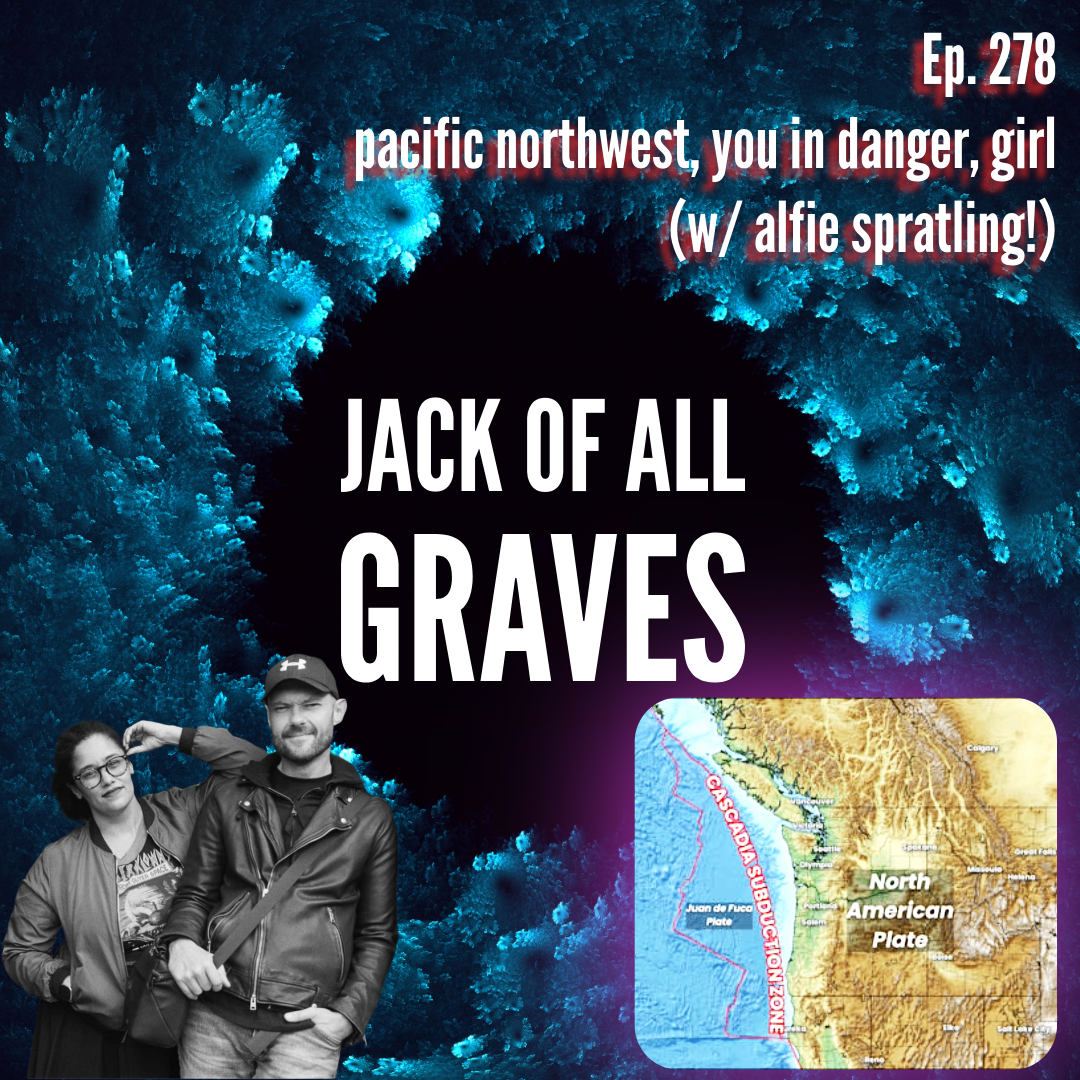
The Cascadia subduction zone is a megathrust fault that runs from North Vancouver island in Canada to Cape Mendocino in California and separates the Juan de Fuca plate from the North America plate.
The Juan de Fuca plate is moving towards the North America plate at a rate of about 4 cm per year, which causes it to subduct or go underneath the North America plate. It's literally like, you know, there was an article that was like, do this with your hands now, move them together, your arms, eventually it's going to go up your sleeve. Right? That's exactly what this plate is doing.
At a rate, like I said, of 4 cm per year.
As the Pacific Northwest Seismic Network explains, at depths shallower than around 30 km, the two plates of the CSZ are locked together by friction.
Strain or deformation slowly builds as the subduction force continues to act upon the locked plates. Once the fault's frictional strength is exceeded, the rocks slip past each other along the fault in a megathrust earthquake.
So geologist Chris Goldfinger from Oregon State University took samples of the seafloor because during subduction zone earthquakes, torrents of land rush off the continental slope, leaving a permanent deposit on the bottom of the ocean. And by counting the number and size of deposits in each sample, then comparing their extent and consistent extent and consistency along the length of the Cascadia subduction zone, he and his colleagues were able to determine how much of the zone has ruptured, how often and how drastically.
Subductions on mega megathrust faults, by the way, like the Cascadia, are the only faults that can produce an earthquake over 8.5 in magnitude on the Richter scale.
[00:20:42] Speaker C: So like with the maximum being 10,
[00:20:45] Speaker A: I think it's a 10.
I think if we ever get there, it is very rare. But I don't know if there's even been a 10. But yes, essentially like the, the fault that like we worried about when I was growing up in Northern California was like the San Andreas fault and that like is incapable of getting as strong as this one does. Also I was reading in another article that it was like these sound closer together than they are, but like each number on the like Richter scale is like 10 times force.
So like an 8 to a 9 isn't like a oop, it's like a huge amount more force than the one before it. So that's something to keep in mind with this as well.
So Goldfinger took samples of. Oh, I already put that on there, sorry. So in doing this he learned that the Pacific Northwest has had 41 subduction zone earthquakes in the past 10,000 years, which means one on average every 243 years.
Obviously that's a blink of an eye. Yeah, if this were a thing that happened in Florida for example, we could very well have had this happen twice since the Europeans settled here.
And certainly when they did arrive, the indigenous folks would have been like a FYI, a huge ass earthquake came through here a couple years ago, like and the land would have been destroyed. You'd be able to tell. Right.
And while Europeans popped through the Pacific Northwest from at least the 1500s, white folks didn't see settle there till the early 1800s when this would not have been the hot goss anymore. Also they had a terrible relationship with the indigenous people there, so they weren't really getting the lowdown from them as well.
If you're familiar with Oregon history, it became a whites only state very quickly in its foundation.
That's for another joag though.
So in the 326 years since that earthquake mind you, I just said 326 years since that earthquake, which operates on about a 243 year cycle. Right.
Since then, we have settled the out of the Pacific Northwest without any clue again till the late 1980s, that it was sitting on a subduction zone that sees catastrophic earthquakes and tsunamis semiquincentennially.
As such, we're looking at a place that is much closer to California, pre Loma Prieta than post, and that is looking at an earthquake that will be many times stronger than the Loma Prieta was.
Keep in mind the Loma Prieta caused big bridges to collapse and crush people to death.
As Goldfinger put it. Quote, the gap between what we know and what we should do about it is getting bigger and bigger and the action really needs to turn to responding, otherwise we're going to be hammered. I've been through one of these massive earthquakes in the most seismically prepared nation on Earth. He's referring to the one that happened in Japan.
If that was Portland, let's just say I would rather not be here.
[00:24:11] Speaker C: Super brief question, thinking out loud, there is this isn't in any way a kind of a human created state of affairs. No, this is just gonna happen anyway.
[00:24:24] Speaker A: This is going to happen.
[00:24:26] Speaker C: It's got nothing to do with us.
[00:24:27] Speaker A: Yeah, we cannot prevent it.
[00:24:29] Speaker B: Yeah, there's definitely things that are exacerbated by global warming and stuff or things
[00:24:34] Speaker A: like fracking and things like that.
[00:24:37] Speaker B: It's not that. It's not like if we stopped those things that it would fix the problem.
[00:24:41] Speaker A: Right.
[00:24:41] Speaker B: Kind of speeding it up a little bit.
[00:24:43] Speaker A: Yeah, precisely that. But yes, even if we weren't doing what we're doing, it would do this eventually.
[00:24:50] Speaker B: Yeah.
[00:24:51] Speaker C: Okay.
[00:24:53] Speaker A: So yeah, let's talk about why he would not want to be in Portland during this.
Like I said, we didn't know about these earthquakes to the late 80s, long after the Pacific Northwest started developing itself, cities and its suburbs.
And throughout the 20th century, quite frankly, the area was built up by rich assholes who didn't give a fuck about the people's safety anyway, namely the Rockefellers and the Guggenheims, among many others who happily poisoned entire populations with lead and arsenic, while the state of Washington cut corners on infrastructure, which led to multiple bridge collapses and hundreds of traffic deaths.
This is one of the many things from the book Murderland that I will revisit in later episodes. But suffice to say, infrastructure in the Pacific Northwest for many years could barely survive regular storms and occurrences and let alone a 19.9.0 earthquake.
And they most certainly haven't retrofitted everything en masse since then.
In fact, and this is crazy, I had to do multiple. I could not believe this was true and did this on multiple search engines. I did a search for articles about earthquake retrofitting of Portland buildings and two articles came up to one about urging homeowners to check for structural damage of their homes after an earthquake a few months ago.
And one from the Portland Mercury eight years ago saying, quote, city council begins planning for Portland's looming earthquake eight years ago.
[00:26:26] Speaker B: And then crickets.
[00:26:28] Speaker A: Crickets.
So then I went and I did a Google news search and I mostly found articles in the past few years with the Portland Council still debating how to approach retrofitting and priorities about retrofitting.
Let me remind you, retrofitting and upgrades from the Loma Prieta earthquake cost billions of dollars and went on for decades.
The time Joe started investing in this as many moons ago.
Not, not now. Certainly not. Still debating should we do this? Or anything of that nature.
Koin Coin, the local CBS affiliate for Portland, pointed out that some 1600 buildings in Portland are, quote, lacking the structural integrity that could hold up to a large earthquake.
City official Amit Kumar explained, quote, it's very expensive to go into an existing building and retrofit. It's probably simpler to build a new and maybe cheaper in some cases.
And as such, businesses have been pushing back against the city to avoid having to make the necessary changes.
[00:27:36] Speaker C: Yeah, that's so cool. That's. That's the best bit so far.
[00:27:39] Speaker A: Don't you love that? Right?
City council, hands tied because the businesses are like, we don't want to do that.
We're not, we're not interested.
As of 2023, only about 20% of at risk buildings had been even partially retrofitted.
Oregon had no seismic code until 1974, and most of the Pacific Northwest. Northwest didn't have one that could do anything in the face of a 9.0 earthquake until 1994.
Most buildings in the Pacific Northwest were built before that.
Ian Madden of the Oregon Department of Geology and Mineral industries estimates that 75% of all of the structures in the state of Oregon could not withstand a major Cascadia quake.
And FEMA estimates that around a million buildings in the Pacific Northwest, including 3,000 schools, will collapse or be compromised.
[00:28:45] Speaker B: I'm just like, oh my God. You have to just be, yeah, it's fine. No, it's not okay.
I literally don't even know how to react to it.
[00:28:56] Speaker A: It's just like, I know.
Okay. It's incredible, incredible stuff. And I'll go on because it gets worse. Of course.
Goldfinger is quoted in the article as saying that the images that will come out of Portland when the big one hits will be more akin to the earthquake, the earthquake that hit Syria, than the one that hit Japan, with people sifting through a sea of rubble, trying to find any survivors underneath it all.
According to the New Yorker, when the Cascadia earthquake hits, there will first be a compressional wave radiating outward from the fault line.
Now, in a place like Japan with early warning systems, this is actually a godsend.
This is not a dangerous thing in and of itself. Compressional waves are high frequency waves of the sort only dogs can hear and humans feel it as like a sudden jolt, just like, whoa, fuck, was that right?
Maybe a little startling, but no biggie.
It happens 30 to 90 seconds ahead of the larger seismic wave, which means that an early warning system can pick this up and trigger automatic functions that will save lives, like shutting down railways and power plants, opening elevators and firehouse doors, alerting hospitals to halt surgeries and triggering alarms that the general public can take cover.
It's a short amount of time, but when the region is prepared, it can react swiftly.
[00:30:25] Speaker C: Yep.
[00:30:26] Speaker A: I don't think it'll come as a surprise to either of you, given what I've said so far, that the Pacific Northwest does not have an early warning system.
As the New Yorker so eloquently and troublingly put it, quote, when the Cascadia earthquake begins, there will be instead a cacophony of barking dogs and a long, suspended. What was that moment before the surface waves arrive and then the shaking will start knocking. Go ahead.
[00:30:54] Speaker C: Fascinating to me. Right.
The only experience I've ever had in an earthquake was it was absolutely fascinating.
Thinking back on it, how the locals in the area, it was in the Philippines, and those who had been through it before, felt it a good 5, 10 seconds before me and my party did. Like, they literally stopped mid sentence and went, oh, there we go. And we had no clue what was happening.
[00:31:28] Speaker A: Yes. Yeah, absolutely. It's really interesting because.
[00:31:31] Speaker C: Didn't feel a thing. Untoward.
[00:31:33] Speaker A: Yeah, but if you're in a room full of people, there's always going to be one person who goes, is there an earthquake before? You know, like, yeah, 10, 15 seconds before it actually hits. It's like a standard thing. There's the one person like, hey.
And then all of a sudden you realize, oh, everything is shaking. What's going on here? So, yeah, that's exactly what it's like. And that is a good warning sign if it's going to be something huge.
[00:32:00] Speaker C: I did not. I had no clue that dogs would be able to pick it up.
[00:32:04] Speaker A: Oh, I mean, I've always had dogs. So yeah, Gaucho would go and like either bark at something or he would like get like really high alert. His tail would like stand straight up. So yeah, for sure you start hearing like the neighborhood dogs bark and whatnot as a result.
Yeah.
But let's see, where was I?
Okay, so they don't have an early warning system and you'll hear the dogs and people being like, what the fuck? And then the shaking will start knocking out the electrical grid everywhere west of the Cascade Mountains.
Everything made of glass will shatter.
Anything unsecured inside of houses will be thrown around.
Gas lines will be loosed. Starting fires. Houses will slide off their foundations or collapse.
90% of Oregon's liquid fuel electrical substations and natural gas terminals flow through a six mile hub in Portland, which would immediately suffer failures, breaches and spills In Seattle, where 15% of its buildings, including 17 daycares in the homes of somewhere around 35,000 people, is built on liquefiable land. Liquefaction from the quake will cause it, cause the ground to act like liquid.
And actually I'm going to put a little video in the chat for you guys of this and I would recommend muting it because the sound is really annoying. But maybe one of you can.
[00:33:34] Speaker C: Never in my years have I hear the term liquefiable land. Never in all of my years or even imagined that it would be a state of land, that it could be liquefiable.
[00:33:44] Speaker A: Not a thing you think about a lot.
[00:33:46] Speaker B: Is that the same area where it's like above the old city or is it in like different.
[00:33:52] Speaker A: This would be more a matter of like, it has to do with sand.
[00:33:56] Speaker B: Okay.
[00:33:57] Speaker A: That's like, kind of like under the surface between like the water. It's like groundwater and sand and it causes it to act like water. So if you click that for me and someone wants to describe what you see in that video, it's, it's pretty interesting. And it's, it's old, so it's a little, you know, fuzzy.
[00:34:19] Speaker B: Yeah. We have what appears to be a large building just scooting down.
Is that a river or.
[00:34:29] Speaker A: No, that's land.
[00:34:31] Speaker B: Land.
[00:34:31] Speaker A: Liquefiable land that is liquefied liquefacted land.
[00:34:35] Speaker B: Okay. So it's like, yeah, just like huge structures just literally scooting along the Ground.
[00:34:42] Speaker A: Yeah, like it were going down a river.
[00:34:45] Speaker B: That is terrifying.
[00:34:48] Speaker A: Right.
So like I said, 15% of Seattle, including 17 daycares and 35, 000 people's homes are on land that would do that in the case of this earthquake.
[00:35:01] Speaker C: And all of this talk of prevention. Right.
And bolstering safety measures and duck, cover and hold and whatever, it doesn't really matter.
[00:35:12] Speaker A: That's not. No, not if you're sitting on that, that's for sure. You just have to hope your ass doesn't fall on you if you're sitting on that land.
But we'll, we'll continue.
All of this is just the first stage right here. After that initial several minutes of collapsing, breaking, sliding and so on, comes the tsunami.
And it is, my friend, nearly impossible to survive a tsunami. Yeah, if you are present during one and you survive, you're pretty much just lucky.
The only thing you can do to make your survival more likely is to get to higher ground.
And for some people that will be basically impossible. For example, and I'm sure you've seen this, Alfie, because I'm pretty sure it comes up in that PBS video. But there's the town of Seaside. Have you ever been to Seaside?
[00:36:04] Speaker B: I've been through it. Yeah. On our way to Cannon beach in Astoria and stuff.
[00:36:10] Speaker C: Oh, there's an actual place called Seaside.
[00:36:12] Speaker A: It's called Seaside. That's the name of the town. It's.
You would love this place. It's like touristy. But if you go in like the off season, it's also very creepy.
Just like misty kind of a strip that almost looks abandoned in the off season. There's like a candy store there that's perpetually playing the Candyman song out of a crackly little speaker.
Yeah, like I said, Oregon, just a haunted ass place.
And this place is very, very spooky also, it is a death trap.
So as both the New Yorker article and like I said, the PBS video point out, the earthquake will immediately make the roads impassable in the seaside and residents will have to leave on foot to head for higher ground. But they'll have somewhere between 10 and 30 minutes to do this and they won't be able to grab anything to take with them. Hesitating to try to go grab stuff will likely mean death. You just have to fucking run for it.
[00:37:13] Speaker C: Sure.
[00:37:14] Speaker A: And even if they do get going fast enough in several areas, it's likely that there are things like a bridge that'll have collapsed that's in their way and they cannot get to higher ground. There's areas that are essentially like marshland. They will not be able to pass. They see. Simply physically will not be able to get to higher ground.
It's estimated that when this earthquake hits, 75% of the population of the town of Seaside will die due to inability to reach higher ground when the tsunami hits. Yeah, 75% also.
[00:37:46] Speaker B: It's like a lot of, like, old people, I feel like, that kind of live because it's a bit more expensive. And so it's like a lot of retirees and things. And so that also makes it feel like they're not going to be like they're not going.
[00:38:00] Speaker A: You know, I will get old people.
[00:38:02] Speaker C: Disabled folks.
[00:38:04] Speaker A: Yes.
[00:38:04] Speaker C: Kids.
[00:38:05] Speaker A: Yes, kids. All three of these things, my friends, I will get to. Because you are correct. Correct.
[00:38:12] Speaker B: Yeah. In Cannon beach, too. Like, it's spooky driving through because every so often you'll pass a sign that says you are above the above.
Now you're below the tsunami danger zone or whatever.
But it's like, it's like up and down driving.
[00:38:28] Speaker A: Right. And it is estimated because of the way Canyon beach is set up, actually, that 90% of Cannon beach will likely survive and 10% will die. So that's still a lot. But it's better than Seaside. Yeah.
[00:38:41] Speaker B: That's insane. I had no idea it was that bad.
[00:38:44] Speaker A: Yeah.
[00:38:45] Speaker B: Over there.
[00:38:45] Speaker A: Pretty terrible.
And to the points that you both are making. Well, it's been illegal since 1995 to build hospitals, firehouses and police stations in tsunami inundation zones. If a building was already there there, it's grandfathered in and can stay further. It's only those structures I just named that you can't build in those areas. So hotels, retirement homes, energy facilities and businesses are all fair game.
Unlike your library, Alfie, businesses and hotels are not legally required to provide evacuation training to employees or to post evacuation routes for customers.
Right.
That's madness.
Right.
Like, everywhere you go normally has, like, little, like, fire, you know, map or things like that. They don't have to have anything like that.
[00:39:36] Speaker B: For tsunami evacuation, our infrastructure out here is arable.
[00:39:43] Speaker A: Read Murderland.
[00:39:44] Speaker C: Nationwide or specifically?
[00:39:47] Speaker A: Yeah, like everywhere.
Very much worse in that area than a lot of other places. It's not great. You won't write home about American infrastructure in general, but very much in that area.
So all of this pretty much guarantees that a good chunk of the people in the inundation zone will die.
22% of Oregon's coastal population is over 65 and 29% of the state's population is disabled.
And as you know, one official put it frankly in one of the articles I read, they will not be saved. We will not go looking for them.
[00:40:27] Speaker C: Yeah.
[00:40:27] Speaker A: He was like, I don't want to sugarcoat it. They're just gonna die. That's it.
Tourists also will be left to die.
You will be able to see the destruction from the International Space Station as all the structures in the inundation zone from Northern California to Canada will be wiped off the map.
If this happens in the off season, say, February, as researchers have based their models off of, it's expected that some 13,000 will die, 27,000 will be injured, and millions will be displaced.
That's the best case scenario here.
If it's summer, when the beaches and coastal cities are filled with tourists, those numbers will be much, much higher.
And unlike the Bay Area, there's no resiliency plan built into the Pacific Northwest. It will take months to restore power, months to a year to restore drinking water and sewer service, up to a year to restore major highways, and a year and a half to get health care facilities up and running.
And this is just in the areas not in the tsunami in inundation zone. Those areas will likely be in inhabit uninhabitable for years.
[00:41:43] Speaker B: If they're even still there.
[00:41:44] Speaker C: Right.
[00:41:45] Speaker A: Like there's. Right.
[00:41:46] Speaker B: They're gonna be underwater forever now.
[00:41:48] Speaker A: Yeah, it's just gonna be gone.
[00:41:50] Speaker C: As in literally underwater?
[00:41:51] Speaker A: As in literally underwater, yeah.
[00:41:53] Speaker B: They have mapped out, like, where they believe there will be islands after this that have been created that were used to be part of the mainland but aren't anymore.
[00:42:01] Speaker A: Yeah.
[00:42:03] Speaker C: Apologies if I missed it. When was the last one of these?
[00:42:06] Speaker A: It was 1700.
[00:42:08] Speaker C: Okay.
[00:42:09] Speaker A: Yeah.
So the people of the Pacific north west, like I said, simply aren't stressed off, stressed enough about this.
Despite there being a one in three chance that this will happen in the next 50 years.
Seaside Superintendent. Oh, and this is. This will make you mad because this is crazy. Seaside superintendent of schools.
I.
No, no, I wrote his name wrong.
And I don't know if his name was Doug or I just wrote it entirely wrong because I wrote. Sorry, Doe Doherty.
Doe. D O U G H. That is certainly not his name.
I'm gonna say it's Doug, but it might be Tom. I don't know. Mr. Dougherty said that in 2009, he proposed building a new K through 12 campus outside of the inundation zone, as four out of five of the town school will be toast. Where they sit, they're like 5 to 10ft above sea level. They're fucking gone.
It would have cost $128 million, requiring a tax increase of $2.16 per thousand dollars of property value.
62% of residents voted against it, and it did not pass. Of course, they'd rather take their chances that the death of Seaside's children will happen after theirs have graduated than pay to make sure no one's kids die.
So while cities try to encourage the retrofitting of homes and buildings, they're not investing the massive amounts of money necessary to prevent total disaster.
And while the quake may happen tomorrow or a hundred years from now, the way things are going, the people of the Pacific Northwest are going to have a very bad time because no one is doing anything to prevent it.
[00:44:06] Speaker B: Hooray. Yay.
[00:44:09] Speaker A: I chose to live here, live there.
[00:44:13] Speaker C: Yay.
[00:44:14] Speaker A: I mean, it's.
It's one of those things where it's like, you read about and you're just like, what? I mean, obviously the thing that needs to be done is like, emphasizing to these, like, board, city officials, all that kind of stuff that, like, this is not. You need to fucking do something. We need to invest in this infrastructure because we're all going to die.
But it's the idea of something that you have, like a 1 in 3 chance, which is high, and such a
[00:44:42] Speaker C: huge percentage of going nana. Yeah.
[00:44:44] Speaker A: Right. Like, they're literally like, the businesses are going, like, now. Take my chances, you know, Like, I think one in three is a huge amount, but people don't process it that way.
But that this will happen, you know, 30% chance or whatever, that in 50 years, within the next 50 years, this will happen. Feels so abstract.
[00:45:04] Speaker C: But isn't that just exactly the thing, though? Isn't that just the thing about.
[00:45:09] Speaker A: Sure.
[00:45:10] Speaker C: Punting it down the road until you're either on fire or underwater or there's a fucking building falling on your head, or you've been.
[00:45:18] Speaker A: Right. And just hoping you've kicked it down the road and it happens be to. To someone else and not you.
[00:45:22] Speaker C: That ain't that just exactly it, though.
[00:45:25] Speaker A: Right. And I think that's the thing that it makes it hard to, like, organize around something like this because it just does not feel imminent. Yeah. To people.
[00:45:35] Speaker B: And I. I would say that that's probably partially due to just the way that our government, like, talks about it. A lot of the. Of being prepared is placed on the individual.
[00:45:46] Speaker A: It is.
[00:45:47] Speaker B: Which I think obviously it is smart and good to always have a plan.
[00:45:51] Speaker C: Right.
[00:45:52] Speaker B: But when you're telling people, every household needs to have this amount of, like, Preparedness, like, they. They say we should have two weeks of water, food for every individual in the house.
And it's like, I'm looking around my teeny, tiny apartment and being like, where do I go?
[00:46:08] Speaker A: Yeah, where do I put that?
[00:46:10] Speaker B: And if I have it stored here and I have to evacuate, because I will have to get out of. My building was built in 92, so it's right before, but yeah, in the best. So. And we're also above marshland. So if I'm in this building and I don't get out, I'm going down.
[00:46:28] Speaker A: That's liquefied.
[00:46:29] Speaker C: Liquefied. Liquefied land.
[00:46:31] Speaker B: Yeah.
So, I mean, even just outside sometimes after a heavy rain, I will not walk Salem in certain areas of our complex, because you just sink right into the ground.
[00:46:43] Speaker A: Yeah. This is.
[00:46:44] Speaker B: I mean, like, I think that there needs to be localized places that are stocking up these materials so that people who don't have the means to do it for themselves can hopefully get to that place rather than it being like you're on your own.
[00:47:02] Speaker A: Well, like, so there is. There's an indigenous group that.
It's not in the PBS video that I was talking about, but it's in a different PBS video they have, like, built. And there's a couple of others of these. But this specifically, they've built, like, a tower. Yes, essentially.
And that tower is built above to, like, you know, be able to withstand a tsunami and be high up and be a place that people can go, and that has stores of, you know, like MREs, water, things like that.
And it costs, like, about a tower. Yeah, it's a tsunami tower.
[00:47:38] Speaker B: Really interesting. You should look at pictures of them. Yeah, they. They have. Yeah, there's a handful already built and there's plans.
[00:47:43] Speaker A: Yeah, there's some in Oregon.
[00:47:45] Speaker B: It's not going to be enough.
[00:47:47] Speaker A: They're. Yeah, they're about 4 million to make a tsunami tower. And obviously, no one wants to pay for that kind of structure. And so it's really like, that's one of the things, again, they tried to do in Seaside, but just haven't had, like, the political and social will to actively do it, you know, so if they put something like that and you could save the population.
[00:48:11] Speaker C: But I'm not being washed out to see now, am I right? Why would I want to pay for it now? Yeah. I'm not on fire today.
[00:48:17] Speaker B: You know, they. They only summer there, and they're Right. Yeah.
That I only live in part of the year.
[00:48:24] Speaker A: Right. I don't care about their Kids. Yeah, right. Yeah. There's a lot of issues like that in this. And it's. It's, again, like you said, Alfie, you know, the Pacific Northwest in general infrastructurally is. And there's a lot of corporate greed behind why it was built that way, along with kind of governmental essentially, like, you know, the government saying you only have both federal and state being, like, you only have X amount to build this thing, so work within that budget
[00:48:53] Speaker B: and then building terrible structures in their own vacations. Right.
So, yeah, like, yeah, it's.
[00:49:02] Speaker A: It's just a whole bunch of terrible things coming together to make this, like, a wildly unsafe place. Like I said, you know, it may happen tomorrow, it may happen 100 years ago, but it is a when.
It's a not an if situation.
And, you know, yeah, kicking it down the line is, you know, not smart.
[00:49:25] Speaker C: I like that. Well, I say, like. Like is obviously the wrong word, but it's sort of grimly hilarious to me that there is calamity waiting for humans that is entirely not of our doing.
[00:49:44] Speaker A: Right. It's not our fault. This one isn't that interesting. Yeah, we're doing plenty of things to destroy the planet, but this one is just the planet every now and again trying to kick us.
[00:49:55] Speaker C: You're not safe. You're not safe. How many times have I got to tell you?
[00:49:59] Speaker A: It's tattooed on me now.
[00:50:01] Speaker C: You're not safe if it's an earthquake. If the earthquake don't get you, the asteroid will. And if the asteroid doesn't, then the climate will. And if the climate doesn't, then cancer will. You're not safe.
[00:50:13] Speaker A: Interesting order that you put.
[00:50:15] Speaker C: An embolism.
[00:50:16] Speaker A: Yes.
[00:50:17] Speaker C: Or a bear. You know what I mean? You're not at any point.
Relax.
[00:50:22] Speaker A: Komodo, Dragon, Rogue.
[00:50:23] Speaker C: Well, not me.
[00:50:24] Speaker A: Couldn't be me. Built different.
[00:50:27] Speaker C: Built different.
Let me quote directly from my notes, if I may.
[00:50:33] Speaker A: Yes, please do.
[00:50:35] Speaker C: Look at these nerds. Oh, mise en scene.
[00:50:38] Speaker A: I don't think anyone has ever said mise en scene in such a horny way before.
[00:50:42] Speaker C: The way I whispered the word sex.
[00:50:44] Speaker A: Cannibal received worst comes to worst. Mark, I'm willing to guillotine you for science.
[00:50:49] Speaker C: Thank you. That's really, really sweet. It's cold outside, but my pancreas is talking to me. I'm. I'm gonna let it.
[00:50:55] Speaker A: You know how I feel about that, Mark?
[00:50:57] Speaker C: I think you feel great about it.
Listeners, and I'll just bring us in.
[00:51:03] Speaker A: Okay. Yeah, go for it.
Yeah, take us there.
[00:51:07] Speaker C: Obviously, you know, it's a new week. It's a new episode. Delighted, delighted. Well, after Martin with us. Delighted, delighted.
[00:51:15] Speaker A: This, it's sprattling. Yes.
[00:51:17] Speaker C: I'm looking at your surname there.
[00:51:19] Speaker B: That's okay. Yeah. No, my, this zoom is through my school account and it has to be.
[00:51:23] Speaker A: Yeah, automatically.
Yes.
[00:51:25] Speaker C: I knew that didn't sound right. It didn't sound right in the mouth.
But look, if you are, if you are, if you are comfortable in any way, can you not be.
If you are kind of relaxed or, you know, just chilled and comfortable in the fact that you woke up this morning and you're assuming you will tomorrow, we are here to maybe challenge that a little because there are so many.
[00:51:49] Speaker A: The.
[00:51:50] Speaker C: The list goes on and on and on of reasons why your thus far unbroken streak of waking up tomorrow should not be taken for granted. Do not get comfortable with it. It's a nice to have. Right.
[00:52:07] Speaker A: It's true.
[00:52:07] Speaker C: And we're here week in, week out telling you to take steps. Right?
Take action.
Prepare yourself. Protect yourself against everything.
That's the only thing.
[00:52:24] Speaker A: Like clear from Final Destination.
[00:52:27] Speaker C: That's the only thing you can do, is lock your doors.
But that won't help.
Well, exercise more and improve your diet. That won't help either.
[00:52:39] Speaker A: No.
[00:52:41] Speaker C: Arm yourself and train yourself, which won't help.
Go nowhere.
Stop breathing and coming into contact with pathogens. But that won't help either.
Be suspicious of others. Won't help you. Do you see what I'm saying?
[00:53:03] Speaker A: Not safe, I say. Yeah, I'm getting where you're going.
[00:53:07] Speaker B: It's all matter of how much further, incrementally. Can I make it?
[00:53:13] Speaker C: Yeah, yeah.
[00:53:14] Speaker A: You don't know.
[00:53:15] Speaker C: So right.
[00:53:16] Speaker B: Can I, can I prolong it a little bit by doing this?
[00:53:20] Speaker C: You're so right. At this point, if it hasn't become clear to you by now, it should be that this is a day by day thing, right?
[00:53:29] Speaker A: Yes.
[00:53:30] Speaker C: Success is survival.
That's all.
And if you're listening to this episode, congratulations, you've succeeded today so far.
[00:53:44] Speaker A: Nicely done so far.
Yeah. You know, hey, on that note, I think a sad shout out to my man, the butcher from aew who did not wake up today, unfortunately.
[00:54:00] Speaker C: Do you like the wrestling, Alfie? Do you like the wrestling?
[00:54:03] Speaker B: I do. I am not as caught up on all of it as. As you guys are, I don't think. But yeah, Steven has definitely gotten me into it and I very much enjoy the wrestling.
[00:54:15] Speaker C: So fucking rough. So rough.
I posted about him earlier on and I had, I've had at least, at least a couple of messages from people who are like, fucking hell. I did not know he was also a wrest.
[00:54:27] Speaker A: Yes. More famous, I suppose, for being the guitarist of Every Time I Die. Every Time I Die. I was like, as I lay dying. That's the wrong one. Every Time I Die.
Yeah. But also a wrestler who came into it late for the love of the game, you know, a thing he did not need to do for money or anything like that. He just fucking loved wrestling and was like, that's my second career.
[00:54:50] Speaker C: Great at it, right?
[00:54:53] Speaker A: Yes.
[00:54:53] Speaker C: And this isn't just. I'm not jumping on shit here. I have publicly spoken plenty of times about how fucking much I love the Butcher. He was great.
[00:55:01] Speaker A: Well, and you know, like as soon as they left aew the Butcher and the Blade and the Bunny, when she left as well, I was like devastated. I just sent you like a link.
[00:55:11] Speaker C: Like, no, fantastic, self aware retro vintage. No gimmick. Just a tough, giant, mean, great look. Great gimmick, great skill set. Tough as fuck. Believable, dependable.
Just a solid professional wrestling guy, man. And.
[00:55:32] Speaker A: And from all reports, the exact opposite of his Persona in real life. Just the biggest teddy bear who everyone loved.
Sweet. Everyone talks about how sweet he was, how kind he was, how he could hold a room with a story, you know, just a big loss. And in front of a crowd on top of.
[00:55:52] Speaker B: That's what me.
[00:55:53] Speaker A: Yeah.
[00:55:54] Speaker B: Not even knowing anything about that story. That's.
[00:55:57] Speaker A: Yeah, that's traumatic for everybody involved that. In front of a crowd, in front of his best friend, you know, just like a truly horrible situation.
So the world lost a real one with the Butcher on, on this topic.
[00:56:15] Speaker C: Right. Because I. I didn't really talk much about all in on Tuesday when we recorded.
[00:56:21] Speaker A: No, you didn't.
[00:56:23] Speaker C: Right.
It's been such a quick week. There's a specific moment I meant to talk to you about on Tuesday, but it. But I. But I forgot. Right.
[00:56:31] Speaker A: All right.
[00:56:32] Speaker C: What a great day for a start.
[00:56:34] Speaker A: Right.
[00:56:34] Speaker C: Just one of the best days.
[00:56:36] Speaker A: And this is a big AEW pay
[00:56:39] Speaker C: per view in biggest show, their biggest show of the year. It was in London, 50 odd thousand people. It was just wonderful. I was delighted. On Friday Owen went back to school, right.
And he was telling me that, you know, he's 12 and they, you know, they did a little thing about what was my favorite bits of the summer holiday. And he said Olim was his favorite bit, the summer holiday. And I just could have died. It was beautiful.
[00:56:59] Speaker A: So sweet.
[00:57:00] Speaker C: There was one such an incredible moment.
It was during Kenny Omega's Coming out right of the.
[00:57:08] Speaker B: Of the.
[00:57:08] Speaker C: Of the backstage and towards the ring or whatever.
And I literally, like, literally, in a physical way, physically, literally felt the sensation of depression leaving my body for a few minutes.
It was fucking mad, Corrie.
[00:57:27] Speaker A: Love that.
[00:57:28] Speaker C: It was nuts. I like, almost sort of sat up and. And noticed it happened. Holy. Depression just left my body. That's wild.
Obviously, it settles back in.
[00:57:40] Speaker A: Well, sure.
[00:57:42] Speaker C: It was like a physical. Like something exited me during his music and walk out. It was. It was magical.
[00:57:51] Speaker A: That is a wild feeling.
[00:57:54] Speaker C: It was magical. It was like something like, you know when your back clicks, Right?
[00:58:00] Speaker A: Yeah.
[00:58:00] Speaker C: Or like when you crack a knuckle or your neck and you're like, whoa.
[00:58:05] Speaker A: Yeah, like, oh, I didn't. I didn't even know I was tense. And then I popped it and then. Holy. It's a new world.
[00:58:12] Speaker C: It was both physically and mentally noticeable. Just everything clicked and it's like, my God, I feel this. I feel amazing.
[00:58:20] Speaker B: And then life is worth living.
[00:58:22] Speaker C: Yes, it's exactly that. Exactly that. Exactly that.
But which is to say, yes, we lost a real one.
[00:58:28] Speaker A: Andy,
[00:58:30] Speaker C: guns up here.
[00:58:32] Speaker A: Here.
What else?
Alfie, we're just glad. Glad to have you here. Listen, I think there's a thing that we have to.
[00:58:42] Speaker C: Class, just super briefly, because it's gonna bug me if I don't.
[00:58:45] Speaker A: Yeah.
[00:58:45] Speaker C: Alfie, over your left shoulder.
What is the poster by the door? It's kind of obscured by your mic, and I'd love to know what it is.
[00:58:55] Speaker B: It is her hellfest, which is a movie that's not that good.
[00:59:00] Speaker A: I just had a good poster.
[00:59:02] Speaker B: It has a awesome poster.
And I actually do enjoy it for how bad it is. To me, it's kind of like a trasher piece type of situation.
[00:59:12] Speaker A: I think I liked that one for. I think the same, like, reason. Not like, oh, this is a really good movie. But like, yeah, this is fun.
[00:59:21] Speaker B: Yeah, yeah, yeah. It's kind of a slasher. It's a Halloween movie, which always makes anything better, right?
[00:59:26] Speaker A: Yeah, true.
[00:59:27] Speaker B: Yeah. But, yeah, it's got a really sick ass poster.
[00:59:31] Speaker A: I was gonna say one thing that we. We should address is familiar voice, unfamiliar name. But this requires a shift because we have been calling marathoning movies by your old name. Yeah. Until this year.
[00:59:49] Speaker C: We do have to update that, don't we?
[00:59:51] Speaker A: And you're like, maybe, maybe not.
[00:59:55] Speaker B: Continue what you were gonna say.
[00:59:56] Speaker A: Well, I was gonna say, like, obviously, Alfie Spratlinging doesn't exactly roll off the tongue, but a thing I had, you know, mentioned to a few other people in the. In the screaming chat was that your username is Ango mcdango, and that angle mcdango ing does, in fact, roll off the tongue.
So, you know, that is my proposal as a.
You know, as a substitution, but it's very much up to you.
[01:00:24] Speaker B: My. My. My reason why I don't think that would work is because it's not original to me.
I took it from another podcast that I love dearly, the Adventure Zone.
[01:00:36] Speaker A: Oh, okay.
[01:00:36] Speaker B: And there's a character named Angus McDonald, and so fans call. Yeah, I guess at some point they called him Ango in the show, and so people called him Ango McDango. So.
[01:00:46] Speaker A: Okay, that's fair. That's fair.
[01:00:48] Speaker B: That would be cute, though. But I don't necessarily mind if it is. If it continues to be Anna Martining, because to me, it feels like lore, like backstory.
[01:01:02] Speaker A: Yes, that's a good point.
[01:01:04] Speaker B: I'm fine with that. I don't have. I don't have the same connection or disconnection, I guess, to my old name. That's. That A lot of trans people do.
[01:01:13] Speaker A: Yeah.
[01:01:13] Speaker B: For me, I didn't ever hate it. I just. It didn't feel like your name, and so I don't. I don't feel bad hearing it by any means.
So I am fine. If you continue to refer to that as Anna Martining, and all right, the
[01:01:30] Speaker A: lore persists, then it shall continue to be henceforth Anna Martining.
[01:01:35] Speaker B: Hell, yeah.
[01:01:37] Speaker A: But it is lovely to see you. It's been a minute since we have had you here, so it is glorious to get you here.
[01:01:43] Speaker C: Good to see you. Great to hear you. Yeah.
[01:01:45] Speaker B: I was so stoked when you asked if I wanted to pop in for that.
[01:01:49] Speaker A: I know. I was so happy about that too. Yeah. You're like, yes, I'm in. I was like, yeah, let's go.
Immediately texted Marco, who did not respond because I texted him in the middle of the night, and he ignores my text messages in the morning, so I wasn't even sure if. If he knew you were coming, to be honest.
Well, it did.
Oh, good.
[01:02:10] Speaker B: Yay.
[01:02:11] Speaker A: You didn't sound surprised when I mentioned it today, so I figured you must have.
[01:02:15] Speaker C: Yeah.
[01:02:16] Speaker A: Read it. Or you were just playing along.
[01:02:19] Speaker C: I don't ignore your text messages.
[01:02:22] Speaker A: You don't acknowledge my text messages in the morning.
[01:02:25] Speaker C: Sleep Corrigan.
[01:02:27] Speaker A: Not when you read them.
[01:02:31] Speaker C: No. That's true.
Let's just not. Let's not.
[01:02:38] Speaker A: I think we've. We've discussed this before. That. Yeah. You. You just don't acknowledge my text messages in the morning. So I'm never sure whether you got them, but you did, and we're happy that you're here.
I don't think we have much to update on before we get into other things. I did send out. All mailers from me are out, so check your mail and whatnot in the next, you know, week or so. I don't know how long. Sometimes things get to the UK quicker than they get to the United States.
It's always surprising. Yeah. It'll be like infrastructure.
Exactly what we were talking about. It'll be like someone in the UK is like, oh, I got it. And then like a week later, Ryan's like, I got my thing. I'm like, how?
[01:03:19] Speaker C: And the.
[01:03:20] Speaker B: Right next to each other.
[01:03:21] Speaker A: Yeah.
[01:03:22] Speaker C: Second bunch will be coming this week at some point.
[01:03:25] Speaker A: Yes. Mark is on that. Oh, but speaking of things from Ryan and the Post, Marco, you do have a little update.
[01:03:35] Speaker C: Listen.
Only that I.
It's hard to articulate. How fun and just uplifting.
The size of the fucking horror fiction care drop I received from Ryan at Gibson's Books was this week.
[01:04:00] Speaker A: What did you. What did you call it in New England? In Concord, New England.
[01:04:04] Speaker C: Their own website called it Concord, New England. That's where it is, according to them. Directly from the state of New England. The state.
Is that not correct? Is that not.
[01:04:15] Speaker A: It is not correct. No. It's in New Hampshire.
[01:04:17] Speaker C: Look. What are they not New England.
Hampshire's in England.
[01:04:21] Speaker A: New England's a region that's comprised of six different states.
[01:04:25] Speaker B: Like the Pacific Northwest.
[01:04:27] Speaker A: Like the Pacific Northwest, exactly.
[01:04:29] Speaker C: Oh, I see.
[01:04:30] Speaker A: Yeah.
[01:04:30] Speaker B: And stuff. Yeah.
[01:04:32] Speaker C: But.
[01:04:32] Speaker A: Go on.
[01:04:33] Speaker C: But huge.
[01:04:34] Speaker A: Did you count how many books were in there? Do you know how many there were?
[01:04:36] Speaker C: I don't. Impossible. Impossible to. Books without number every.
[01:04:41] Speaker A: When you pull them out of the box, they just. Yeah.
[01:04:43] Speaker C: Impossible to quantify the number of books here. Just impossible to do it.
But I've already. I've ripped into him.
[01:04:55] Speaker A: Yeah.
[01:04:57] Speaker C: Day. Clay McCloud Chapman, I believe.
[01:04:59] Speaker A: Yeah. Who I love.
First.
[01:05:01] Speaker C: First one of his I've ever read.
[01:05:03] Speaker A: Yes.
[01:05:04] Speaker C: Well, Kill your darling. And it was grim and it was grief sodden.
[01:05:09] Speaker A: Yeah. He does that well.
[01:05:11] Speaker C: Ah.
So grim but evocative and just beautiful. To unlike you with your Aphantasia, you know.
[01:05:23] Speaker A: Yep.
[01:05:24] Speaker C: It was a movie in my head. Was fantastic.
I had Jeff Bridges as the lead actor.
[01:05:31] Speaker A: Oh, interesting.
[01:05:32] Speaker C: Just immediately this guy was Jeff Bridges.
[01:05:34] Speaker A: Okay.
[01:05:35] Speaker C: What do you think of that? Isn't that strange?
[01:05:37] Speaker A: I don't. I haven't read it yet, so maybe that's what'll Pop into my head too.
[01:05:41] Speaker C: If I read it in the day, you'll polish it off in the morning.
So great. And I'm immediately onto the next and I think I'm. I'm like a pig in with this box of books, let me tell you. Rolling around, just loving it.
Chomping on a turnip.
[01:06:00] Speaker A: Oh, man.
So shout out to Ryan and Gibson's bookstore for that.
[01:06:05] Speaker C: You're the best, Ryan.
[01:06:07] Speaker A: I just got two of the books that I ordered from their sale, their annual sale in and then I have two that are pre ordered that'll come at the end of September. So I'm stoked on that. But I've also, you know, kind of following in the footsteps of your book era, Marco. I noticed that in August I felt like I was on my phone a lot, you know, and I don't do like the tiktoks or like the Reels or anything like that, you know, I'm not like, like I'm not really doing anything more than like stuff or whatever.
[01:06:34] Speaker C: I'm going to tell you something. Do you want me to tell you something?
[01:06:38] Speaker B: You're gonna allow me to tell you
[01:06:41] Speaker C: something, if I may. I'm gonna let you finish, but I gotta tell you something.
[01:06:44] Speaker A: Yeah, go on.
[01:06:46] Speaker C: Recently, as part of my job, right, I've become privy to a lot of polling and insight from the UK population. Right.
[01:06:58] Speaker A: Okay.
[01:06:59] Speaker C: Right. I don't have the exact numbers in front of me, but compared to five years ago, the number of people who spend more than four hours per day on their phone is wildly higher.
[01:07:11] Speaker A: Right, Yeah, I can imagine.
[01:07:13] Speaker C: At the same time, the number of people who believe that time online contributes nothing to their lives is also massively.
Yeah, loads of people are spending more time on their device knowing full well it is contributing all to their life. Isn't that amazing?
[01:07:31] Speaker B: I think that's like, it's so clearly in the camp of addiction at that
[01:07:35] Speaker A: point, you know, like, absolutely.
[01:07:38] Speaker B: I had to put a timer on my Instagram that would tell me, you've been on here for an hour, you should get off.
[01:07:46] Speaker A: Get the fuck off of here.
[01:07:47] Speaker B: It has helped. It really has.
[01:07:48] Speaker A: It's. I think those things are so valuable. And like it was funny because my friend Melanie, she texted me and she was like, I was on, like I was on reels and tik tok for like four hours straight yesterday.
And like, Mark, you were like, yeah, I am struggling with the screen addiction and I just, I don't even use those things. But it's just like there's lots you just End up clicking around things, looking at stuff, whatever. And I was like, I need to not.
And so I was like, the normal times when I would be like, either like, scrolling or just like watching tv, like Good Morning America, stuff like that, I was like, I'm gonna read instead. And so we're. It's September 6th and I finished four books already and have been like, just, yeah, Pig and shit. Marco. Having a great time.
[01:08:39] Speaker C: Yeah.
[01:08:39] Speaker A: Reading the books that like, I told myself like two months ago, I said this to the book club that I was like, I can't. I've banned myself from taking anything out of the library until I read at least five of my own books.
Like, I can't. I have to put myself on timeout. I, I take out too many books. And so I've been like, trying to now, like, read books that I own.
[01:08:59] Speaker C: It's horrible, isn't it?
What are they done to us, man? It's terrible.
[01:09:08] Speaker A: But, yeah, so all that to say zone as well right now, which feels really.
[01:09:13] Speaker C: And there's AI as well. It's terrible, isn't it?
[01:09:17] Speaker A: It's terrible. But I mean, the recognition from people I think is interesting that like, yeah, there's, there's got to be a breaking point in a sense to that, right? Like, of like, I, this is making me miserable.
[01:09:31] Speaker B: Maybe an earthquake will happen and we will have the liquefied land.
[01:09:36] Speaker A: It'll be station 11 or whatever.
Just people vibing, living in the moment
[01:09:43] Speaker B: in an apocalyptic scenario.
Not a cell phone in sight, much like the climate.
[01:09:50] Speaker C: You know, again, a big characteristic for me of as we all move into the final years of civilization and humanity is that every single bit of it, I, I, we all saw coming, man, nobody can tell us that we didn't see it coming because we did. We all did.
Well, I've come to start to think about humanity in the past tense. Do you notice that? Yeah, I think I say did because I think it's already happened. It's already too late.
[01:10:20] Speaker A: Well, yeah, this is where we part ways a little bit.
[01:10:23] Speaker B: It's like a crazy time to be alive. It is like, I think about like, like the worst throes of, of climate change and living through a global pandemic. And then like, people in my area are like, in imminent it like, I'm just like, why did I have to exist here in this time? But at the same time, it's like,
[01:10:44] Speaker A: but like there's not really like a better time.
[01:10:46] Speaker B: Exactly.
[01:10:47] Speaker A: Socially. Yeah.
[01:10:48] Speaker B: I could have died of typhoid, Right? Yeah. Another era.
[01:10:52] Speaker A: So it's like, you know, you're living in the end of the world, but at least like, you know, there's some nice things about it, which is I
[01:11:00] Speaker B: know cool people that live at this time. So.
[01:11:02] Speaker A: Yeah.
[01:11:03] Speaker C: But I will say from other parts of the world, you know, the world is smaller in many ways.
[01:11:09] Speaker A: We are sitting. I am 3,000 miles from Mark and you are 3,000 miles from me, Alfie.
And we're all just like sitting here shooting the shit. Yeah, like that's, that's pretty cool.
[01:11:19] Speaker B: Yeah. Without the Internet I never would have met you guys.
[01:11:22] Speaker A: Right?
[01:11:23] Speaker C: Great, great.
[01:11:24] Speaker A: Hell yeah, there's all of that. But I will say reading Murderland, which is a really fun, far reaching book, you know, it's sort of the like main kind of thesis of this is about chemicals like lead and arsenic and cadmium and things like that and the impact that they had on crime in the, you know, 60s, 70s, 80s, 90s. And the way that like basically once we removed those things from our day to day lives, the curve drops with it. Of course, crime, especially violent crime, basically everywhere that that happened. And, and she kind of like this is a thing that I've. I talked about years ago that scientists, sociologists have been looking at for decades now.
But she also then kind of uses like these like specific cases to show all of this. But the other thing that this book does, one of the many things that it does is then also talk about like the corporate greed that is responsible for all this. That's also responsible for things like the infrastructure problems in the Pacific Northwest. That's responsible for kind of all of the webs of problems that we have specifically in the United States. But it applies around the world. Like we can trace so much ill in this. She's talking about the Rockefellers and the Guggenheims, but you can also include, you know, the Asters. You can talk about the, the.
What are the, those fucking guys.
My brain has. Oh, the Duponts, you know, these like families, right. That like in the early days the United States had all of this money and used it to just be evil, to make more and more money at the expense of everybody else. And then they put their names on philanthropic things like museums or whatever, and that's all we think of them for instead of the way they've been killing us systematically for generations.
But the thing that struck me in all of this is that a lot of times we talk about like how hard it would be to change anything, right? And when you read about, how about all of this, you realize like it's it's not that hard. We, we have the solution and is basically dismantle all of that.
The billionaires are the problem. You take them out of the equation and you fix everything.
You know, you can then take the toxicity out. Because the only reason that all of this stuff happens is because they can buy politicians and they can pay off things and like you know, just money talks.
And so it's so frustratingly simple, you
[01:14:04] Speaker C: know, like again, you know, don't ever, ever anybody tell me that we weren't warned and didn't see it coming. Right. There is an economist that we have over here in the uk, a guy by the name of Gary St. Stevenson and he's an influencer, he's a YouTuber, he was a, an ex market trader, not like as in the bonds and stocks market.
And it talks a great deal about his, he's, he's, he was a very, very successful market trader. Right. Super, super successful on the bonds market and is a self styled kind of futurologist, Very, very good at predicting economic trends in the future and talks a lot about exponential wealth growth among the already super rich.
[01:14:54] Speaker A: Right.
[01:14:56] Speaker C: As in when you've got such a tiny percentage with such a colossal majority of all the wealth, the only thing left for these people to buy is assets which then prices working class people out of property, out of service, access out of anything that, that is a, a marker of a healthy economy.
[01:15:19] Speaker A: Yes.
[01:15:20] Speaker C: And that is a pathway towards quickening societal collapse.
[01:15:26] Speaker A: And that is exactly what we see
[01:15:28] Speaker B: I I contributing to our homeless epidemic. Everything.
[01:15:32] Speaker A: Yeah, when I look at, I said to someone recently, it's like if you want to like radicalize someone really quickly, two things are give them Murderland and give them the recent last podcast on the Left series on the duponts and you'll realize that it is this like this economist is saying this like small group of people, you know, who have most of the wealth, who are making everything worse for us on every level from housing to the environment to our laws.
[01:16:03] Speaker C: But it's speeding up, it's happening quicker, quicker and quicker.
[01:16:06] Speaker A: And it's you know, built upon these guys who started doing this in the like late 1800s. And this has just. Yeah, this is the natural. Much like climate change. Yeah, it's the snowball that's happened as a result of this and it's such a simple fix is fucking cut that off tax.
[01:16:25] Speaker C: Sure.
[01:16:25] Speaker A: Right. You know, that's all we would have to do and you fix everything and it's just a matter of what, at what point do we Reach where it's like this has to happen, you know. And that is a thing that I think is, I don't think it's impossible but it definitely requires like a, a brand of politician that you know, can't be paid a bunch of money to, to just be like whatever and like actual people with the gumption to you know, not be like the Portland city council being like well the businesses don't really want to retrofit and I guess we gotta let em because it's a
[01:17:05] Speaker B: bunch of tech bros who came in and already ruined everything anyway.
[01:17:08] Speaker A: Yeah, they're not contributing anything. They're making things worse. You might have some nicer restaurants for them to eat in, but it is not a better place for everyone else there.
[01:17:18] Speaker C: I enjoyed both of the voices that you did there. Both of you.
Oh well I like them both.
[01:17:26] Speaker A: Thank you any.
But yeah. So this is just something that I think is interesting from like the more I read on things, the more that that just seems like it's, it's the solution is right there. Everything else will fall into place but the solution is on making sure that nobody has that much more wealth than everyone else on the planet.
[01:17:53] Speaker B: Yeah.
[01:17:54] Speaker A: There you go.
[01:17:56] Speaker B: Amen.
[01:17:59] Speaker A: So let's talk about what we watched, shall we?
[01:18:04] Speaker C: Yeah we can.
Yeah we can, we can, we can. I, I, I, I almost, I'm almost wary of stating, of stating this but I, I nothing that we've ever spoken about over six years plus has given me any optimism at all.
[01:18:31] Speaker A: Yeah, no, you're pretty stuck in your ways on not being optimistic about anything.
[01:18:36] Speaker C: I have no optimism. No about any of it.
[01:18:39] Speaker A: You can only be pleasantly surprised. Mark.
[01:18:42] Speaker C: That's a fucking thank you. That is it.
[01:18:44] Speaker A: That's great. That's the reframe here.
[01:18:46] Speaker C: That's a great point.
[01:18:47] Speaker A: You'll be pleasantly surprised.
[01:18:49] Speaker C: That's a great point. Ah, you've solved it. That's a great point. Yeah. Let's talk about. Wait, do you want to start? What have you been watching, Alfie? What you been, what you've been enjoying?
[01:18:57] Speaker B: Yeah, yeah, I have a few, I have a few things I now that I'm in grad school I have not had as much time but the so something I recently watched was the Ghost too big to rig concert.
[01:19:14] Speaker A: My brother missed that.
[01:19:16] Speaker B: I pre ordered my tickets like literally over a month ahead of time.
[01:19:20] Speaker A: I did too and then I was just in a bad mood.
[01:19:23] Speaker B: Oh bummer. Yeah. Oh my.
[01:19:26] Speaker A: But was it amazing?
[01:19:27] Speaker B: I had the best time.
[01:19:29] Speaker C: Did you get out to see the show live? You saw Them on.
[01:19:32] Speaker B: You did? They came to Portland in February and I saw them and it was my first concert ever.
[01:19:39] Speaker C: No.
[01:19:40] Speaker A: Yeah.
[01:19:42] Speaker C: Water. What a free time.
[01:19:44] Speaker A: I tell people.
[01:19:45] Speaker B: Yeah. No, I was raised super Christian and super, like, strict, high demand religion, and that is wild. We did not do.
[01:19:54] Speaker A: Not even, like. Yeah. You didn't even go to, like, a D.C. talk show or something?
[01:19:58] Speaker B: I've gone to, like, symphony orchestra concert.
[01:20:01] Speaker A: Right. Yeah.
[01:20:02] Speaker B: But never. Never.
[01:20:03] Speaker A: Not a rock show. Yeah.
[01:20:05] Speaker B: You know, and. And so by the time I got to the point where I was listening to that kind of music, you know, I was.
I didn't have a lot of money. Like, I didn't know. And I'm still. I still feel like I don't know so much music.
[01:20:16] Speaker A: Sure. Yeah. Yeah.
[01:20:17] Speaker B: Whole world unknown to me, but you introduced me to Ghost.
[01:20:24] Speaker A: Which one of us are you pointing at?
[01:20:25] Speaker B: Oh, sorry.
Corrigan introduced me to Ghost, like, maybe three or four years ago at this point.
[01:20:35] Speaker A: Yeah.
[01:20:36] Speaker B: And it has never left me since. And so, yeah, the concert film was. I saw it in imax, I will say in imax, the sound was not as good the entire time, but the picture was phenomenal. They shot it on film.
The lights, the light show, it just looks so gorgeous.
And now, listening to the live album, it sounds great. Like it?
[01:21:03] Speaker A: Yeah.
[01:21:04] Speaker B: You know, it was just the theater that I was in.
[01:21:05] Speaker A: Yeah. That happens a lot with. Find that. Because I feel like when I went in Sicilia, one battle after another, I was like, this is. What is going on in here? This sounds terrible.
[01:21:14] Speaker B: Right? I was pretty sure that it wasn't the actual film, but it was so sweet. Like, people were dressed up and somebody gave me, like, a friendship bracelet, which is like, kind of like a LEGO tradition. It was, like, so sweet. It was so sweet. And I just had the most amazing time.
And I. Yeah. If you're a ghost.
[01:21:31] Speaker C: Was there, like a concert atmosphere there? Was it like a gig vibe?
[01:21:34] Speaker B: Oh, yeah, yeah.
[01:21:35] Speaker A: Like, it was like that when I saw the first one, too.
[01:21:37] Speaker B: Yeah. Yeah. It was so great. It was so fun because everybody there was like, you know, she's such a huge fan. It's not like somebody like, you're not
[01:21:45] Speaker C: gonna get a cat.
[01:21:47] Speaker A: Right.
Nobody's just showing up to the theater like, oh, I'll see this.
[01:21:51] Speaker B: Yeah, Ghost. Yeah. Like, I was walking up and seeing people in, like, nun outfits.
[01:21:56] Speaker A: Yeah.
[01:21:57] Speaker B: Like. Like, it was when I went to the actual show. I love that. But, yeah, I mean, I cried at all the songs that I always cry at.
[01:22:04] Speaker A: Yeah. Right.
[01:22:05] Speaker B: So they just. It was. And, you know, they talk about how, you know, two days before this was filmed, he was pooping his brains out.
[01:22:14] Speaker C: Yeah. Violently shitting.
[01:22:15] Speaker A: Yeah.
[01:22:16] Speaker B: Food poisoning and stuff. And then to go on and just do such a kick ass show.
[01:22:23] Speaker A: It was. Man is a performer.
[01:22:26] Speaker C: I will confess that at the show on this tour, I also had a little, tiny, quiet little cry.
[01:22:34] Speaker A: Yeah.
[01:22:36] Speaker B: I thought you were gonna say you
[01:22:37] Speaker C: had to shame yourself a violent.
I did not.
[01:22:43] Speaker A: Yeah, it's like, oh, gosh, that's tough.
[01:22:46] Speaker C: Yeah.
[01:22:47] Speaker B: Future is a foreign land Gets me so. Oh, is that the one every time? That one for sure. Darkness at the heart of always Even
[01:22:56] Speaker A: when I'm just listening to it at home, I cry when I listen to that. Yeah.
[01:23:00] Speaker C: I can't remember what song it was,
[01:23:02] Speaker A: but I mean, my opener with Peace
[01:23:04] Speaker B: Field is like everything is just so electric and it's just like I love live performances so much that sometimes even if I'm not crying out of sadness, I'm just crying out of the sheer overwhelm. Excitement.
[01:23:17] Speaker C: I feel that completely.
[01:23:18] Speaker A: Yes.
[01:23:19] Speaker B: And just I get to be alive and I get to be in this place and we're all here together loving this thing that someone has poured their heart and soul into. And that's so beautiful.
So, yeah, it was really is. It really is an amazing experience and I'm so glad that I got to get to see that before they went on hiatus.
[01:23:39] Speaker A: Yeah, for sure.
[01:23:40] Speaker B: Because it was like the one thing that I. I was like, one day
[01:23:43] Speaker A: this will be my show. Yes, I love that. And I'm sure they'll be back around before long. I feel like that guy doesn't sleep, but yeah, you know, I do. I hope that they bring it back in theaters at some point because it was like a really inconvenient time too. It was like, you know, only at like, you know, six and nine o' clock on a Tuesday and a Wednesday or whatever. It's like this is not normal times that people can go to the cinema.
[01:24:09] Speaker B: Right.
[01:24:10] Speaker A: You got it. You got to give us some a range of times here.
[01:24:13] Speaker B: Well, you know, if you have a good home sound system that, yeah, it's
[01:24:17] Speaker A: better for, you know, 4K TV, things like that. But yeah, it would be nice if they bring it back eventually. It spent all that money on IMAX film. They might as well bring it back.
[01:24:28] Speaker C: Creative and electric performer and relentless, you know, workhorse though he is, he's also very good at milking the fan base.
Oh my goodness.
[01:24:41] Speaker B: Consider me milked, man.
[01:24:43] Speaker A: Yes.
[01:24:43] Speaker C: Oh, likewise.
[01:24:44] Speaker A: Listen, right, hook me up to that little machine you Know.
[01:24:48] Speaker C: So. Yes, I. I think it might out on disc.
[01:24:53] Speaker A: Yeah. Oh, yeah, yeah, definitely.
[01:24:55] Speaker B: I mean, right here, right now. Came out on this pretty soon after which I, as a staff pick, got that into our library.
[01:25:03] Speaker A: Nice.
Oh, well played.
[01:25:07] Speaker C: Very smooth.
[01:25:07] Speaker A: Yeah, love that.
[01:25:08] Speaker B: So, yeah, that was a great experience.
It was just beautiful.
[01:25:14] Speaker A: Excellent. Little jealous, but I will see it soon, I'm sure.
Mark, I think. I don't remember if I talked about this or not, but I saw you watched Coyote vs. Acme and Alfie. Have you seen this yet?
[01:25:27] Speaker B: No, but I'm very interested because I remember reading stuff about how it was like the whole.
[01:25:33] Speaker A: Yeah. Like the battle around it.
[01:25:35] Speaker B: Yeah.
[01:25:36] Speaker C: Bring me up to date on this then, because I don't really know anything of this. Did it get Batgirled? Is that what happened?
[01:25:44] Speaker A: Is to say, like, shelved by Warner
[01:25:46] Speaker C: Brothers, like a tax exercise? Exactly.
[01:25:50] Speaker A: That tax write off situation. And, you know, this was a huge passion project for everyone who was involved with it. And so they went and they were able to get alternative distribution for the film and put it out. And it's. You know, what I gotta say is that, like, I'm not a Looney Tunes person. I went basically because I wanted to, like, support this, like, anti corporate film and the movie itself. I don't know if this is what it looked like before it got shelved, but boy, it is anti corporate.
And certainly makes a big show of this being like, you know, about fighting corporate powers and all that kind of stuff. And. And, you know, whether you win or lose that it's important to like, go up against these big bads and not let them just fucking take from the little guy, you know, Which I thought was pretty cool.
[01:26:45] Speaker C: All agreed. It came across loud and proud, you know.
[01:26:48] Speaker A: Yeah.
[01:26:52] Speaker C: That said a lot of people. It. Right when it finished. It was one of those experiences where I kind of thought, did I. Did I see the same movie as everybody else?
Because it was.
[01:27:07] Speaker A: A lot of people are just very into do Looney Tunes and like, what it is. Yeah, I think a lot of people have much more, like, attachment to the characters, to the humor that's in Looney Tunes, things like that. I didn't like it growing up. And so, like, it's just not my sense of humor particularly.
I did love Space Jam and none of the people who like actual Looney Tunes like Space Jam.
So I feel like it's kind of on the, like, outside. Like, I like Space Jam and like. Yeah, yeah, it's not. L. That sucked.
So, you know, I think that for the. It's much like the Beavers movie. You know that it's like it has that audience of people who like loved that kind of stuff and I don't. And I'm like listen. Good for you. But it didn't. Didn't hit for me. Yeah, right. Like that's one of those ones where I'm like, did we watch the same movie? But I'm like, it's just a thing that does not work for me. But if you like it, it's everything.
[01:28:05] Speaker C: It's always great to see MacGruber every.
[01:28:07] Speaker A: Oh yeah.
[01:28:08] Speaker C: I don't care.
Ah like wherever he shows up. Right. I will always enjoy MacGruber.
He, you know, he actually, he actually made his little bit of I think you should leave even better than it was anyway just by being a. He's great.
[01:28:24] Speaker A: I think the thing that I just that like the first thing I remember will forte from when he was on SNL during the like they.
They now have. This is overstayed its welcome and it's the worst. But the first time that they really like got like into like political like commentary as like their bag was during like the 2008 election.
And he had this one thing where he came on Weekend Update and he was performing a song about the result of a vote in Congress.
And the whole bit was just that they were trying to get him to stop singing this song where he'd be like John Bain, a Republican. Yay. You know, like every single one he'd just go this person nay. And the whole bit was just them trying to get him to stop this. And then every time they stopped him, he'd start from the beginning to name every single congressperson. And I was like, this is so dumb. And I love this man with all of my heart. I will. I will follow him wherever he goes.
And it has been true ever since.
[01:29:26] Speaker C: Plenty of times I've spoken about how dumb is very difficult to execute in my eyes.
Dumb in and of itself contains an entire rainbow spectrum of levels and sub dumb genres. You know, that's true bits and you know, execution and he always, always, always is the right.
Yeah of them for me. So over the three stars I gave Kobe's exactly. They were all for him really because I have no connection to Looney Tunes like you.
The message was very heavy handed because if you're gonna make it for kids,
[01:30:03] Speaker A: then I don't know if it is for kids.
[01:30:05] Speaker C: Well, you see this? Hear me out.
[01:30:06] Speaker A: If you're gonna make it for kids,
[01:30:08] Speaker C: then they're not gonna have any connection with Any of those characters.
[01:30:11] Speaker A: But listen, there were. But if you're not making it for
[01:30:13] Speaker C: kids, then why is the message so heavy handed?
[01:30:14] Speaker A: Okay, so I think this is entirely wrong and I think a lot of people like our age think this, like it's irrelevant to kids or whatever. It is not. The theater that I went to was like half children.
Fucking loved it. Like, you know, laughing, all that. And they were calling out like, that's Bugs, that's Tweety. Like they knew all of these characters. I don't know where they know them from.
[01:30:39] Speaker C: Fascinating.
[01:30:40] Speaker A: They absolutely knew these characters. They were. There was even a kid who like when you heard there's a part where you hear bugs on the phone.
[01:30:47] Speaker C: Yeah, yeah.
[01:30:48] Speaker A: But you don't see him.
He's like kind of a Deep Throat kind of character in this. And so one of the kids was like, it's Bugs bunny, like in 2026.
[01:31:00] Speaker B: I don't know.
Jam reboot.
[01:31:03] Speaker A: Yeah, there was a space jam reboot
[01:31:05] Speaker B: a few years ago, years ago that was like. Did pretty well.
[01:31:08] Speaker A: Yeah. So I think like it's still a thing kids are exposed to and yeah, they loved it whether they understood it or not because it's like it's just got that running like physical comedy and all that kind of stuff to it that like goes beyond whatever the message is. Which like. Yeah, to an adult like, oh yeah, it's like pretty heavy handed on this to a kid. They're like. I don't know what that meant but there was a lot of people getting hit with mallets or whatever.
So you know, that's universal, baby.
That's for sure.
[01:31:39] Speaker B: High in the face, always funny, always.
[01:31:41] Speaker C: Yes, quite right.
[01:31:44] Speaker A: Alfie. What else? What else?
[01:31:45] Speaker B: Yeah, I. Yesterday I watched a horror movie from this year I believe called Iron Lung.
[01:31:53] Speaker A: Okay, I have not seen that one.
[01:31:54] Speaker B: So have you guys ever watched the YouTuber Markiplier?
[01:31:58] Speaker A: Oh right, right, right. Okay. I have heard of this movie.
[01:32:03] Speaker B: I, I have not kept up on YouTube too much in the last many years, but I used to watch him.
[01:32:08] Speaker A: Yeah, his way like he's been on too young for. Yeah, he's like. I would not know him from like my watching of things, but I know like culturally who Markiplier is.
[01:32:19] Speaker B: I've always had like just good vibes with him even though I haven't necessarily kept up with his content over the years.
But when I saw that he had like written and directed a horror movie, I was immediately interested.
[01:32:33] Speaker A: Yeah.
[01:32:34] Speaker B: And so I rented it because I missed when it was in theaters and I, I really really liked it.
[01:32:45] Speaker A: Okay.
[01:32:46] Speaker B: It was one of those ones where I wasn't sure throughout. Like there were things that I liked and things that I was like, what is this gonna be?
It was, it is two hours long and I think it could benefit from like a tighter edit.
[01:32:59] Speaker A: Yeah.
[01:32:59] Speaker B: But that's really my only, my only like real critique with it because I was just so in awe of the level of detail in the set. It's a very limited locations and it as I didn't look up too much about it yet, but I think I read somewhere that it was pretty low budget and it's got sick ass special effects and makeup.
[01:33:26] Speaker A: Nice.
[01:33:27] Speaker B: Real.
[01:33:27] Speaker A: Okay.
[01:33:28] Speaker B: Like real real.
That made me literally go, oh, oh.
[01:33:34] Speaker C: I did not see that coming. This took a turn. Wow.
[01:33:36] Speaker B: So it's, it's, it's set in a submarine.
[01:33:42] Speaker A: Oh, I love submarine movies.
[01:33:44] Speaker B: Yes. So this is the thing is like, I, I think, Corey, that there's a lot about it that you will. You would really like.
[01:33:51] Speaker A: Yeah.
[01:33:52] Speaker B: I do think you might get bored at certain points because of how long it is.
[01:33:58] Speaker A: Yeah.
[01:33:58] Speaker B: But I still think you should watch it definitely. Because it has a lot of very Joe Aggie themes. And then Mark. I think some of the things that you would like about it.
[01:34:09] Speaker C: Yeah.
[01:34:09] Speaker B: Is that it gets weird.
[01:34:13] Speaker A: Yes.
[01:34:14] Speaker B: So I would say give it like let the first 20 minutes, like just know.
[01:34:20] Speaker A: Right. Just be like a little bit. It'll get there.
[01:34:22] Speaker B: Yeah.
[01:34:23] Speaker A: Okay.
[01:34:23] Speaker B: But when it gets. Gets there, it gets there.
Okay.
[01:34:28] Speaker A: Beautiful. I'm in.
[01:34:29] Speaker B: I, I highly recommend.
[01:34:30] Speaker A: It's been on my list. I just kind of forgot about it, so.
[01:34:34] Speaker B: And I will say he is really good in it. I, I was like, I know he's like made.
I don't know if he's done any like movies necessarily yet, but I know he's done like YouTube shows and things.
[01:34:47] Speaker A: Sure.
[01:34:48] Speaker B: And he's like very charismatic, great performer. But I'd never seen him like do acting. Acting before and Yeah, I thought, I thought it was, I thought it was great. And I think it's cool always to support, you know, more indie creators and stuff. And I think that's part of also why I had more goodwill towards it going in because I always want to support people that have a vision and make that. And like you can tell that so much care and dedication and thought was put into every aspect. There's so many just like loving shots of things that kind of linger and you're. And. And I just kept thinking like, who the people that put this set together, like they didn't. They they wanted it to be real, and it just feels so real. Like, this is a real place that I think that's so hard to do when you don't have a huge budget.
So, like, I just was very much in awe of. Of all of the production of it, and I think the story is very interesting as well.
[01:35:49] Speaker A: So I'm in Iron Lung.
[01:35:51] Speaker C: Wonderfully, beautifully.
[01:35:53] Speaker A: We're there for sure.
Less sold on the Whisper Man.
You guys seen this one? Yeah, this is like. It's like a week or two.
Yeah, it's. It's on Netflix. Adam's the. The cast is incredible. It's got Adam Scott, Robert De Niro, Michelle Monahan, and then on and on and, like, the supporting.
[01:36:18] Speaker B: This?
[01:36:19] Speaker A: Yeah, yeah.
Oh, Michael Keaton.
[01:36:21] Speaker C: Like, oh, my favorite.
[01:36:24] Speaker A: I didn't know he was in this because, like, the poster, I think, just has the Robert De Niro, Adam Scott, and Michelle Monahan. And then, so when he showed up, I was like, hey. Huh? It's like, first you're seeing him, like, pictures or whatever, and I'm like, is that Michael Keaton? And then, sure enough, it was unfortunately not a good movie.
Yeah, it's like just sort of a very.
I don't know, by the by the numbers kind of flick. That's kind of. It seems like it's trying to do a sort of Silence of the Lambs situation and not really pulling it off.
[01:36:58] Speaker C: Do you remember a time when seeing Robert De Niro's name on a poster was like, fuck me. This is gonna be amazing. This is an absolute seal of quality, and this is gonna be a piece of work that I have to see.
[01:37:14] Speaker A: Okay, here's the thing. No, because again, it's kind of like when we were talking about John Travolta a couple weeks ago. By the time I was, like, the age of seeing movies, he was in, like, Meet the Parents and stuff like that, you know, so it's like. It didn't have the, like, cachet of being the guy who was, you know, in the Godfather and Taxi Driver.
[01:37:39] Speaker B: And, like, that Robert De Niro movie I saw was the Intern.
[01:37:44] Speaker A: Yeah, right.
[01:37:44] Speaker B: I actually really do like that movie.
[01:37:46] Speaker A: It's a good movie, but it's not
[01:37:48] Speaker B: Robert De Niro coded at all.
[01:37:51] Speaker A: Exactly.
[01:37:51] Speaker C: I can. I can pinpoint. I think it was Rocky and Bullwinkle for me. What the. The is he doing now? And that was. That kind of was it.
[01:38:03] Speaker A: I was thinking about this earlier, though, and I can't remember who it was in particular that made me think of it, but there is. I feel like there's always kind of like a weird middle section of actors careers. Like there's a few people who managed to be like top of their game the whole time. Like, sure, they're gonna be in some stinkers, but they're like always a list.
But for like most actors, even if they are at some point a list, there's like a period where they're just gonna do like pay the bills, you know, like they're not who everyone is looking after. Especially like, you know, when you're looking at that era, it's like, okay, you go from being like an ingenue, you go from being a leading man or whatever. And then there's like the middle aged period where they're like, what do we do with. They're not hot enough anymore. What do we do with these people? And then like they come back and they can do old prestige movies. But like in the middle there's like this weird slump like that. And I think Robert De Niro is one of those where it's like, yeah, he's the most of the time. When I was like a teenager, 20s, he was not in stuff that was like in any way prestigious. He was just like in shit that pays for his kids going to college.
[01:39:12] Speaker B: I can't remember which Sprouse twin. I saw this clip of an interview.
[01:39:16] Speaker A: I don't know which is which either. That's fine.
[01:39:18] Speaker B: He was talking about how it's like really a huge privilege in the industry to be able to only have amazing movies on your resume.
[01:39:29] Speaker A: Yeah, like does not happen often.
[01:39:31] Speaker B: Don't. Are not able to pick and choose. Like they just aren't.
[01:39:35] Speaker A: Yeah, exactly.
[01:39:37] Speaker C: 83. 83.
[01:39:39] Speaker B: No.
[01:39:39] Speaker A: Yeah. No, I knew this because he, he's one of the like two guys who's having the kids in their 80s like him, him and Pacino.
[01:39:48] Speaker C: Sure.
[01:39:49] Speaker B: Yeah.
[01:40:02] Speaker A: If you're looking. Looking for the next baby daddy.
There you go.
But yeah, I don't know, it's. It's always. It's just to me, he's one of those people that like, it's. Now obviously I've seen more of his older stuff, but it was more by reputation that I knew he was supposed to be a big deal than like by output.
[01:40:26] Speaker B: But what's it back to the Whisper Man. What did, what did you like, not like about it?
[01:40:30] Speaker A: It's just boring.
There's really just like nothing to it. You know when you watch something and you're just like just nothing stands out about this. I also think like the villain character in it was very Caricaturey and a weird, like, cheesy.
[01:40:45] Speaker C: Is it a name?
[01:40:46] Speaker A: I don't think it's made by anyone. I could be wrong, but it didn't have the style of anyone, that's for sure. Just. Yeah, just absolutely boring. One of those movies where you're watching it and you. You're not doing anything else, but you find yourself tuning out.
Like, I just missed, like, 10 minutes of this, but I am not rewinding.
[01:41:06] Speaker C: That's rough. You're not even looking at your phone. You just sort of look at above the tv, just off to the right a little bit.
[01:41:12] Speaker A: Yeah, yeah. If you're gonna watch Adam Scott horror, go with Hokum, not the Whisper Man.
[01:41:18] Speaker B: Yeah, I. I just want to say I don't think Adam Scott is enough in the conversations of scream kings, because in my interesting heart, he is a beloved scream king to me.
[01:41:32] Speaker C: Like, I feel he might get there.
[01:41:35] Speaker B: He's been in, like, Piranha 3D, Krampus, I'm sure.
[01:41:42] Speaker A: Other things that I'm not in the month forgetting about.
[01:41:45] Speaker C: Yes, he very much is. He's in the opening.
[01:41:47] Speaker B: Oh, he is in which one?
[01:41:49] Speaker A: I almost watched that the other night, and then I would have remembered that. Yes, yes.
Yeah, you're okay. Fair enough. Yeah, he is.
You raise a very good point here, Alfie.
I. It's. I feel like it's one of those things, though, that he was still like, a. That guy in, like, Piranha, things like that. So, like, we just forget. You, like, watch something with him, and it's like Zach Griff from Boy Meets World. Like, it's not like, not. Is that Adam Scott at that point? So, you know, maybe that's part of why he doesn't get the recognition that he should as scream king.
[01:42:20] Speaker B: I love. I love. Because, like, I think the first significant thing I saw him in was Parks and recognition, right?
And so it's like, I have that view of him, you know? And then I get. And I see him in horror movies. I'm like, this dude loves horror movies.
[01:42:33] Speaker C: Or actually, maybe stepbrothers.
[01:42:36] Speaker A: Oh, yeah, You. You love your stepbrothers.
[01:42:38] Speaker C: Fuck me, do I love stepbrothers? God damn.
[01:42:43] Speaker A: This is the one I had to disappoint Mark with, like, a year ago or whatever. So I finally watched it, and I was like, I think I have been hearing all the funny lines too much for the past 20 years. And it did not quite hit right.
[01:42:56] Speaker C: One of the two funniest films in the world. The other being MacGruber, obviously.
Again, my talk, you know what I'm saying, about the right kind of stupid as, but just the right kind.
[01:43:10] Speaker A: Yes. So don't watch the Whisper man is what I'm saying.
[01:43:13] Speaker C: I think I will iron lung. However, I will date with iron lung this week. Maybe put it on while I'm doing my mailers.
[01:43:21] Speaker A: Ah, now there's an idea. I love that we also this week, by the way, we will also on Tuesday talk about the.
[01:43:34] Speaker B: I'm so excited for that. Yeah.
[01:43:37] Speaker A: This is Alfie. I think you should watch it if you haven't yet.
[01:43:40] Speaker B: Oh, I have.
[01:43:41] Speaker A: Okay.
[01:43:41] Speaker B: Yes. Yeah, it's. Yeah, it's really cool.
[01:43:44] Speaker C: Have you seen it before? You've seen it prior to.
[01:43:45] Speaker A: Oh, yeah.
[01:43:46] Speaker C: Oh, yeah, of course.
[01:43:47] Speaker A: It's right up your alley.
Perfect sense. Yeah, absolutely.
[01:43:51] Speaker B: I love weird Slavic older movies and
[01:43:56] Speaker A: it very much has a lot of DNA with a lot of those, like early monster movies, whether like the old classic Universal ones or like the. More Hammerheart. Hammerheart for sure. Like all of that is very much in there.
[01:44:10] Speaker C: So Hammer and sickle back labs.
[01:44:12] Speaker A: Hey,
[01:44:15] Speaker C: thank you very much.
[01:44:16] Speaker A: More jokes like that on the Kofi,
[01:44:18] Speaker B: Russian and Czech movies.
[01:44:21] Speaker A: We need to put a. Give us a wreck for a Czech one.
[01:44:25] Speaker B: Okay, I gotta pull up my phone.
[01:44:26] Speaker A: You don't have to do it off top of your head. Just, you know, then we can add it to our list of to watch. But we'll talk about that on Tuesday on the Kofi and be enjoyable while Alfie does that. Mark, you finally saw the Odyssey.
[01:44:42] Speaker C: I did.
[01:44:44] Speaker A: Now, good story.
[01:44:48] Speaker C: I, I'm trying to. I, I'm very fresh from seeing the Odyssey. Right. I saw the Odyssey mere hours ago.
[01:44:54] Speaker A: Yes.
[01:44:56] Speaker C: And I lack. I mean, I. It might be the greatest film in motion picture history. Maybe. It might be.
[01:45:05] Speaker A: Wow. Oh, okay.
[01:45:07] Speaker C: It's so great that it's so spectacularly good. Right.
That I at the minute feel like the. I don't have the grammar.
[01:45:22] Speaker A: You have to like it first. Yeah.
[01:45:24] Speaker C: The only, the only means I have right now of talking about the Odyssey is to say stupid bits about it is to kind of just say stupid little things about it. Because I, I'm. Obviously I do. Right. It's every. It's his best. It's not. It's Chris Malone's best movie. Right. And it's not, you know, not even close.
And that says a lot because I love him.
[01:45:46] Speaker A: Yeah. You're like a full on Stan.
[01:45:48] Speaker C: Right.
But it's absolutely his best movie. All of the bits that he does are matured in this.
The kind of non Kind of out of sequence storytelling that he does. The non chronological storytelling, jumping back and forth in the narrative. Those tiny little second or two second long flashbacks and forwards that he'll drop in the middle of a scene. Just a glimpse of a character doing something to evoke another place in time.
The leans into horror here and there are brilliant. Yeah, brilliant, brilliant.
[01:46:28] Speaker A: Yeah. What I say about the Cyclops. Terrifying, right?
[01:46:31] Speaker C: Brilliant, brilliant, brilliant. Mutant, mutated, but. But yet somehow super believable and just real. And the witch and the sirens, all so powerful. Right?
Just an easy, easy, easy. Five stars all day. It wasn't long enough for me, right.
I could have done another 25 minutes of that, no problem.
And such a lot of unintentional fun in there as well, right? Intentional unintentional. It's funny in so many ways. Do you know?
[01:47:10] Speaker A: And you don't think he did it. You don't think he did it on purpose, though. That's what. I know, what I mean.
[01:47:14] Speaker C: Nope.
No.
[01:47:16] Speaker B: And that's a plus for you.
[01:47:18] Speaker C: Oh, yeah, right. The entire, the entire first like 90 minutes of the film. Right, yeah. Is get back in the boat.
[01:47:28] Speaker A: Right, yeah.
[01:47:32] Speaker C: The men are weary, we need supplies. We'll just pull into Cyclops island, get on the boat, run.
After a fortnight, we. Oh no, it's the giant back of the boat.
And they do that repeatedly for now.
[01:47:46] Speaker A: I mean, that's the story, isn't it? Yeah, that's it. It's a lot of blunders.
[01:47:53] Speaker C: Every 25 minutes somebody shouts back to the boat.
It's brilliant. And like, doesn't matter how many times Odysseus just gets himself involved in some idiocy and some tomfoolery and then every time Zendaya will pop up next to him, just go, fuff fuji sake, mate. Just shake her head.
[01:48:11] Speaker B: What?
[01:48:13] Speaker C: And then it'll happen again a bit later on. Yeah, it's just brilliant. Just brilliant.
[01:48:21] Speaker A: That's a lot of fun. Yeah, Enjoyable. Surely the Robert Pattinson's character is supposed to be funny, right, in the end.
[01:48:28] Speaker C: Yeah, possibly, possibly. Any.
[01:48:31] Speaker A: Maybe that's just any art that he
[01:48:33] Speaker C: might have had is just abandoned at the end. And he becomes like.
[01:48:36] Speaker A: Yeah, he becomes. What's his face?
What's my guy from Jaws, you know, the guy I watched Ramble for hours that one time. Dreyfus. Richard Dreyfus.
He becomes a Richard Dreyfus character. Maybe he does like Richard Dreyfus in red. I'm the bad guy, you know, but good. I'm glad that you enjoyed it and I Was worried you were gonna miss it.
[01:49:08] Speaker C: Oh, enjoyed. It doesn't even come close. It was brilliant. It was. It was so great. And the Griblies. All of the griblies were great.
[01:49:16] Speaker A: Griblies are very good in this movie.
[01:49:19] Speaker C: Also so skilled at.
Come with me a sec here. Not telling you the story, you know, but putting. Just shifting the angle on it a little, right?
To wit, the story of the Sirens.
When you don't, you see nothing of them. You see nothing of this beast.
You see just silhouettes from half a nautical mile away.
I don't fucking know.
[01:49:52] Speaker A: Nor do you hear them.
[01:49:54] Speaker C: Nor do you hear them. What you see is the misery.
What you see is the sheer fucking depth of the misery that promise in this song can cause.
My goodness, what an angle.
What an angle.
Delighted. Delighted by that.
Monsters fighting.
I just. I loved it so much.
[01:50:24] Speaker A: Amazing. So you'll be owning whatever 4k steel box, whatever comes out of that, I assume I will.
[01:50:31] Speaker C: And don't tell my wife, but I'm gonna buy a new telly for Grand Theft Auto.
[01:50:36] Speaker A: Aren't you also buying the machine or have you. Have you given up that pursuit?
[01:50:42] Speaker C: I'm not gonna get PS Pro.
[01:50:43] Speaker A: Oh, okay, okay. I was like. I was like, buddy, she's gonna notice when you spend, you know, three grand.
That's a fair compromise, I guess.
[01:50:56] Speaker C: And so incredible, right, that on a Sunday afternoon, six weeks after or more since this film has been on general release, there wasn't a seat in the room.
[01:51:09] Speaker A: Incredible. Yeah.
[01:51:10] Speaker C: I had to book a chair, like, in the corner.
[01:51:14] Speaker A: Yeah. I noticed when you sent me your, you know, I'm at the theater selfie, I was like. He's like, on the side in the corner.
[01:51:22] Speaker C: And I'll tell you something else, right?
How blessed we are right now.
How blessed we are in one calendar year, right?
[01:51:35] Speaker A: Why are you holding up three fingers?
[01:51:37] Speaker C: I'll get there in one.
You've got to stick with me. In one calendar year, right, New films from Christopher Nolan, Denis Villeneuve. Yeah.
Eggers.
[01:51:56] Speaker A: Yeah.
[01:51:56] Speaker B: Oh, yeah.
[01:51:57] Speaker C: What a blessed, thrice blessed this year we are.
[01:52:02] Speaker A: I don't know if I'm necessarily the target audience for any of those men, but. Oh, absolutely not. No. I hated Dune 1. And then I was like, I'll give Dune 2 a try. And then I was like. Like, I would rather die than watch another.
[01:52:16] Speaker C: Come on.
[01:52:17] Speaker A: It's like, no, you can put it in the ground before you need to get in a.
[01:52:22] Speaker C: Watch that spice frame of mind.
[01:52:24] Speaker A: Come on. I will watch The David lynch one.
[01:52:27] Speaker B: Yeah.
[01:52:27] Speaker C: For 10 times. Yeah.
[01:52:30] Speaker A: 10 times before I go and watch Dune 3 off Timothy Shimothy.
Absolutely not.
[01:52:39] Speaker B: His face so much.
[01:52:40] Speaker A: Same makes me mad. I don't. I. And it's got Pattinson and Zendaya in it, which I'm into, but, no, I will not be doing that.
[01:52:49] Speaker B: Florence Pugh in that as well.
[01:52:51] Speaker A: Oh, yeah, that's right. Yep. I mean, obviously, the cast is ridiculous.
[01:52:55] Speaker B: Yeah.
[01:52:55] Speaker A: I just don't want anything to do with it.
And also, Eggers is hit or miss for me, so I am excited for werewolves, though.
It could go either way for me.
[01:53:06] Speaker B: Yeah.
[01:53:06] Speaker C: Eggers, as you'll know, I don't really care what he makes.
[01:53:13] Speaker A: No, you.
[01:53:13] Speaker C: I don't give us anything what he makes because the vibes this guy pumps out are just exactly my vibes. Yeah, I don't. I don't care what you make.
Yeah, right. As long as you keep saying the. You say.
Yeah, I'll just. I'll be there. I'm seated.
[01:53:34] Speaker A: Right.
[01:53:36] Speaker C: What. So what then is there left for Christopher Nolan? What do you do now, mate?
[01:53:44] Speaker A: I just made, like, the thing that was.
[01:53:46] Speaker C: What do you do now?
[01:53:47] Speaker A: I don't know. Romantic comedy.
[01:53:51] Speaker C: Interesting.
[01:53:52] Speaker A: Although I did. I have heard he said he wants
[01:53:54] Speaker C: to do horror, but I found myself thinking this, right?
During one of the peaks of the film, when I could not. There was nowhere left for me to be carried away to, right? So I had to just intellectually check in with myself and just really give myself a little pat down and look up, you know, name five things I could see and that kind of thing, right?
And I thought, what the do you do now, pal?
Because, you know, I don't think there's. Where do you go now?
[01:54:30] Speaker A: That's tough, that is.
[01:54:31] Speaker C: Not only. Not only did you make this Is
[01:54:34] Speaker A: How We End Up With Peter Jackson,
[01:54:36] Speaker C: you delivered the Odyssey, you stuck the landing, buddy. You pulled it off. Where do you go now?
[01:54:44] Speaker A: Yeah, it's obscure. World War I documentaries at this point, I think.
[01:54:48] Speaker C: Yeah.
Eight hours of the Beatles.
[01:54:51] Speaker A: Yeah.
Oh, boy.
Good luck.
[01:54:57] Speaker C: What's the one called? What's the worst film ever? The Lovely Bones. That's it. The worst movie I've ever seen.
Boy, did he fall off.
[01:55:09] Speaker A: That's. That's not him, though, is it?
[01:55:11] Speaker C: Lovely Bones. That's Peter Jackson.
[01:55:13] Speaker A: It is.
[01:55:13] Speaker C: Oh, for sure.
[01:55:15] Speaker A: I forgot. Yeah.
[01:55:17] Speaker B: That's odd. Filmography.
[01:55:19] Speaker C: Odd.
[01:55:20] Speaker A: Very weird.
[01:55:21] Speaker C: Filmography.
I'm not in a good way.
[01:55:26] Speaker A: No. Alfie, do you have any more watches lately you want to discuss?
[01:55:31] Speaker B: Briefly. I wanted to talk about Exit 8, which I know. Mark.
[01:55:34] Speaker A: Mark watched that one.
[01:55:36] Speaker B: And I could have sworn you guys talked about it on the show.
[01:55:40] Speaker A: Thanks.
[01:55:41] Speaker C: So.
[01:55:41] Speaker B: And I was, like, trying to, like, listen back, find where it was, exactly what was. And sometimes I skip through when I know I'm gonna watch something and I don't.
[01:55:48] Speaker C: Yeah.
[01:55:48] Speaker B: Yeah. But anyway, so apologies if I say anything that's already been said, but it's. It's a newer, like, kind of liminal horror type joint.
[01:55:58] Speaker A: Yeah. It's a pretty divisive one I've found for my letterbox. People seem to either love it or. Yeah, not vibe with it at all.
[01:56:04] Speaker B: Yeah, I. There's. There's a ton of things about it that I loved.
I think that the cinematography and the set design was incredible.
I think that it really evoked, like, that feeling of being just in a public transit, like a large public transit facility, and the kind of lostness that can happen to you while you're there.
And there's. There are so many reflective surfaces in this movie.
[01:56:42] Speaker A: Oh, interesting. Okay.
[01:56:43] Speaker B: I. I just loved how beautiful it was and. And how deftly they filmed everything because there's a ton of extremely long takes in this movie.
And so the performances were also like, wow. Like, these people are just, like, on the money. Like.
And then just seeing the. So the filmmaking aspect of it, I just was really, really into.
I definitely understand why certain people feel frustrated with it because it features a character who makes a lot of dumb
[01:57:19] Speaker A: decisions, and that can be tough times.
[01:57:23] Speaker B: I do not enjoy that.
However, I think that this. This movie did it on purpose. I don't think that.
[01:57:32] Speaker A: Okay, it's aware.
[01:57:33] Speaker B: Yeah, I don't think the character's dumb because the writer is dumb.
[01:57:35] Speaker A: Right.
[01:57:36] Speaker B: I think the character is. Is. Is making dumb choices because of the place that the movie sets this person up to be in.
And.
And so basically, not to give too much away, he gets stuck in this subway underground station and he has to find his way out.
And it becomes.
You're able to figure out how to get out of here pretty fast. And so it's. It is frustrating to see him constantly, like, just not go. Just go out of here.
But because of the narrative of the story, I. The longer that I thought about it, the more I was like, it totally makes sense.
[01:58:15] Speaker A: Right?
[01:58:15] Speaker B: How often in our lives do we know the right thing to do? And we linger in area of uncertainty and anxiety even though the path forward is very clear.
So I think that some of this allegorical, you know, like, he's. He's approaching this puzzle. Like, he approaches his life. And that is in line with his character.
So it. It is. It is annoying. It is. I will say I was frustrated. I was very frustrated. And I was yelling at my tv like, just. Just go there, go there, do this, whatever, blah, blah, blah. But then later I. I just could not stop thinking about this movie. It just stuck with me so much and I just kept thinking, like, why, like, why was he doing that?
And then I was like, no, the movie told me exactly why. The movie told me exactly why he was that way. And I think it was like a really, really good, very inciting, delightful piece about the nature of certain types of humans.
So.
And yeah, there's. There's some. There's some corniness and there's some things that I would have done differently.
[01:59:28] Speaker A: Yeah.
[01:59:28] Speaker B: But overall, I love when my.
When I'm not sure about a movie and then I can't stop thinking about it.
[01:59:38] Speaker A: Right? Yeah, totally. I will change like a rating later on because I'm like, like I'm still thinking about this. So, you know, and not in a way that's like. And I hate it.
[01:59:48] Speaker C: Yeah.
[01:59:48] Speaker A: Like in a, like comfort the disturbed
[01:59:51] Speaker B: and disturb the comfortable. And I was disturbed by something then maybe that is to that piece of art's benefit. Like, maybe. You know, it. It really did something that. Just because I feel bad doing something, just because I feel anxious or upset or frustrated during a movie, that doesn't mean that the movie is doing something wrong.
[02:00:12] Speaker A: Right. Like, maybe that's exactly how you're supposed to feel.
[02:00:15] Speaker B: Exactly.
[02:00:16] Speaker C: So, so, so, so hard. Agree.
The.
A lot of people have mentioned it in the same breath as backrooms. Rightly so.
I had. Even though I'm a backrooms enjoyer, on the second time around, I. What you've just said about Exit 8, I think I can apply. You can apply more literally to back rooms. Why did they simply just walk out of the back room?
[02:00:42] Speaker A: Yeah. My. Look at it like there's. There's a door.
[02:00:45] Speaker B: Yeah.
[02:00:46] Speaker C: You know where the door is out of here.
[02:00:47] Speaker B: Yeah.
[02:00:48] Speaker C: You have free will.
[02:00:49] Speaker B: Yeah.
[02:00:50] Speaker C: I would simply leave the bathrooms, but exit 8 is more of a kind of a Rosencrantz and Gildensternade dead type affair where the corridor is. The point. The point is we're all in the corridor. You know, that, that, that's what I kind of got from exit 8. So I completely agree. He doesn't leave because none of us do.
Whereas backrooms is not operating on any such level. It's.
[02:01:11] Speaker B: It's a lot more transparent that we don't need to get into. Right.
[02:01:18] Speaker C: Now, not yet, at least. Maybe for the future.
[02:01:21] Speaker A: Yeah.
[02:01:21] Speaker B: I think, I think Exit 8 does that maybe more deftly than backrooms did. So I, I, I do agree in that. Yeah, yeah, yeah. I, I, I recommend it if you like that vibe.
For sure.
[02:01:35] Speaker A: I feel like I probably wouldn't like it necessarily, but you made me interested in, like, just how it, you know, how it plays itself out more than anything else, you know, knowing I'd be annoyed by it. I might, you know, put it on just to be like, okay, I see what, I see what Alfie was saying here.
[02:01:52] Speaker B: Totally. But, yeah.
[02:01:55] Speaker A: Did you find a. Oh, yes, I have a couple.
[02:01:59] Speaker B: I have a couple. One, One is called Alice. It is like a retelling of Alice in Wonderland and it has a ton of really awesome stop motion in it. Really cool little critters and gribblies and.
[02:02:14] Speaker C: Yeah, it's slow back.
[02:02:18] Speaker A: Check, check.
[02:02:19] Speaker B: Yeah, yeah. And it's, it is very creepy and very unsettling and one of the more creative adaptations of that story that I've seen, which is saying a lot because, yeah, there's a lot of already weird as fuck.
[02:02:35] Speaker A: Yeah, yeah.
[02:02:37] Speaker B: And then the other one is an animated one, and it's called the Fabulous Baron Munchausen from 1962.
[02:02:44] Speaker A: Definitely heard of that one.
[02:02:46] Speaker B: It is one of the most gorgeous things you will ever lay your eyes on.
[02:02:52] Speaker A: Okay. Beautiful.
[02:02:54] Speaker B: It's just a bunch of, like, random fairy tale, like, episodic type of stuff, like the story. I honestly couldn't really tell you everything that happens in it.
[02:03:03] Speaker A: Sure.
[02:03:04] Speaker B: I was just so in awe of the visuals. And, like, there's, there's like just the detail of all of the sets is so, like, granular and it's just beautiful. It's just a beautiful labor of love. And I really, I mean, that's one of those things that, you know, you also might want to just have on in the background to see.
[02:03:27] Speaker A: Sure.
Right.
[02:03:28] Speaker B: But yeah, I would recommend those too, for sure.
[02:03:31] Speaker A: Beautiful. We'll add them to the international films list going forward.
That's sweet.
Journey.
[02:03:39] Speaker C: While it's on my mind, I really must shout your liminal photography. Instagram.
[02:03:45] Speaker B: Thank you.
[02:03:47] Speaker C: Captivating. Thank you. I enjoy it. Where are these places? Talk to me about. Firstly, where are they and how do you know about them to get to them? Are there lots of empty, abandoned spots like that around you?
[02:03:58] Speaker A: Good question.
[02:03:59] Speaker B: Yeah. So far, everything I've posted has been from one place and a couple shoots that I went and did there. So there was.
[02:04:07] Speaker A: Oh, yes, the Lloyd Center.
So crazy that that's gone. Huge mall in Portland.
[02:04:12] Speaker B: Yeah, yeah, historic. You know Tanya Harding. Is that her name?
[02:04:18] Speaker A: The ice skater? Yes.
[02:04:19] Speaker B: Yeah. Yeah, I.
[02:04:22] Speaker A: She.
[02:04:23] Speaker B: She like skated on that skating rink and stuff.
But yeah, so it's been a dead mall for quite a while and I had seen that it was gonna break in or.
[02:04:34] Speaker C: Can you just walk in?
[02:04:35] Speaker B: Oh, no, it was open still.
[02:04:37] Speaker C: Okay.
[02:04:38] Speaker B: Like there were maybe a dozen stores still.
[02:04:41] Speaker A: Yeah, there's always those last clingers.
[02:04:44] Speaker B: More than that. But like it's a three story structure and.
Yeah, like I was. I just. Being in a back. Back rooms. Having just seen the back rooms and everything, I just really wanted to go there and see what it was like. And so, yeah, I got. I got a lot of really fun shots there of just like how empty and strange it felt to be in there and just reminding me of like the time I spent in malls as a kid and everything. So. Yeah, that, those, those. That was really, really fun.
We also liberated a couple of mall plants because they were just gonna die. Yeah. I mean, gonna leave them there to die. So we literally took a spade with us on our second trip.
[02:05:35] Speaker A: Oh my God.
Honestly, that's so Portland. Yeah, it feels right.
[02:05:43] Speaker B: But I do have plans because there's so many awesome locations here. There's like kind of a more industrial area that I would love to go to. I've wanted to go there before to take pictures because. Yeah. Like, even when you are in the metro area, it still feels very like Nate. Like there's always this juxtaposition of the land and the man madeness.
[02:06:12] Speaker A: I have always said this, like ev. Like when I lived up there and everything, I was like. One of my favorite things about up here is like the juxtaposition of like industry and nature that you get in so many places. Which is obviously the remnants of a lot of really shitty, shitty stuff. But like, it's really beautiful how many old, like rusted out things there are around there that are like sitting in a meadow or like whatever. Just lots of really interesting juxtapositions between those things.
[02:06:39] Speaker B: Yeah. So. But yeah, thanks. Yeah, I. I minored in photography in college and then I was telling some of my friends, like when I. When Stephen and I moved out here for several years, I feel like I kind of lost all my hobbies because I was just trying to figure my life out. It was the first time living away from my family and we, you know, we just. Life and stuff and so. But I, I knowing that I had a deadline, that at a certain point I would not Be able to go there anymore. It was right. Really put. Lit a fire under my ass. And I was like, okay, I have to get over here, because this is something I really want to do.
[02:07:15] Speaker A: Yeah.
[02:07:15] Speaker B: And then doing that, it just. I feel like it gave me my spark back. And I'm, like, looking at the world in the way that I used to. I used to take a picture every single day, and I was always looking like, what is there around me?
It just reminded me that I was alive. And it gave me, like, a history of. Of what I have done throughout my life.
[02:07:35] Speaker A: Yeah.
[02:07:35] Speaker B: And I. I didn't have that eye for a couple years, and now I feel like I'm getting it back. And I'm, you know, I'm just like. Is so happy to get to engage in this art form that I used to love so much. And also having kind of this affirmation that my style is cool, because when I was in a Christian school and a feedback that I would get all the time was, this is so dark and, like, this kind of thing. And so I really internalized a lot of that. Like, oh, my work's not as good as other people's because of whatever, like, the way that I see it.
But then having people now be like, no, that's, like, really cool. And I was like, oh, my God, thank you.
[02:08:16] Speaker A: I was right all along.
[02:08:18] Speaker B: Yeah.
[02:08:19] Speaker A: I love that. So, yeah, what's the. What's the handle on that Instagram?
[02:08:24] Speaker B: Alfie takes pics with an.
[02:08:26] Speaker A: Alfie takes pics with an X. Yeah. Yeah, Check it out. It's very cool stuff. Thank you.
Obviously, Marco, we have run low on time to talk about your psychosis.
[02:08:37] Speaker C: Fine.
[02:08:38] Speaker A: So we'll revisit topic next week.
[02:08:41] Speaker C: I. I'm glad almost, that we've run out of time on.
[02:08:44] Speaker A: Because you're, like, in down the rabbit hole almost.
[02:08:48] Speaker C: Well, rabbits, rats, primates.
[02:08:51] Speaker A: Oh, okay. Interesting. That's a nice little preview.
[02:08:54] Speaker C: Yeah.
[02:08:55] Speaker A: Because this was earlier in the day. Marco was like, so I don't have anything to bring to this. And I was like, oh, that's fine. I'm sure we'll talk enough. And then, like, 45 minutes later was like, just kidding.
Disregard. I do have something to talk about. So we'll get more into that next week.
[02:09:12] Speaker C: Then I'm gonna butcher some science. I'm gonna really fuck up some science.
[02:09:17] Speaker A: Look forward to that. Alfie, thank you so much for coming.
[02:09:21] Speaker C: Beautiful to see. Absolutely.
[02:09:22] Speaker A: What would you like to tell people to look for you doing?
[02:09:26] Speaker B: Yeah, I mean, I would like to address the elephant in the room that I am appearing on a podcast and have not recorded an episode of Min in a few months.
[02:09:36] Speaker A: Sure.
[02:09:37] Speaker B: But we are working through that. We have two movies left and we're doing John Waters Filmography next.
[02:09:43] Speaker A: Oh, wow. Okay.
[02:09:45] Speaker B: On Hell Rankers.
[02:09:46] Speaker A: Hell Rankers.
[02:09:48] Speaker B: So that'll be out. It comes out when it comes.
[02:09:50] Speaker A: It comes out when it comes out. Yeah.
[02:09:52] Speaker B: So, yeah, you can. You can find me doing stuff for Hell Rankers podcast and then. Yeah.
[02:09:58] Speaker A: And the Instagram.
[02:09:59] Speaker B: Alfie takes pictures.
[02:10:01] Speaker A: Beautiful. Thank you so much again. It's been wonderful.
You know, work on your bug out bag or whatever.
So maybe you start the movement. I don't know.
[02:10:12] Speaker C: But that's good advice for all of you. In fact, every honestly listening to this,
[02:10:17] Speaker A: we should all have our bug out bag and be ready for the big one. Whatever kind of one that is.
We don't know.
[02:10:26] Speaker C: But all we know is it's coming.
[02:10:28] Speaker A: All we know is it's. It's coming.
You're not safe. What else, Marco?
[02:10:35] Speaker C: Oh, is it that time? Stay spooky.