Episode Transcript
[00:00:04] Speaker A: A few weeks ago, we were talking about some of the UK's recent prime ministers, some of whom, Liz Truss, for example, were just like, comically unfit for the job.
And. And you asked me if we had presidents like that who were just, like, so inept it was hard not to laugh, like, just like real dumb shit.
And my response was, unfortunately, not really.
Our presidents have largely been very effective at what they were trying to do. It's just a lot of times what they were trying to do was, like, bad and wrong, but there aren't, like, a whole lot of really inept presidents.
[00:00:49] Speaker B: Do you know just how bad Liz Truss was? Do you know just how fucking shit she was? Just how inept? Do you know the depths of her ineptitude? Do you know what happened there?
[00:01:00] Speaker A: I mean, I. I can't be entirely sure if I know the depths of it, probably not as someone from over here, but I can say that every single thing I saw of her was about the stupidest thing I've ever seen in my life.
[00:01:12] Speaker B: So she lasted 49 days.
[00:01:16] Speaker A: Yeah. It didn't outlast the lettuce. Right. Was it the. Or cabbage.
[00:01:19] Speaker B: Yeah, one of the. Whatever. She lasted 49 days, during which she announced something like 45 billion in completely uncosted tax fucking cuts. Right.
[00:01:36] Speaker A: Sure.
[00:01:38] Speaker B: She crashed. The fucking pound sterling plummeted.
[00:01:42] Speaker A: Yep.
[00:01:43] Speaker B: The cost of government borrowing fucking absolutely spiked.
She. Up pension funds. She forced. She forced the bank of England to intervene, which they don't do, to intervene to stabilize the financial markets.
[00:02:01] Speaker A: This kind of thing will come up
[00:02:02] Speaker B: today, but go on in less than 50 days.
[00:02:06] Speaker A: Yeah. That's impressive right there. Just a level of, like, holy. What the.
[00:02:14] Speaker B: Just profound.
Profound incompetence.
[00:02:18] Speaker A: I think what's always funny to me or like, I don't know, funny, but just interesting to me because I didn't know anything about, like, how your system of government worked before we started talking about it. Right. And so it's always been like a revelation of these things. I didn't know how a Prime Minister became a Prime Minister or leaders of, you know, the parties and things like that happened. And so then now kind of knowing how things work. I am always shocked when someone like Liz Truss, or what's her. What's her fuck, like Kimi K, whatever her name is.
Kemi Badenok. Like, how.
How do these people end up in these positions? Well, it makes less sense once, you
[00:02:58] Speaker B: know, Kemi Badenok, as leader of the.
Or as leader of, you know, an opposition party is at the very least.
Let me see, Let me Choose my words here. Because the last thing is be in any way complimentary towards a fucking bastard Tory. Right?
[00:03:18] Speaker A: Right. Yeah,
[00:03:21] Speaker B: she's awful. She is an awful, awful, terrible being.
[00:03:25] Speaker A: But she seems very dumb, too.
[00:03:29] Speaker B: Not just dumb, but very, very. She is venomous. She's a spiteful, venomous woman at the dispatch box.
[00:03:35] Speaker A: Like one of those people working fully from the lizard brain. There's, like just nothing higher order happening in that brain at all.
[00:03:42] Speaker B: But I think something is going on with it. I mean, she's polling quite well.
So crazy amongst her party, but from a very fucking low bar.
[00:03:54] Speaker A: Right.
[00:03:55] Speaker B: Do you understand what I'm saying? I mean, if when your predecessors were so I don't have the words for how bad your predecessors were, and when the Prime Minister that you are, that you are debating in the Commons every week has the lowest approval rating just in less than two years, has managed to absolutely fucking tank his party's approval rating, then I don't know, maybe it's easier to seem a little bit. It's easier to seem competent.
[00:04:27] Speaker A: Yeah, that's valid, I suppose.
But, yeah, it is very interesting.
But to that end, and this is not to say that there's not a lot of corruption and stupid decisions and we will get to some of that financial nonsense in what I'm going to talk to you about today, like, there's plenty of bad decisions that have been made by presidents. I just don't think anyone has been, like, comical or like anything. You could be like, oh, you goober.
[00:04:53] Speaker B: Yeah.
[00:04:54] Speaker A: Now, we've had presidents with weird little quirks, of course.
Yes, famously, for example, Lyndon Johnson loved to get his dick out.
It was his favorite intimidation tactic. Just slang that thing. End of. End of conversation.
[00:05:11] Speaker B: I'm gonna stop you there.
[00:05:12] Speaker A: Yeah.
[00:05:13] Speaker B: What?
I really am just gonna pause you there. What the.
[00:05:20] Speaker A: Did you just say Lyndon Johnson would get his dick out all the time.
[00:05:25] Speaker B: Where and when.
[00:05:26] Speaker A: And just like anyone, if he. If he was, like, having an argument with someone, things like that, his trump card was to get his penis out. Yes, it is true. This is a. This is a famous thing everyone knows about Lyndon Johnson, is he loved to get his dick out as his sort of intimidation tactic.
[00:05:47] Speaker B: Corey, you can't. You can't start an episode like this.
[00:05:50] Speaker A: You're welcome.
[00:05:53] Speaker B: So he's in, you know, the Oval Office.
[00:05:56] Speaker A: Yeah.
[00:05:57] Speaker B: He's holding court with his cabinet and the Secretary of Defense.
[00:06:02] Speaker A: Sure thing. Yeah, That's a thing.
[00:06:04] Speaker B: And you know, the Supreme Court justice of the Peace. Is that a thing?
[00:06:09] Speaker A: I don't. I don't Know if that would be a part of this.
[00:06:12] Speaker B: And they're discussing an amendment to the Constitution.
[00:06:16] Speaker A: Okay, no, no, not so much.
No.
Let's say, you know, he's with his aides, you know, and they're discussing policy or whatever and someone is, you know, asserting themselves too much in a way he doesn't like and out flops Johnson's. Johnson.
[00:06:35] Speaker B: As, as, as a. I'm trying, I'm just thinking as a tactic. It's really not that bad.
[00:06:40] Speaker A: It's pretty, it's pretty brash. It's bold.
[00:06:43] Speaker B: Your argument is invalid. Here is my car.
[00:06:47] Speaker A: Exactly. I mean, it stopped you in your tracks, didn't it?
[00:06:50] Speaker B: It really didn't. It just.
[00:06:53] Speaker A: I didn't expect this to be a surprise to you. So I am. I. That was a better reaction than I could have expected.
Beautiful. This isn't even the only penis related fact I'm going to give you here, just the first.
But let's see. Franklin Pierce was arrested while in office for running over an old woman with his horse.
The charges were dropped for lack of evidence, but it'd be a weird thing to make up. I. I'm gonna go ahead and say he probably ran over an old lady with his horse. Just gonna.
[00:07:25] Speaker B: What happens?
He didn't like chase her down like death race, right?
[00:07:30] Speaker A: Yeah, no, it wasn't like a Sleepy Hollow situation or anything. Yeah, just.
[00:07:34] Speaker B: I can forgive that. Oh, as long as he wasn't. Looks like he didn't have his out at the time.
[00:07:39] Speaker A: As long as he wasn't just chasing this lady with his dick out. Ran over in his horse.
What are you gonna do?
[00:07:47] Speaker B: That just seems like an unfortunate thing that happened to a guy.
[00:07:50] Speaker A: Well, it was a hit and run, so you know, he didn't, he didn't like apologize or anything like that, so.
[00:07:58] Speaker B: Plus, I guess a president wouldn't be driving his own horse and cart, would he? Would have had somebody else doing in the drive in for him.
[00:08:03] Speaker A: Listen, presidents used to do all kinds of things by themselves, so, you know, that I wouldn't be surprised. I mean, this is amongst the reasons Garfield ended up getting shot. You could just go into the White House and like ask if you could see the president and go and talk to him and whatnot.
These are the kinds of things that people did back then. So I don't know, I don't know the details. He.
The charges were dropped. So we'll never know exactly what happened with Franklin Pierce and this old lady.
[00:08:35] Speaker B: If I may, back to Lyndon B. Johnson's penis.
Not a phrase I have ever said before.
[00:08:44] Speaker A: Yeah.
Now back to Lyndon B. Johnson's penis.
[00:08:51] Speaker B: How was that instrumental. How did he leave office? Was that instrumental in him leaving office or did he.
[00:08:57] Speaker A: Not at all. It was just a thing he did.
[00:09:02] Speaker B: I can't visualize almost. I can visualize a male penis being the owner of one myself.
[00:09:07] Speaker A: Yeah, you could look down, but I
[00:09:09] Speaker B: can't imagine just whipping it in a situation where a head of state would be allowed to do that.
When. When did. When did he serve? Corrigan, please. If I may.
[00:09:23] Speaker A: He came after Kennedy. So 1963 have been. That's pretty recent.
Yeah. No, not. Not that long ago that he was in office and listen, did some great things. He signed the Civil Rights act and the Voting Rights act and stuff like that. You know, he, he. He did some really phenomenal stuff.
Also sexually assaulted or sexually harassed people left and right.
[00:09:48] Speaker B: You know, my sleep podcast, the rest is history. I listen to the rest is history all the time. And they do fantastic, you know, three or four episode long deep dives they've done into the Kennedy assassination. Fucking, you know, Napoleon and Prohibition and fucking, you know, the Aztecs and just. They go everywhere.
Never one single time have they mentioned Lyndon B. Johnson getting his fucking schlong out in the middle of meetings. As a negotiator, as a negotiating tactic. It seems like something I'd. Something like you'd stop your kid from doing in school, like, right. Mr. Lewis, I'm sorry to have to call you in the middle of work, but your son's got his dick out in maths again.
All right. Oh, fuck. All right, I'll come and get him. We'll stop this. But not the President.
[00:10:40] Speaker A: Well, he's the president. Who's going to tell the President not to get his dick out? This is like not the time when sexual harassment was a thing.
You know, like, he just keeps doing this.
[00:10:54] Speaker B: I.
You can see my face.
[00:10:57] Speaker A: Yeah. I'm happy to have stunned you here
[00:11:01] Speaker B: absolutely to my core. But listen. All right. To continue.
[00:11:05] Speaker A: All right, so let's see. After the success of the teddy bear, which was of course named for Theodore Roosevelt, William Howard half tried to replicate that with his own own plushie. You want to know what that plushie was called?
[00:11:19] Speaker B: What was the guy's name again?
[00:11:21] Speaker A: William Howard Taft.
[00:11:27] Speaker B: The.
I don't know. No, I got no idea. I got nothing.
[00:11:35] Speaker A: Billy Possum.
It was. It was an opossum.
[00:11:40] Speaker B: Okay.
[00:11:42] Speaker A: Needless to say, it did not take off.
[00:11:44] Speaker B: No. Well, you don't. You don't hear of them. You don't hear much of them, do you?
[00:11:48] Speaker A: Yeah. My beloved Billy Possum I carry with me everywhere. Not so much. Sold for a few months.
[00:11:55] Speaker B: I bet they'd fetch a couple of bucks, though, if you could find one.
[00:11:58] Speaker A: If you still had one. It literally was only made for, like, three to four months. So if you still have a Billy Possum somewhere, then. Yeah, you. If you took that to Antiques Roadshow.
[00:12:08] Speaker B: Yeah.
[00:12:09] Speaker A: They'd probably tell you.
[00:12:09] Speaker B: You get it by penny college money, isn't it? That's. That's. Yeah, yeah, yeah.
[00:12:14] Speaker A: We. Presidents whose middle names were just the letter S.
Not short for anything, just
[00:12:20] Speaker B: S.
Let me see if I can. If I. If I know of any S.
Roosevelt.
[00:12:28] Speaker A: No.
[00:12:30] Speaker B: Okay. That's all I got.
[00:12:32] Speaker A: Ulysses S. Grant.
[00:12:34] Speaker B: Bollocks.
[00:12:35] Speaker A: You're gonna. You're gonna be so mad at yourself for this one. Harry S. Truman.
[00:12:39] Speaker B: Son of a. And it didn't stand for anything.
[00:12:41] Speaker A: It was simply, Simply S. That's it. In fact, Ulysses S. Grant wasn't even Ulysses. It was Hiram, and it was a printing mistake that made it Ulysses S. Grant. But he thought US Grant looked good for a guy who was, you know, a military person.
[00:12:56] Speaker B: Interestingly, have you ever heard of the British Bulldog? Dead ex WWE wrestler Davey Boy Smith.
[00:13:03] Speaker A: I don't. I don't know. I mean, saying British Bulldog sounds like a thing I've heard, but I don't know.
[00:13:10] Speaker B: Massive, massive crackhead and huge steroid abuser and a fan of drugs of all manner of, you know, all manner of narcotics. Died in a lot of pain with a lot of back injuries. Had a short career, but was beloved by the fans. He was a big, big, big, big celebrity. Davey Boy Smith.
But Davey Boy Smith was actually.
Well, that's his real name. Due to an error in his birth certificate. They wrote boy as his middle age.
[00:13:38] Speaker A: Like, as in it was supposed to be his gender. And they were. They're like, Davey Boy Smith. That's amazing. There is a theory that this is also how my stepdad got his middle name, which is Ronald, not Ronald.
And he's not the first one. He's the. The second.
And it was his great. Or his grandpa was a drunk and was supposed to be filling out the birth certificate and forgot the D. And so now there is two Ronalds.
[00:14:09] Speaker B: You'd have to play that off. You'd have to. You'd have to pronounce it like renal, wouldn't you?
[00:14:13] Speaker A: Nope. They just pronounced it without the D.
Gary. Ronald Arnold.
Another one.
Ronald and Nancy Reagan were Hollywood weirdos who loved astrology and they let an astrologer make a lot of the key decisions in the government for them.
Just let this person make out star charts and tell them what they should do.
I didn't write down a list of them, but if you listen to the episode of the Dollop which features Patton Oswalt as the guest, they go through some of the decisions that were made with their astrologer and it's like huge things. It's not like what do we have for breakfast? Type thing. Say, let him guide a good chunk of their decision making public policy. Yeah, they're horrible people. And I highly recommend that Dollop series.
[00:15:11] Speaker B: Incredible.
[00:15:13] Speaker A: And, and one of my favorites here, Warren G. Harding had lots of affairs and in order to hide them, he nicknamed his penis Jerry and would write to his paramours of Jerry's affection for them.
In one letter he wrote Jerry, Jerry came and will not go.
Says he loves you, that you are the only, only love worthwhile in all this world. And I must tell you so. And a score of more of other fond things he suggests. But I spare you, you must not be annoyed. He is so utterly devoted that he only exists to give you all.
Jerry, Jerry, good old Jerry Harding.
[00:15:56] Speaker B: See, and there, there is, there is method to why I'm so interested in this.
Right?
[00:16:06] Speaker A: Yeah.
[00:16:07] Speaker B: In the peccadillos and idiosyncrasies and straight flat out behavioral disorders of our leaders.
[00:16:16] Speaker A: Right.
[00:16:18] Speaker B: Because while your Lyndon B. Johnson was whipping out his. At seemingly every given opportunity. Right?
[00:16:26] Speaker A: Right.
[00:16:27] Speaker B: Between us, Both, between the US and the United Kingdom, we have a combined GDP of around $35 trillion. Right.
[00:16:44] Speaker A: That's great.
A trillion of that is Elon's.
[00:16:49] Speaker B: Well, yeah. On paper at least one third of all economic activity globally in dollars at least, comes out of two fucking countries.
Comes out of you and our country.
[00:17:09] Speaker A: Definitely ideal.
[00:17:10] Speaker B: Right.
Global GDP is about 120 trillion.
[00:17:15] Speaker A: Yep.
[00:17:15] Speaker B: And between the two of us, we account for about 30 odd percent of that wild.
So it can't be fucking right.
The decisions on that scale are being made by fuck ups like this, right?
[00:17:36] Speaker A: Yeah. By guys who walk into a room and pull their peen out.
[00:17:41] Speaker B: Pull out their.
[00:17:44] Speaker A: He called it jumbo, I think, by the way.
I'm sorry. Just, you know, it's worth noting
[00:17:55] Speaker B: he is.
And you know, I've struggled with this in weeks. Recently in conversations that you and I have had both in private and on the cast. I, I'm. I see the threads, but I can't connect them. Right. I see the spider's web of where this fucking entire shit show is collapsing and it is collapsing and I see it all connected, but I just. I'm not fucking smart enough to articulate the ways in which the collapse is happening and who is at fault and where the fucking root cause of the idiocy lies.
But when you think about the States, right, having so many fucking financial institutions living there, Red.
Goldman Sachs and fucking JP Morgan and fucking Morgan Stanley. Over here in the uk, we got Barclays, hsbc, just colossally important global fucking financial powers.
And these countries are being run by, in many. In many. In many cases, people who are woefully un.
Qualified and underprepared for the job.
[00:19:19] Speaker A: Yep. Yeah. And in many other ways, even unqualified, unprepared doesn't even really cover it because I think, like I said, and, and I'll get into this as I proceed, but part of the problem is not the inept ineptitude, right? Like Liz Truss did do like a ton of damage in 50 days or whatever, Right? But overall, that this could happen is part of institutional failure and intention and part of, you know, things that people are actually accomplishing, the things that they set out to do, those things are just really terrible. It might. It works out great for them and their friends, you know, the people who. There's a group of people who benefit from her crashing the British economy to give all these tax cuts or whatever, but it's not, I mean, you to.
[00:20:11] Speaker B: To talk about that. The fucking, the. The. The network of, like you said, the friends who benefit.
[00:20:18] Speaker A: Mm.
[00:20:21] Speaker B: Just. Your fucking country alone. Your country alone hosts, Apple, Microsoft, Nvidia, Meta, Amazon, Alphabet. These are all on your fucking shores, right?
[00:20:37] Speaker A: And then let's get into the war machines too. On top of it, right?
[00:20:40] Speaker B: Yes.
[00:20:41] Speaker A: Lockheed Martin, Boeing, like all these different. They're ours. This is our shit that we're making all the money off of.
[00:20:51] Speaker B: And as I was. As I was chatting yesterday to somebody about Elon. Oh, Elon. He's a fucking trillion.
That is not a. That is not funny.
It is not in the least bit fucking cool.
And that is not money.
That is not.
That is not money that is made out of nowhere. It comes from somewhere else, right?
That is money that is not in housing or health care or fucking welfare.
That is money that has been taken.
[00:21:28] Speaker A: Right.
[00:21:28] Speaker B: Somehow, you know?
[00:21:30] Speaker A: Yes. There's also plenty of argument that that money is not real either. Well, yeah, on top of everything else,
[00:21:35] Speaker B: of course, the other thing, which is, of course the other thing is the. That's. That's the bubble, isn't it, of course.
[00:21:39] Speaker A: Yeah, exactly, 100%.
And over here, you know, we've got. I don't, I don't know if they're talking about this. A bunch on the news, though, about how Trump and his sons just scammed like $3 billion or something like that from people with their crypto company and all that stuff.
[00:21:57] Speaker B: Yeah, yeah.
[00:21:58] Speaker A: And for some reason. Well, I know what the reason is, but the people who were scammed by that, blame the Democrats. They said that the Democrats shorted bitcoin instead of acknowledging that, you know, your president is a scam artist.
But today, actually, this is all.
[00:22:18] Speaker B: And he is right.
Didn't. Didn't Vance. Didn't JD Vance say recently that had Watergate happened today, it would be out of the fucking news cycle in 12 hours?
[00:22:33] Speaker A: J.D. vance said that?
[00:22:35] Speaker B: Yes.
[00:22:36] Speaker A: It's. Oh, that's. J.D. vance is such a weird character because he just, he. He doesn't know how to human properly. And it's like. That's not a thing you say out loud when you're the Watergate. We at Watergate party don't say that to people.
Keep the quiet part.
[00:22:52] Speaker B: And he did. He's pushing a book, right? He's pushing a book about how he converted to Catholicism or something like that.
[00:22:57] Speaker A: Yeah. And allegedly in, In.
[00:23:01] Speaker B: In admitting that. And he's right.
[00:23:04] Speaker A: Yes, of course he's right. It's 1,000% true.
[00:23:08] Speaker B: Watergate would have come and gone within a news cycle.
[00:23:11] Speaker A: Right.
[00:23:12] Speaker B: But that is in itself an admission that worse shit happens than Watergate on a daily fucking basis and we simply forget about it and move on.
[00:23:23] Speaker A: Yeah, yeah. Doesn't seem like a thing you'd want to point out, to be honest. But I didn't even hear about it. So.
[00:23:31] Speaker B: Yeah, you tell you someone else about J.D. vance.
[00:23:34] Speaker A: Please.
[00:23:35] Speaker B: What am I, Corrigan? I'm a trained dramatist. Right.
Tell you what else I am, right? Yeah, I am.
And I'm not very good at blowing my own Trump, but I do not enjoy talking about things that I am personally good at. But God damn, you put me in front of a fucking crowd and I will talk like a motherfucker and people will listen. Right?
[00:23:53] Speaker A: True.
[00:23:54] Speaker B: And I know tells. I know how to spot people. I know how to spot people who are fucking frightened of doing that. Right?
[00:24:02] Speaker A: Right.
[00:24:02] Speaker B: And I want you and listeners, I'd love you to do the same thing if you can bear it.
Next time you see JD Vance addressing a crowd, Right.
Watch him. Watch how every maybe 4, 5, 6 seconds, he will rock back and forth on his heels that is telling me this is a guy who wants to fucking run.
Yeah. He is fucking terrified of speaking in front of people. He hates it.
And the. The confidence to not just plant your fucking feet and let your words do the talking for you is so powerful. And he does not have that.
[00:24:44] Speaker A: And you can hear it in the way he speaks too. On top of it, besides, the posture and whatnot is, you know, he's. He's searching for approval with everything he says. He doesn't say things with, like, the confidence of his convictions. He's always not. He needs the feedback from other people. And, you know, if it falls flat, he gets more visibly nervous, more giggly, things like that, as opposed to when, you know, there's a good reaction to it. So he's a person who just, you know, and I think he just doesn't have, like a self. He's a person who does everything out of ambition and nothing further, you know, like, he's not a Catholic. That man is not a Catholic. Someone. There was a conversation on Blue sky the other day where a bunch of people were like, as an atheist who was like a former religious person, he is clearly an atheist.
They're like, I recognize all the tells of my journey. That man is an atheist.
But, you know, he's using this as a way to sort of channel the traditions of the church and stay in it, you know, and things like that. While it's a cover for, you know, whatever bigotry he believes and things like that. Like, that man does not have.
Again, he's got nothing really going on inside except blind ambition. And I don't know what he wants out of.
[00:25:57] Speaker B: No, there's no, there's no value system in there. There's nothing. There's nothing.
If you strip away the, the, the, the. The. The desperation to climb the ladder, if you strip away the need to be someone somewhere to some, you know, in some fucking institution, then there is nothing behind it is one of these people that is barely a person. They are simply an ambition. And that's fucking repugnant.
[00:26:31] Speaker A: Yeah, that really goes for a lot of those guys, really. If you talk about any of them, whether that's him or Elon Musk or, you know, any of those other sorts of guys that are ruling the world at the time. They're. They're empty but for ambition, basically.
[00:26:45] Speaker B: Yes, yes, yes, yes.
[00:26:47] Speaker A: Well, Mark, in relation to all of this, I would like to tell you about our worst and most evil president.
And you might be thinking, but Corrigan,
[00:27:02] Speaker B: not generally a word we use.
[00:27:04] Speaker A: I Know, it's not one, but I choose it intentionally just to get across the mindset of this man. Right. I don't mean that obviously in a religious sense, but in terms of a person who wanted to cause pain, who wanted to do violence, a person who. That was his belief system was just bad things for people.
That's what I mean when I say evil. And you might think it's. It's the one we have now. But friends, this is the man our current head of state considers to be his favorite.
This is the guy that he's trying to emulate.
All the most evil people you know have the same number one top guy on their list of presidents.
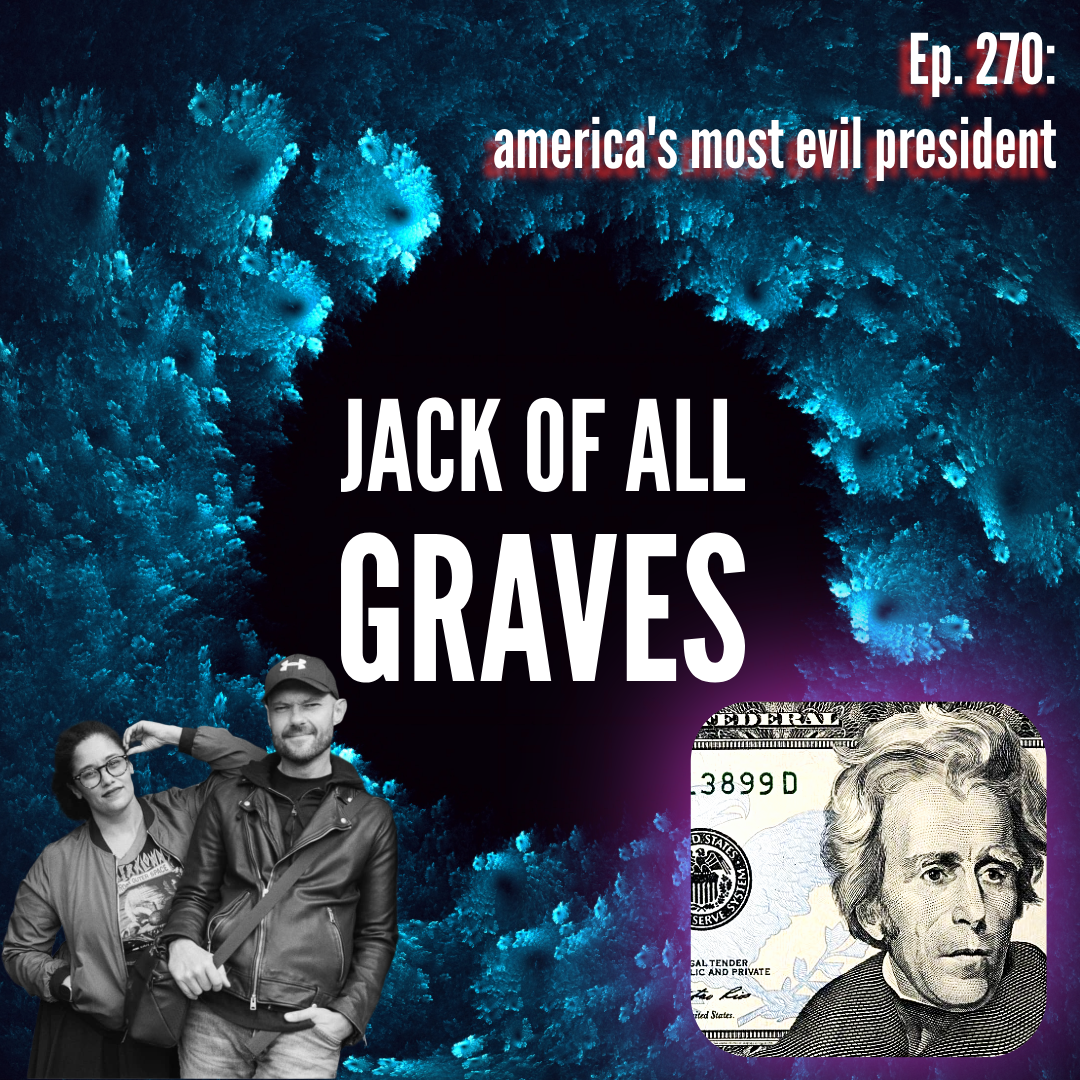
And that guy is Andrew Jackson.
[00:27:54] Speaker B: Is that right? He's not a name I know he's not one that I'm familiar with.
[00:27:58] Speaker A: You've seen him before because he is on our twenty dollar bill.
[00:28:02] Speaker B: Is that so?
[00:28:04] Speaker A: Is indeed. Yes.
There was a time when he was going to be replaced or at least it was going to be shared with Harriet Tubman because he's such an evil
[00:28:14] Speaker B: person, in spite of his, to use your words, in spite of his evil.
America has not erased him. He's on the money.
[00:28:21] Speaker A: No, like I said, he is basically the whole Republican Party's favorite politician.
And reading about him is really interesting because the degree to which people try to just smooth over these edges, when they're not edges, they are, you know, spears. They're sharp pointy bits. You know, these are things that you would impale yourself on and cannot.
[00:28:48] Speaker B: Off topic, super briefly, by the way. Have you, have you, has it reached you? Have you heard what we're doing with our, with our banknotes? Have you heard what we're doing with our cash? No, we're taking people off and we're putting animals on them.
[00:28:59] Speaker A: Good.
[00:29:00] Speaker B: Yeah.
[00:29:00] Speaker A: That is the best way to do it.
[00:29:02] Speaker B: Isn't that cool?
We're putting indigenous British wildlife on our banknotes.
[00:29:08] Speaker A: Is there going to be a groundhog note?
[00:29:11] Speaker B: We don't have groundhogs over here. What are the.
[00:29:13] Speaker A: Not groundhog. That's not what I meant.
[00:29:15] Speaker B: Hedgehogs.
[00:29:15] Speaker A: Hedgehog. That's what I meant.
[00:29:16] Speaker B: It might be. There might be. I don't know what the animals are yet. I don't know if it's been decided yet.
[00:29:21] Speaker A: I would get cash out to get a hedgehog.
I'd be going like, you know when you go to those claw machines and you're like, just try over and over again to get it. I'd be like, atm, like, please give me a hedgehog.
[00:29:35] Speaker B: Yeah, give me, give me, give me two hogs for a badger, you'd say,
[00:29:40] Speaker A: I would like a badger too, to be honest with you.
[00:29:42] Speaker B: Which was this, which was the style of the time?
[00:29:47] Speaker A: Anyway, let's talk about Andrew Jackson. Andrew Jackson was born on March 15, 1767, the same day as Harriet Tubman. As Clarence Lusane points out on the City Lights bookstore blogger, this will be where the similarities end between those two figures.
Now, one of the things that Jackson stands love to point out is that he was really one of us.
He grew up in poverty, an orphan by the age of 14.
At around that same time, he joined the army during the American Revolution.
The same thing poor folks do today. Got nowhere to go. Join the military.
[00:30:26] Speaker B: Yeah, yeah, yeah.
[00:30:28] Speaker A: He moved up through the ranks, eventually becoming an army commander. And he did this by being terrible, but we'll get there.
Like a lot of founding father types, he bounced around through various career paths, from law to business to politics. As Usain put it, quote, over the course of his life, he became an enslaver, human trafficker, attorney, solicitor, U.S. representative, U.S. senator, land speculator, Tennessee Supreme Court justice, store owner, military commander, Tennessee governor and President of the United States.
And the part we like to focus on is that he accomplished all the cool stuff while being more or less uneducated. This was not a guy who went to college.
What a guy. Aspirational.
[00:31:09] Speaker B: Well, that seems like a success story to me. That seems like an everyman.
Yeah, strap, you know, right.
[00:31:15] Speaker A: As long as we, you know, just don't like mention the human trafficking part super loudly, you know.
But Jackson, who was born of Irish immigrants, was a. From the womb he was known for flying into rages and being an all around uncontrollable little git when his parents died.
[00:31:39] Speaker B: Bless you. Cultural exchange.
[00:31:41] Speaker A: I know, right?
When his parents died, he did receive a small inheritance.
He immediately lost it gambling and drinking at the age of 15.
This burned through his entire inheritance. Drinking and gambling at 15 years old.
[00:31:59] Speaker B: I bet there was some whoring involved as well.
[00:32:01] Speaker A: This I am sure there must have been a little bit of whoring while a military messenger. According to a biography by Robert Remini, Jackson apparently fell into the hands of the British and was asked by a British commander to clean his bed boots.
He declined as a prisoner of war. And when the officer then thrust his sword at his head without flinching, Jackson reached out his hand and grabbed the blade, leaving scars on his head and his fingers for the rest of his life.
And this would not be the last time he'd Be real cavalier about nearly dying.
[00:32:35] Speaker B: Yeah.
[00:32:37] Speaker A: The strongest indication of Jaxton's character is perhaps the most famous story about him.
In May of 1806, he met for a duel with a man named Charles Dickinson.
At this point, Jackson was breeding horses for, as you might imagine, gambling purposes.
[00:32:54] Speaker B: Yep.
[00:32:55] Speaker A: Dickinson was also a horse breeder.
Sorry, my thing just suddenly jumped here. Here we go. Okay. Dickinson was.
Was also a horse breeder and claimed that Jackson owed him an unpaid racing debt, which does not seem out of character given what we know about him so far.
Insult to injury, though, Dickinson accused Jackson's wife of infidelity.
But again, this is actually technically true.
Jackson and his wife Rachel had eloped while she was still married to a man named Lewis Robards.
The two had met and begun a relationship while Jackson was boarding with Rachel's mother.
As a result, Lewis Hobart filed for divorce.
But a whole bunch of bureaucratic bullshit pertaining to the rearrangement of states and laws and whatnots meant the filing basically got lost in the mail. So Andrew and Rachel Jackson were living as bigamists. She was married to two different men.
Eventually, Robards was able to file for divorce on the grounds of adultery and abandonment, and the Jacksons had to remarry in order for their union to be considered legal.
So, yeah, Charles Dickinson wasn't wrong technically about Rachel, but he probably shouldn't have said it.
Yeah.
Now, the thing about duels back then is that they were largely bluster.
Kind of the equivalent of a guy acting like he's going to start a fight in a bar to protect his rep, but knowing that his friends are going to hold him.
[00:34:27] Speaker B: Exactly. Hold me back. Hold me back.
Oh, you're so lucky.
[00:34:30] Speaker A: I got exactly.
[00:34:33] Speaker B: Okay, let's go.
[00:34:35] Speaker A: Most of the time, one or both of the opponents didn't show up.
If they did, that was pretty much.
[00:34:41] Speaker B: Can I just ask, were they done by sword, or was it, like, a blunderbuss? How would you. How would the duel.
[00:34:48] Speaker A: I'm not a gun expert, but it would be guns. Yes.
[00:34:50] Speaker B: Okay.
[00:34:50] Speaker A: Okay.
I don't know what kind. I will say from what's going to play out here that clearly. I mean, what if you look back at guns in the, like, revolutionary period and stuff like that, they weren't, like, the most effective things in the world. So unless you were, like, standing, you know, inches from someone else, it might, like, the bullet would break apart or it would just, like, go off in a random direction.
[00:35:13] Speaker B: That's why your gun laws are still a fucking horseshit.
[00:35:17] Speaker A: They're made for guns. That if you, like, might just like,
[00:35:22] Speaker B: you know, nobody had envisioned, like, the AK might exist at some point.
[00:35:26] Speaker A: Yeah, you couldn't aim these, really, so,
[00:35:30] Speaker B: you know, that's the sticky thing that you would stick down the barrel, right?
[00:35:34] Speaker A: Oh, you just wait until I dry my powder, right? Yeah, pretty much.
So, yeah, if you showed up, that was pretty much good enough. It showed you had the balls to. To do the jewel. Right. Honor all that stuff. You're good.
Everyone goes home in peace. Normally, no one ever shot their gun.
And if they did, it was generally into the air, just kind or like, just kind of in the vicinity of the other dueler. You'd kind of, you know, make them dance or whatever. You're basically just trying not to flinch and look like a coward. That was the idea behind it.
But Andrew Jackson. Jackson was not the kind of guy who shows up to a duel for shits and giggles.
And after Dickinson went to a local paper with his slander, he was like, oh, let's go, you dumb.
But Dickinson was the same kind of hothead.
So both showed up ready to go.
Of course, there's one like, basically, in a duel, one person at a time shoots, right? Which is crazy. But again, guns didn't have the same level of accuracy and lethality back then.
[00:36:40] Speaker B: So I'm not expecting you to know this, but did they do the whole kind of back to back again paces?
Okay.
[00:36:46] Speaker A: They would stand on their marks and basically, you know, try and kill one. Yeah, try to kill each other from their marks. That's basically it. And once, like, I would excel at the duel. Yeah.
Basically,
[00:37:01] Speaker B: I would simply shoot the other man first and with greater accuracy.
[00:37:05] Speaker A: Well, here's the thing.
Dickinson drew first.
It was his turn first. And he shot the out of Jackson right next to his heart, causing a collapsed lung and two broken ribs.
Now, after that, that person has to walk back to their mark and let you shoot at them. You would think in this situation that Jackson would have immediately fallen to the ground. That was it. All of this is over.
[00:37:34] Speaker B: Wait a minute, wait a minute. Wait. You can't even take. You don't even shoot together. You've got to take it in turns.
[00:37:39] Speaker A: Yeah. You take turns. Yes.
[00:37:41] Speaker B: It's the stupidest thing I've ever heard in my life.
[00:37:44] Speaker A: No, dueling is dumb. There's no reason to do this.
[00:37:47] Speaker B: Right.
[00:37:47] Speaker A: It's a bad idea.
All right, now you go. You. You hit me this time. Yeah. No, it's a stupid system.
[00:37:54] Speaker B: That's not even a duel.
[00:37:58] Speaker A: And to be fair, like, there are duels like you're thinking of with the, you know, 10 paces, turn around, fire or whatever. That's just not what they did at this time.
Different kind of situation. They would just stand there and take turns shooting each other.
[00:38:15] Speaker B: Because it doesn't just, like, have a fucking fight.
[00:38:18] Speaker A: Well, sure, yeah. I mean, there's a lot of alternatives to standing and taking turns shooting each other. I would have plenty of suggestions before we got to this point.
[00:38:29] Speaker B: Are you allowed.
And again, I don't know if you know, but are you allowed to, like, dodge?
Or have you just got to stand there?
[00:38:37] Speaker A: I mean, that's a valid question. I think you could dodge. You would just look like a pansy, and it would defeat the entire purpose. Right. Because the whole point of this is to show I'm, you know, a big man and I'm not scared of you. Go ahead and shoot me. You know, so it's all a big, you know, pissing contest, essentially. Right. So if you flinch, like, yeah, sure, fine. But, like, you flinch, you. You lost. Your dignity's gone.
[00:39:06] Speaker B: Tell me something.
In school in the States, what if I.
Did you ever have or do you have or did you ever play slaps?
[00:39:17] Speaker A: Slaps?
[00:39:19] Speaker B: Yes, Slaps. Slaps. Slaps.
Every British guy of a certain age knows exactly what the fuck I'm talking about. I want you to watch the zoom right now. Right.
[00:39:30] Speaker A: Okay.
[00:39:31] Speaker B: What you do is two kids, both engaged in a game of slaps, would hold their hands like that so the fingertips were touching one another, right?
[00:39:39] Speaker A: Yeah.
[00:39:41] Speaker B: And whoever's turn it was would have
[00:39:46] Speaker A: to slap the hands.
[00:39:48] Speaker B: Slap the fuck out of the other person's hands hard enough to really fucking.
[00:39:51] Speaker A: Okay. Yes, we definitely did play that. Yeah.
[00:39:53] Speaker B: But what you could do is you could faint, like, pretend to slap.
And if the other person jumped because they thought you were going to slap them free. Slap.
[00:40:06] Speaker A: Oh, that's rough.
[00:40:09] Speaker B: Oh, it is rough.
There was some red hands. Fucking. Well, I've never taught my kids to play slaps. Mental note, I'm going to teach Owen and Pete slaps tomorrow.
[00:40:20] Speaker A: Great. Perfect.
[00:40:21] Speaker B: Healthy.
[00:40:23] Speaker A: Well, see, listen, you're here dogging the duel, and yet you played this freely in school of your own volition. So, yeah, there you go.
[00:40:34] Speaker B: So, Jackson, what I particularly like about slaps is it the name of the game is perfectly sums up what the game is, it Slaps, isn't it?
[00:40:43] Speaker A: No ambiguity there. You can pretty much figure it out.
Figure out the rules.
Yes. So, Jackson, he has been shot now by Dickinson next to his heart, collapsed long, two broken ribs. Instead of immediately falling to the ground and calling for help. He steadied himself, aimed, and shot Charles Dickinson right in his stomach, causing him to bleed out and die.
Wow.
Yeah.
And he recovered.
And this would probably be enough dueling for most of us. You get shot in the chest to nearly die once it's scratched.
[00:41:21] Speaker B: Yeah.
[00:41:22] Speaker A: Not Andrew Jackson, though. He was stirred to such rage so often that he engaged in over 100 duels over the course of his life and was shot so many times, People would joke that his body rattled like a bag of marbles because he had so many bullets lodged permanently in him.
[00:41:44] Speaker B: I mean, I'm. I'm. That guy sounds pretty cool if you ask me.
[00:41:50] Speaker A: Listen, it's like if you just take the. I've been shot a bunch of times and I rattle around like marble's thing on its own.
Yeah. If you realize he's a guy who. Who will fight anyone over anything and is always in such rage that he's like, let's shoot each other.
[00:42:10] Speaker B: I guess what I'm saying is he feels to me like the king of walking it off.
[00:42:14] Speaker A: Right.
[00:42:14] Speaker B: And this, Which I respect.
[00:42:16] Speaker A: He almost had, like, a Rasputin like, quality in mythology to him that people are just like, you just can't kill. Andrew's name again. Andrew Jackson.
[00:42:27] Speaker B: Yeah, Andrew Jackson.
[00:42:28] Speaker A: So he had that.
[00:42:29] Speaker B: And he's on the 20. He's on the 20. He's ON the 20.
[00:42:30] Speaker A: He's ON the TWENTY. So you're. You can see, though, already, like, why the, like, mythos around him makes him someone that people want to, like, follow. Right. Like, this guy who came from nothing, who, like, you can't kill, who just, like, takes bullets, is like, whoa, give me more. I eat them for breakfast. Like, he seems cool and the kind of person when. Especially at this point of westward expansion in the United States, stuff like that. You're looking for, like, rugged, individualist guys. Like, he is what we want to imagine ourselves as at this point.
[00:43:02] Speaker B: Yes, yes, yes.
[00:43:06] Speaker A: But, yeah, I mean, I think it's hard to find a better illustration of what an asshole this guy was. I don't know if I've gotten into a hundred arguments in my life, and this guy was regularly getting into it so bad, people wanted to shoot him or he wanted to shoot other people.
[00:43:22] Speaker B: Trivial of shit.
[00:43:23] Speaker A: Just like any fucking thing.
[00:43:25] Speaker B: Load up. We're gonna deal.
[00:43:27] Speaker A: We're going outside. Yeah. So violence was just an absolute way of life for him at another point in his life. And again, this is going to make him seem cool. He served as a judge in Tennessee when a Defendant stormed out of the courtroom one day and the sheriff was having trouble tracking him down. Jackson ordered a 10 minute recess and went out himself with a pistol in each hand and ordered the man to surrender.
And the man did.
When asked why, he obeyed and went back inside when no one else could get to, get to him, get him to, he replied, quote, when he came up, I looked him in the eye and I saw shoot. And there wasn't shoot in nary other eye in the crowd.
[00:44:09] Speaker B: Me.
[00:44:10] Speaker A: That's some serial killer right there. He's describing him like Quint describing a shark in Jaws. He had shoot in his eye.
[00:44:19] Speaker B: Yeah. And he also, he had two guns. Like some John Woo shit. He had like, you know, like a better tomorrow. The guy was packing in both fucking hands.
[00:44:28] Speaker A: Yeah, okay. Like he just. Yeah. When you saw Andrew Jackson, you knew just looking in his eye that he wanted to kill.
I remember, don't give him a reason.
[00:44:39] Speaker B: With John Woo. Right. When Mission Impossible came out, which, which Mission Impossible did he do? Is it Mission Impossible 2 or 3?
[00:44:46] Speaker A: I don't know.
[00:44:48] Speaker B: I'm sure John Woo did one of those. And the interviewer said to him, how would you, if you were ever to make a James Bond movie, John, what would you do to improve it? How would you improve James Bond film? And he just paused and he smiled and he just went, two guns.
[00:45:11] Speaker A: When he's right, he's right.
[00:45:12] Speaker B: Isn't that fucking sick? I love that.
[00:45:16] Speaker A: That's beautiful.
Anyway, back to Andrew Jackson.
As a commander, he was ruthless towards the enemy, but just as ruthless towards his own men. Shouting, shooting those who dare to desert their post.
[00:45:30] Speaker B: Yeah.
[00:45:31] Speaker A: But he particularly loved inflicting violence upon black and indigenous people. Okay.
[00:45:37] Speaker B: Yeah.
[00:45:37] Speaker A: You knew it was coming.
You knew it was coming. Yep. As the United States expanded west, so called Indian wars that have been going on pretty much since white people got here only intensified.
Americans wanted the land and the resources. Indigenous people were already there. And while we totes made all kinds of treaties with tribes across this landmass, folks like Andrew Jackson had absolutely zero intention of keeping them.
Things only got worse when in the War of 1812 various Native American confederacies joined the British side of the conflict against the United States.
And I am not going to explain the War of 1812. It's part of the larger Napoleonic Wars. You can learn about it in the Maritime Museum in England.
[00:46:19] Speaker B: Yeah.
[00:46:20] Speaker A: So lots of context there that I'm not going to give.
But suffice it to say it was largely a naval conflict between Britain and various places. But and the United States. The United States challenging Britain in this case.
And like I said, the Native Americans, not all of them, but some groups of the Native Americans joined the British side of this. We'll get into the difference later on. But in the aftermath, large swaths of Native land were transferred to the US in these treaties, which weren't kept anyway. And the US government, Jackson in particular, was champing at the bit to get his hand on pretty much all of it, especially if there were natural resources like oil or gold.
See Killers of the Flower Moon for a stark example of this.
That's after Jackson's time, obviously, but it's a story that repeats itself over and over again.
So Jackson was absolutely brutal in his command during the Indian wars.
As Delaney Bartlett writes in the first Seminole War, for example, troops under Jackson's command raided Seminole territories in Florida, which was under the flag of Spain, in order to recapture runaway slaves. During those raids, the soldiers, including Jackson, burned down their villages and killed women and children.
On top of that, to keep track of how many Indians they had killed, he would have his men cut off and collect their noses.
[00:47:44] Speaker B: Stop.
[00:47:45] Speaker A: Yeah, it's pretty horrifying. I mean, he was so brutal with like this that people spread rumors that he was a literal cannibal. Like they would talk about him just like eating six Indians, you know, stuff like that. Because it was just. He didn't. He wasn't a cannibal, but he was so vicious that it was like he might.
Sounds like a think he thing he'd do.
[00:48:11] Speaker B: And if I may, as someone who is hearing this tale for the very first time. Yes, it feels very telling to me that this motherfucker is still on your currency.
[00:48:24] Speaker A: Yeah, right.
And I'll keep going and yeah, you'll see, not only is he on our currency, but it is being fought for for him to stay on this currency that we've already decided we'd replace with Harriet Tubman.
So people want this guy on the money.
So Jackson had been drooling over obtaining Indian land for ages. His hatred of them was something else entirely. Like you can argue in any war, whatever, soldiers are just doing what they have to do. And just because they kill someone as a means to an end doesn't mean they hate them.
I don't think that's valid, to be clear, but it's an argument you could make, you know.
[00:49:06] Speaker B: Yeah.
[00:49:07] Speaker A: This was not the case with Jackson. Even though he did have some Indian relations and things like that in his life, he really wanted to see indigenous people tortured and displaced in the most cruel ways possible.
And thus his very first major piece of legislation when he became president was the Indian removal act of 1830.
Yes.
[00:49:27] Speaker B: Just a.
[00:49:27] Speaker A: Sounds bad right out the gate.
[00:49:29] Speaker B: Just a wording.
[00:49:31] Speaker A: Yeah, yeah. It tells you. Much like slaps tells you exactly what's going to happen here.
This would give land belonging to the Cherokee, Creek, Chickasaw, Choctaw and Seminole to white settlers and forcibly remove those tribes from that land.
[00:49:48] Speaker B: And again, makes Lyndon S. Johnson getting his dick out feel very quaint by comparison.
You cheeky guy.
[00:49:56] Speaker A: It's fine.
Yeah. And there's more to this, like, whole entire thing, especially with the Cherokee, who tried their darndest to get various treaties and things like this out of it. All of which, of course, the US Government, Jackson in particular, went back on.
So there's a whole bunch here. But essentially those tribes are the ones who are ordered to be removed and are.
And the Supreme Court actually did side with the Cherokee who went to court to fight this. But Jackson was literally like, lol. Okay, try to stop me.
It is said that he responded, quote, john Marshall has made his decision.
Let him enforce it.
We don't know whether he actually said that word for word or not, but it's certainly the tactic he took. And indeed, this is one of the issues we face with the Supreme Court on the rare occasion they make a good decision. Yeah, there's no SCOTUS police.
[00:50:52] Speaker B: It can only be whether apocryphal or not. That is certainly true. It feels true in intent, if not in literal fact.
[00:51:01] Speaker A: Exactly. That SCOTUS ruling can only be enforced insofar as the rest of the government and institutions are willing to do their part to enforce it.
So they may have ruled this way, but it's not like anyone was lining up to make sure nobody removed the Indians, and thus it was allowed to happen.
So Jackson ordered the removals to be carried out, and under him and his successor, Martin Van Buren, we got what's now known as the Trail of Tears. Have you heard that before you.
[00:51:33] Speaker B: Many times. You've used the term Indians.
[00:51:37] Speaker A: Right.
[00:51:40] Speaker B: I was under the impression that was not the term to use it.
[00:51:44] Speaker A: It depends.
For one, a lot of things are like the title of things here, Indian Removal, things like that. Also, it's a very like.
It's a touchy thing with different groups of Indians, indigenous people, Native Americans, because they don't all want to be called the same thing. Right. Like, if you say Native Americans, well, this was not America. They're not Native Americans. They were the people who were here. Which now is why we often use indigenous. Right. But a lot of people have chosen Indian because they didn't want to be called Native Americans. Right. It's kind of like, like for me, I don't like being called African American. I'm not African, so I'm black. Right. But there are other people who would prefer to be called African American, you know, because they see that as like the less problematic term and something that more like acknowledges their heritage. So, you know, it's always, when it comes to like, how people identify in America who are marginalized, it's always this kind of fraught thing between like, what people called us, what we want to be called, what is the more appropriate thing, what gets largely accepted. So that's why I do indeed use Indian sometimes throughout this thing, because it is a word that is not entirely one that people don't use.
[00:53:03] Speaker B: Very difficult.
[00:53:04] Speaker A: Right, yeah, exactly.
In fact, I didn't mention them by name in here, but there is a tribe that's tangentially related to this, which is the Miccosukee tribe in Florida, who is responsible basically for getting Alligator Alcatraz shut down.
And that's. They call themselves the Miccosukee Tribe of Indians.
So it's complicated is what I'm telling. Telling you here.
Yeah, but that's a valid question, like why it makes it sound like I'm calling them a slur or something like that. It's just one of many things, one
[00:53:38] Speaker B: of the most famous. Obviously I know that coming from you, it wouldn't be, yes, sir, but I
[00:53:44] Speaker A: could be accidentally slipping up or something though, or, you know, so it's a fair question.
[00:53:48] Speaker B: But it's just I'm.
I've.
Through our discussions and through my reading, I've. I've always lent. I've always understood that Native American was. Or Indigenous American was the, the safe term was the term to use.
[00:54:06] Speaker A: Yeah. I would say, like if you were going for the safest thing, saying indigenous is always, you know, you're not gonna offend anyone saying indigenous.
[00:54:14] Speaker B: Okay.
[00:54:14] Speaker A: That's, that's the actual thing they are.
But otherwise, you know, there's also first nations, it's like. And then obviously tribes. Like, there's. Yeah. Many ways to identify folks.
Yeah. Like. And I was also gonna say one of the, like, biggest sort of well known movements in America for indigenous rights was the American Indian movement and like the 60s, 70s, 80s. So, yeah, it's a, it's a fraught term for sure.
[00:54:41] Speaker B: Yeah.
[00:54:43] Speaker A: Let's see, where was I? So, okay, so Martin Van Buren and Jackson are responsible for moving them in the Trail of Tears.
You know that term?
[00:54:55] Speaker B: I believe it's one we've discussed before. Could I talk to you about it? No.
[00:54:58] Speaker A: Sure. Okay. Fair enough.
As the National Endowment of the Arts put it, Indian Removal was considered by Jackson, quote, the happy consummation of a policy pursued for. For nearly 30 years.
Between 1830 and 1850, some 50 to 100,000 Native Americans were forcibly removed from land in Michigan, Louisiana and Florida. Many of them were removed at gunpoint, including the elderly and the sick, and were not allowed to take any of their belongings with them.
They journeyed west on foot. And we have talked about how unsuited for survival the American landscape is. So that's just as harrowing as you would imagine it to be.
[00:55:35] Speaker B: It feels like Natchez, right?
[00:55:38] Speaker A: Yes. I mean, all of this stuff, everything I'm talking about here is the stuff that Natchez is ignoring happened. Essentially, that movie is about white people pretending none of this occurred. And I bet if you ask any of the people in that documentary, they would say Andrew Jackson is their favorite president.
[00:55:57] Speaker B: Yeah.
[00:55:59] Speaker A: Yeah. So 50 to 100,000 Native Americans, depending on, you know, where you look for that.
And they had to travel on foot. And as a result, somewhere between 10 to 15,000 people died due to starvation, disease and the elements.
And countless more suffered, were injured, fell in, ill, and so on. It was not a nice journey.
Basically, best case scenario was if you were kind of starving, but you arrived okay, essentially.
Now, a lot of things you read will try to downplay Jackson's significance in all of this, pointing out that he wasn't the only one calling for Indian Removal or the only architect of this.
That Van Buren is actually responsible for the Trail of Tears. That Indian Removal had already been happening before he got into the presidency. And, yes, this is all true, but it's also true that Indian Removal was not popular.
I mean, if the Supreme Court rules against you, you know, this is like a particularly egregious thing.
Many people, especially in the north, protested the idea of Indian Removal. There was a strong movement against it, much like abolition.
The factor. Fact of the matter is, we know Jackson spent a whole decade moving the needle on Indian Removal in government, even as it was unpopular with the American people and his colleagues.
[00:57:22] Speaker B: Moving it in the wrong direction.
[00:57:23] Speaker A: Exactly. Yeah.
And it's not a matter of, like, oh, well, this would have just happened anyway. He is very much responsible for the way that things unfolded.
But the slaughter and desecration of Native Americans in war and the removal from their lands. Wasn't the only instance of Jackson being an evil, amoral bigot.
Jackson was, as mentioned before, a human trafficker.
That's right. He didn't just keep slaves, he traded slaves.
In fact, that's how he made his fortune.
Marco, are you familiar with the term being sold down the river?
[00:58:05] Speaker B: Oh, yeah. I mean, it's, it's not in the, not in its original context, but if, if somebody you over and knocks on you, if someone fucking. You know what I mean? Motherfucker sold me down the river. You son of a. I use it in the same phrases like you've thrown me under the bus.
[00:58:22] Speaker A: You know, you shouldn't use it.
[00:58:25] Speaker B: Okay, very much then.
[00:58:27] Speaker A: I never will, just FYI.
[00:58:29] Speaker B: I mean, but it is, it isn't like in my daily lexicography. It isn't. I don't, I don't use it all the time.
[00:58:34] Speaker A: It's really fascinating though, to hear that from a Brit. Right? Like, because as I'm about to explain to you, for that to become such a part of like, you know something, you know exactly what it like means.
[00:58:45] Speaker B: It's not like mega straight, it's not mega common over here, but if I were to hear it said, I would
[00:58:49] Speaker A: know what they were, would know what they meant.
[00:58:51] Speaker B: Yeah, sure, sure, sure.
[00:58:53] Speaker A: A few years ago, the singer Pink got into a little hot water for using the phrase in a song talking about relationship drama, because, oh boy, it is not about that.
[00:59:02] Speaker B: Pink writing a song about relationship drama. I find this difficult to believe.
[00:59:08] Speaker A: Yeah, well, you see, the further south you went in America, the worse it got to be enslaved.
[00:59:16] Speaker B: Yeah.
[00:59:17] Speaker A: Deep Southern plantations often entailed much harsher condition and treatment with slave owners who are ready with the violence for any small slight. When you see those like postcards of people whipped to. Absolutely. And things like that and, and you know, enslaved people being beaten to death and stuff like that, you're often looking at stuff from the very deep South.
So when an enslaved person in a more northern plantation was sold down the river, it meant that they were being given something akin to a death sentence, basically, at minimum, social death and at worst, actual physical death. They were being sent to a situation even worse than the one that they were already in.
And much of the time this involved family separation.
If you were a particularly strong or skilled enslaved woman, for example, and you had a five year old, those southern plantations are like, what am I going to do with a five year old? That's another mouth to feed.
So they don't want that kid, they just want the Mom. Slave traders would happily separate that mother and child or any other familial configuration that you can imagine.
[01:00:27] Speaker B: Yeah.
[01:00:27] Speaker A: And because chattel slavery is lifelong, they would likely never see each other again.
[01:00:34] Speaker B: So to use that term, soul down the river is to make light right of rendition of families of exact fucking trafficking. Okay, okay, okay.
[01:00:45] Speaker A: Yeah. It's pretty much one of the worst things that could happen to a human being. Being. Yeah. Rendition of families. Exactly. Being torn apart from those you most love in the world, sold down into a situation where you would likely be beaten regularly, maybe die out there.
Horrific.
And Andrew Jackson. And Andrew Jackson specialized in trading slaves down the river from the upper south to the lower South.
He became so wealthy from this trade, he was able to buy the 420 acre plantation in Nashville known as the Hermitage, where he would own over 150 enslaved people himself.
And I cannot stress enough that this is not normal. I think when we talk about, like, slavery, people think that that's like. Yeah, that's what it was like. Everyone lived on these plantations and they had, like, you know, enslaved people everywhere, you know, and that was not the case. Most people who did have enslaved people had a small number of them.
Only about 5% of plantations enslaved over 100 people. So he's a mega slaver, basically.
[01:01:57] Speaker B: Yeah.
[01:01:57] Speaker A: Yeah.
And this is, again, a thing people try to avoid talking about or act like he was a man of his time, but he wasn't. He was a spectacular kind of evil.
Like when Harriet Beecher Stowe wrote the book Uncle Tom's Cabin and people found out about this selling down the river practice, they were so horrified. It galvanized the abolitionist movement in a whole new way.
When people at that time knew this shit was happening, they immediately went, holy fuck, that's evil. And they meant it in the Christian way. They meant, this is an abomination. This is against God, what is going on down here? So he was not a man of a time. He. He was a slasher villain even to people who would have existed at that point.
Now let's go back to the War of 1812 again.
Around that time, many.
[01:02:49] Speaker B: And he's still on the 20s. And he's still on the fucking 20s.
[01:02:52] Speaker A: On the. Oh, yes. And he's still. Yeah, on our $20 bills. Yeah, just keep going back to that.
Fighting for him to be on the $20 bill.
So many blacks, both free and enslaved, had joined forces with some of the native people and the Brits against America in that fight, joining what was known as the red stick resistance.
Creek leaders who were friendly to Jackson, ceded 23 million acres of land to the US in the Treaty of Fort Jackson.
But the red stick Creeks were like, absolutely not. And set up eight towns of about 2,000 inhabitants each on that land on the outskirts of Pensacola, Florida.
And the Brits were like, hell, yeah, this is great. We'll set up a base here and enlist the Creeks and blacks to our marines. And they promised them that if they won the war, the black recruits would be given land in the West Indies as well as their freedom.
As you can imagine, Jackson and his slaveholding slave trading ilk were not pleased and insisted that the Brits were trying to, quote, excite the black population to insurrection and massacre.
I'm gonna yada yada here because there's a lot of details and I'm already six pages in. But long story short, a fort was constructed to be the hub of the British black and indigenous opposition.
When the British were defeated at the battle of New Orleans, a bunch of them and the red steamer and some of the red stick Creeks went back to Britain to try to get the crown to keep supporting them.
[01:04:23] Speaker B: Super. Briefly, the battle of New Orleans. I would not. Maybe not for now, but I would love to hear more of this in the future.
[01:04:31] Speaker A: Is it a thing you've heard of or you're just like, oh, that sounds interesting.
[01:04:34] Speaker B: It just sounds fascinating to me. I'd like to hear more of that.
[01:04:37] Speaker A: You're asking me to talk about maritime history here, so.
[01:04:41] Speaker B: I know, I know.
[01:04:42] Speaker A: I'm. I just want to let you know what you're getting yourself into.
[01:04:47] Speaker B: But at some point in the future, I'd like to. I'd like to hear more of that, please.
[01:04:51] Speaker A: All right, noted.
Anyways, so the Brits go back to the crown, like, hey, can you re up your support to us? Or whatever. And in the meantime, they left behind a huge artillery. Artillery of weapons and ammunition, by the way. Got very east coast here, apparently because I left out the H and just wrote huge artillery of weapons and ammunitions.
And while most of the natives abandoned the fort, about 300 blacks were left in control of it.
Soon some three or four hundred more runaway enslaved people joined them.
This caused problems.
Whites nearby, along with military officers, were displeased by hundreds of armed black folks manning this fort and started claiming that they were committing robberies and piracy and all kinds of things like that.
Meanwhile, the fort was becoming a thriving black community where they were cultivating fields using West African agricultural methods that have been passed down through the generations.
The community grew as more runaways joined them. And now this was a real threat. Threat to the old peculiar institution, as slavery is often called.
[01:06:01] Speaker B: The peculiar institution.
[01:06:04] Speaker A: Institution referred to as.
[01:06:06] Speaker B: Yes, even today.
[01:06:07] Speaker A: I mean, it was like a thing of the time. And it's thus the thing that, like, you learn that people called it. Oh, the peculiar institution of slavery.
[01:06:16] Speaker B: Yeah, Me.
[01:06:18] Speaker A: You're learning all of the insane euphemisms like that we used over here.
[01:06:24] Speaker B: I. Listen, honestly, I. I wasn't really prepared for tonight's podcast. I didn't. I didn't. I didn't realize we were going to go this deep and this far into something so abhorrent.
[01:06:37] Speaker A: Yeah, well, like you said last week, I do have a tendency to do this, don't I?
[01:06:42] Speaker B: Yes.
[01:06:45] Speaker A: So. And it was the Fourth of July, so, you know, it was necessary. So British Colonel Nichols, who was from Bermuda and therefore clearly all about the slavery life, called the area Negro fort and wrote, quote, no time ought to be lost in recommending the adoption of speedy energetic measures for the destruction of a thing held so likely to become dangerous to the state of Georgia.
[01:07:09] Speaker B: Right.
How, again, help me out here. Right. Just from a place of educating me. Negro.
[01:07:19] Speaker A: Yeah. Negro.
[01:07:20] Speaker B: Don't be saying that.
[01:07:22] Speaker A: Yeah, you. You shouldn't say it, but it's one of those like. Like, say in the night. This is kind of one of those ones. I mean, it doesn't come up as often, but, like, a lot of my students will use the term colored when they're talking about people of color.
[01:07:39] Speaker B: Yeah.
[01:07:40] Speaker A: Okay. So listen.
[01:07:41] Speaker B: Whoa, whoa, whoa, whoa. Yeah, yeah, yeah.
[01:07:42] Speaker A: It's not a slur, per se, but it is outdated in a way that has connotations that are negative. Right. And Negro is kind of the same thing where it's like, at. If it were the 1960s, that was the normal word you used for people. Right. Like, and black people would use it about themselves, too.
Now, it is anachronistic in a way that sounds like a slur if you say it.
[01:08:10] Speaker B: I'm so glad that you brought that up, because I. Please, for fuck's sake. Don't ask me to remember how, but this occurred to me, like, on Wednesday, earlier of this week, Negro. I must ask Corrigan this.
So thank you very much.
[01:08:24] Speaker A: Came back up again. There you go. Yeah. No, I think as. As a black person, I think it's a funny thing to call each other.
Like, if someone is irritating you or whatever, you're like, this Negro is entertaining. But if a white person said it, I would not find it funny.
Next.
[01:08:43] Speaker B: Next time I'm in America, let's try that shit out.
[01:08:45] Speaker A: Let's just.
[01:08:45] Speaker B: Just see you follow me with a little. Just a hidden camera kind of experiment,
[01:08:51] Speaker A: just imagining, you know, like you, me and Kyo hanging out, me annoying you, and you turning to Kyo and be
[01:08:55] Speaker B: like this Negro, let's go to a bodega and just ask for some shit.
Cheers, Negro.
[01:09:05] Speaker A: Yeah, Would not recommend.
But yes. I mean, in this case, it's that mixed thing. We're calling it Negro for it because it did have a different name, which I can't think of at the moment, but was like, certainly an intentional slight where still, Negro wasn't necessarily a slur at this point either.
But yeah, it was definitely trying to say, like, this is a group of people that we find undesirable over here.
So, yeah, he.
On March 15, 1816, Secretary of War William C. Crawford told Andrew Jackson to inform the governor of West Florida, which was a Spanish territory at the time, that this was a problem and to, quote, put an end to an evil of so serious nature if the governor didn't squash it. Jackson was to do whatever was necessary to do it himself.
As it turned out, two weeks before he even wrote to the Spanish governor of Florida, he had already ordered the destruction of Negro fort.
He had told a General Gaines, quote, I have little doubt of the fact that this fort has been established by some villains for rape. It said Rapine. I don't know what this word means. R, A, P, I, N, E. And I made to look, meant to look it up, but that and plunder.
Yeah, I don't know if that's supposed to mean rape or if it means something entirely different, but either way, that and.
[01:10:37] Speaker B: Well, let's find the fuck out, shall we?
[01:10:40] Speaker A: Yeah. Then while you do that, I will finish the sentence and that it ought to be blown up regardless of the land on which it stands. And if your mind shall have formed the same conclusion, destroy it and return the stolen Negroes and property to their rightful owners.
What does it say?
[01:10:56] Speaker B: Rapine. It's a biblical word.
Refers to the violent seizure of property, plundering and pillage.
[01:11:04] Speaker A: Okay, so basically it's redundant. He's saying the same thing twice, but yes. So he had already told this guy.
[01:11:12] Speaker B: Tautology. Is that what that's called?
[01:11:14] Speaker A: Maybe.
I'm very terrible at remembering which of the those mean what.
It's a constant problem in a PhD program that people would always have an ology and I'd be like, huh, let me just look at my phone real quick.
Anyways, so he tells him, blow it up, even if even though it's Spanish land. Fucking blow this shit up.
Take back the stolen Negroes and return them to their enslavers.
And so they did just that. And while at first the blacks at the fort were able to stave off the many attempts at invasion, by the way interlopers, the tide did turn.
On July 27, a gunboat fired into the fort store of gunpowder and detonated it.
Lt. Col. Duncan Lamont clinch wrote, quote, the explosion was awful and the scene horrible beyond description. Our first care on arriving at the scene of the destruction was to rescue and relieve the unfortunate beings who survived the explosion. The war yells of the Indians, the cries and lamentations of the wounded wounded compelled the soldier to pause in the midst of victory, to drop a tear for the sufferings of his fellow beings and to acknowledge that the great ruler of the universe must have used us as his instruments in chastising the bloodthirsty and murderous wretches that defended the fort.
Fuck that guy. Obviously, another witness, a little less concerned with making the whole thing seem righteous, wrote, quote, the explosion was awful and the scene horrible beyond description. You cannot conceive, nor I describe the horrors of the scene in an instant. Lifeless bodies were stretched upon the plain, buried in sand and rubbish, or suspended from the tops of the surrounding pines.
Here lay an innocent babe, there a helpless mother. On the one side a sturdy warrior, on the other a bleeding squaw.
That is a slur.
Piles of bodies, large.
[01:13:09] Speaker B: You do not need to tell me that, just FYI.
[01:13:13] Speaker A: Piles of bodies, large heaps of sand, broken guns, accoutrements, etc, covered the site of the fort. The brave soldier was disarmed of his resentment and checked his victorious career to drop a tear on the distressing sea. Seen, it's kind of, yeah, similar message, but with very different intent. One of them is like, you know, thank God we came and stopped these horrible godless people. And the other one's like, that was the worst thing that I've ever seen, and I just feel really bad about it.
So There had been 330 people, including women and children inside, and 270 of them were killed instantly in the explosion.
Half of those that weren't killed would succumb to their wounds later.
[01:13:57] Speaker B: Only 30 gunpowder does it take to kill 270 people outright?
[01:14:02] Speaker A: Yeah, it was their whole stock on this thing that had been put in this fort by Britain. So I imagine it was a good amount.
They. Yeah, not. Not great. I mean, and like that description, right, like there were bodies in trees These people were blasted for a long way.
It's surprising that 30 people actually managed to survive this, this whole thing.
Blacks who were captured were largely executed. Some were re enslaved. One, a Runway named Polypore. Andrew Jackson himself took and enslaved at the hermitage. Sort of a little trophy from the whole experience.
Most of the rest of the thousand blacks who had lived there had escaped before the Americans showed up. But it was a clear indication of the lengths enslavers were willing to go in order to maintain the institution of slavery. Slavery and their ownership of the land.
[01:14:56] Speaker B: Ask you something, Is it a crime in the States to deface your currency?
[01:15:03] Speaker A: I don't think so because people do it all the time.
Like you know, and there's even like, like stamps that people put on them and stuff like that. I think it's pretty common. If it is illegal, nobody enforces that.
[01:15:17] Speaker B: Well, how would you.
[01:15:19] Speaker A: Right, yeah, it'd be very difficult to
[01:15:21] Speaker B: enforce because how do you get a 20 without writing cunt on on that?
[01:15:27] Speaker A: That might be something that's looked down upon. I don't know. They. Because I think they do have to take them out of circulation if they're vandalized in certain ways. You know, if you can't read like the serial number type things on them, stuff like that. So I would wager if it's vandalized in a way that they have to take it out of circulation.
[01:15:43] Speaker B: I went through a phase of writing my email address on banknotes.
[01:15:49] Speaker A: Did anyone ever email you?
[01:15:50] Speaker B: Nah. Oh, I did it.
[01:15:52] Speaker A: I would have.
[01:15:53] Speaker B: I did it for a year. Just whenever I, whenever I would have some cash money I would just drop my email address in the corner.
[01:15:59] Speaker A: I love that sometimes I do that in books with that. I like put in little free libraries and stuff like that. Like put my Instagram at or something like that. But nobody ever, or at least they don't tell me if that's why they followed me.
I always seem like it'd be so fun to connect, but there we go. But anyways, on top of all this evil, Jackson was also just regular old corrupt.
His presidency operated under a spoils system, much like ours does now, where people who had done him favors and not whatnot were given roles in his administration while people who were qualified were fired to make room for them.
This led to predictable financial turmoil and the economic panic of 1837 which involved real estate speculation and and banking policy that led to paper money in America seeing a sudden depreciation in value.
A six year depression followed as a result of this, which is you Know, a fun reminder of what can happen when you let your president carry out all of his favorite bigotries and vendettas while hiring the dumbest motherfuckers on earth to manage the most important elements of the government.
Just, you know, an aside totally apropos. Nothing in 2026.
[01:17:18] Speaker B: Yeah, yeah, yeah, yeah.
[01:17:20] Speaker A: There it is.
[01:17:21] Speaker B: You say that this guy remains a hero. Yep.
[01:17:26] Speaker A: Like I said, Trump's favorite president.
This is. I once on Instagram, I posted a picture of me and Kristen and Bri flipping the bird to an Andrew Jackson statue in New Orleans. And every now and again, still, I get people coming through and commenting about, you know, how much he did for us and what a wonderful president he is and how we should be ashamed of ourselves. Things like that. Like.
Sure, it's a real.
[01:17:54] Speaker B: Can I just.
Now you mentioned their names. Can I just take a moment to greet Kristen and Bri?
Just thank them, because I love them a lot.
[01:18:06] Speaker A: They're pretty great.
[01:18:07] Speaker B: Yeah, they are. Yeah.
[01:18:09] Speaker A: Unlike Andy Jackson.
[01:18:11] Speaker B: So what's the takeaway here, Corey? I mean, what.
What the fuck? Like.
[01:18:17] Speaker A: Well, like I said, I mean, I think what we take from this is a. The fact that this is still a person that we fight to have represent us and to be looked at as, like, the ideal of what Americans should be like. It tells you something about, like, looking at the surface level of someone always such a badass, oh, he was poor and he came from nothing, without looking at the deeper elements of. Of what that person believed, you know, and what they. What they did to other people. It's about erasing the history of the horrors that happened to other people and then letting them repeat in various ways. You know, it's doing the exact same things. People compare what ICE is doing to the Trail of Tears, right? They're doing the exact same now that they were doing then, just on a larger scale.
[01:19:07] Speaker B: Again, I can see the threads, but I can't connect them.
It's. It's.
I've always felt, right, particularly in the corporate kind of world, right, that in order to reach a certain level of seniority or a particular pay grade or a particular level of influence, you need to lack a certain kind. You need to be able to compartment.
[01:19:40] Speaker A: Be a little bit of a sociopath, maybe.
[01:19:42] Speaker B: Not that I wouldn't necessarily go that far, but you need to be able to compartmentalize the fact that you're not going to see your family as much. You're not going to be able to pursue your personal interests as much. You're not going to Be able to.
You. The humanity that you were born with is going to have to take a little bit of a backseat because you want to do this more than anything else.
And those who have reached that echelon of power, who look to this as a role model, are seeking to propagate what he's done. The, the, the, the, the. If not, if not directly the actions, then the thought processes and the philosophies behind them.
[01:20:35] Speaker A: Right, Exactly.
[01:20:37] Speaker B: And on it continues. The cycle propagates. We continue. We go round and round and round and the world gets worse and. And we get closer to the edge of the.
[01:20:46] Speaker A: Yeah, yeah, that pretty much sums it up.
[01:20:50] Speaker B: Let me quote directly from my notes, if I may.
[01:20:52] Speaker A: Yes, please do.
[01:20:54] Speaker B: Fucking look at these nerds. Oh, mise en scene.
[01:20:57] Speaker A: I don't think anyone has ever said mise en scene in such a horny way before.
[01:21:01] Speaker B: The way I whispered the word sex cannibal recently.
[01:21:04] Speaker A: Worst comes to worst, Mark, I'm willing to guillotine you for science.
[01:21:08] Speaker B: Thank you. That's really, really sweet. It's called out side, but my pancreas is talking to me.
[01:21:12] Speaker A: I'm.
[01:21:13] Speaker B: I'm going to let it.
[01:21:14] Speaker A: You know how I feel about that, Mark.
[01:21:16] Speaker B: I think you feel great about it.
Cheers for that. Thank you.
[01:21:23] Speaker A: You're welcome. I went dark.
[01:21:27] Speaker B: It's what we do, friends. It's what we do.
[01:21:30] Speaker A: I started silly. At least you got a couple penises before I got into the murders of natives and enslaved people.
[01:21:38] Speaker B: At least. At least I got Jumbo out of this.
[01:21:40] Speaker A: Yes, you got Jumbo and. What was our. What was our other guy's name?
Jerry. Jumbo and Jerry.
[01:21:46] Speaker B: Jerry and Jumbo. Jumbo and Jerry. Yeah.
If I ever get pets, if I ever get two dogs, I'm gonna call them Jumbo and Jerry.
Why are they called Jumbo and Jerry, Mark? Well, let me play you a little episode of a podcast,
[01:22:03] Speaker A: a journey.
[01:22:06] Speaker B: I don't even feel as though I need to bring us in tonight. I think we're in. You know, we're in. And we don't really have much. Much long to talk really, tonight.
After that, can I. I had some things I wanted to cover tonight as
[01:22:19] Speaker A: well, but that's not as fast.
Can we just say. Are we. I mean, can we say what we told our friends earlier about our.
Our journey? No, we can't.
[01:22:34] Speaker B: Secret.
[01:22:35] Speaker A: It's a secret. Fine. Okay, never mind.
But everybody, things are exciting for August, so, you know, make your plans and whatnot.
[01:22:48] Speaker B: I swear to God. Right. Joag live in London on August 8, 2026 is gonna be fun as it really is.
Names are coming in. Confirmed names are coming in.
Activities are starting to coalesce, and the crew is of a very high caliber.
[01:23:16] Speaker A: It's very true.
[01:23:17] Speaker B: Let me say this. We've got the. We've got the creme de la creme of the Joag audience here, and you are all so fucking welcome, right?
If you're in the UK and you're listening to Jack of All Graves, and you're anywhere near London on the 8th, and you're thinking to yourself, I quite enjoy this podcast. I quite like listening to Corrie and Mark talk shit. I'd quite like to get involved in this. Even if you just want to dip the fuck in and say hi, then feel free because the packet is coming soon, right?
[01:23:50] Speaker A: Yeah.
[01:23:52] Speaker B: And I feel as though I've been saying that for maybe, like, eight months now.
[01:23:56] Speaker A: That's true. We probably need to, you know, get the packet going within the next, like, week or two, I would say.
[01:24:01] Speaker B: But, yeah, the packet's coming. But what I'll be doing on the Discord soon is I'll be trying to lock in names so that we know when we're trying to book stuff. We can get the approximate figures right. But Corey and I have taken a step that we've promised ourselves we're gonna take for a few years now, so that probably gives you clues to what we're doing.
I've got some. I've got some really fun thoughts for what the podcast itself might look like in the Zombie Games cafe. Yes.
We're gonna be doing some cool shit in London on the 7th, and I simply can't wait.
I'm. I'm gonna. I'll. I'll share that.
I am very, very emotionally turbulent at the moment. Right.
[01:24:42] Speaker A: Yeah, this is very true.
[01:24:45] Speaker B: And I like. And I don't know where this is coming from because again, on paper, things are going great for me right now. Working. I'm having such a. I'm having a lot of fun at work.
[01:24:54] Speaker A: Yeah, it's a good run,
[01:24:57] Speaker B: you know, I'm having my friends. I love my friends. I love my family so much. You and I, you know what I mean? We. What we have is special. As. Corey, you can't.
[01:25:07] Speaker A: Absolutely. I would never.
[01:25:09] Speaker B: So why then, right?
Why then on Thursday of this week, when I woke up in the best mood.
[01:25:18] Speaker A: Yeah.
[01:25:18] Speaker B: And I was funny as. Right.
And from my perspective, Right.
[01:25:25] Speaker A: Well, I do.
[01:25:26] Speaker B: I do bits that I find funny.
[01:25:28] Speaker A: Right.
[01:25:29] Speaker B: So please, please don't think this is hubris or me being a Prick. When I say that I was funny.
[01:25:33] Speaker A: I was entertaining yourself.
[01:25:35] Speaker B: Yeah, I was finding myself funny as.
Which I do, and just laughing and just seeing the kids off to school, and it was great. By lunchtime.
By lunchtime, I was fucking literally sobbing tears down my face at just pop songs on Radio 2. Interesting. The odd lyric would catch me, and I was just like, just fucking.
From dizzying highs to terminal lows.
What is that? Is that a sim. Is that. Is that. Is that. Is that a spectrum thing?
[01:26:08] Speaker A: I mean, probably, I would imagine. I. Sometimes. I don't know if I, like. I think sometimes I get that way, but it's just like an excess of emotion. Less than a low.
[01:26:17] Speaker B: That's what it is.
[01:26:18] Speaker A: Like, I'm not sad. I'm just like, all of a sudden, like.
Like, I have to. I must cry.
[01:26:26] Speaker B: That is how I have kind of rationalized it to myself. I sometimes feel as though I just have too much to feel.
[01:26:37] Speaker A: Right. Yeah. You know, it's like some sort of internal sensory overload instead. It's not like, you know, stuff outside of you is causing it. It's just like, oh, it just boiled.
[01:26:47] Speaker B: And then so many people have said to me that I. I don't have, like, a middle setting.
[01:26:55] Speaker A: Yeah, that sounds about right.
[01:26:57] Speaker B: You know what I mean? It's. It's either all the way up or all the way down. I. I don't have a middle. And I, I.
[01:27:03] Speaker A: It's the.
[01:27:06] Speaker B: I don't think I even want one.
[01:27:08] Speaker A: Yeah, there's. I mean, there's nothing necessarily wrong with that. It's the. The Kristen Bell and the sloth thing. Did you ever see that?
[01:27:16] Speaker B: No.
[01:27:17] Speaker A: Kristen Bell said that, like, you know, she's like. Basically, her emotions are always so heightened, and if she's anywhere that's like, below a four or above a seven, she's crying.
Yeah, that sounds about right. And then they bring a sloth out to meet her, and she's just sobs.
[01:27:37] Speaker B: I'd love to meet a sloth.
[01:27:39] Speaker A: It would be great to meet a sloth. I'd be very into that.
[01:27:41] Speaker B: It would. They seem to me as though like koalas, with all. With less of the fucking horrific, shitty behaviors.
[01:27:48] Speaker A: That's true. I have met a koala, though.
Touched its butt. Its name was Archer.
[01:27:53] Speaker B: You probably got chlamydia, A little bit
[01:27:56] Speaker A: of finger chlamydia as a result. But I'll say, you know, I always appreciate. It'll be like, I text you in
[01:28:03] Speaker B: the morning, like, oh, hello, 65 million podcasts. Right? And this is the only One where we had Lyndon S. Johnson's dick and finger chlamydia Johnson.
[01:28:11] Speaker A: But that's true, Linda.
[01:28:12] Speaker B: Right, and, and finger chlamydia in one episode.
[01:28:15] Speaker A: That's a really good point.
[01:28:16] Speaker B: Everywhere else, right? That's the Joa journey. See you on the hoax, motherfuckers. You wanna get a taste of this?
[01:28:24] Speaker A: But I was just gonna say I do like your, your text messages on your emotionally compromised days. Because I'll like text you about something or whatever, and then you'll be like, hello, don't talk to me. I'm having a day.
I am not in an emotional state to speak with anyone.
[01:28:40] Speaker B: Well, that's the other thing, right?
I'm, I'm, I'm. I'm very stretched work wise at the minute. I've got a book, you know, a lot of things on my desk at the minute. And you know, you know how it is if you're not, if you're not locked in, you're not locked in. And it, and it's so tough for me to get locked in.
[01:29:00] Speaker A: Yeah, it's like once you're there, it's like, don't blinders on nobody.
[01:29:03] Speaker B: Please leave me alone. I have to get this done or I'm fucked. Yeah. So I, I will never, ever not love getting a text from you. But there are some things.
[01:29:14] Speaker A: No, I do not take it personally. I enjoy, I enjoy the straightforwardness because that's like, you know, my friend Emily always calls these friends versus versus best friends things. Right? Like, your friend will try to like break something down to you in a nice way or something like that. Talk around something. A best friend is like, hey, I can't. Please don't talk to me right now.
[01:29:33] Speaker B: Just caps off and. Not now, Corrigan.
[01:29:35] Speaker A: Yeah, right.
This is just hand to face, basically, you know, the text equivalent.
[01:29:44] Speaker B: Stop you there.
[01:29:45] Speaker A: Nope, no more.
I would not like to hear from you.
And I, I enjoy that.
[01:29:54] Speaker B: I will talk about the greatest series of watch alongs we have done in six years. Right?
[01:29:59] Speaker A: Yes. Pretty. Pretty.
[01:30:01] Speaker B: We, we did it, team. Over the space of four weeks, we watched all five Evil Dead movies. And I think I speak for the rest of the crew, all of whom I got to thank for showing the fuck up.
Every single one of them revealed itself afresh to us.
[01:30:25] Speaker A: Mm.
[01:30:26] Speaker B: You think you, you know, you think you know Evil Dead, you know how great it is, you know how, you know how, how it is a unique series.
[01:30:37] Speaker A: It is.
[01:30:38] Speaker B: But during these four weeks, during these four watch alongs, they, they really revealed themselves in just ways that you Just you just you see them afresh from the grime and the innovation and the scrappiness. Yet they just. The effectiveness of that first one to the everything at the screen, throwing it all the out there to the third one to the second one to, to the third one just being a complete left field. What the screwball comedy and then the tonal shift between 13 and rise. Jesus, these are some nasty ass movies.
[01:31:22] Speaker A: Yeah.
[01:31:23] Speaker B: And seeing the chat just come to life with these films was.
Right. I'm gonna share something with you, right.
That I don't think I've shared before. As a teen, like maybe 17, 18, I always dreamt, I always had an ambition of hosting movie festivals. Right, okay, true story. Yeah, I would always, I would always dream of maybe having 20 or 30 people with a screen in the backyard and talking a little bit about a movie and showing movies I loved. It goes back to remember me talking about Alex Cox and Movie Drome. Yeah, definitely on BBC2.
That had such a profound impact on me. It was something I'd always loved to do and I feel like I kind of get the chance to do that during the watch alongs.
[01:32:14] Speaker A: Yeah, totally.
[01:32:15] Speaker B: And seeing people just fucking again, almost seeing these films anew was an absolute privilege.
And by the next time we speak, you and I, by the next time we speak, this coming Tuesday at 6pm at the Prince Charles Cinema in London with Sebastian Vanicek in attendance, I will get the chance to see Evil Dead burn.
And I'll tell you something about the Prince Charles Cinema. Right. I've never been.
[01:32:47] Speaker A: Right.
[01:32:48] Speaker B: But much like I believe your Alamo Drafthouse, they are not shy about saying, you text, you talk, you get the fuck out.
[01:32:59] Speaker A: Ah, it's a beautiful thing.
[01:33:01] Speaker B: Oh, it's so beautiful.
[01:33:04] Speaker A: Very on board. I wish, I wish other theaters still did that.
[01:33:07] Speaker B: I cannot fucking wait. I am, I am into, I am just going to shut off all of the outside world and give myself to this film. Thing is there's a Q A afterwards and the Q A is going to be very busy and I don't want to, I don't want to. I don't want to. Obviously I'm going to raise my hand, but I don't ask something. I don't ask a noob question. I'm a. Yeah, I'm a deadite.
[01:33:33] Speaker A: Right, yeah. You've really gotta come up with a like choice question.
[01:33:38] Speaker B: Yeah. So I'll think on that a little more. But.
[01:33:42] Speaker A: And the movie might bring something up.
[01:33:45] Speaker B: It might, it might. And look like I've said before, you can't you can't take social media reactions after a premiere at face value, but holy, are they good.
[01:33:55] Speaker A: All right.
[01:33:57] Speaker B: Yeah.
So by the time we speak next. I will. I will.
[01:34:02] Speaker A: Well, we'll both have seen it.
[01:34:04] Speaker B: We will. Yes, we will. And. And everybody else
[01:34:09] Speaker A: along.
[01:34:10] Speaker B: So maybe it's a snack. Maybe it's a snack. Who knows?
[01:34:14] Speaker A: We'll see other things that we watched while we're in the neighborhood. Mark, you finally. You finally done did it.
[01:34:23] Speaker B: Yeah. Obsession.
[01:34:25] Speaker A: Finally saw Obsession, which I was like very stressed out about because you didn't rate it. You just went to bed, which kills me when you do that.
[01:34:33] Speaker B: It's the real deal, isn't it?
[01:34:34] Speaker A: It is the real deal, right?
What a flick.
[01:34:40] Speaker B: It's the real fucking deal.
[01:34:42] Speaker A: Yeah.
[01:34:43] Speaker B: It gets right so many things that other movies get wrong and that I notice when movies get right and they just make me so happy for a start. People talk like people in this movie.
[01:35:00] Speaker A: Very much so.
[01:35:01] Speaker B: Dialogue between people who sound like actual, real humans having real, actual conversations.
Obsession feels like you are watching real people interact and it's brilliant.
[01:35:14] Speaker A: Yeah. I was. There was the only negative review from like a friend, you know, or a mutual. On letterboxd. They had said like, oh, the acting and the writing is bad. And I was like, did we watch a different movie?
Because this was the most like real movie I've seen in a minute.
[01:35:31] Speaker B: In terms of the acting, the performances were bad. Is that. Is that what this.
[01:35:35] Speaker A: That's what they're saying? Yes.
Including ending in the.
[01:35:39] Speaker B: Navarrete, hit the bricks. You.
[01:35:41] Speaker A: I was like, you must have not been in the mood. Like, that's the only thing that I can imagine is like, you were not in the mood for this movie and you just.
[01:35:49] Speaker B: But I mean, it isn't for me. That isn't even a matter of objectivity. That isn't a mood based thing. The performances in this film, they're great, stunning. Like, apologies, you might not agree with this comparison, but these are hereditary level performances.
[01:36:05] Speaker A: Sure. I mean, listen, the performances are not what I don't like about hereditary. It's everything else I don't like. I know this. Yeah. I am willing to say. Yeah.
[01:36:15] Speaker B: Please remind me of the performer in Obsession, the girl who is she in Day Navarrete.
Yeah. She has to be.
[01:36:25] Speaker A: She has to be in the awards conversation instantly.
[01:36:27] Speaker B: She has to be in the awards conversation. This is our chance to get justice for Toni Collette. She has to be in the awards conversation because she is fucking phenomenal. Phenomenal.
[01:36:39] Speaker A: Next level. Next level.
[01:36:43] Speaker B: Can we talk specifics about the film. Can we talk specific scenes?
[01:36:46] Speaker A: No, it's because I recommended it to Ben this morning. Who? Ben's family is in Shasta and he's home because he had a show. So he's been watching all the horror movies and texting me as he watches them.
And he tried to watch Obsession. He's like, oh, it's not so streaming. So he could not watch it. So since it's not streaming, we don't. We don't give spoilers, per se.
[01:37:07] Speaker B: Obsession is the real deal. And this kid has the keys to Texas.
[01:37:15] Speaker A: Yep.
[01:37:17] Speaker B: Can you imagine?
[01:37:18] Speaker A: Really interesting. Yeah, for sure.
[01:37:20] Speaker B: Can you imagine how this makes me feel?
[01:37:23] Speaker A: Yeah.
[01:37:24] Speaker B: Right after the. Shall we call it Divisive? Netflix Chainsaw Massacre.
[01:37:30] Speaker A: Right. Yeah.
[01:37:34] Speaker B: Curry Barker has the keys to Texas. And if Obsession is anything to go by, what he is capable of doing, if he can repeat that. If he can repeat that.
[01:37:44] Speaker A: Yeah, we're in good hands.
[01:37:46] Speaker B: Fuck me. Crew, we are back.
[01:37:50] Speaker A: Yeah, I'm stoked on it. And, you know, it's great because I think, you know, I loved milk and cereal and you thought it was good enough, but it wasn't, like, didn't blow you away.
[01:37:59] Speaker B: It didn't seize me, but I could
[01:38:01] Speaker A: see like, yeah, the bones.
And so I love that this one hit you, you know, the way it's intended. And I think there really is.
I think there's just something to. Because this actually, I mean, has done so many things that movies don't do now. It's gotten bigger every week, which doesn't happen.
Broke Sinner's record as the highest box office for an original movie this decade.
You know, just.
Right. It's. It's pretty wild.
[01:38:30] Speaker B: I mean, this. This isn't my observation. Right. This was. This was Marina Hyde on the rest is entertainment. But all of the studios who are searching for. Hang on a second. Fuck. Why aren't people going to movies? We need movies that get in cross generational appeal. We need to get kids into movies.
We need movies that don't plummet after their first weekend.
[01:38:53] Speaker A: Right.
[01:38:53] Speaker B: We need movies that are cheap to produce but turn over a huge profit.
[01:38:57] Speaker A: Right.
[01:38:58] Speaker B: We need new ip.
All of that is happening in horror.
[01:39:02] Speaker A: Yeah.
[01:39:04] Speaker B: Is happening in our genre.
[01:39:06] Speaker A: Yep, 1000%.
And I think, you know, there's something to be said, and I've said this like in the past as we've talked about this movie, but I think now that you've seen it, you can kind of get behind me on the fact that I think that this is a story we know really works in its favor that this is a monkey's paw story. Right. And that, like, as such, it's not relying on twists. It's not relying on those, like, little tricks and things like that that, like, often are like, what we expect of a horror movie. Right.
[01:39:39] Speaker B: If anything, it's the opposite. Right. You see the disaster.
[01:39:42] Speaker A: You know exactly what's going to happen. Yes.
[01:39:46] Speaker B: You know, the trick is watching. Watching it slowly coming towards you and getting worse and worse and worse and worse.
[01:39:51] Speaker A: Right, exactly that. And I think that there's. That's one of the things that's so special about this movie, is not pulling tricks on you. It is the movie that it lays itself out to be from moment one. And I think that is something is
[01:40:05] Speaker B: about to happen, and you are going to see it happening.
[01:40:07] Speaker A: You're just going to watch that train wreck.
Yeah. I just think that that's one of the really key elements of, like, you know, everyone's trying to figure out what is it about this that that hits so hard. And it's a combination of things. It is the writing, the acting, you know, the way this whole thing is set up and all that. But I really think there's something to the fact that it's like. It's a story that doesn't. Doesn't jerk you around.
It is the story it sets itself out to be, and you're just along for the ride.
[01:40:34] Speaker B: Yeah.
I'm going to speak of a book super briefly.
[01:40:37] Speaker A: Okay.
[01:40:40] Speaker B: I don't know how long it's been, Right. I think it's probably been two years. But I'm finally at the bottom of Ryan's bag of books. I'm finally. I've finally done it. Right. I've finally done it.
And I've also.
In that bag of books, I've finally found a Josh Malamon novel that I enjoy.
[01:41:02] Speaker A: Marco, you talked about this last week.
[01:41:05] Speaker B: Did I? Yes, you did. But there's more. There's more.
[01:41:07] Speaker A: Oh, okay. There's more. All right, go on.
[01:41:08] Speaker B: There's more. Goblin did nothing for me. Pearl did nothing for me. Incidents around the House I fucking loved.
[01:41:14] Speaker A: Right.
[01:41:15] Speaker B: And I have since learned that this year it is to become a movie.
[01:41:21] Speaker A: You told you. We talked about this and it's going to.
Yes, and who's going to direct it?
[01:41:28] Speaker B: I'm sorry, I thought this was new news.
[01:41:30] Speaker A: This is news. No, we discussed this last week.
[01:41:33] Speaker B: It isn't called Incidents around the House anymore. It's called Other Mommy and Imagine. Imagine. Well, the Gribbly is called Other Mommy in the book.
[01:41:42] Speaker A: Well, yeah, it Just doesn't feel like it. I don't know.
Feels pandering.
[01:41:47] Speaker B: Imagine my. Imagine my delight at learning that it's Rob Savage. Just imagine my delight.
[01:41:52] Speaker A: Other Mommy by Rob Savage.
[01:41:56] Speaker B: Yeah.
[01:41:56] Speaker A: Yeah. What was. He did that. What was that other one that he did? Because this is more than the dash cam issue. It's that one just like absolutely bland horror movie that. Yeah, that's what I think of when I like really think of him directing. This is just like taking something that seems like it's really impacting. It did for you, for Ryan, for Lauren.
[01:42:18] Speaker B: Mentioned.
[01:42:21] Speaker A: Gets really under your skin and that's not what's gonna happen.
[01:42:25] Speaker B: You know how rare and delighted I find it when a horror piece gets me because again, I'm a gorehound. I've been doing this a long fucking time.
[01:42:37] Speaker A: Yeah. Gotta wake up pretty early in the morning to freaking.
[01:42:40] Speaker B: To get a fucking scare on Marco. Right. And in incidents around the house. Did it.
[01:42:45] Speaker A: I love that.
[01:42:46] Speaker B: It got me.
So. Thanks, Rob. Looking forward to you.
[01:42:56] Speaker A: Have you, have you watched the Sheep Detectives?
[01:43:01] Speaker B: Yes, we watched it the other night.
[01:43:03] Speaker A: You watched it. What did you think of Sheep Detectives?
[01:43:06] Speaker B: It was not for me.
[01:43:08] Speaker A: It wasn't for me either. I just. But I don't know if this is an expectation issue. Everyone was talking about this like everyone on my letterboxd has given this like 4 to 5 movie of the year.
[01:43:22] Speaker B: It's been a wildly critically acclaimed film
[01:43:24] Speaker A: and so I, I don't know, I was expecting like a Paddington 2 situation out of this whole thing. I didn't realize this movie was like written or not written, but directed by the guy who did Last of Us and what was the other.
[01:43:39] Speaker B: I don't recognize that either.
[01:43:41] Speaker A: Yeah, just really, really dark shit that this guy makes.
[01:43:45] Speaker B: It's like George Miller making fucking Babe 2 for fuck sake.
[01:43:48] Speaker A: Exactly. It is right in that, that wheelhouse. And so this movie was just like so much sadder than I thought that it was going to be. Like. I really, I enjoyed Nicholas Brawn in it. I thought he was pretty delightful, but I was. I didn't expect to be like sad. But I also thought that, I mean, maybe I wasn't paying attention to the commercial for the trail, the trailers for this, but I thought Hugh Jackman was like the main character. I didn't know he was gonna in the first like three.
[01:44:16] Speaker B: I was veering away from the spoilers, but I mean, he's right in the middle of the poster. Yeah, he's right in the middle. You don't cast Hugh Zackman in your Film and then kill him in the
[01:44:26] Speaker A: first 10 minutes situation here.
[01:44:28] Speaker B: Yes.
[01:44:29] Speaker A: Like, what. What's going on? I mean, he.
[01:44:33] Speaker B: He doesn't come cheap. You don't get Hugh Jackman for cheap British working title money, you know?
[01:44:40] Speaker A: Yeah, I was. That was. That threw me. Yeah. And I don't really consider that a spoiler because it's literally the inciting incident of the entire movie and I just missed it.
But it's just, like, there's so much death and, like, musing about, and these are things that I'm not normally opposed to, but I don't really like it with animal things. Humans, I can deal with, like, you know, the sadness and working through, like, memory and, you know, all that kind of stuff. Fine. When it's animals, I'm just sitting there the whole time. Like, you know, I don't like that stuff. I don't. I avoid that at all costs. Like, I just. Yeah. So I just spent that movie feeling very down and, like, my stomach was, like, roiling. Like, I felt like I was gonna throw up because I was so sad watching it.
I don't. That was not. It was not for me. It was not the movie that I wanted it to be.
Did your family enjoy it?
[01:45:40] Speaker B: No, not really.
[01:45:41] Speaker A: Okay, fair enough.
[01:45:42] Speaker B: Did I talk about Naked Lunch last week?
[01:45:44] Speaker A: You did, yes.
[01:45:45] Speaker B: Okay.
[01:45:47] Speaker A: It's. I think it's because. Oh, no, we recorded Sunday. I just posted it Monday. I don't know, maybe it was just a fast week for you.
[01:45:55] Speaker B: It's because my memory is Swiss cheese from decades of narcotics abuse.
[01:46:01] Speaker A: Maybe it's that makes it sound like you were much more drug addled than you actually were.
[01:46:08] Speaker B: What, you know, is a fraction of what took place.
[01:46:11] Speaker A: I just mean, you know, I just feel like that makes it sound like you just went through life for the past several decades, never sober.
[01:46:21] Speaker B: Oh, no, that's not the case.
But since my early 20s, I've had a relationship.
[01:46:26] Speaker A: You know, we've been cordial with one another. Me and Drew
[01:46:33] Speaker B: relationship. Yes.
[01:46:35] Speaker A: Also just, you know, it was the 4th of July and it was 100 degrees out. So after the parade, came home, obviously watched the Evil Deads and then Jaws and Twister.
Because what's more American than Jaws and Twister? It's absolutely beautiful.
[01:46:53] Speaker B: Is there a line in all of cinema that goes harder than Mommies with the maggots now?
[01:47:04] Speaker A: It's pretty hard. It'd be difficult to find a competitor that goes hard.
Movie's no joke, man.
[01:47:16] Speaker B: Me, I.
I bumped up Rise from a four and a half to a five after that.
[01:47:24] Speaker A: Nice.
Love that.
[01:47:27] Speaker B: And I can't remember who it was. I think it was Eileen who talked about the incredible sound design in all of these films.
[01:47:34] Speaker A: Oh, yeah, yeah. And Dan was listening to it with headphones on, so he was really getting all the squishiness of everything.
Which, as someone who's defense with these movies is to plug my ears. That does not sound like fun to me.
[01:47:50] Speaker B: I. I don't know if we've talked about this to listeners. Right. But I quite enjoy. In fact, I love your technique of when maybe when I send you a Gore video from time to time and you want to see it, but you don't want to see it, you'll just kind of unfocus your eyes a little bit. Just a little.
[01:48:05] Speaker A: Like you're looking at a magic eye.
[01:48:09] Speaker B: That is very cute.
[01:48:14] Speaker A: Thank you.
It's worked for me. All this. This. This time, you know, gauging what I can and can't handle.
[01:48:25] Speaker B: Listen, it's quarter past eleven this. I'm done. I'm going to bed.
[01:48:29] Speaker A: All right. Friends?
Yeah, I mean, I think we're pretty much done anyways, for sure.
So, you know, whatever, it. We'll see you next week or whatever. Yeah.
[01:48:43] Speaker B: This was fun. Love you. Stay spooky.