Episode Transcript
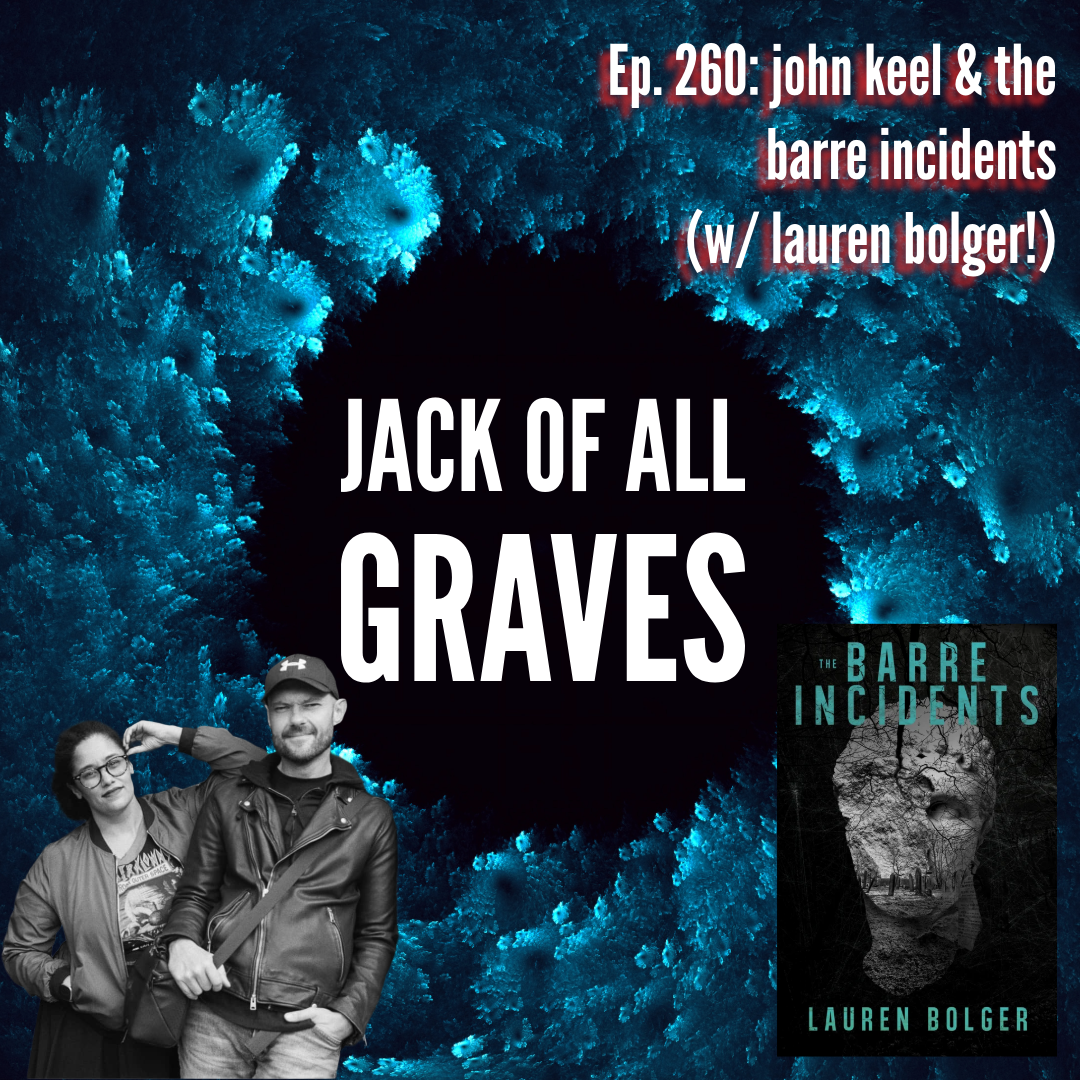
[00:00:04] Speaker A: While I don't tend to introduce the third voice in our cold opens when we have a guest until later on, you know, it's a little bit of a mystery the whole time. I am going to point it out this week for relevance sake, because we've got author Lauren Bulger here and my open this week was triggered by her book, the Barry Incidents.
The Barry Incidents features two folkloric characters near and dear to my heart, Mothman and Indrid Cold.
Old school listeners of Jack of all Graves will absolutely know this, of course, but Lauren, you don't pardon my scratch.
I spent over a year of my life deeply researching everything related to Mothman for a pilot for FX that for some reason, after spending a ridiculous amount of money on it, they decided not to pick up.
I don't understand Hollywood. I'm just a lowly researcher. But I read all of John Keel's books and the websites about him. I read tons of terrible Mothman tomes and watched lots of half assed documentaries.
I went to Point Pleasant and I met with people who were there when all of it went down. I went to their library and combed through all the microfiche from the time.
I probably know more about Mothman and Point Pleasant than the vast majority of enthusiasts because I was looking at the situation sort of from all angles and not just the paranormal ones.
What were the economic and political tensions that were facing the area? Who were these people? What did they see? What did people say about it at the time? How did Mothman end up leaving Point Pleasant and being cited all over the US along with the very creepy semi related smiling man known as Injured Colt?
And I have to say, the way that you presented Injured Cold in this book.
Ugh.
Loved it, man. Just the scariest, scariest possible iteration of this character.
Absolutely loved him. And we can get into more of that later.
But I cannot tell you how fascinating all of this is when you really dig down. Most people just want the spooky stuff though, so they have no sense of the larger picture, obviously.
So all that to say is that today I want to give a little background on these figures that show up in the Barry incidents and on John Keel's theory of ultra terrestrials and the super spectrum, which tie in really nicely to this story as well.
Lauren, while your work on the book, did you dive into Keel's theories and his book the 8th Tower at all?
[00:02:41] Speaker B: I did not.
What I had read? Well, I saw the movie Mothman Prophecies. I feel like a lot of us have.
[00:02:48] Speaker A: Yes, definitely.
[00:02:50] Speaker B: When I read Mothman Prophecies, I was like this. There's so much, like, way scarier stuff in this book than was in the movie. So people. And the movie was good people, like, a lot of people like it. They were creeped out by it. But I was terrified by the book.
[00:03:06] Speaker A: Yeah.
[00:03:07] Speaker B: And it stuck with me.
[00:03:09] Speaker A: Absolutely. It's kind of interesting to me, you know, Like, I think when I first saw Mothman Prophecies, I liked it a lot. And I read the book when I was in college, and, I mean, they both came out when I was in college, or. I mean, I read the book in college and I saw the movie in college because that's when it came out.
But I remember after reading the book and going back to watching the movie, I was like, it's kind of trash. This is not nearly as as interesting as the stories that are in the book or as scary as you say, but it's interesting that, you know, you're going sort of from that because you did a hell of a job of actually kind of stumbling right into John Keel's theories, clearly, without necessarily realizing it in some fantastic ways.
[00:03:55] Speaker C: But would you mind.
[00:03:55] Speaker A: Yeah, go ahead.
[00:03:56] Speaker C: If I dial us back just a little bit here?
You just used a term that I've never, ever, ever heard before. What do you mean by super terrestrial? Not a term of feud. I've heard.
[00:04:07] Speaker A: Ultra terrestrial.
[00:04:08] Speaker C: Ultra terrestrial. Sorry.
[00:04:10] Speaker A: You know what I'm gonna say here? Yeah, okay, we'll get there.
But let me first start by talking a little bit about John Keel himself, for those unfamiliar. And, Marco, I'm assuming that's you. Are you familiar with John Keel?
Yeah, that's what I figure.
He was most well known as the author of the Mothman Prophecies, which was later made into, as we've just discussed, a fairly nonsensical movie starring rich gear in 2002. Nonsensical. If you know the actual story and then you're like, why did they do it like this?
It makes sense if you don't know anything else.
And Keel was an interesting character. According to his biographer, Brent Rains, he was raised in abject poverty in a farmhouse with no electricity, no insulation, an unheated outhouse, and a sulfuric tasting. Well, that house was heated only by kerosene lamps.
And as part of this sort of impoverished upbringing, he never actually finished high school.
He left for New York and never looked back. But people often thought that he had a doctorate because he was knowledgeable as fuck about a wide range of things.
In fact, later on in life, he would receive honorary doctorates in herpetology and archaeology.
It's kind of interesting, herpetology, that's. It's like reptiles, like. Yeah.
Not turtles specifically, but yeah, reptiles.
He's a doctor of turtleology, famously.
But yes, if your autism flags are waving, mine too.
In fact, they wave a lot when one learns anything about Keel and his Point Pleasant counterpart, Mary Higher.
We do not have any information about neurodiversity in these two figures and I obviously can't diagnose them, but I have my theories anyway.
Keel had a super wide ranging career. He was drafted into the army during the Korean War where he became the chief of continuity and production for the American Forces Network.
He then was the special government consultant for the Department of Health, Education and Warfare or Welfare, the Bureau of Radiology and the Air Force Office of Technical Research.
He wrote for TV and radio, including as head writer for Merv Griffin and Gene Rayburn. He was a novelist whose 1966 novel The Fickle Finger of Fate sold almost a million copies.
[00:06:41] Speaker C: You're just burning through stuff. Bureau of Radiology.
[00:06:44] Speaker A: Bureau of Radiology. That's apparently or was a government department.
[00:06:48] Speaker C: Are we talking like X rays or radar?
[00:06:51] Speaker A: I would assume X rays and things like that. Seems like it's a. His work seemed to be largely in health. Medical. Yeah, that kind of general field and technology related therein.
So yeah, but like, yeah, I'm kind of burning through it because he did like a ton of stuff.
[00:07:13] Speaker B: Any of this.
[00:07:14] Speaker A: Right. It's bonkers. This is all, you know, in this biography that this fellow that I just mentioned had written, which is the funny thing about a lot of this stuff with John Keel and all of his theories and Mothman and stuff like that is it's so buried.
Like there's like the main sort of text that you can read on these things and then everything else. You almost have to know they exist to find them. And amongst them is this biography which the showrunner that I was working for at the time had dug up and sent me a PDF of and you know, is really fascinating, but yeah, so sold almost a million copies of his book. He appeared on Carson, on Jack Parr, on Letterman as well as on the game show To Tell the Truth, which I cannot find footage of. And it drives me absolutely crazy. Every now and again I like check YouTube and like, you know, Vimeo and Dailymotion, all those things, like surely someone has posted this somewhere.
Hasn't come up.
But he was a man of many interests and many careers.
He didn't drink, he was super into magic.
He loved performing comedy sketches, particularly ventriloquism. Ventriloquism.
And while all of these things might make him seem like he might be, like, quirky and fun, by all accounts, he was a real mixed bag of funny and charming and a real bummer to be around.
According to Brent Rains, people often described him as, quote, difficult, depressed and negative to be around sometimes.
He would often respond to being asked how he was doing by saying struggling and suffering, which, Mark, he could be friends with you.
[00:08:53] Speaker C: I think I relate to a great deal of what you're saying.
Super fun, super varied, super interesting, super entertaining, but a real downer
[00:09:05] Speaker B: indeed.
[00:09:06] Speaker A: He's a kindred spirit, if you will.
[00:09:08] Speaker C: Yeah, yeah, yeah, yeah.
[00:09:10] Speaker A: See, the thing about John Keel was that he was obsessed with his reputation and with being taken seriously, which, given the penchant for magic, gives some Job Bluth vibes, to be sure, but fine.
He was perpetually frustrated that mainstream ufologists didn't seem to understand him or his ideas.
He felt he was not only being shunned by gatekeepers, but also misunderstood, even by people who were fans of his work.
In the documentary Mothman's Photographer, he lamented that people took his theories on ultra terrestrials and the super spectrum, which we'll get to, literally when he had actually never meant them thus. Which is a wild thing to say about a theory you wrote a whole ass book about.
So I guess you can count me amongst people who misunderstand John Keel.
[00:09:58] Speaker B: It is very confusing, right, guy, come
[00:10:02] Speaker A: on, make up your mind here.
But despite being a bit of a grump, he kept a very close circle of friends and actually really liked people. He enjoyed long phone calls and he valued deep, lasting friendships. And he had plenty of luck with women dating frequently, including TV writer Arlene Stad, ufologist Lyn Kato, and a German woman named Leda, who figures prominently in his book Jadu.
So he may have been a bit of a Charlie Brown, but he did indeed have hoes.
Now, let me just pivot for a little bit and we'll come back to our man.
Let's talk for a minute about Indrid Cold.
And boy, oh boy, like I said, did I fucking love how terrifying he is in the Barry incidents.
I love the idea of Indrid Cold. I obviously don't believe in him, but what a figure. And a lot of people do think this is a real guy, for lack of a better word.
So In November of 1966, a sewing machine salesman in Mineral Wells, West Virginia, named Woodrow Woody Derenberger was returning home From a business trip in Ohio when he noticed what he thought were police lights ahead of him.
However, when he stopped, he realized that these lights were not from a car, but the lights of some sort of aircraft that he described as looking like a kerosene lamp chimney, which is basically, you know, like kind of that, like, bulbous look, like a lantern or whatever. Like a bulbous thing.
[00:11:35] Speaker C: Flu.
[00:11:35] Speaker A: Yeah, a flu. Yes, that's the word I was looking for.
A man stepped out of the aircraft and approached him.
In appearance, he looked fairly normal, According to Darren Berger. He described him thusly. Quote, his face looked like he had a good tan, a deep suntan. He was not too dark, but it was just like he had been out in the sun a lot and had a good tan. He's really, really fixated on this good tan.
His hair was combed straight back, and it was a dark brown. And he seemed to have a good thick head of hair. His eyebrows, his face, his features were very normal. I don't believe they looked any different from any other man that you would meet on the street.
However, while he may have looked fairly normal, he sure as fuck didn't act it.
He kept a huge grin on his face and his arms crossed, with his hands in his armpits. He spoke without moving his smiling lips, Communicating telepathically.
The man told Derenberger he shouldn't be afraid that, quote, we mean you no harm. We wish you only happiness. Then told him that his name was Indrid. Cold freaked out, Darren Berger called the police, and the media went absolutely bananas for the story.
And one of the fun things about this story is that they're actually, like, videos you can look up on YouTube of interviews with Woody Derenberger. Because he was like, if people would listen, he would tell them the story. So he was just, like, all over the place. So you can find lots of fun videos of him talking about this stuff.
And, you know, it's hard to doubt that he's a sincere guy who believes the story he's telling. Some people think that he was just a, you know, liar.
[00:13:13] Speaker C: See, you know, I struggle with that. You know, I struggle with that, right? Whenever. I mean, if you take psychics and mediums, right? So on, I always, always struggle with. There's only two possible outcomes. Either they believe it, in which case they're insane, or they don't believe it, which means they're grifters. And I always kind of worry which is which. And in.
For this guy, you believe it. In this camp, you think he actually believed what he was saying, yes, I
[00:13:41] Speaker A: think he probably did.
He is.
You know, he lost a lot as a result of this, including his marriage.
[00:13:49] Speaker C: Okay, okay, okay.
[00:13:52] Speaker A: So, yeah, yeah, his wife left him because of all of this stuff. And I think that's usually a sign that, like, especially when you're not getting like, paid in any way for this. Like, he did publish a book later on, but it wasn't like a bestseller or anything like that. He didn't really make any money off of all of this stuff. He just really wanted to tell his story. And I've met people who knew him and they largely, you know, say the same thing. Like, you know, he was a crackpot, but, like, he wasn't a liar. You know, he seemed really genuine. And you see that even today, anytime there's an article published about this story, if you scroll down to the comments, there's always going to be one or two people in those comments who are like, I knew him, salt of the earth. He would never lie about things like this, you know. So it seems like generally people largely thought that he was telling his truth.
If you, if not the truth, you know, he's as trustworthy a narrator as you can imagine, even if that doesn't make him a reliable narrator.
So as time went on, Derringer claimed that Cold would continue to visit him regularly, telling him about his home planet of Lanulos and offering to take him to see it.
After a while, he agreed and the two of them went for a visit, where it turned out all the aliens were nudists with super hot bods.
I'm not kidding about that. It was. Yeah, he said they were all like,
[00:15:18] Speaker B: I did not know.
[00:15:20] Speaker A: Yeah, he said they were all like, really thin and fit and that, like, he stood out because he had, like a little bit of a, you know, paunch and whatnot.
I just, I love, like, sweet. Woody is just like so amazed by how these people look. Like, how he kept talking about the tan.
[00:15:39] Speaker C: Tell me again about this planet. Where was it called?
[00:15:42] Speaker A: It's L A N.
You can find it.
Anyways. Yes. So he, he went up there. He made more alien friends with names like Demo Hassan and Karl Ardo. Very like Star wars names.
Pre Star wars, of course. Along with Indrid's wife, Kimmy Derringer would tell anyone who would listen about these events. Events including lots of appearances on the radio.
And as happens pretty much every time a phenomenon is allegedly spotted, others quickly started calling in their own reports of run ins with Indrid Cold, perhaps most consequentially a college student named Thomas Monteleone.
Monteleone was 21 and attending the University of Maryland when he heard Derenberger on a radio station in Washington D.C. and thought it'd be a fun prank to call in and say that he'd experienced the same thing.
He claimed, like Woody, that he'd been taken to Indrid Cold's planet and named several aliens that he'd met there as well.
And Woody, bless him, validated him saying, yeah, I think, I think I might know those aliens too.
This drew the attention of John Keel particularly.
[00:16:59] Speaker C: Happens to me all the time, being Welsh, by the way. Whenever I meet somebody else from Wales, they go like, you must know my cousin. No,
[00:17:09] Speaker A: sure, yeah. It's probably also named Mark, realistically.
But yeah. This drew the attention of John Keel particularly because Monte Leone seemed to know a detail that Keel felt he could only know if he had really encountered injured Cold.
He reported seeing so called men in black who drove a brand new black Buick and slightly threatened witnesses of the paranormal occurrences that had happened, like the Mothman sightings.
These are of course the template for the extraterrestrial investigators at the center of the Men in Black franchise.
Kiel was so taken in by Monteleone's story, he actually included it in the Mothman prophecies and referenced it in several other books.
But Monteleone made that shit up.
That's, that's the kind of thing he liked to do. He would go on to become a multiple Bram Stoker Award winning sci fi and horror author while also continuing to be a giant piece of shit.
Most recently, he was kicked out of the Horror Writers association for being an unrepentant racist asshole A couple years ago.
[00:18:14] Speaker B: I am remembering his name. Oh my. That's, that's what, I know his name. Yeah, right.
[00:18:20] Speaker A: You don't know him from the Mothman story. No one talks about it. He's that asshole.
[00:18:25] Speaker B: And I probably read about him in Mothman Prophecies, but it was like, I don't know, I was like in my 20s.
[00:18:30] Speaker C: Does he still draw breath, this guy? He's still alive.
[00:18:32] Speaker A: Yeah, yeah. Like that literally happened like in 2022 or something like that. It's very recent.
He was born, I think in 1946.
So yeah, he's still kicking around being a dick.
[00:18:46] Speaker C: Incredible to me. I mean, you know, people like Roald Dahl and Lovecraft and Tolkien or whatever all had deeply questionable opinions and leanings. But, but to, to openly espouse that kind of nonsense in 2026, what do you think is going to happen to you. How do you think that is going to impact on your career?
[00:19:10] Speaker A: Yeah, I mean, pretty much. And, and it seems like the way that he flamed out, he kind of knew that would be the case. And you know how these guys are. They just see themselves as then like, then I'm a martyr for my cause or whatever. I'm gonna go on a right wing tour somewhere and be fine. But that's the trajectory of that.
[00:19:30] Speaker C: Go on Rogan.
[00:19:32] Speaker A: Go on Rogan.
Yes, exactly. Kid Rock for sure.
But damage was done, at least to kill personally. Reputationally, it doesn't seem to have made a huge impact. No one really talks about what Thomas Monteleone did.
Most of the time the story is still repeated as if it actually happened as irrefutable evidence that injured Cold and his home planet of nudists and the men in black were real phenomena.
But Keel knew he had been taken for a fool. And those that knew him said that blows to his credible credibility like this would cause him to fall into deep depressions.
The thing about Kiel is that much like Derenberger, it's hard to charge him with being a grifter or hoaxter. He had genuinely dedicated his life to the pursuit of knowledge about the nature of extraterrestrials and UFOs.
He said that he saw his first UFO in Egypt in 1954, claiming others saw it with him. He spent three years traveling through the Middle east and Asia in search of unexplained phenomena, in particular the yeti. He was super fixated in finding out the truth about the Abominable Snowman.
He followed stories of anomalies in newspapers and then would try to travel to experience them for himself, which is what led him to the Mothman.
He had read a story in the Associated Press about a pair of young couples in West Virginia who had encountered a seven foot semi humanoid figure with glowing red eyes and bat wings near what was known at the time as the TNT area.
A press conference was held by the Mason County Sheriff's Office, after which a newspaper editor coined the name Mothman as a reference to the current hit TV series Batman.
Again, once that cat was out of the bag, people started reporting sightings all over the area and folks flooded the TNT zone to try to catch a glimpse of him for themselves. Which by the way, is somewhat crazy to me because if you go to the TNT area, there are like all these little like domed buildings in there where they actually stored tnt. That's why it's called that. And every now and again one would just like Blow up.
And so they would just like be these collapsed domes where like these things just imploded from old tnt. So like that people hung out in there is pretty crazy to me.
[00:21:59] Speaker C: I imagine there's like a Mothman kind of cottage industry around there these days.
[00:22:04] Speaker A: Oh yeah, we'll definitely get there. Yeah, yeah, for sure.
But for what it's worth, looking through the archives, it seems fairly clear that the consensus was it was a sandhill crane. Have you guys ever seen a sandhill crane?
[00:22:19] Speaker C: Oh, one of those big ass beak, terrifying birds.
[00:22:23] Speaker A: No, no, no, that's. I think you're thinking of a spoon bill.
Or not a spoon bill. A hornbill is what you're thinking of.
Yeah, those are awful. These aren't that awful. But they are still terrifying.
But saying this is a real quick way to piss off Mothman enthusiasts because they do not like this theory.
But it was obvious to most.
[00:22:45] Speaker C: Not a bird.
[00:22:47] Speaker A: It's not a bird, it's a Mothman.
[00:22:49] Speaker C: Shut up.
[00:22:52] Speaker A: It was obvious to most people at the time and even became something of a running joke that appeared in the papers over and over again.
When I went to the TNT area, which is now a wildlife preserve, I immediately came across two sand. Sandhill cranes that scared the ever loving shit out of me.
They are huge. They're not seven feet tall, but they are very tall.
They have enormous wings.
They look humanoid. Especially if, say you are partaking in a little of the devil's lettuce, which of course the couples claim they were not doing.
But they have a deeply unsettling gate and, and a habit of taking off straight up into the air exactly as witnesses described.
[00:23:35] Speaker C: I feel as though I could take one.
I'm gonna tell you.
[00:23:41] Speaker A: You go ahead, go ahead and try.
Honestly. Yeah. I don't think you would get some scratches and things like that. I don't know that like, I don't think they're like fighters per se. They just look scary. They look like dinosaurs.
And they also have orangey red eyes on top of everything else.
[00:24:01] Speaker C: It's fun.
[00:24:01] Speaker B: Oh, I, I remember looking up like just large owls because I don't remember where I was just googling around or something. And yeah, there are some, some creepy owls. Like if they're mid flight and their eyes are kind of glowing and then some of the sounds that they make are.
[00:24:17] Speaker A: Yes, incredible. Yeah, 100%.
[00:24:19] Speaker B: But the way you're describing sandhill cream crane, it does sound more in line with.
[00:24:24] Speaker A: Yeah. With what they witnessed. It really kind of sounds like both of those things. It could go either way, I think I lean Sandhill Crane just because that was what a lot of people thought immediately and because I've seen them like just out there walking around.
[00:24:38] Speaker C: I can't, I can't think of another species like an owl where same animal. But they range from the most beautiful, adorable little pocket sized, almost little tiny Pokemon type things to these gigantic, horrific, you know, otherworldly nightmare. Same, same animal.
[00:24:59] Speaker A: Yeah, yeah.
[00:25:00] Speaker B: 101 other thing it makes me think of is before the movie, the fourth kind where there was like an owl was kind of like a stand in for. You saw something horrible that like you were. What was the word? You were like hypnotized out of remembering kind of thing, right?
[00:25:17] Speaker A: Yeah, yeah.
[00:25:17] Speaker B: That really creeped me out because you couldn't picture someone coming up with. It was the same thing as that you're saying about like the claims about injured cold. Like you can't, you can't picture someone making that up. Even though obviously someone made it up for a movie. So they clearly made it up.
[00:25:31] Speaker A: But it was, but yeah, it's convincing, right? Like so, yeah, both of those theories. Owl, Sandhill Crane, things like that are very prevalent around this. Eileen Sandhill Crane. But it could easily be owl as well. The thing about all of this is like you're, you're taking these kids at their word, right? And that's a lot of like where a lot of this comes from is just people being like, they would never lie.
They, they were good kids. They wouldn't have been drinking or smoking out there or anything like that.
[00:26:05] Speaker C: You're like, it feels to me like another one of those cases where we don't necessarily know what it is, but
[00:26:12] Speaker A: we certainly know we know what it's not. Yeah, right, exactly. You know, and I've said many times in here that despite the fact that I don't believe in the paranormal, I'm happy to suspend disbelief and experience things when, you know, I'm in a so called haunted house or something like that. Right. Like we are very susceptible to the power of suggest and a lot of times we want to see something spooky. And I think that's what happened here. You know, a bunch of young people saw a big creepy bird probably at more of a distance than you know, they say they did. They freaked themselves out and they convinced themselves that they'd seen something far more sinister.
I imagine they didn't think they were about to ignite a global phenomenon with their little flight of fancy. You know, most of us have some story of like, ooh, we Went out to the graveyard and we saw this scary thing. You guys remember when we saw that thing and like that's as far as that goes.
[00:27:03] Speaker C: The closest I've come to that. And I'll ask the two of you this. Have you ever heard a sheep cough?
[00:27:08] Speaker A: Oh, you have told me about this, but please tell Lauren about this because I love it.
[00:27:11] Speaker C: It's terrible.
My friends and I as kids, like teens, we would go camping a lot. Right. We lived in quite a rural part of Wales and we would pitch tents and go camping and there is nothing more uncanny in the dead of the night than hearing a sheep outside your tent cough. Because it just, it just sounds like a bloke who's just been smoking cigarettes and then off they go.
So I, I get it, I completely get it. However we were, we were drinking and
[00:27:43] Speaker A: smoking weed and apparently knew there were sheep nearby.
[00:27:48] Speaker C: Yeah, yeah.
[00:27:51] Speaker B: That's wild. And then I can't, I was trying to picture do they have like a hoof or like. But picturing them like covering their mouth excuse.
[00:28:02] Speaker A: Oh my God, that's now in my head cannon of your story, I've added this.
[00:28:07] Speaker C: Did I wake you? I apologize.
[00:28:10] Speaker A: That as well. Sheep. So polite.
But that's such a good example though because like you can also imagine a different group of people being in that exact same tent.
[00:28:23] Speaker C: Yes.
[00:28:23] Speaker A: And a sheep coughing outside and what they go home and they tell people happened. It's entirely different. It's a monster where. Or a ghost or a whatever, you know, it's interpretation. A sheep man. Yes, exactly.
The Tredeger sheep man.
[00:28:44] Speaker C: Well that's another story I don't mind telling you.
[00:28:48] Speaker A: Oh but yeah. Keel became fixated on the story and the continued sightings by others in the area. Along with Woody Darenberger's and Thomas Monteleone's encounters with Indrid Cold.
He was convinced something was really going on here.
In the book he claims he began to hear reports from UFO contactees of some sort of warning of impending catastrophe.
Then on December 15, 1966, Point Pleasant Silver Bridge, which connected West Virginia to Ohio, collapsed in rush hour traffic, killing 46 drivers and pedestrians, some of whom had been Mothman witnesses.
People became convinced that all of the strange activity that had happened in the area was actually meant to warn them.
Especially since the activity largely dried up after the disaster.
Now the obvious reason that report stride up is that the town faced a huge ass tragedy that not only killed a chunk of the population in such a small town, but also crushed their economy in one fell swoop.
No one was making up fun little stories about being visited by a giant moth or a smiling alien or men in black. Anym it wasn't fun.
Imagine calling the police about the Mothman when they're spending their days diving into the Ohio river to retrieve corpses of their neighbors.
[00:30:11] Speaker C: Yeah, after Pen y Van or something similar to the Pen y Van tribe.
[00:30:14] Speaker A: Right? Exactly 100%, which is Lauren A
[00:30:21] Speaker C: Again, a mining Wales way subsidence in a pit overlooking a school just killed some 40 year old children.
[00:30:31] Speaker B: Horrible, horrible, horrible.
[00:30:32] Speaker C: Yeah, but you're not going to blame that on the Sheep man of Wales, are you? You know what I mean? For sake.
[00:30:36] Speaker A: No, I mean I'm sure that there are people who have, you know, legends surrounding Pen y Van and stuff like that as well.
You know, I'm sure there's ghost stories around and stuff like that because that is how we deal with tragedy. But in the immediate wake of one, you know, you're not going to have people making up all these silly fun little urban legends, you know.
So interest in the story didn't really pick back up again until the release of the film, believe it or not. So it was 2002 when people started getting interested in the Mothman again, which was honestly a godsend for Point Pleasant because as you mentioned, Marco, this is a cottage industry for the place which had never fully bounced back from the collapse of the bridge and its impact on the.
Obviously they eventually built new bridges and things like that, but like for a period of time there was no bridge.
And west. This part of West Virginia is like very cut off from like. So across that bridge is a place that it looks like Gallipolis Ohio, but it's Gallipolis Ohio.
[00:31:46] Speaker C: Mega. Briefly, let me just correct myself. It was Abervan, not Pennavan.
[00:31:49] Speaker A: Oh yeah, Aberfan, not Peniven. Yeah, duh.
[00:31:51] Speaker C: Obviously hundreds of.
It was like 140 odd kids, not just like 50 or 60.
[00:31:56] Speaker A: Which by the way, I did consider doing Abervan for this because it related to the minors in the book. And then I was like, no, I need to info dump about John Keel instead. But that was in the list of topics that I considered for Cold Open today.
[00:32:12] Speaker B: And I think they covered that in an episode of the Crown too.
[00:32:15] Speaker A: Oh yes, indeed.
[00:32:17] Speaker C: Yes, yes, they absolutely did. They absolutely did. The royal response was it came under massive, massive, massive criticism for how slow it took them to formulate any kind of response to that.
[00:32:28] Speaker A: Yeah, good call.
[00:32:29] Speaker B: Sad.
[00:32:32] Speaker A: But so after this, this incident, like it really cut them off from like where all of their like commerce was coming from at that point. Like it's not. While there are plenty of mines in West Virginia, this was actually not a mining community or anything like that. So they didn't have anything they were kind of doing in that area. And it shut them off from the ability to travel and, you know, do the kinds of things that actually made money for this little community.
So they hadn't really bounced back from that disaster.
But now tourism keeps the town afloat and it's actually really nice for such a small town now. Have you been there, Lauren?
[00:33:14] Speaker B: Point Pleasant.
[00:33:15] Speaker A: Point Pleasant, yeah.
It's great. I highly recommend it. It's a wonderful little town. It has a big, beautiful park. I think it's called Tuendihi or Tuendui, something like that.
It has murals and sculptures. It has a giant statue of the Mothman with an absolute dump truck ass, probably Mothman's ass.
[00:33:37] Speaker C: Is that from reports or is that artistic license?
[00:33:40] Speaker A: That's definitely artistic license, but it was
[00:33:44] Speaker C: just remember the red eyes and the wingspan and he, as he took directly off from the ground, I could just see these fucking huge cheeks
[00:33:54] Speaker A: Mothman caked up.
But yeah, there's lots of little shops, including several queer owned ones, which is, you know, not something that would have been a thing before in a town that has something like a church for every 12 people or something like that. It's truly wild how many there are.
But let's wrap this up by bringing this back to our boy Keel, who by now we know was largely too credulous and easily, easily taken in by alleged witnesses who are just having a bit of fun, including fellow UFOlogist Gray Barker, who loved launching a UFO hoax and made multiple calls to Keel pretending to be a witness to the anomalies in the Point Pleasant area.
Through all of his experiences studying unexplained phenomena throughout history, he came to a theory, what he called the super spectrum, which he detailed in his 1975 book the 8th Tower on Ultra Terrestrials and the Super Spectrum.
Sikhil had started to think that maybe UFOs weren't extraterrestrials. That is, they weren't space aliens.
The wide range of different UFO phenomena seemed to him to indicate that there was something considerably more complex going on.
Further, he posited there might be some link between UFO phenomena and all kinds of other different unexplained and paranormal anomalies that have been cited throughout human history.
Monsters, cryptids, ghosts, fairies, gnomes, elves, vampires, aliens. What if they were all connected?
What if they were even more what or they don't or they're not real. Is your nose.
You know, Mark, we, we don't need none of your naysaying here.
[00:35:40] Speaker B: One of the words I came across that like, I don't remember where I got it from, which is sound, I sound so knowledgeable when I say that. But in like interdimensional creatures, that was like.
[00:35:52] Speaker A: Right.
[00:35:52] Speaker B: I don't know who coined that term, but that was the one that like googling stuff. That's the one I came across.
[00:35:57] Speaker A: I don't know if it's really. It's similar. So that is probably from another ufologist by the name of Jacques Vallee who had a very similar kind of theory to the super spectrum, except his did posit different dimensions, right? These beings coming out of in it, in and out of different dimensions, which is a little different from what Keel was saying, which I will get to in one second. You'll see what the difference is.
But essentially he was saying, what if all of these things are manifestations of the same thing, different disguises for one overarching phenomenon.
So he referred to these chameleon like manifestations as Trojan horses, their disguises.
As the Axis Mundi blog put it, quote, the unknown reality would change in the various historical epochs. The way of dressing up to intentionally adapt to the historical sort of social and cultural contexts existing in the various historical periods in order to blend in more easily.
Thus fairies and elves for the Middle Ages, because that would make sense to people in the Middle Ages based on their understanding of the world.
Aliens and spaceships for the space age, because that makes sense to us in an era of technology.
This thing is always manifesting itself to people in a way that it thinks that we are going to accept it based on our current realities.
All right, shut up, Mark.
The paranormal entity disguises itself as something that makes sense and that we find credible based on the realities of our age.
Why? Because this entity, which he came to call the super spectrum, wants to control and manipulate humans.
It uses these Trojan horses as a way to keep us in line and make us do what it wants.
So when we think about ghost spirits and other paranormal phenomena, we tend to think about things like parallel dimensions and alternate universes.
Keel, on the other hand, said that these things existed right here with us in our dimension and universe, but on an imperceptible part of the electromagnetic spectrum, the super spectrum.
We can't perceive the super spectrum unless we possess some sort of extrasensory perception that allows us to peer inside.
But all of these phenomena, the UFOs the yetis, the ghosts, the werewolves are ultra terrestrials, Trojan horses created by the super spectrum to enter our world in a way that we can perceive.
[00:38:38] Speaker C: Now if I may. Yes, There's a definite tangential link here to a previous opener that we've done whereby a way of accessing a realm like this is through dmt.
[00:38:54] Speaker A: Sure, yeah.
[00:38:55] Speaker C: All the DMT experiments that we've read about where even in clinical, you know, lab quality, peer reviewed trials, so many people who use DMT report communication with specific entities, right?
[00:39:11] Speaker A: Yes.
[00:39:11] Speaker C: And at a stretch I could kind of get on board with that maybe as something that you can unlock through some kind of endocrine pathway or some kind of fucking, you know, tweaked perception where you're able to receive and send signals to, to another world.
Actual, just extra dimensional beings popping in and taking the form of, you know, what might be more acceptable to them in the time period they choose to pop up in. I don't know, but I think, hey, I'm a skeptic and I don't believe any of this shit, but I'm more inclined to believe that you can alter your brain chemistry in a way that tunes you to that frequency.
[00:39:55] Speaker A: Yeah, I think that's what makes this such an interesting, you know, compelling, if you will, theory. You know, again, it's not something I necessarily, I believe I was gonna say necessarily, as if there's a caveat to that, I don't believe this. But I think what sells it is exactly that, that I think we do understand, you know, like the idea that like there are colors that we can't see. Right? Like we know that that is a thing and the idea that there is some, you know, like through DMT or things like that, that like we know that people have had experiences that are weirdly, you know, synchronistic completely independently of one another, as if they seem to have accessed something that the rest of us don't have access to.
I think that's what makes this so that you can kind of go, oh, I see, I smell what he's stepping in here, right?
Like it kind of makes sense in a, in a weird way.
But you know, again, the idea here is that they, these things are all these Trojan horses, right? They come to us in these disguises and thus they kind of scare us into doing what thing, what they want, what the super spectrum wants, I should say. So everything that we do on this earth is sort of guided by this unseen thing that.
[00:41:10] Speaker B: Only yeah, if you talk in more detail about like what they're like, what. What would.
[00:41:15] Speaker A: What's their purpose?
Well, yeah, yeah, yeah, yeah. It's been a minute since I read the whole book, so, you know, I don't remember him having, like, a specific theory of what they were trying to do.
[00:41:30] Speaker C: Are they malevolent?
[00:41:31] Speaker A: I think he considers them to be somewhat. On a malevolent.
It's kind of like Trickster. Yeah, you will, Right. Like, whatever the goal is, they do maintain control over us in order to get us there. Right.
So they're manipulative is mostly. The kind of thing that he's looking at is like, this whole super spectrum is manipulative of human experiences. So it doesn't necessarily mean, like, I don't think he's putting forth that like, werewolves actually eat us or things like that, but that, like, by bringing these into our sort of reality, they inherently kind of keep us from our free
[00:42:14] Speaker B: will in some way, maybe just for their own entertainment.
[00:42:18] Speaker A: Well, I mean, I know that that does come up in there a little bit too. Like, they're kind of fucking with us. YOLO degree, right? Yeah, exactly.
[00:42:27] Speaker C: The YOLO dimension.
[00:42:28] Speaker A: Yeah. But if you look at it then in terms of like, the Mothman experience, right? Like, then in this case, like, that they were trying to intervene in the case of impending tragedy, right? Like, you know, they're out there like, hey, hey, wait, wait, wait, wait, wait. We know this thing is about to happen. Heads up. Or whatever.
You would think that they would just, like, say it instead, but it's, you know, they're trying to drop all these hints, you know, supposed convergent dreams that they were giving to people about, you know, the bridge collapsing and seeing Christmas presents floating in the water and stuff like that. Like, these were the ways in which these Trojan horses came in and tried to, you know, swerve us away from, you know, this big tragedy. So it's clearly not all malevolent in his eyes, but we're certainly being manipulated by these outside forces.
However, like I said, Keel later claimed that none of this was to be taken literally. And I'm not sure what he means by that. Like, why would you write a whole book about this and then be like, why the fuck did people think I meant that? Like, it doesn't make a lot of sense to me.
But in light of the Barry incidents, perhaps our dear protagonist has pierced the super spectrum and the ultra terrestrials simply aren't fucking having it.
[00:43:48] Speaker C: Let me quote directly from my notes, if I may.
[00:43:51] Speaker A: Yes, please do.
[00:43:53] Speaker C: Fucking look at these nerds. Oh, mise en scene.
[00:43:56] Speaker A: I don't think anyone has ever said mise en scene in such a horny way before the way I whispered the word sex. Cannibal routine. Worst comes to worst, Mark, I'm willing to guillotine you for science.
[00:44:06] Speaker C: Thank you. That's really, really sweet. It's cold outside, but my pancreas is talking to me.
[00:44:11] Speaker B: I'm fucking.
[00:44:12] Speaker C: I'm gonna let it.
[00:44:13] Speaker A: You know how I feel about that, Mark.
[00:44:15] Speaker C: I think you feel great about it.
Yeah, I'll bring us in. I'll bring us in. And I'll start on a note of congratulations to all of our listeners.
Congratulations. Because what you've done is you've made it another week, haven't you? You've made it another week closer, which is in and of itself both a blessing and a curse. Because not only have you managed to make it another week forward, another week, you've progressed in whatever it is your life goals are with your family and with your careers and just with your life, but you've also made it another week closer towards the end, haven't you? You've made it another week closer towards the end of all things, which seems to be racing towards that at a race of knots, at a rate of knots and only getting quicker. I mean, just. We've given up trying to catalog the various ways that the world is falling to shit. I mean, have we?
Well, I think. I think our remit has kind of swerved a little bit back in the early days.
Back in the early days, our kind of.
Our purpose was to kind of almost chart the end times. To sit here with our front row seat and talk about the fucking collapse that's happening all around us. But I think it's happening too quickly for us to keep up now. Do you get that impression?
[00:45:31] Speaker A: Yeah, I think that's valid.
[00:45:34] Speaker C: What do you do first thing every morning? Reach for your phone? I've forgotten what it feels like to wake up of a morning and not be shocked and astounded at the outlandish that has happened overnight while I've been asleep.
[00:45:50] Speaker A: True.
[00:45:50] Speaker C: So what we tend to do now more on a Sunday is just shoot the. About, you know, whatever we've been watching, whatever we've been seeing and however we are taking solace and how we're trying to ground ourselves amongst all this. Because if we were to honestly take a real stab and others are doing it better, if we were to take a real stab in that space at chronicling the end times, it would. It would be completely outdated by the time we'd finished every single episode. I mean, just in the last fortnight, geopolitics, the geopolitical landscape of the world has changed.
You know, energy infrastructure is completely in question, global supply chains, food security, you know, the fucking precarious at best balance of geopolitical power in the world is just swinging to the left and swinging to the right. So at a certain point on Jack of All Graves, we have to just go, yeah, we know we can't really keep talking about that stuff anymore because by the time we talking about it every week, it becomes completely irrelevant and outmoded. So instead, this week, a treat.
A treat, dear listeners, A treat, a guest. And oh, my word, do we love to have a guest on this show. It is always a privilege, it is always a treat. It is always so validating and just such a gift that we have guests who will give up their time, give up a little chunk of their very, very, very precious free time to spend an hour or so with Corrigan and I here on Jack of All Graves. Which is why it is such a delight.
And I mean, I wouldn't say it if I didn't mean it. I sincerely mean it is an absolutely delight to welcome to the show Lauren Bolger, author, drummer.
[00:47:47] Speaker B: I've never been in a band, but I do drum for fun.
Yeah.
[00:47:51] Speaker C: Do you?
[00:47:52] Speaker A: That's a drummer.
[00:47:52] Speaker B: I'll say drummer.
[00:47:53] Speaker C: I'm a drummer again, a huge intersectionality of my passions. Yeah, I love to read and I love to listen to music. Do you mind me asking what kind of drummer you are? What kind of stuff you listen to? Do you mind me asking him what kind of stuff you're into?
[00:48:06] Speaker B: Oh, sure. It's all kinds, but rock and mostly. Yeah, I would say rock. I like to do like the band Ghost, which Corrigan and I have talked about a little bit here and there on social media.
[00:48:19] Speaker A: Yes, Mark is who got me into Ghost initially.
[00:48:22] Speaker B: Oh, cool.
[00:48:23] Speaker A: Yes,
[00:48:26] Speaker B: we are all Ghost fans of
[00:48:29] Speaker C: some of the greatest gigs I've been to, maybe the top 10 gigs I've ever been to my life. Ghost at like six of them.
They always deliver, man. They always deliver life.
So I was delighted to have you along on the show in the first place, but now you've just dialed that up by a factor of 10.
So, yes, we are delighted to have you and you are most welcome to Jack of All Creeps this week.
[00:48:53] Speaker B: Awesome. Thank you so much. Yeah, I've only seen them three times, but they were. Yes, they were incredible.
[00:49:00] Speaker A: Only in the Ghost fandom do you say only three times.
[00:49:03] Speaker B: Right, exactly.
[00:49:05] Speaker C: Did you Catch the show where you had put your phone in a little pouch.
[00:49:08] Speaker B: Yes, I did one of those. That was last.
[00:49:10] Speaker C: Really something.
[00:49:11] Speaker B: They came twice to our area last year and we just went once. But, yes, we did have to do the phone pouch there.
[00:49:17] Speaker C: It was intense, wasn't it? Just the spectacle of the whole thing. It was wonderful.
[00:49:22] Speaker B: It was. It was like. I didn't know how I was going to feel about it, but, yeah, it was. It was really nice not having to feel like you had to document everything because you could be there.
[00:49:31] Speaker C: Beautiful collective experience.
[00:49:33] Speaker B: Yeah. And they sent you these, like, really cool, like, professional shots afterwards. So it was like, oh, well, those are better than anything I've taken seriously.
[00:49:43] Speaker A: I try to do the thing where I, like, limit myself anyway, where it's like, okay, I get three little videos or whatever, and then I have to put my phone away and, like, you know, just live instead of being like, oh, it's like. It's not like I sit there and, like, watch them all the time or whatever. But, like, I do like to have a little memory of what happened.
But it was like, it wasn't that big a deal. As a result, a big argument you'll
[00:50:06] Speaker C: often hear from people about phones or gig is, well, you're never going to look at them anyway. But I do. You know what I mean?
[00:50:10] Speaker A: Well, you do go back and revisit.
You absolutely do.
[00:50:14] Speaker B: What I really like is Tobias Forge explaining why. And he was telling the story of, you know, how he, like, Cerises. Somebody, like, some fans might, or people listening might not know. But, yeah, he'll, like, hold his hand out and, like, hold someone's hand while he sings Cerise, which is probably their most. Well, at some point, it was their most popular song. But he was doing that once and then they were. With their other hand, they were holding their phone up and putting it in his face and he was like. It was very strange.
He was not a fan of that.
[00:50:47] Speaker A: Yeah.
[00:50:47] Speaker C: But it just adds just another layer of lore and mystique to the band. And as. As someone, as I'm fond of saying, a trained dramatist. I've got a drama degree and I love stagecraft and I love plays and whatever and just the production of the whole thing, it is the grandest of spectacle and it's such a treat. Oh, God, I love it so much. I'm so pleased to have you on the show, Lauren.
[00:51:11] Speaker A: We're already besties around here.
[00:51:13] Speaker B: See,
[00:51:17] Speaker A: Lauren, you wrote the book that I have referenced several times already, the Barry incidents, which we read for Book club a few weeks ago.
One that I had a great time with, you know, and just connected with on a lot of different levels.
One thing that I connected with it as was sort of as a New Englander, I'm from Massachusetts originally, and this takes place in Vermont.
However, from what I understand, you have, Barry is a real place.
You have never actually been there, which was wild because it felt very legit to me. I grew up in a small town. I live directly in front of a cemetery. This was my. Kind of spooky all the way through.
But why Barry?
[00:52:06] Speaker B: So when I was trying to decide just what. What book do I do next? I do a lot of just looking at interesting places, trying to find somewhere where I can insert some kind of supernatural something.
And I did, like, as I wrote it, I was mapping out some actual real locations in the town and just kind of I'll, like, doodle it and draw it or just, like, print it out. And so there are locations there that are real, like the granite quarry and Hope Cemetery. Those are two real places.
And then additionally, if you remember, there's, like, this workshop where the.
Why am I.
[00:52:49] Speaker A: You can't remember your character's name?
[00:52:53] Speaker B: Yeah, one of them bit it, like, a long time before the story takes place, and then the other one is still alive. But there. This is based on a real workshop where.
[00:53:03] Speaker A: Oh, wow.
[00:53:04] Speaker B: There are a lot of things that are done mechanically now or with machines like these when they carve these monuments, but there is one. Well, as of I last read, he was still doing this by hand. And. But then again, when I read it, I think he was in his 80s. It was his article.
So since then he's much older, and I don't know that he's still doing it, but there were pictures of his workshop and he was just kind of describing why it's, you know, why it's better to do it by hand. He had a lot more connection to the old way of doing things. And again, just like, lots of photo photos of his workshop, lots of just figures, you know, not. Not alive figures all around him in this crowded workshop. And it just, like. It was very.
[00:53:49] Speaker A: Just jumps out. You're like, yeah, no, this is. This is a spot. What do you do to find, like, is there, like, are you combing, like, Atlas Obscura? Or like, what is it that draws you to places? How do you find them?
[00:54:00] Speaker C: That was exactly my question. In fact, if Bari is a place that you've never actually physically visited, what goes into the research process about that place to make sure. That it feels authentic to people who perhaps have been there.
[00:54:18] Speaker B: Read the book. Okay. To make it feel real. I can't remember how I first came across it, but part of what I do as well is, like, some of these places in the book are places that I really worked or places I've been around here, like, where I work.
So the. The restaurant that, you know, that is in the Barry incidents. It's literally. I'm just describing a restaurant I worked at when I was in my 20s.
It's called long Grove Cafe, and it's in Long Grove, Illinois.
But there's like, the covered bridge is really there. And then, like, I'm just picturing them going into the restaurant and back into the kitchen. So, like, everything they're doing in my head is, like, in a real kitchen that I used to be in and wait tables in that restaurant. So that place was, like, real to me. Because it was real.
[00:55:06] Speaker A: Right.
[00:55:06] Speaker B: I was actually.
But it wasn't actually in Barry. So I do kind of these, like, transplants for some of these places.
[00:55:13] Speaker A: Like, there's some elements that are kind of universal. It doesn't really have to be that you're.
[00:55:18] Speaker C: Yeah. Restaurants, isn't it? Yeah.
[00:55:20] Speaker A: Right. Yeah. I mean, have you spent any, like, time in New England in general?
[00:55:25] Speaker B: Not. Not. Not a lot, but I don't know. I do know, like, I watched a lot of videos as well.
[00:55:32] Speaker A: Yeah.
[00:55:32] Speaker B: Like, you know, of Rock of Ages Quarry. They. They were doing tours there, and I think they recently stopped. I don't know that they still do tours, but I was kind of like, you know, watching videos of some of the tours of. Of what I could see, like, looking a lot of pictures of, like, all the different angles of the quarry and then that, like, gorgeous, like, turquoise blue water at the bottom. I don't know, just like a whole, you know, lots of that. And then they have, like, a little.
What do you call it? Like, a gift. I don't know if it's a gift shop, but it's like a little indoor area where they have a lot of things on display.
[00:56:05] Speaker A: Like an interpretive center. Yeah. Something of that nature. Yeah.
[00:56:09] Speaker C: Did he get much in the way of feedback from residents of Barry to let you know that you. You'd nailed it? Did you get. Did you get much in the way of tactile response from people from that
[00:56:19] Speaker B: area that I didn't? It's interesting because I know there was somebody that was. From Barry that I think wasn't. You know, they. They wished it was more true to it, and that Made me feel like what I'm doing for my next book is I'm actually doing the opposite. I'm, like, writing it based off of a place I've been multiple times and renaming it just to be, like, you know, if you. If you've been there, I don't want you feel like, you know.
[00:56:44] Speaker A: Right.
[00:56:44] Speaker B: So.
So, yeah.
[00:56:47] Speaker A: I think that's interesting, though, like, to. I was thinking about this earlier, just the idea of, like, you know, the way that you go about researching something like this or whatever. Like, obviously there's artistic license to this, even if it was, like, your hometown. Right. And so I was curious, like, whether it's Barry itself or kind of the mythology that. Using this. Because this is a book steeped in all kinds of mythology from various sort of walks of life and world religions and things like that. I think you yourself are Jewish. Right. And that obviously comes into this story as well.
And, you know, I. I was curious, like, to what degree you're like, oh, I've gotta, like, dig deep into this lore and get it right. And to what degree you go like, this is just. This is a frame and it's my story.
Like, how does that work?
[00:57:38] Speaker B: Yeah, I was. I was very. Like, I. I tried to be realistic to a point, but, yeah, it. You do reach the point where you're like, I need to research this more. I need to research this more. And then you get to the point where you're like, if I keep researching, I'm never gonna finish.
[00:57:53] Speaker A: Right.
[00:57:53] Speaker B: So that's kind of what I. I guess I. I researched to a point. But.
But, yeah, I kind of tried to. I think I. I hopefully did okay. Like. Like melding all these concepts, but a lot of things, it was just like, well, what if this and this were connected? And, yeah, again, taking a lot of the things that did happen in Point Pleasant, the fact that Mothman is something that's been cited or something like it has been cited, like, all over the world. And just being like, well, it could happen here, too.
[00:58:23] Speaker A: Yeah, Yeah.
[00:58:24] Speaker B: A lot. A lot of the. I think pretty much any, like, Legend, Titan thing that's in the book did not necessarily happen in Barry. So all these things were, like, arbitrarily.
[00:58:37] Speaker A: It's your hellmouth sort of situation here. It's just kind of like, this is
[00:58:41] Speaker B: where things hanging out here.
[00:58:42] Speaker A: Yeah, right. They all. They all come here. It's the watering hole for whatever else exactly is going on. And I like that concept. I mean, you know, obviously, I like digging deep into researching things and whatnot, but I. I think, think one of the things I really like here is that I didn't feel like, oh, I need to be like a, you know, student of Norse mythology to understand what is going on here. And it didn't. Like, you didn't waste time, like, explaining every element of it to me.
And that is something that I really appreciate because I think a lot of times, like, I'm not a fantasy reader, you know, nor is Mark.
And a lot of the, like, thing is, it's like, I just. I don't want to.
I don't want all of this explained over, you know, thousands of years.
Yeah. Thousands of years of world building of who begat who and blah, blah, blah, blah, things like this.
[00:59:36] Speaker C: And I felt like a colossal fan of just the book, trusting you enough to just mention whatever crazy law or tech or whatever and just you. You assimilate into the story and move on. I don't think there's any need for that kind of bit by bit explanation of what a thing is, which I really respond to.
[00:59:56] Speaker A: Yeah. Which I think is one of the things that you do so well in the Barry incidents is kind of like, trust that we're like, we're along for the ride.
We get where you're going with this and can kind of like pick out how these things work, you know.
And I saw someone in this was a few weeks ago that I had read this. Every time we read a book for book club, I tend to read like, storygraph reviews and, you know, things like that. And. And someone had pointed out, like, when it comes to the characters within it especially, I can't think of. I looked up how to pronounce it at the time of book club and now I can't remember. Is it like the one. It's spelled like nidhogg. But that's not how you say it. Right.
[01:00:41] Speaker B: That's how I've been saying it.
So I like, oh, crap.
[01:00:47] Speaker A: Well, great. That's wonderful.
I feel better about it. I spent. I do this with this podcast all the time too, is that anytime there's something vaguely I might not be able to pronounce, I go on YouTube and watch like 30 videos to see what the consensus is of how you say it. And there's a guy who, like, just has a video, like, pronouncing Norse shit.
Because it's essentially like a loss. Not like a lost language per se, but, like, the pronunciation. It's like Latin. Right. Like, nobody knows actually how you're supposed to pronounce Latin, but this is what they Think of this. And I think it's supposed it's something like he said, like, Nidhogg or something like that. With this, just FYI, I can send you the video if I can find it again. But regardless, the person had pointed out that Nidhogg. I'll say it. The way you wrote it speaks is entirely different from the mindset of the rest of the book.
And you very much, like, see, you know, this, like, loathing that is, like, very inherent in there. And I don't know, the strategizing and all these things going on within the mind of this character. And what is it like for you to write, like, all right, this character.
This character is doing something different. How do you get into, like, the head of that character and write in a totally different voice?
[01:02:11] Speaker B: It almost. I feel like that one almost flows better for me.
[01:02:15] Speaker A: Okay.
[01:02:15] Speaker B: Because it's. It feels like. Like, almost like you're tapping more quickly into some sort of, like, creativity because you feel more. A little more limitless because this is like this ancient creature. And I don't know. I don't. I don't know. I don't know why, though. I just. It's. It's very enjoyable to write in that voice. And then I think I also.
The first, like. Like, Alex Woodrow, she, like, edited the book. And I remember there was. I had another character who was speaking similarly, and she was suggesting, like, you might just want to have the one like that.
[01:02:52] Speaker A: And I was like, I think I
[01:02:53] Speaker B: did that by accident.
[01:02:55] Speaker A: I was just having so much fun.
[01:02:56] Speaker B: Yeah. I was just like, this was. This was really fun for me, but I don't know why. It feels like it flows easier. But, yeah, she's. She's real angry, and it's.
[01:03:06] Speaker A: It's fun.
[01:03:07] Speaker B: Maybe it feels like you can more loosely, like, vent some anger or something.
[01:03:11] Speaker A: Right.
[01:03:11] Speaker B: Or something. And I don't think. I think I'm. I'm. I made her like a lady.
Not a lady person, but a lady creature.
[01:03:19] Speaker A: Right.
[01:03:21] Speaker B: But yeah. I don't know why it was so much fun to write, like, her in her voice.
[01:03:25] Speaker C: Someone I'd love to ask, when it comes to Barry incidents and the horror is something uncovered. Right? Something uncovered through, you know, mine and the exploration and so on. It's something the characters actually happen upon.
Is it.
Is that a tenet of your belief in what makes good horror in that horror is something the characters discover as opposed to something external that discovers them?
[01:03:58] Speaker B: Oh, that's a good question. Oh, my gosh.
[01:04:06] Speaker C: Take something like. Take something like hellraiser for example. Right. They summon the Cenobites by about with the box and being all pervy. And they find the horror right through. Through kind of no fault of their own. But it's a bit hacky. But let's take Elm Street, Freddy is something that comes for you.
[01:04:22] Speaker B: Yeah.
[01:04:23] Speaker C: Where do you stand on that? Or is it not as binary as that? Do you think the characters happen upon the horror by mistake, or is it a malevolent force that seeks them out?
[01:04:34] Speaker B: Oh, that's a good question. I. I really like. I think both ways are awesome because it's like. And. And it feels like they could both say something different about it. Where it's like. If you seek it out, it's like you had this coming.
[01:04:52] Speaker C: Around. Find out. School of Horror thinks.
[01:04:56] Speaker B: But then if it just shows up, it's like, what does that mean?
I don't know which. And which is creepy. Or maybe it depends on the situation.
[01:05:04] Speaker A: Yeah.
[01:05:05] Speaker B: I don't know. I. I always had this fear of, like, looking out the window when it's nighttime. Like, I don't. And this is. This is a tangent. Sorry.
[01:05:16] Speaker A: Do it.
[01:05:16] Speaker C: That's what we're all about.
[01:05:18] Speaker B: What was that? It was like a trilogy. And it was like the. Those stories, scary stories.
[01:05:24] Speaker A: Oh, to tell in the dark.
[01:05:25] Speaker B: Yes. Thank you.
[01:05:26] Speaker A: Yes.
[01:05:27] Speaker B: But there was a story called the Window, and it was like this girl, and, like, all she did was look out the window at night. And she was like, well, she's screwed now because that thing keeps getting closer. And then.
So that one is like. Did it just come to her? Or is like. What if she looked out the wind? I don't know.
[01:05:46] Speaker A: Totally. I mean, it's kind of the. Like. It's the thing where you pull the sheets up over your face when you're in bed. Right. Like, if I don't see it, does it, like, not come for me?
[01:05:56] Speaker B: Right.
[01:05:57] Speaker C: Corrigan has a fantastic technique on this. If I share a video with her that's spooky, what she'll do is she'll look at it, but she'll kind of unfocus her eyes a little bit so she doesn't have to see it properly, which is so innovative. Such a great way of dealing with it. But I know what you're saying. It's kind of like the tree outside the window in Poltergeist. It's the clown on the chair, isn't it?
[01:06:18] Speaker A: It.
[01:06:18] Speaker B: It's kind of.
[01:06:19] Speaker C: Oh, shit. Shit, shit, shit, shit.
I. Apologies if this sounds a bit hacky. Right. But I'd love To know.
Can you pull on the thread and trace the career path that you're on now? The, the horror creation that the, the pathway that you're on now to anything that happened as a childhood? Was there a moment as a kid when you thought, I've got to write about this stuff. I've got. I. I must create horror. Was there something that, was that a catalyst for you?
[01:06:49] Speaker B: That's a good question.
I don't know if there was like a specific event necessarily. There was. I was like obsessed with ghosts when I was a kid. Like I.
Everything. Yeah. If something moved, if I left something somewhere, I forgot that I put it there. It was a ghost. Put it there.
[01:07:04] Speaker A: Yeah.
[01:07:05] Speaker C: Do you mind me asking, are you a. Are you a spiritual agnostic or a believer or are you kind of a realistic.
[01:07:12] Speaker A: I'm like, what a way of putting it.
[01:07:15] Speaker C: Well, you know what I'm saying? No shame.
[01:07:18] Speaker B: I just, it's like, I feel like I don't know anything.
[01:07:21] Speaker C: Okay, okay. Okay.
[01:07:22] Speaker B: And I don't.
But is it like, are we thinking like religion and like, spooky stuff or like all of it?
[01:07:31] Speaker C: Well, anything beyond the kind of, you know, the solid realm, the stuff we can see and touch.
[01:07:37] Speaker B: I think I would say agnostic then, because, like, I don't, I don't think any of it's real necessarily. But like, I think like Corgan was saying, like, I love to entertain anything that's.
[01:07:48] Speaker A: That can be entertained 100%. Yeah, it's like I, I, you know, we've talked about this quite a bit and kind of the, like, what would it take to be convinced of something? And I think probably my barrier to entry is lower than Marx would be, but it's is high nonetheless. But in the right circumstance, I'm, I'm on board to at least act like I think it's happening.
[01:08:13] Speaker C: Whereas I've always been of the mind that literally everything can be explained somehow. There's always an explanation and it's never ghosts.
[01:08:22] Speaker A: But to your. You were saying to the question mark asked about this thread. So you are spooky kid. You like the ghosts?
[01:08:29] Speaker B: Oh, yeah. So one of the things that I did was I read Wait till Helen Comes by Mary Downing Hahn. Yeah, it was so. It was.
[01:08:38] Speaker A: Loved that one. Yes.
[01:08:39] Speaker B: And then I, I wrote a story, like a full short story in second grade with like, like a little, these little illustrations, and I basically just copied that book. But like, at the time I was like, this is original.
[01:08:53] Speaker A: But I did the same thing.
[01:08:55] Speaker B: Yeah, it was, it was so much fun because yeah, you get inspired by it and then you just slowly learn, like, what's the difference between, you know, copying something and being inspired by it and doing something that's kind of actually your own? So.
[01:09:10] Speaker C: And what was your teacher's reaction in school when they realized that you were on the spooky path?
[01:09:15] Speaker B: I think it was good because there, it was like some, I think they, there was some sort of contest that I won because I think it was like, yeah, like, if you're really into it, I guess they can just tell versus if you're just like, like, I don't want to do this.
I guess I was in the. I really wanted to do this.
[01:09:33] Speaker A: Right, so you kind of supported from early on in this trajectory.
[01:09:37] Speaker B: Yeah, yeah. And I don't remember, like, if the teacher said anything like, oh, you like that stuff, huh?
[01:09:43] Speaker A: What about your family? Like, is your family into like horror and things like that?
[01:09:50] Speaker C: Is it a religious kind of community you're in? Are they a God, God fearing kind of family that you have?
[01:09:56] Speaker B: Oh, good question.
[01:09:57] Speaker A: So what, what kind of Jewish?
[01:10:00] Speaker B: So for me, the second my parents were like, you have to pay for your own ticket to attend Yom Kippur services, I was like, cool, I'm opting out. So I, I'm not like, I don't practice at all, but my parents do still, like go to temple and they, you know, and we, we do like, we celebrate the holidays and stuff. Like we'll eat together for Passover and celebrate Hanukkah, like all that stuff. But my dad does. My dad is a horror fan. I think that was in the question.
[01:10:28] Speaker A: Yes, it was.
[01:10:30] Speaker B: My dad's into horror. My brother likes horror. And then my mom is like, no, she, she's read my books but doesn't watch. Yeah, it was. And there was one time she read something that was like horror and she was like, that wasn't scary. I was like, oh, this is really good feedback.
[01:10:48] Speaker A: Your mom, who can't handle it, doesn't think it's scary. You're like, exactly back to the drawing.
[01:10:52] Speaker B: I can't remember what it was. Maybe like a short story or something.
[01:10:55] Speaker A: That is so funny.
[01:10:57] Speaker C: As an author, do you have any kind of red lines that you won't cross when it comes to, you know, gore? And is, is there. Have you ever, have you ever had to kind of self check yourself? Oh, this is too far.
[01:11:12] Speaker B: That's a good question too.
Not that I can think of because like a lot of time, times if I'm going to submit to a place I'm trying to think. Is there anything where, like. Because you can sometimes tell, like, they'll tell you their guidelines and they'll be like, know this, know that. So a lot of times they'll be like, no. Splatter punk. No. Like, I'm trying to think of, like. Like over the top, like, violence, like.
Right. You know, certain kinds of violence that are not okay. A lot of times I don't think I hit any of those where I'm like, oh, they're not going to want to see this because it's too much.
So I don't. I don't know. Like, I. I do get pretty gross sometimes. But.
[01:11:57] Speaker A: Yeah, I mean, everything that happens in this book with your Indrid Cold character is amongst just like, some of the most horrifying things that I have read. It's just like, Jesus Christ. Oh, my God.
[01:12:10] Speaker C: What a compliment.
[01:12:14] Speaker A: Yeah, so it's certainly. It definitely gets gross, for sure.
But I mean, when you. When you think about, like, what you like to read or like, the horrors in your head that you want to put on the page or that you want to read yourself, like, are you still largely drawn towards ghosts? Because I gotta say, I was like, Marco said something earlier about, like, you know, the ghost miners or whatever, and I. I literally. When I got to the, like, first appearance of the ghost miners in the book, I literally, like, got like a chill. And then I went, oh, fuck. Yeah. I was like, this is my shit right here.
And is like, is that still your. Like, mostly you're like, you're a ghosty girl at heart or, you know, do you have, like, a broad range of like. I want to explore every type of horror.
[01:13:03] Speaker B: Oh, good. That's a good question. Yeah, I. So it's weird because, like, I was so into ghosts and a lot of times now when I write, it's like, not necessarily ghosts, though they are. And then additionally, the Kill Radio had, like. It had ghosts in it, but they're not like, the main event, I guess.
[01:13:24] Speaker A: Sure. Yeah. It's always like a lingering element in the books. Yeah.
[01:13:29] Speaker B: Yeah. And. And then it's also like, I do feel like it's easier to explore gross stuff when you're writing versus in a movie. Because, like, for example, like, I watched Mother of Flies recently.
[01:13:43] Speaker A: Oh, yeah. I haven't gotten to that one yet, but I. It's on my list. Adam's family. Yeah.
[01:13:48] Speaker B: Like, yeah. And it's like I'm trying to think about it and I'm thinking, like, if I read it, I almost think if I read It. It would be easier to.
It would gross me out less because you can't see the like.
[01:14:00] Speaker A: Right.
[01:14:01] Speaker B: Viscera.
[01:14:02] Speaker A: Yeah.
Also that's good to know about Mother of Flies that it gets that gross. I mean, movies tend to get pretty gross, but, you know, good to know in advance.
[01:14:12] Speaker B: Yes, I'll try not to. I'll try not to, like, talk about it too much. But. But Mark, I think that's like, part of. Part of it. It's like. It is easier to be more gross, I think, because I'm writing instead of like having someone, like, look at the real thing.
Sure, yeah. I think.
[01:14:27] Speaker C: Which was kind of my next question. I mean, I am going somewhere with this, trust me. But I mean, I've had friends who've worked in like cake factories and chocolate factories, and I found that those people then can't be around cakes or chocolate. Are they still.
Are there still works of horror fiction, be they movies or books or whatever, that get to you? Are you, Are you as an author, are you still susceptible to a scare?
[01:14:55] Speaker B: Yeah, yeah, I totally, totally am.
I think, like, that's what, like that I do get so excited, like when something. When something does scare me.
[01:15:05] Speaker A: Yes.
[01:15:06] Speaker B: It's. It's like more meaningful maybe. I don't know. Yeah, but like, when I watched like Hereditary, that one, like, scared me.
[01:15:12] Speaker A: Oh, you're speaking his language right now. Oh, yay, he's gone.
[01:15:20] Speaker B: That one scared me for like a month.
Did it scare you too?
[01:15:27] Speaker C: I don't want to derail the podcast. Right. But I. It is such a thrill, a thrill to me when you are watching a movie and you know, even before the movie is over that you are watching something very, very special.
And as a 47 year old die hard gorehead. Right.
I finished Hereditary and I turned the light off and I fucking ran upstairs to bed in case the gribblies got me. You know what I mean? Absolutely. And I knew right then that this was one for the old timers. Do. Do you do any come to mind like that that have had that effect on you?
Hereditary?
[01:16:03] Speaker B: Oh, let's see. Other, like, movies or books.
So for books. Ghost Story was a big one for me by Peter Straub.
[01:16:13] Speaker A: Oh, okay. Yeah. Classic.
[01:16:15] Speaker B: Did you read that one When I
[01:16:17] Speaker A: was much younger, yeah.
[01:16:18] Speaker B: Oh, yeah, that one was so good. And like, he. The way he builds the tension is like, he doesn't. You don't realize he's doing it almost until like. And then there's no, like. Well, no, there were a couple. There was one part that like, it it was like. It shocked me. Like, you're reading it, but it shocked you. And it's like, how do you do that in a book? Like, movies have jump scares. Like, do books? I don't know.
[01:16:41] Speaker A: It's a really good question, actually.
[01:16:43] Speaker B: Yeah. You're, like, reading and then this thing happens and you're like, like, what the.
So Ghost Story had a moment like that. Like, I don't want to. I don't think I should describe it just in case somebody wants to read it and then be startled.
[01:16:56] Speaker A: Yeah. Have that experience they haven't had in years as horror fans.
[01:17:01] Speaker B: Yeah, yeah, that one. And then I'm trying to think of what else for movies. I mean, I still. There still are ones since Hereditary that have been scared. Oh. Oh, okay. So it's really weird because I watched both of these with my dad and they were very weird to have watched with my dad.
[01:17:18] Speaker C: Your dad is the last fan, isn't he?
[01:17:19] Speaker A: Yes.
[01:17:20] Speaker B: Yes. Yeah. So, like, we were still. I was like, in my 20s or 30s, I can't remember, but we were watching. We saw Hereditary in theaters together. And the ending is so disorienting. There's like. And there's even, like, a bell ringing in the background when all this crazy stuff is happening and you're just like, what the hell is going on?
And, like, you didn't even know. I didn't even know how I felt about Hereditary until I had, like, an hour or two for it to sink in. I think. Think, like, I knew I was scared, but I also knew, like, the very. The ending is, like, to me, disorienting. Like when they go up in the tree house and it's just the strangest, which is great, but at the time I was just sitting with my dad and we're like.
[01:18:02] Speaker A: I love.
[01:18:02] Speaker B: That is another one that I watched. This was like, I watched with my dad.
[01:18:07] Speaker A: And that's so funny.
[01:18:08] Speaker B: Subject matter. Yeah.
[01:18:10] Speaker A: Did you know when you were going in?
It was horrifying, but that's great.
[01:18:16] Speaker B: There's also that jump. Like the jump scare of where, like, her friends don't believe her yet. And the thing is visiting her again. And now she knows because it came in her own house and her friends are there, and then she gets chased upstairs. And then someone knocks on her bedroom door, and it's her friend.
So she's like, her friend is there. It's just her friend.
And then that.
Well, I don't. I don't want to say because people
[01:18:43] Speaker A: haven't seen it, but. Yes, I know. Exactly.
[01:18:46] Speaker B: And you're like, we are not safe at all whatsoever.
[01:18:51] Speaker A: Yes, absolutely. I love that.
[01:18:54] Speaker C: What a deep thrill it is to have a guest who loves Ghost and Hereditary.
You fit right in on this cast.
Where have you been for the past six years? This. This is amazing.
[01:19:05] Speaker A: Well, especially with the love for Hereditary, because he has to deal with me not liking that movie, so, you know, he might replace me with you.
[01:19:12] Speaker B: You know what, though?
A lot of my friends, like, I've had to, like, I've made. Had the same argument where I'm like, no, it's amazing. And they're like, they are not fans. Like.
[01:19:22] Speaker C: Yeah, what are you not seeing? I can't understand what you're not seeing.
[01:19:26] Speaker A: Right. It's the we seem to be watching different movies issue.
[01:19:30] Speaker B: No, but. Well, the thing with Hereditary, too, like, you were talking about something like, something outside your control, just, like, controlling your. What you're doing.
[01:19:41] Speaker C: There's a lot of external forces coming in, isn't it?
[01:19:44] Speaker B: Yeah. Because there's, like, the dollhouse in the movie, and she's, like, creating these, like, things and, like, controlling them. And then, like, this is what is being done to them, her and her whole family for, like, her. Since before her daughter was born, they'd been, like, controlling everything.
I don't know. Anyway, I read too much about it after the movie.
[01:20:06] Speaker A: Oh, you know, that's a good thing. That's a good thing.
[01:20:09] Speaker C: Sure, sure.
[01:20:10] Speaker A: But interestingly so, now, I assumed because of the way this book was written, that you were a member of the Dead Dads Club, which you clearly are not.
[01:20:19] Speaker B: Your.
[01:20:20] Speaker A: Your father is with you, which is wonderful.
One of the things that I actually really loved about this book as a Dead Dad's Club member, was that storyline involving her. The death of her father.
And the really. The thing that really struck me about this, and we talked about this in book club, is kind of the way that what is happening that they're uncovering on this, like, supernatural level in the town really kind of parallels the character dealing with her father's death and this idea of, like, you know, your dad dies, you don't know how to deal with it, but life goes on as yours is unrecognizable and collapsing. Right. Like, this is a small tragedy in the grand scheme of things that, like, you know, you're going. I likened it to sort of the. The famous Buffy episode, right? Where her mom dies and. And, like, you know, like, life. She's kind of commenting on the fact that, like, life is, like, just going on when it should stop. Right, sure. And in this book also, this sort of supernatural story that's going has like these catastrophic ramifications potentially, but for a very small group of people. Right. It's not a world ending collapsing event that is going on here.
And I thought that was such like a really cool way of kind of paralleling the grief. And I don't know if you did that on purpose or not, but I really found that to be like kind of a moving way of dealing with the death and this story here of her grief going along as she's uncovering this. I don't know, was that intentional? Is that sort of coincidental the way
[01:22:02] Speaker B: that it was unintentional for it to be like that parallel? And I love that though.
That's really cool. And I'm sorry for your loss.
[01:22:12] Speaker A: It's been many moons, 15 years now, so it's not a freshman fresh wound, but thank you.
[01:22:18] Speaker C: She calls it the Dead Dad Club.
[01:22:21] Speaker A: That's true. That was such a indicator, but.
[01:22:25] Speaker B: Yeah, but so that it wasn't intentional as a parallel for grief. But I think one of the things is. And it's. I don't know if it seems silly, but it's like even just like being participating in the Marvel universe and being tired of like every movie is like, if you don't fix this, the world will end. Like, I didn't want it to be on that scale, so I wanted to scale it down and be like, for the, this is for like the townsfolk, not for the entire world.
[01:22:55] Speaker A: I thought that was such a cool way of playing it. Even beyond that sort of parallel with the, the grief of her father, I think that that is, you know, when you say it that way, I think that is something that's refreshing about it because things tend to have such high stakes in a lot of the media that we consume. And for this to have these like, big stakes for the people involved, but not more broadly, I think is just really a cool way to, to write this story. You know, like their world is collapsing right now outside of Barry, it would make no difference.
[01:23:33] Speaker B: Right.
[01:23:35] Speaker A: I really liked that element of it.
[01:23:36] Speaker B: It
[01:23:39] Speaker C: curious. Did the, did your, your your.
Did your Jewish family unit, did the Jewish upbringing have any.
Did that have a part to play in. In the direction that you took? Did. Did that, you know, does that have echoes in what you write?
[01:23:58] Speaker B: Yeah, yeah, I think it does. So I mean, I. That both my parents are Jewish, so I don't. I made her half Jewish, so that. That's not relevant necessarily in like my life. But the thing that I put in. And it's like, I guess it is sort of a ghost story. Ish. But. And I don't know, like where reality comes into play with it. But the story where she has a yard site candle and she's burning it and her dad is going to like it's going to attract her father and then she's telling the story about her grandfather and it like attracting her grandfather. Like that had happened that that's like a re. Based on a real thing. Well, a thing that like we think that people say, I don't know, I'll just tell the story.
[01:24:44] Speaker A: Yeah, you don't have to add caveats to it.
[01:24:48] Speaker B: Like if I told the story it would all click. Yeah, but, but yeah, basically my, my grandpa passed away. I think I was like, like 8 or something.
And additionally the area in my house I grew up in, which my parents still live there now. But there's this area in the living room, dining room. Some point when you start to cross through that area, you just get this freaked out feeling. And like my dad, my brother and I are the ones who are always like, I just want to run through this part of the house. I don't know why, I just do. And we've all like, we had always felt that way, at least during childhood. I don't even know if I still feel that anymore as an adult when I'm in that.
I think it's changed. I don't know why or what, whatever. But. So my grandpa passed away and we had the yard site candle burning in that room over the fireplace.
And so then we were burning it because he had just passed. So my uncle and aunt came in town and they were going to sleep in the living room where the yard site candle was burning. And we, we weren't told at the time because we were kids and we would have been freaked out. But my uncle was like, I'm not sleeping in here. It feels weird in here.
And my parents were like, okay, I guess we'll just set you up in the den, whatever. And then that same night, I thought I heard someone whispering my name from the hallway. And like the living room is like, goes right, you know, into the hallway. It's like flows that way or whatever. And then the next morning I said that and my brother was like, me too.
I heard someone whispering my name in the hallway and it was like, like if I, if I put tomatoes on a sandwich, my brother would be like, me too. So it's like a grain of salt.
But it's just a weird story. And it's just a weird coincidence that my uncle was like, I am not sleeping in here. Like, I don't think we'd ever talk to him about what are the.
[01:26:38] Speaker A: Like, are there specific.
And I know, like, you are not like a religious Jew, at least at this point in your life, but are there beliefs around, like, ghosts and stuff like that within, like, Jewish spiritual practices? Because I know Christians have, like, you know, very fraught relationships with it between the, like. No, there's no such thing as ghosts. And anytime you think there is one, it's a demon or, you know. Well, there is, you know, a ghost that is raised in the Bible and things like that. And, you know, so there's all kinds of different, like, spiritual rationalizations within Christianity of, like, what a ghost is, what do they exist or whatever. Is that like a thing that there's a particular story around within the Jewish faith?
[01:27:22] Speaker B: That's a good question, too. I was never like a super good, like, Bible reader or like, you know, just like, you know, no knowledge of stuff. But then, like, that should have jumped out to me if there were, you know, if I were right.
[01:27:34] Speaker A: If there were like, really specific views about it, you probably would remember. Yeah.
[01:27:38] Speaker B: But I. I do think I had talked to my dad about it and I think there is like, a book that had like, in Jew in that. In the Jewish faith that like, does talk about ghosts. Yeah.
[01:27:51] Speaker A: It's probably the same thing from like the Old Testament. Slash, thus, I guess the Torah, that would say the. Like. I think it's like the ghost of like, Samuel or someone is raised in.
In the book. And therefore that's like the. Like, maybe, you know, there's a. There's a reason that there could be ghosts in the Bible, like, to consult or whatever, but it's looked upon as bad and thus, like, you're not supposed to try to contact ghosts.
[01:28:16] Speaker B: Okay. Yeah, that's if it's old. If it's the Old Testament.
[01:28:20] Speaker A: Yeah. Then it's probably similar sort of thing. I was just curious if that was a thing that, you know, came up.
Yeah. When you were.
[01:28:28] Speaker B: I think. I think I remember my dad mentioning that. Yeah.
[01:28:32] Speaker A: Do you this. Oh, sorry, Mark. I didn't want to.
In terms of, you know, this sort of world that you have built here in Barry and this kind of very small story that's happening here that kind of revolves around this, mine and, you know, these. The world tree and all that in your head, head canon, whether this would be a book or not. But just like in your head of this. Are There other Barry's are. Is this all over the place? Like, you know, does every town have something like this lurking beneath them?
[01:29:05] Speaker B: Oh, that's a good question. I. I hadn't thought that far at all.
Like, I did think. Well, maybe I sort of did because.
No, honestly, I hadn't thought that far.
They're definitely are like it was supposed to. Supposed to be. It was supposed to look like a great basin. Bristlecone pine, which is like the oldest.
I think that these are the trees that can live the longest out of like any tree on Earth.
[01:29:35] Speaker A: Oh, wow.
[01:29:35] Speaker B: And in the book I had put that they. She referenced like Nidhogg or however you say, or his name. Their name. Yeah, references another one that was named Methuselah because it was so old and that. I think that's in California somewhere.
[01:29:55] Speaker A: That sounds. Yeah, that sounds familiar.
[01:29:56] Speaker B: Very specific for such a large state.
[01:29:59] Speaker A: Right, Yeah. I mean, listen, I lived there for a good chunk of my life, and while that sounds familiar, couldn't tell you where.
[01:30:07] Speaker B: Again, that's very comforting, I guess.
[01:30:11] Speaker C: Building on Corey's question, is there any temptation that you feel, you know, how so much like Stephen King King's main.
All of his stories are related into one story. Is there any temptation on your part for your subsequent books to share that kind of same universe?
[01:30:29] Speaker B: Okay, so Kill Radio has a similar concept.
There's a similar thing going on in the Underworld type thing.
So it could kind of be the same universe, Honestly.
[01:30:48] Speaker A: Yeah, yeah.
[01:30:50] Speaker B: It's like. It's a. It's a diff. Very different story. But like, things are accessed in a certain way in a different way using a radio.
[01:31:00] Speaker A: But.
[01:31:01] Speaker B: But yeah, I guess it could be the same universe as like previous books. So like future books, maybe.
[01:31:06] Speaker A: Yeah, maybe there is. We start seeing like a random side character just walk through a scene here and there, like in a Stephen King book.
[01:31:15] Speaker C: I'm a sucker for that gimmick, by the way. I'm a sucker for a side character popping up in another story elsewhere.
[01:31:20] Speaker A: I love that.
[01:31:21] Speaker B: That would be fun.
[01:31:23] Speaker C: The radio as an artifact, then, is a part of the way you approach the horrors that you speak of.
Is it that they are tied to a particular artifact or summoned by a particular artifact? Artifact or, you know, is that like a conduit for reaching out to horror or are they otherwise inaccessible until one of your characters stumbles upon the artifact that they need to bring them forth?
[01:31:57] Speaker B: Yeah, that's exactly what happened. It was.
It's old and its origin, who built it is like, you don't know, but it is turned on. It's found in a closet and turned on. And it first opens, like, something, you know, below, like, beckons to. Something below kind of opens.
It doesn't open a portal that you, like, see, like, the floor, right?
[01:32:22] Speaker A: Yeah.
[01:32:23] Speaker B: Only actually there is someone in the story who can see it, who can see, like, the opening super spectrum. Yeah. Oh, there you go.
The super spectrum is breached.
Yes.
But then at the same time, somebody who has been waiting for some sort of sign to find where that thing is is beckoned. It's like a person, all of a sudden, they're like, oh, my God. Like, it. It exists and it's been turned on. Like, somebody.
It basically brings a couple things.
[01:32:57] Speaker A: It's like the. The book in Hocus pocus, you know, the beam, the beacon goes up and it's like, whoops, here they come, coming for it.
[01:33:05] Speaker B: Exactly.
Yeah. It's just like that. Exactly.
[01:33:10] Speaker A: I think that's a concept that I enjoy, you know, stumbling upon the artifact and, you know, whether it's a Jumanji or, you know, say cheese and die from the Goosebumps books or, like, you know, things like that. Like, oh, you've stumbled upon something, and you have unintentionally opened up something you did not understand. I think that's a fun trope.
[01:33:31] Speaker B: You know, that one was creepy. This is random. But in the show, like, Goosebumps, that episode, did you know, like, Ryan Gosling is in that.
[01:33:39] Speaker A: Yes.
[01:33:40] Speaker B: He's crazy.
[01:33:41] Speaker A: He shows up. I think he shows up in two different.
Or he's. He might show up in two. Are you afraid of the dark? Maybe he's, like, all over those, like, early little kid anthology shows.
He actually the. One of the are you afraid of the darks? That he's in has to do with a radio.
[01:34:00] Speaker B: Oh, cool.
Now I want to watch it. I wonder if I've seen it.
[01:34:04] Speaker A: Do you have Paramount plus?
[01:34:06] Speaker B: I think we do. I get mixed up. I always ask my husband.
[01:34:10] Speaker A: Yeah, if you have Paramount plus, it has Nickelodeon on it, and it has are you afraid of the dark?
And that episode you can watch on there, and it's a pretty good.
Pretty good little episode. I can't remember what the name of it is or what season it is, but if you just Google, like, Ryan Gosling, are you afraid of the dark? It'll come up.
[01:34:28] Speaker B: That's so cool. I'm gonna look for it.
Yeah, that. One of the ones that traumatized me from that was, like, that I'm cold, kid.
[01:34:36] Speaker A: Oh, the. The girl. It's the. The tale of the lonely ghost where she think so in the house next door writing help me on walls.
[01:34:44] Speaker B: I think so. Yeah.
[01:34:45] Speaker A: Yeah.
[01:34:48] Speaker B: That might be a different. Is she like. That's like in an apartment building, right?
[01:34:52] Speaker A: No, that one. It's like the. Like the next door house is like abandoned or whatever. The parents left years before.
Might be different. I watch a lot of Are you afraid of the dark?
You know, I may be mixing them up. I. But I go. I go back to are you afraid of the dark? Fairly regularly.
It's awesome that there was a time that I was, you know, we went to Japan and I got the flu and I was. Kia went and he hiked Mount Fuji and I was in a hotel that his cousin managed. And the TV doesn't have, like, anything in English. It's Japan. So I just sat and I watched are you afraid of the dark for two days straight. Went through life, like three seasons of this show just like lying on my back.
It's a favorite.
[01:35:37] Speaker B: Can I ask, at least you had that comfort.
[01:35:39] Speaker A: Yeah.
[01:35:40] Speaker C: As part of your writing process, how do you. Or what mechanisms do you have to. To check that you're staying clear of tropes?
There was a book I read quite recently. What was it? It was a Grady Hendrix book, I think. Something about vampire hunters and.
[01:35:57] Speaker A: Oh yeah, Southern guide to southern guy,
[01:36:03] Speaker C: the Vampire Vampire Club or something like that. That I love that.
Don't get me wrong. Enjoyed the book, but it featured an old character who has, like, dementia.
And this character's sole purpose was to come back to lucidity maybe two or three times to push the plot forward.
[01:36:23] Speaker A: Right.
[01:36:25] Speaker C: What.
How do you check yourself? How do you check in with what you've written to make sure that you're steering clear of kind of tropey bits that would make the author go. The reader go, oh, God,
[01:36:41] Speaker B: oh, that's hard. I mean, I hope it's one of those things where you hope you're doing okay because, like.
[01:36:47] Speaker C: Yeah.
[01:36:47] Speaker B: Yeah. I think. I think the biggest thing is to be aware of when you're being trophy and then decide if it's like, done in a different enough way or like, there are unique enough things surrounding it where it's okay. I guess. Yeah.
So, like, I think the main thing is just be.
Be like whatever genre you're writing in, like, be reading and watching stuff.
[01:37:12] Speaker A: Yeah, totally.
[01:37:13] Speaker B: You know what they are.
[01:37:14] Speaker C: Yes.
[01:37:15] Speaker B: Handle them. Right. I guess.
[01:37:17] Speaker A: Yeah, that's a really good point.
You're up on it and, you know, it's kind of the, like, the thing where it's like, okay, I get it, then if I do the thing, then I can do it on purpose and not because I am, you know, being hacky about it or whatever. Like, if I do the trope, then it's because that's the thing that fits here and makes the most sense to write. Yeah.
[01:37:39] Speaker C: How honest is your editor? How kind of, you know, what kind of relationship do you have with your editor? Are they able to kind of be, you know, take the gloves off with you? Are they able to kind of. Of be as. As blatant as possible with the feedback you get?
[01:37:57] Speaker B: Yeah, she's amazing. Like, yeah, she's.
I just feel very.
What do you call it? Just comfortable. Good. She's. She's very comfortable and open and.
Yeah, just has a lot of an. A lot of knowledge around the. The genre.
And then she's like. She edits for. She's the editor in chief of Tenebris Press Press, too, which is, like, one of my favorite horror indie presses.
But, yeah, she just, like, I don't. I don't know how to explain. Like, she. She encourages to like anybody writing. Make sure you get a sample of. From your editor so that you know that the kinds of edits you're getting are the kind that you're looking for and that you're, you know, so make sure you are confident and you feel that you're in good hands. But, yeah, she's very.
She's not. But she's very tactful.
[01:38:51] Speaker C: Sure.
[01:38:52] Speaker B: And she's also not.
She's not, like, afraid to, like, you know, make it the best that it can be, I guess you'd say, on
[01:39:00] Speaker A: that note, because we do have, like, a lot of listeners who are writers, and we also have a lot of listeners who are neurodivergent in various ways. And a lot of the. One of the things that comes up a lot with neurodivergent people is sort of rejection, sensitive disorders, dysphoria. Right. When you receive any form of critique, taking that, like, really to heart and that being really difficult to deal with, which can make then the process of writing and getting an editor and things like that super hard. Because getting that sort of feedback feels like being stabbed, you know? And my question is, you know, how for people who sort of have that experience, what. What is that like for you? Is it hard to receive feedback? And what kind of advice would you give for someone who, like, has a hard time hearing any, like, sort of critique because, you know, even stuff that it's, like, necessary Sometimes can feel like this means I'm bad at writing. How do you. How do you get past that to get that feedback?
[01:40:02] Speaker B: Oh, that's such a good question. It's. I think it's something that it's good to. I mean, and then I hate that. I don't know if this is like, like super obvious. Like it. I would say ignore whatever I say. If like, you're already aware of this as like, you know, someone receiving this. Be this. I like, whatever I'm suggesting. But one of the things is like, if. If you like, disagree with it right off the bat, sit with it a little bit and then it's not that later you're for sure gonna suddenly agree with it. But like, the feelings need time to like, like, yeah, yeah, simmer or so. Or not simmer. Whatever the opposite is like, right to disperse, maybe.
Yeah, just give yourself time. Because like, yeah, there. There are things where I'm like, no. And then you like, you almost want to explain why you did what you did. And it's like sometimes it is like you should. It's like, oh, I'm gonna keep it this way because blah, blah. But I think like, like a good. However, whatever time frame works for. And it's going to be different for anybody. But yeah, if you get feedback, give it some time and then probably whoever it is is going to have the best knowledge of what that time frame would be. Whether it be like a few hours or overnight, I think helps me.
But then like, also, like, maybe more importantly is like, make sure you keep searching until you find somebody who you trust wants you to get across what you're. It is you're trying to express. Like, they need to show that they're putting the work in to understand what you're going for and then trying to help you carry that out versus someone being like, like, this should be red because, like, yeah, and I think like, critiquing is an artist part too. It's like being, you know, like just wanting to give your opinion versus, like, again, like being able to. And it's hard sometimes to like, like when I bring mine for critique, like, sometimes I get so much. And this is like even just like critiquers versus, like an editor. You get so much feedback and then other ones is like, whoa, this is like, good to go as it is, right?
[01:42:19] Speaker A: It's like, yeah, what's the in between of these places?
[01:42:24] Speaker B: Yeah, exactly. So the fact that like, that can vary is. I think it's like, find your people. Find your people that, you know, they're not just trying to, like, make you feel silly. Like, they're actually, like, wanting you to.
[01:42:37] Speaker A: Yeah. Such good advice. And really resonates because I always say that, like, I always really struggled with the sort of rejection, sensitive dysphoria until I started working at Wisecrack. And then it would be like, we'd be sitting there and, like, an entire, like, like, you know, page of something that I had worked on, they just, like, cut it, like, you know, and I'd be sitting there and be like, oh, that wasn't so bad, actually. I get it. I get why that didn't fit there or whatever, because it was like, oh, we're just trying to make this, like, work. We're trying to make it fit together. We're like. They're like, no, we really loved what you wrote. It was just like, this is too long.
[01:43:06] Speaker B: This.
[01:43:07] Speaker A: Blah, blah, blah, blah. And it, like, felt really like, these are my people. Like, we're, you know, we're just trying to make the best thing we're doing as opposed to, like, being in, like, a PhD program. And I was thinking about this. I actually reread. Had a paper that I wrote for a class, like, two days ago.
And I remember when I wrote this paper, I got it back, and the feedback that the Prof. Had written on. On it was, this is not what I asked for, and, you know, it.
[01:43:37] Speaker B: Oh, my God. Yeah, it's like, the kind of stuff, like, what?
[01:43:41] Speaker A: And so I read through it the other day for the first time in, you know, 12 years or whatever since I was in grad school, and I was like, this is a good, good paper.
What the, man? But at the time that, like, destroyed me, I was like, I don't. I don't understand. And that's, like, the difference between that, like, a bad faith critique, like someone who just wants to put you in your place and tear you down, versus someone that's, like, on your team with things 1000. So I think that's really good advice for, you know, people who are looking for, you know, beta readers, people who are looking for editors, things. Things like that. What you've said absolutely resonates. Find your people. Find people who want to make your thing better, but, you know, aren't trying to tear your down or whatever.
[01:44:24] Speaker B: Yeah, absolutely. It's like. It's sort of like if every time they, like, help you out, like, you want to stop writing, like.
[01:44:31] Speaker A: Right. Yeah.
[01:44:32] Speaker B: Like, we're trying to have fun here. Okay.
[01:44:36] Speaker A: Right. Yeah, Absolutely. Great call.
Marco, do you have any more?
[01:44:40] Speaker C: Yeah, yeah, just the Last thing I want to ask. I'm sure this will be super brief when it comes to the.
The entities in your books. The cosmic horror, the old beings, the Gribblies as I like to call them.
Do you spend much time, or a load of time kind of sketching out their realm?
Do you spend as much time drawing out and fleshing out the story of the non human presences in your book as you do the actual human characters? Do you have like a clear idea as to where do they inhabit? How are they summoned forth? What would they, would they not do? How do they interact with the living? Do you spend as much time time on, on the Gribblies as you do on the people
[01:45:36] Speaker B: I.
[01:45:37] Speaker C: Or do you wing it? Go on. You can, you can tell me if you wing
[01:45:41] Speaker B: might be a little bit less. Just because it's like the, like. Well, because the main plot, a lot of what we're seeing is you know, what the characters are going through, but the part is also of course super important because it's like whatever their motivation is and it's like you don't always have to see their motivation necessarily because if it's, it's like, I don't know if it's like cosmic horror, like there's a lot that's like kept out of sight for a reason, but still there should be, you know, like something like, like I was asking like what, what's. What's your goal here?
[01:46:13] Speaker A: Right?
[01:46:14] Speaker B: That is important.
And then I do have like, I'm trying to think, but it is, I think it is less than the, than the main characters.
[01:46:27] Speaker A: Which again I think is part of why I resonate more with like this as opposed to some other sort of fantasy based stories is like as much as it's good to know what's going on in that other realm and stuff like that, ultimately I think I'm more interested in you know, the human story and just having like enough to know like what my rules are here. You know, how does it work to degree, like what are the boundaries of this as opposed to, you know, what, what's every deep dark motivation and what does it look like and you know, all these kinds of things.
I just find there's like a really good balance in here.
[01:47:01] Speaker C: You get to that kind of stuff in sequels, don't you?
[01:47:04] Speaker A: In like Part four, that's when you
[01:47:07] Speaker C: send them into space or whatever. That's when you find out what they're, what they're all about.
[01:47:10] Speaker A: Right?
[01:47:11] Speaker B: Yeah. And I think I did do a lot more of that. Like in the Barry incidents than in other. I might. In other books. And it was like, oh, I really should have said dark fantasy, like, more prominently because, like, that swerve, I think, through some people where it was like, you know, there's this like, side, like, yeah, semi relationship thing going on.
[01:47:32] Speaker A: So it's a hard balance, I think, when it. To me, I think, you know, I, I didn't feel misled in any way by what I was getting out of this book based on synopsis or things like that, you know, and I think it really has just a good balance of things. I really like the kind of little crush love story thing that's sort of happening throughout the. This, this book as well and the, you know, the way that that is being developed in it. I like, you know, what we get of this underworld that's going on and this like, little struggle that's almost like an aside to what's going on and, and watching the journeys and all the little spooky bits. And, you know, I love a spooky bit. So, yeah, I just think, you know, in reading this book, I felt like it had a nice balance of all of those elements where I didn't feel like at any point, I was like, I just. I need you to stop talking about this.
Which often happens when I'm reading like a dark fantasy book. Or I'm like, I would just really rather we weren't still going on about this part.
I could be past this, which I am known for. In our book club, we, as I was saying, our dear friend Ryan, she has like a story graph challenge for Gibson's Bookstore.
And there's all these different categories of things, and one of them is like, read a book that's a blank of blank and blank. And I was like, oh, no, any one of those is going to be like a fantasy book.
So I finally picked one out and like, 40 pages into it, I was like, I want this to stop happening.
[01:49:07] Speaker C: The second you mention a dragon or a goblin, I'm gone, man.
[01:49:14] Speaker A: So all that to say, I think you managed to. To walk that tightrope. Well, for someone who has a very low tolerance for those kinds of things.
You handled it expertly
[01:49:27] Speaker C: to wrap us up. Allow me to say with the greatest of sincerity, Lauren, that I absolutely adored that conversation. That was just the best way for me to spend a couple of hours this Sunday evening that I could think of. So sincere. Thank you to you for spending a time with us tonight.
[01:49:43] Speaker B: Oh, thank you, Mark.
[01:49:45] Speaker A: I love that the, the cat. The cat gave a Little, you know, booty wave. Just
[01:49:53] Speaker C: throw some of that Mothman ass.
[01:49:56] Speaker B: Oh, yeah.
[01:49:59] Speaker A: It was like, Mothman's not the only one who got cake.
Thank you, Lauren. And maybe one thing before we go to leave people on what. What should follow? Folks be reading right now, other than Kill Radio and the Barry Incidents. What. What should be at the top of their tbr.
[01:50:14] Speaker B: Oh, like other books. Okay, so what did I re. I most recently finished. Oh, my God. Why is it I wrote it down? Dear Stupid Pen Pal. Oh, I read that Hartley is. And, like, you know, my book had romance in it. This one is, like. It's a mix of.
It's like deep space, a little cosmic horror, and the main story is romance, but it's like.
It. I don't know. I had, like, goosebumps for some of it. I, like. I cried a little bit reading it. It was like. It was wild. But it's a novella. It's like a Teniverse Press book. And Rascal Hartley is the author. And.
[01:50:56] Speaker A: Yeah, what was the title again?
[01:50:57] Speaker B: Dear Dear Stupid Pen Pal.
[01:51:00] Speaker A: Your stupid pen pal. Okay, well, I'm in on that. Great. Love it.
[01:51:04] Speaker B: Yeah, it was. It was an awesome read.
[01:51:06] Speaker C: So movies.
[01:51:09] Speaker B: Oh.
Oh, if I had legs, I'd kick you. I really enjoyed that one.
[01:51:16] Speaker A: That's. I haven't seen that one yet, but I have heard. I mean, that's the one that Rose. Rose Byrne got, like, nominated or did she win an Oscar for it?
[01:51:24] Speaker B: I.
I don't think so, because I feel like I watched part of the Oscar, like, anyway. I'm not sure, but.
[01:51:31] Speaker A: Okay. But she was nominated one.
[01:51:33] Speaker C: It's a very intense movie.
[01:51:34] Speaker A: Very intense.
[01:51:35] Speaker B: It is.
I feel like it has a lot to say, and it might be like. I think it's. I think there's some horror in it. So I don't know. I don't know if everyone would agree, though.
[01:51:47] Speaker A: You heard it here, folks. Thank you so much, Lauren, for joining us. Us. And what's your cat's name?
[01:51:54] Speaker B: Maggie, this is.
[01:51:55] Speaker A: And Maggie. Maggie, thank you for joining us as well.
Lovely to have you both.
And friends, make sure that you check out Lauren's books, the Barry Incidents, B A R R E and Kill Radio. A link to that stuff in the description under the podcast and on the blog as well. Anywhere else people can find you that you would like to shout out.
[01:52:21] Speaker B: I guess laurenvolger.com has. Yeah, everything.
[01:52:23] Speaker A: So all the things.
Perfect.
[01:52:26] Speaker C: Now to wrap up. What I'd like to do is I'm gonna count to three, and could we all Just say the words. Stay spooky together. Is that doable?
[01:52:32] Speaker A: Let's do it.
[01:52:33] Speaker C: One, two, three.
[01:52:35] Speaker B: Stay spooky.
[01:52:36] Speaker A: Spooky.