Episode Transcript
[00:00:04] Speaker A: Nice and loose.
[00:00:07] Speaker B: Don't start like that.
I was on a vacation, Marco, and you know what that means.
[00:00:16] Speaker A: Oh, God, you've got another tattoo.
[00:00:19] Speaker B: Actually, no, we did not. We were too tired. We were going to do that, but then each night when we would have been like, oh, we'll walk into a place and go get tattoos. We were like, or drink wine and watch tv.
[00:00:32] Speaker A: The second option is Maritime Museum.
[00:00:35] Speaker B: Maritime Museum.
That's the one.
[00:00:37] Speaker A: Am I right? Did I get it?
[00:00:38] Speaker B: That's the one, Marco. Yes, that's right. I have brought you back a story from a maritime museum.
[00:00:46] Speaker A: Okay. Where was the museum? We'll get there. I know, but just, you know what? Bring me in. Real mean.
[00:00:53] Speaker B: Great, great question. The museum was in Halifax, Nova Scotia. And a thing that I did not know somehow, until actually going there is that this region of Canada that includes, like, Nova Scotia, pei.
The New Brunswick.
What's it called? Newfoundland.
[00:01:11] Speaker A: Prince Edward Island.
[00:01:12] Speaker B: Prince Edward Island. Correct. That area is called the Maritimes.
The whole that area is called the Maritimes. Yes, because this is like a huge route for basically all kinds of shipping and sailing and discovery and all kinds of things. So they actually call this region the Maritimes, which was a delightful find for me. People kept asking, like, oh, is this your first time in the Maritimes? I was like, yeah, it feels.
[00:01:41] Speaker A: It feels like a place you would be right at home.
[00:01:42] Speaker B: It's where I belong, I think. Yeah. If it weren't, you know, deeply expensive and whatnot, it'd be like, let's pack up. We're going to the Maritimes.
But nonetheless, as.
As you've pointed out, Maritime Museum is kind of obviously where I was going with this. And most people are probably thinking, corrigan went to Nova Scotia. She loves boats. She's gonna talk about the Halifax Explosion, which is probably the most famous of all the incidents that occurred in that area. And you know what? I will.
[00:02:18] Speaker A: It was that. It was where. It's where your mind goes, isn't it?
[00:02:21] Speaker B: So it's where, you know, it's where your mind goes. I. I understand that and I will. I will get to that.
[00:02:27] Speaker A: Obviously, a little bit gauche for you.
[00:02:29] Speaker B: Well, that's the thing. Am I going to go on a vacation and come back and bring you back, like, the biggest story from the area?
No, that ain't me.
[00:02:38] Speaker A: It's not you, and it's not us. It's not jack of all gray.
[00:02:41] Speaker B: It's not us. We will get to the Halifax explosion because it is a very exciting thing, but that is not the story That I have brought.
[00:02:46] Speaker A: Brought back. Like me coming on next week and talking about Bigfoot.
[00:02:50] Speaker B: We have talked about Bigfoot on here.
[00:02:51] Speaker A: Well, yeah. You know what I'm saying?
[00:02:53] Speaker B: Yep.
No, today I have a different boat core horror story to share with you, and it has to do with a ship called the Saladin.
[00:03:02] Speaker A: Nice.
[00:03:03] Speaker B: Let me tell you, I think this is. This is a very straightforward story of maritime murder. Today, we're not gonna. We're not going to salvage anything.
[00:03:13] Speaker A: We're not.
[00:03:14] Speaker B: Yeah. Not do anything crazy. I'm just going to tell you a story of murder at sea, if that's all right.
[00:03:19] Speaker A: You know, that's exactly the kind of mood. I mean, that's exactly the kind of zone I'm in.
Immediate intrigue around the name of this lady. This ship.
[00:03:28] Speaker B: This lady. Yeah. And honestly, I. I did not look up why it was called that. Ships are called all kinds of things.
[00:03:36] Speaker A: Why have you, as your preoccupation, shall we say, with maritime disaster?
Is that a lifelong thing you've always had?
[00:03:50] Speaker B: Yeah, well, I can. I can point to, like, where it came from, essentially.
[00:03:56] Speaker A: Please.
[00:03:57] Speaker B: Now, two things.
It was the Poseidon Adventure.
[00:04:01] Speaker A: Right.
[00:04:02] Speaker B: Have you seen the Poseidon Adventure?
[00:04:03] Speaker A: Yeah, of course. Well, I know. I'm aware of it. I'm sure I've seen it at some point. Yeah.
[00:04:06] Speaker B: That I saw that when I was probably 4 or 5 years old scared me to my very soul and became something that I was just chasing from that point forward.
[00:04:17] Speaker A: That first hit.
[00:04:19] Speaker B: That first hit from that moment, I
[00:04:21] Speaker A: was like, you can never get it back.
[00:04:22] Speaker B: You know, this is it. This is what I'm about from this point forward, you know?
[00:04:27] Speaker A: Yeah.
[00:04:28] Speaker B: And then I.
When I was in, like, four, fourth grade, I read A Night to Remember about the Titanic.
[00:04:36] Speaker A: The Titanic.
[00:04:38] Speaker B: And it was like, off to the races from that point. So, yeah, basically, ever since that first hit, watching.
Watching Poseidon Adventure on, you know, TCM or amc.
[00:04:49] Speaker A: And you're how old here? Like, just that one?
[00:04:52] Speaker B: I was. Yeah. I was like 4 or 5 years old when I. When I saw that. Yeah.
[00:04:55] Speaker A: Because it. It does occur to me that you might have pursued a career on the seas.
[00:05:03] Speaker B: Well, there's a story behind that, too, Mark. I mean, I don't want to be on the seas. To be clear, like, I talk about maritime disasters of the seas here. Yeah. No, but I did have a strong interest in marine. Marine biology growing up. And I am actually extremely good at science.
Aced every science class I ever took. Very good at biology, physiology, things like that. However, I can't do math.
And you're not allowed to keep taking science classes if you can't pass a math class. And that is why I am not on the seas today at the age of 41.
So, yes, that's a. That's a reasonable set of questions there. But instead, I sit on this podcast and I tell stories of maritime disasters.
[00:05:51] Speaker A: Just as good.
[00:05:52] Speaker B: I get my kicks, you know.
So let's. Let's talk about the Saladin. And I don't know why it is called that was not a thing that I looked up on this journey. Here's the thing I'll say out the gate, too, is that there aren't, like, a ton of sources on this, which is really interesting.
I'm pretty pleased with this story because actually how I came upon it was that we were at the Maritime Museum and. And there was, like, a tour going on that had started like a half hour before we got there. And I heard the guy's voice, and I was like, oh, we just gotta join that. So we just jumped in on this tour, following this guy around.
[00:06:27] Speaker A: Sold on the strength of the guy's voice alone.
[00:06:30] Speaker B: Yeah, I was like, I'm in. Yeah, precisely. He was wonderful, fantastic tour guide. But we get to this one, you know, display, and he kind of brushes over it. It's about the Saladin. He's like, I would love to tell you more about this, but I'm already running out of time, so. So we're gonna have to skirt past it. And I was like, okay, interesting.
So we finished the tour, and he's like, I'll be standing over here if you have any questions. And of course, I'm like, question, what happened to the Saladin, please? Because this was in an exhibit about shipwrecks. So I was like, tell me more.
And so he told this tale, and it's the kind of thing that you really will only stumble upon if you are either in a museum like this, where you see it, or if you are really into the history of maritime court systems. And that's where I found the information about this, because the only people writing about the Saladin are people who are interested in how the judicial process evolved in the Nova Scotia region in the 19th century. Okay, now, don't worry, I'm not going to get into that.
[00:07:47] Speaker A: Okay?
[00:07:48] Speaker B: I'm just telling you that's where the source.
[00:07:51] Speaker A: When I say on this, I just. I just went to a really dark place.
[00:07:54] Speaker B: No, I'm not. I'm not gonna do that.
[00:07:57] Speaker A: Promise.
The second you try going there. Right, I'm gone.
[00:08:01] Speaker B: But What I am saying is this is probably the only podcast you're going to hear about the Saladin on, specifically because I do enjoy how minor a story this is. So let me get into it.
It's February of 1844, Valparaiso, Chile, and Captain Alexander Mackenzie has made a huge mistake.
[00:08:27] Speaker A: Beautiful opening. Just beautiful.
[00:08:29] Speaker B: Thank you.
[00:08:29] Speaker A: Just beautiful. Hooked me right in. What if I told you that a cousin of Laura's who has recently moved to Bicester, he lives in Britain now, but is by birth Chilean.
[00:08:45] Speaker B: Oh, interesting.
[00:08:47] Speaker A: So how well known is the tale of the Saladin in Chile?
[00:08:50] Speaker B: It's not. I am telling you, this is so minor. This is such an obscure story.
[00:08:56] Speaker A: It's a deep cut.
[00:08:57] Speaker B: It is such a deep cut.
If anyone has ever heard of this, it'll be someone from Halifax and not from Chile, I guarantee you. It's kind of more famous for where it ends than where it starts.
[00:09:10] Speaker A: Okay, okay. Adrian is quite. Quite a niche kind of fellow.
[00:09:16] Speaker B: Yeah. You know what? Ben had a roommate in college who was a white guy from Chile.
[00:09:21] Speaker A: Yeah, yeah.
[00:09:22] Speaker B: I was gonna say what his name was, and then I realized everyone called him Chili and I don't remember what its actual name was.
Julian. His name was Julian. That was it. Shout out to Julian, also to Adrian.
[00:09:32] Speaker A: Hello.
[00:09:33] Speaker B: And to Adrian. Julian and Adrian.
[00:09:34] Speaker A: Yes.
[00:09:36] Speaker B: So 1844, Chile.
Captain Alexander Mackenzie makes a huge mistake.
[00:09:41] Speaker A: Big mistake.
[00:09:42] Speaker B: He had taken aboard his ship a man by the name of George Fielding and his son, also named George.
And for the record, sources vary.
[00:09:54] Speaker A: Young George Field, George's son, or Captain Alex's son.
[00:09:58] Speaker B: George's son is also.
[00:10:00] Speaker A: So George's son was also called George Finote.
[00:10:02] Speaker B: Yes. And young George is somewhere between 13 and 15. It depends on what source you read on this, but suffice to say, he's a young teen.
Fielding was himself captain of a bark called Vitula and had been arrested trying to smuggle guano from Peru, which in and of itself doesn't sound like a huge deal.
The.
One of the larger parts of the offense was that he had attempted to, quote, evade a government schooner, which they felt he was guano. I'll get to that in a sec, because I went guano.
Especially because it comes up again in a second.
It, they felt, showed he was a real rapscallion.
So he and his son managed to escape their imprisonment and in Peru and ended up in Valparaiso, where he tried to talk his way onto several ships headed for the United Kingdom. He had been born in Jersey until finally Captain McKenzie allowed him free passage on the Saladin.
It was a bad move. Like I said, the Saladin, which was headed for Liverpool, had a crew of 14 men, if you included the Fieldings, and was carrying copper. Silver.
[00:11:16] Speaker A: Silver.
[00:11:17] Speaker B: Specie. Which is apparently a boaty way of saying coin money as opposed to paper notes and specie.
[00:11:25] Speaker A: Say that again.
[00:11:26] Speaker B: S, P, E, C, I, E. Specie. Spacey specie.
[00:11:31] Speaker A: I specie my fucking years as a landlubber. If I hear that.
[00:11:36] Speaker B: I read it as spices the first time and wrote it down. And then it kept coming up and I was like, wait, nope, that's not what that says. And so then I had to Google it.
But so it's coins. Lots of coins.
[00:11:47] Speaker A: Okay.
[00:11:48] Speaker B: But also guano.
So as a side note, I was like, what's the deal with the guano?
So I looked it up and it's actually kind of bonkers, according to the National Museum of American History. And I'm just going to read this paragraph.
Quote.
Though it authorized our nation's earliest imperialistic land grab outside our continent, the 1856 Guano Islands act is little known today.
The act stated that the United States could claim any island that had seabird guano on it, so long as there were no other claims or inhabitants.
Which is crazy. Just like, hey, if a bird's pooped on that, that's ours.
What the fuck?
Also, any guano mined had to be sold to American farmers as fertilizer at a reasonable price. So guano or mined Mining for guano? Yes, guano or seabird excrement, was at the time the finest natural fertilizer. And farmers needed it to replenish the nutrients in their fields.
[00:12:54] Speaker A: Well, well.
[00:12:55] Speaker B: And seabird guano, especially that produced by cormorants, boobies, and pelicans on the three tiny Chincha islands off the coast of Peru, had a remarkably high nitrogen content that promoted plant growth. So beginning in the early 1840s, it was commercially mined, transported, and sold in Germany, France, England, and the United States. So we are right in that window. 1840s.
This happens in 1844. They are transporting guano like crazy so that people can fertilize their soil in the United States and Europe.
Meanwhile, we can claim any island that it exists on.
[00:13:33] Speaker A: Up your own tricks again.
[00:13:35] Speaker B: So all of this had to, like, go through us, which is why he got arrested for this. Basically, he was trying to, like, circumvent.
[00:13:41] Speaker A: What president would this have been under. So wherever there is birdship, we can own it. And birdshit becomes, like, an incredibly wealthy, profitable export. You know, we can Claim any island
[00:13:54] Speaker B: that has it on any island that has come on guano.
Yeah. It would have been around Martin Van Buren at that point.
Yeah. Martin Van Buren would have been the President.
[00:14:08] Speaker A: This is a very learny episode for me already.
[00:14:12] Speaker B: I know, right? There's, like some interesting little facts in here. I promise it. It starts being dumber in a little bit.
[00:14:22] Speaker A: Peruvian guano.
[00:14:23] Speaker B: But I knew as soon as I kept reading guano in this, I was like, mark's going to have the same question as I do. What's with the guano? So there you go. That's why.
So. But in this case, the ship that he got onto was carrying guano, legally doing it the right way.
So the cargo of this boat would have been pretty normal at the time. Money, silver and gold guano, specie, whatever the fuck that is.
If you know how to pronounce that, go ahead and hit me up.
But anyway, nothing particularly out of the ordinary about this journey, except that Mackenzie had picked up this extremely shifty character who apparently felt zero loyalty to the man he'd agreed. Who had agreed to carry him home free of charge.
In April, just after the ship had rounded Cape Horn, Fielding approached a crew member named George Jones with a plan for a, you know, cheeky little mutiny.
They would overpower Captain Mackenzie, his first and second mate, and five others of the forward crew and murder them.
[00:15:22] Speaker A: Was this another. Was this another George?
[00:15:25] Speaker B: Same George. So there's just the two Georges. George Fielding and his. Oh, no, I'm wrong. There is. There is a third George.
[00:15:32] Speaker A: Yeah.
[00:15:33] Speaker B: Has hit the towers.
[00:15:34] Speaker A: George and his son George approach his crewmate called George.
[00:15:39] Speaker B: Yeah.
[00:15:40] Speaker A: Oh, man. You understand my skepticism.
[00:15:44] Speaker B: This is what it's like every time I go to the uk.
[00:15:46] Speaker A: Mark, you just had third George just hit the tower.
That's very good.
[00:15:53] Speaker B: I will only refer to the crewmen by their last names for the rest of this. So Jones, we'll just. He's just Jones, not George Jones from now on. For the sake of, you know, clarity.
So the idea they pitched with to Jones here, overpower Captain MacKenzie, his first and second mate, and five of the forward crew and murder them.
Why?
Because there was silver and gold and fucking specie on that ship. Yeah, yeah, yeah.
[00:16:24] Speaker A: Rich Pickens.
[00:16:25] Speaker B: Yeah. And as of now, whatever spoils they would receive from this journey would be split amongst 14.
[00:16:31] Speaker A: Talk to me about the Saladin. Talk to me about her birth. Talk to me about her crew size.
[00:16:36] Speaker B: I just. I told you all of those things.
[00:16:39] Speaker A: Did you?
[00:16:40] Speaker B: I did, yes. There's 14 of them, including George and His son carrying all of those things that I mentioned just now.
And they're going from Chile to Liverpool.
[00:16:55] Speaker A: Fine.
[00:16:57] Speaker B: So, yeah, they have all of that and they're splitting it between 14 people. If they knock out a few, of course, have fewer folks with whom to split the booty. It's classic. It's every pirate.
Right? Yeah, exactly.
So at least that was the idea.
It was also strategic on Fielding's part. Right. It's not super easy to convince an entire crew to mutiny, especially when you just got on this ship. They don't. They don't know you from Adam.
[00:17:24] Speaker A: No one knows that better than I.
[00:17:27] Speaker B: God knows you've tried, but it is not that easy.
So there was probably no way that he was going to be able to convince all of these guys to join him.
But he could convince a few enough to run a ship.
So kill the captain, his most loyal guys, and anyone who he hadn't convinced to join the plot.
This would leave him with four of the crew, himself and his son, as it worked out.
Or six of the crew, I should say.
So on the night of the 13th of April, they carried out their plan.
They first killed the first mate, who hadn't been feeling well and was resting in the hen coop. I don't know why he was resting in the hen coop and not his bed, but that's where he was.
Two of Fielding's mutineers, Johnston and Anderson, set upon him and hacked him to death with an axe before throwing his body overboard.
[00:18:22] Speaker A: Here we go.
[00:18:23] Speaker B: Next, they called for the ship's carpenter, and when he emerged from the hatch, he too was met with a blow to the head from the blade of a broad axe.
However, he wasn't dead yet when the mutiners tossed him overboard to drown.
And before doing so, he managed to cry out from the water. Murder.
Realizing this might draw the captain, Fielding decided to do it himself, shouting, man overboard. Which indeed brought Mackenzie to the deck.
And Bamo, struck by an axe.
He fought back and was hit several more times with the axe before he too was tossed overboard.
Then it came time to dispatch the second watch as they emerged from below decks.
When a crewman named Allen came up to relieve the helm. Anderson beat him to death with a hammer.
And then what do you think he did?
[00:19:23] Speaker A: Mark pretended that he was just. Tried to, tried to, tried to, tried to hide the murder.
[00:19:34] Speaker B: Just like, you know, tied him up
[00:19:36] Speaker A: to the weekend of Bernie's.
[00:19:37] Speaker B: Them to the helm. It was like, wee, I'm riding a ship.
No, he tossed him overboard. Okay, next crewman Moffat and Collins came up to stand watch.
Collins went to go to the bathroom, leaving Moffat sitting next to mutineer Hazelton, who proceeded with Johnston to ax Collins in the head and toss him to the deep.
Meanwhile, Anderson snuck up behind the pissing Collins and hit him so hard he fell overboard.
This left the mutineers and the cook, a man named Carr, and the steward named Galloway. Galloway, who were asleep this whole time and completely oblivious to what had been going on on the deck of the ship.
So when Fielding was asked what to do about them, he said, don't worry about it. I'll poison them once we get near land.
When the two awoke, needless to say, they were like, what the.
And Fielding asked Carr to join the plot, to which he was initially like, hell, no, you can throw me overboard. I'm not. I'm not doing whatever you guys are doing here.
But the crew had kind of already decided, like, we don't want to kill anyone further from this point. And they managed to persuade him to just, like, carry on cooking, act like nothing happened. We're just going to, like, keep on sailing. And he's like, all right, fine, I'll do that.
Then Galloway was asked if he'd carry on and throw in with the rest of them.
According to some of the later confessions, Galloway apparently was only mad that he hadn't gotten a chance to get a piece of Captain MacKenzie himself and happily joined in with what they were doing.
Although Johnston's confession differed from everyone else's and said that Galloway had actually been quite terrified by what was happening. So we can't know for sure, but he might have been, like, itching to do a little mutiny.
However he responded, he ultimately agreed to keep on keeping on and thus spared himself an axe murdering.
[00:21:44] Speaker A: You've. You've got to.
And I don't know how you would, but you've got to trust your crew, haven't you?
[00:21:51] Speaker B: Well, it's interesting that you say that, Mark, because obviously when you've convinced a bunch of guys to do murders, you can't really trust them, can you?
[00:22:01] Speaker A: This is exactly it.
[00:22:03] Speaker B: Yeah, yeah, he's the right. Yeah.
Untrustworthiness is kind of part of the whole thing, right?
So they've proven themselves willing to do shifty shit in the name of getting that bag.
So the day after the murders, Fielding ordered them to gather all of the arms and the carpentry tool, carpentry tools used in the murders, and throw them overboard.
They then swore on the Bible, an oath of brotherhood to each other, which is, you know, you can't.
Can't break that, obviously.
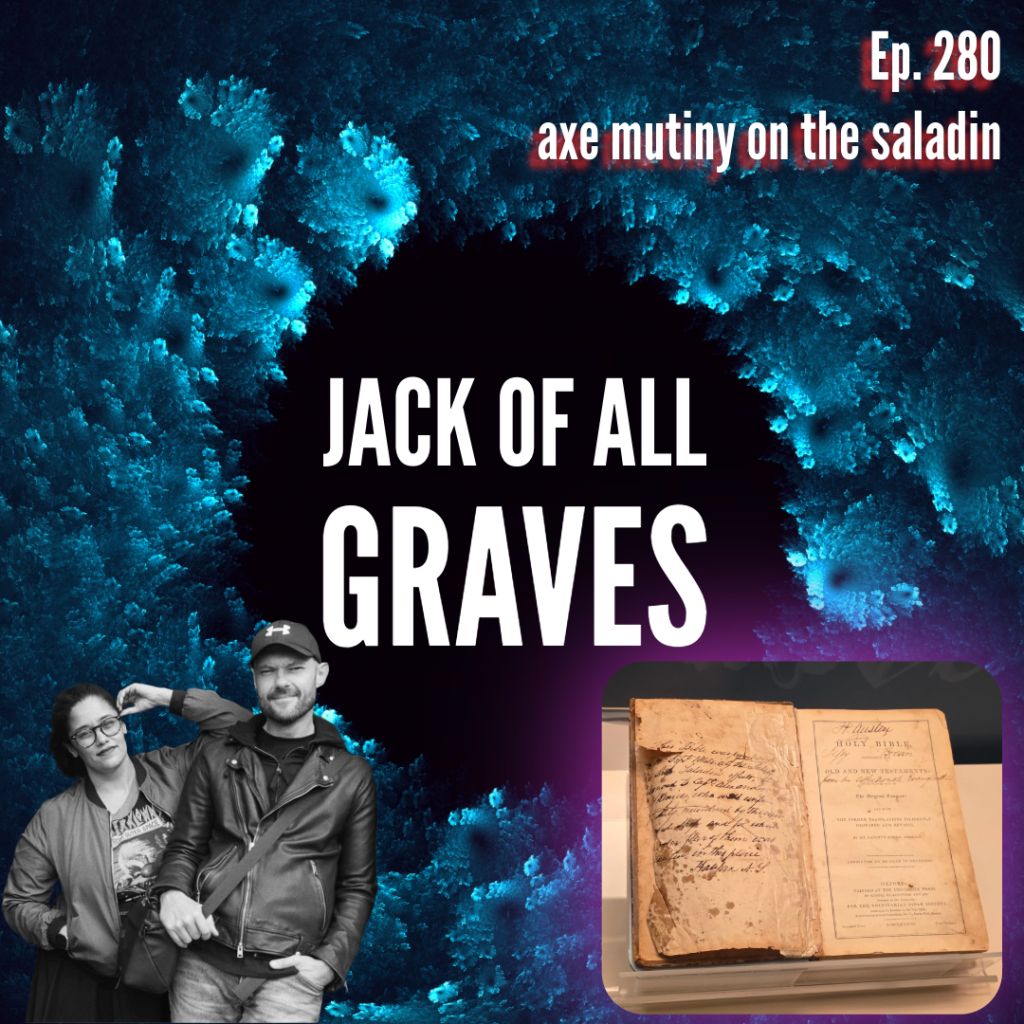
And that Bible. Oh, that Bible is actually in the museum in Nova Scotia.
[00:22:48] Speaker A: That self. Same Bible. That would be a cool relic.
[00:22:50] Speaker B: Yes. Let me. Let me show you. I can send it to you right now, Mark. I'd love that, because I saw this Bible and had a good laugh at this being what they did to ensure that they won't kill each other. So if you want to just describe what you see there,
[00:23:10] Speaker A: this would not.
I wouldn't.
It means nothing. This is. This is a pamphlet.
[00:23:17] Speaker B: It's.
Right.
[00:23:19] Speaker A: We all swear on a Bible to be loyal and brotherly to each other.
Yeah.
[00:23:30] Speaker B: So, yeah, that's.
That'll do it.
[00:23:34] Speaker A: On a Bible.
[00:23:35] Speaker B: Yeah.
[00:23:36] Speaker A: It's cute.
[00:23:37] Speaker B: It's cute. It's very quaint. It's got that very, like, kind of like spit in your hand and shake
[00:23:43] Speaker A: when you're a kid in this situation. It does.
[00:23:45] Speaker B: It does.
So all set then? Right? We talked about salad and pirates. Yes. Everybody's told Jesus they're brothers, no prob. Onward to Liverpool.
Only, obviously, Fielding didn't get rid of his weapons. Are you crazy? Come on.
A few days later, Johnston discovered two pistols Fielding had hidden, along with a copper vessel containing powder for those weapons.
He told the others, and together they confronted Fielding, who, of course, was like, oh, what?
I don't know about any weapons.
They naturally toss those weapons overboard, Their standard solution to everything.
And later, Anderson told the others that Fielding had approached him with a proposal to kill Jones, Carr, Galloway and Johnston before they killed him.
Now, on a crew of liars and murderers, who knows if that's true?
It's perfectly plausible, though, and they certainly weren't taking any chances.
So they bound Fielding and searched the ship.
In a liquor cabinet to which Fielding had the only key, they found a carving knife that had gone missing days earlier, as well as two bottles of brandy that they were pretty sure was poisoned.
[00:25:01] Speaker A: Realizing what, I wonder what poison they would use.
[00:25:07] Speaker B: That's a good question.
I mean, I think they had a lot of things you don't.
[00:25:10] Speaker A: You don't kind of. It's not a part of the ship's manifest. Right.
Provisions for 14 men for three weeks.
Chickens, guano, poison, you know, so you'd have to improvise something.
[00:25:24] Speaker B: Well, here's the thing, though.
At that point in time, there were so many poisons that were also used for other shit. You know, where it's like. You know, people would have arsenic or, like, strychnine or things like that because they were, like, used for something Else, you know, so it's perfectly possible that there was something that was like just a straight poison on the ship, but they used it for something even for like killing rats, for that matter, because ships are famously full of vermin.
So, yeah, I mean, they didn't test it to find out what it was, but, you know, they were like, yeah, he was talking about poisoning, folks. I' ma say that brandy is tarnished.
So realizing, hey, this guy who signed this Bible with the rest of us can't be trusted, and that he would eventually kill them all or convince each of them to do it to each other, they decided there was only one thing to do.
And what was it? Marco.
[00:26:25] Speaker A: Kill him first.
[00:26:27] Speaker B: Specifically.
[00:26:30] Speaker A: Poor Axe to the head.
[00:26:33] Speaker B: Throw them overboard.
[00:26:34] Speaker A: Okay, okay, okay. I'm not playing ball with this, am I? It's been the same answer all along.
[00:26:38] Speaker B: It's been the same answer for everything.
[00:26:41] Speaker A: I'm giving them far too much credit.
[00:26:43] Speaker B: Yeah, they have one idea, Mark.
That's it. Just the one.
So more specifically, Carr and Galloway would have to be the ones to do it, since they had not participated in any of the earlier murders. I assume this is because the other crewman wanted them to be like, equally culpable.
You don't want to get on shore and have two guys who are like, hey, these guys kidnapped me. I was just trying to survive.
[00:27:08] Speaker A: Yeah, yeah, yeah.
[00:27:09] Speaker B: So you throw a dude overboard, you're now a murderer.
So car Galloway yeeted him and for good measure, they gave the old he hoe to his son as well.
Or 13 to 15 year old George. Young George went over the boat as well. Brutal.
This left six of them, which is honestly kind of a weird situation. They were all original crewmen here, right. Who would have done nothing of the sort had this man not gotten onto the boat in Chile and convinced them to do this. It's like kind of a strange situation. We've now killed the guy that was like the catalyst for this and who had us crew these, kill these other guys we've been sailing with all this time.
[00:27:53] Speaker A: What are, what are the, the surviving accounts of the Saladin. Then? What are the sources here?
[00:27:58] Speaker B: Because the men, they will get to their testimony.
[00:28:03] Speaker A: Their testimony.
[00:28:04] Speaker B: Yes. Right, okay. Because, Mark, they didn't get away with it. I'm just gonna spoil it for you right here.
They did not get away with what they pulled.
But yeah, so they, yeah, so there's the six of them left, and they divide all of the booty and they give command to Galloway, since he was apparently the best at navigating Only it turned out he was not, in fact particularly good at navigating because a few weeks later they ran aground at country harbor in Nova Scotia while attempting to scuttle the vessel at the Gulf of St. Lawrence, which is up by Newfoundland. So they were quite a ways off from where they thought that they were.
[00:28:49] Speaker A: And they would.
If you're planning to scuttle your own ship.
[00:28:53] Speaker B: Yeah.
[00:28:53] Speaker A: You've presumably docked and you've gotten all of your goods off.
[00:28:56] Speaker B: Yeah. You take everything and run, basically. Yeah. But they did it. So if they were in The Gulf of St. Lawrence, that's like a big area or whatever to do. This country harbor in Nova Scotia is like, right. Goes right up into the, like, city of Halifax. Like, this is like you're just running up against where there's like people faking, fishing people bringing shit through. It's like a very busy place to run aground here. They were spotted by two men accompanying one Captain Cunningham of the schooner Bellow.
Cunningham boarded the ship to find, quote, intoxic, intoxicated crew disarray in the cabin, specie in an open chest.
[00:29:38] Speaker A: Yeah, yeah, yeah.
[00:29:39] Speaker B: And tales of men washed overboard.
[00:29:43] Speaker A: Many of the many men, men, they
[00:29:45] Speaker B: just, you know, happens all the time. Yeah.
I love this whole scenario, to be honest. These dumb have crashed their boat and are just staggering around drunk on a messy ship. Like, oh, no, where did our crewmates go? They must have gone overboard.
You know, cutting him was like, right, okay.
And immediately sent two men to go for the magistrate on 21 May. Guysborough. It might be Giesborough because everything's French over there. I don't know, we're gonna say Guysboro county justice of the Peace Charles Archibald showed up and assembled a posse to offload the ship's cargo.
Yeah, G Y G U Y S. Burrow.
Yeah.
[00:30:35] Speaker A: Cunningham in French, man.
[00:30:40] Speaker B: Cunningham then sent an affidavit to the judge of Vice Admiralty summing up what he saw. And in response, the judge issued a warrant, quote, to arrest the whole property as being goods in the possession of pirates. Wheresoever found and authorized the arrest of the six seamen. So again, this is such a weird situation. They took off from Chile, just a crew of guys, and now they're pirates.
That's a big change in identity by the time they get to Canada.
[00:31:10] Speaker A: An all in one journey. It just takes one fucking journey, man, to change a man.
[00:31:15] Speaker B: Yeah, seriously, this quite a situation.
It's a lesson in choices is what this is.
But before the warrant even arrived, the six mutineers had fucked off and disappeared.
If Archibald Cunningham and the rest of the discoverers of the Saladin had bought the story about the accidental deaths on board at all before. It was very clear at this point that this ship was sus. Why would they run away if they thought an investigation would find that they weren't responsible for what happened to the rest of the crew? Running said, something's amiss here, of course.
[00:31:50] Speaker A: Of course.
[00:31:52] Speaker B: So the crew were apprehended again fairly quickly and detained at Archibald's house for two nights before being taken to Halifax.
On May 27, 1844, a note from Cunningham appeared in the shipping news section of the Nova Scotian. It read, simply, came ashore at the island at Country Harbor. The officers reported dead. Cargo now in charge of C.R. chipald, Esquire, justice of the Peace.
A note on the editorial pages added that foul play was suspected. So as you might expect, the people of Nova Scotia were like, holy shit. What?
What happened here?
[00:32:28] Speaker A: Just mega quickly. I'm on a dictionary here.
[00:32:30] Speaker B: Yes.
[00:32:31] Speaker A: And I'm just gonna play species, please, and I'll just report straight back.
It's Specie. Did you hear that?
[00:32:40] Speaker B: Specie.
[00:32:42] Speaker A: She Species.
[00:32:43] Speaker B: That sounds better. That fixes it.
[00:32:45] Speaker A: Yeah, Specie.
[00:32:47] Speaker B: I feel great about that. I like that a lot better than Specie.
[00:32:50] Speaker A: Yeah, we're doing it wrong. Specie.
[00:32:52] Speaker B: Specie. There we go. Thank you.
[00:32:54] Speaker A: You're welcome.
[00:32:56] Speaker B: If I could turn back to Specie.
Sorry, you're all gonna have to listen to me saying it wrong the rest of this. But anyway, so the people of Nova Scotia are like, what the fuck?
And the fate of the Saladin became the subject of much chatter in the Maritimes. It was basically a true crime sensation. Everybody was suddenly talking about, like, this ship pulled up with, like, all the people on it dead. And, you know, foul play is suspected. What's going on?
And the courts were not around while the men held the story that the captain had, quote, died some seven or eight weeks previous, the first officer three days after, and subsequently the second officers and others had fallen from a loft and been drowned or killed.
Nobody was buying that.
[00:33:46] Speaker A: From aloft, as in high up.
[00:33:48] Speaker B: Yeah, from high. From high up. They just. Oops. They all just fell one at a time.
[00:33:53] Speaker A: Aloft from the attic.
[00:33:56] Speaker B: A L O F T. One word.
[00:33:59] Speaker A: I'm good.
When the Co Op. Next time I buy something from the Co Op, I'm going to ask, am I right to pay in Specie?
Just pull some coins out my pocket. Just buying a pack of biscuits.
[00:34:11] Speaker B: Please do, Kash. I'd be paying in Species, you're gonna activate. Activate some maritime nerd who's like, really?
What kind? You got the balloons.
[00:34:23] Speaker A: Great idea. Just keep an eye on people's tattoos. And if there's a guy who's got
[00:34:27] Speaker B: like boat tattoos, get. See a schooner, you offer him species.
[00:34:31] Speaker A: Oh, man, I've only got a 20. Can you go any Species.
[00:34:34] Speaker B: You can.
[00:34:35] Speaker A: You can break this 20.
[00:34:40] Speaker B: My God, I've been waiting for this question my whole life.
So, yes, nobody was buying that. And four of the six crewmen were quickly convicted. S.G.W. archibald, the judge of the Vice Admiralty, had gotten them each alone and told them to give him their stories and that they weren't required to incriminate themselves as such. None of their stories matched because they were all trying to save their own asses.
Anderson, Jones, Hazelton and Johnston, whose real last name turned out to be Travaskis, were found guilty of piracy and murder of Alexander Mackenzie, with the jury returning their verdict in under 15 minutes.
[00:35:25] Speaker A: This story is so rich in strange detail.
[00:35:28] Speaker B: It is, isn't it? You know, that's what's kind of fun about it.
[00:35:31] Speaker A: Just like men asleep in the hen house.
[00:35:34] Speaker B: In the hen house? Yeah. Why not?
[00:35:37] Speaker A: Foraging and improvised poisons.
And Johnston, whose real name was Travaskis, it emerged.
[00:35:45] Speaker B: Yeah. There was no indication earlier in the story that he was not who he said he was.
And then it comes up in the court records. BT dubs his name is Trevaskis, who
[00:35:56] Speaker A: was actually called Trevaskus.
[00:35:59] Speaker B: Oh, all right. Yeah.
[00:36:00] Speaker A: It doesn't impact the tail at all. I've just left that out. No, but I like this from the beginning. It doesn't matter. But I enjoyed it.
[00:36:07] Speaker B: Yeah, I felt that it needed to be said.
I don't know. It means something to me.
But yes, under 15 minutes, the jury was like these guys and they were found guilty of piracy and murder.
[00:36:22] Speaker A: Oh, God.
[00:36:23] Speaker B: Carr and Galloway were not indicted for these crimes since they weren't actually involved in that part of the plot, but were later indicted for the murders of Fielding and his son.
The only evidence against them, though, was their own testimony, given voluntarily. And their counsel told the jury that they were involuntarily acting and actuated by motives of self preservation.
Makes sense.
The first jury they had could not agree on a decision, but a second jury convened and found them not guilty.
[00:36:54] Speaker A: How do you find them? Not guilty.
[00:36:57] Speaker B: I mean, all they did was throw the, you know, the mutinous guy off of the boat and his son, which they very much could have done under duress. Nobody had any, like There was no proof that wasn't how it happened. And all the other guys did say that they were not involved in, like, the mutiny.
So.
All right, at the end of the day, it's very easy to say, like, they were coerced into it. Whether or not they were, it's. You can't really prove they did that for any other reason than self presence.
[00:37:26] Speaker A: Obviously very, very different time and very alien circumstances to me. But I mean, if you can't, you can't prove anything, really, can you? Be on the shadow. You can't prove a full extent.
[00:37:37] Speaker B: So they all had stories that at least kind of, they tried to throw each other under the bus, but they all told the story of the mutiny. Also. One of the great things about this time is people wrote down all the time, so, like, they were like journaling some of this stuff that they said, you know, that they were doing as it was happening.
And so, like, there are, you know, basically their own testimony against each other as opposed to against themselves was really what kind of damned them. Because no matter what happened, like, standards
[00:38:12] Speaker A: of proof might have been a little different in those days.
[00:38:15] Speaker B: Yeah, I mean, yeah, it's just, I think, you know, obviously there's also just the fact that their story was clearly not true. They rolled up saying, like, oh, these guys just spontaneously fell off the boat one at a time.
Sure, that sounds plausible. So, yeah, I think, obviously, because they don't have the forensics of now, it's going to be a little more lax. But they're. They confessed ultimately, and with, you know, four of them. Well, six of them, because those guys, Cara and Galloway, did testify against the others, too.
[00:38:51] Speaker A: Galloway, whose real name was Beauregard.
[00:38:57] Speaker B: Maybe if it were, I would add it.
Just saying.
And we'd all be happy about it.
So, yeah. The guilty four were sentenced to death by hanging on July 30, 1844, and crowds assembled to watch what would turn out to likely be the last public hanging of multiple people in Halifax. Oh, so there you go. Just another tiny, weird detail of this case.
[00:39:27] Speaker A: That was an incredible case.
[00:39:29] Speaker B: Right, yeah, you can see why.
[00:39:31] Speaker A: So they did all go to the gallows and they were all hanged.
[00:39:34] Speaker B: Four out of six. Not the two guys who were potentially coerced, but the other guys hanged in front of the. The people of Halifax.
[00:39:43] Speaker A: The last multiple public hanging.
[00:39:46] Speaker B: Yes. In Halifax history.
[00:39:49] Speaker A: Incredible.
[00:39:51] Speaker B: Yeah. Right. What a weird story.
[00:39:54] Speaker A: So layered. I've learned so much. I've learned about the bird thing, the. The guano thing.
I think smuggling guano is an excellent Euphemism that I'm going to take forward.
[00:40:06] Speaker B: Have you decided what for yet or open to?
[00:40:09] Speaker A: Well, anything. I mean, you know, if I've got to put the foot down. Driving home somewhere and somebody asking, why you driving so quick, Mark? Gotta get home. Sorry. I'm snuggling guado, if you know what I'm saying.
[00:40:20] Speaker B: I do not. I don't. Well, let me tell you about 19th century American imperialism.
[00:40:29] Speaker A: That's a lot of detail.
So great. And I went on a journey myself during that story, as you could possibly tell from my face. I. I was getting. I was in and out of that one a little bit. But by the end I was fully in. Fully in.
[00:40:43] Speaker B: Good.
That's all I ask.
[00:40:45] Speaker A: Yeah, yeah, man.
Let me quote directly from my notes, if I may. Yes, please do fucking look at these nerds. Oh, mise en scene.
[00:40:55] Speaker B: I don't think anyone has ever said mise en scene in such a horny way before.
[00:40:59] Speaker A: The way I whispered the word sex.
[00:41:01] Speaker B: Cannibal received worst comes to worse, Mark, I'm willing to guillotine you for science.
[00:41:06] Speaker A: Thank you. That's really, really sweet. It's cold outside, but my pancreas is talking to me.
[00:41:11] Speaker B: I'm.
[00:41:11] Speaker A: I'm gonna leg it.
[00:41:12] Speaker B: You know how I feel about that, Mark.
[00:41:15] Speaker A: I think you feel great about it.
I. I'll preface this. And if I. If I seem a little off. Off my game this week, I'd have step a little bit. It's because. It's because I am, quite simply. But as I said to Corrigan at the start, and I do sometimes, you know, we'll have a little huddle before the pod. We'll have a little 10, 15 minutes, just, you know, any bits you want to talk about. Anything you got. I just. Fuck. I don't know whether it's the Sundays or I've got, you know, very tired. I've got the dizzies quite a bit.
[00:41:43] Speaker B: You are. You yawned many times.
[00:41:45] Speaker A: Many times. And that wasn't even the tale, that was just fatigue. Yeah, but what I would say to you other than the obligatory weekly welcome, listeners. Right, during our huddle, Corrigan talked to me about an anxiety that she has sometimes when she worries not for her, but for the versions of her that exist elsewhere in the quantum string multiverse. Right.
[00:42:15] Speaker B: This is like the ultimate anxiety disorder.
[00:42:19] Speaker A: Yeah, isn't it?
[00:42:21] Speaker B: Isn't it?
[00:42:21] Speaker A: There's nothing you can do about it. Corrigan grows anxious sometimes worrying for the. The. The partically altered versions of herself that are out there living a Life that she'll never know, never touch, never experience, might not even exist.
But the versions of her that are doing something different to her and that she would not like.
[00:42:44] Speaker B: Yep.
[00:42:44] Speaker A: You know?
[00:42:45] Speaker B: Yep.
[00:42:46] Speaker A: The versions of her that have made different choices and taken different paths and are living a life which does not align with her values in this one. Isn't that incredible?
[00:42:58] Speaker B: A FOMO for alternate me's quantum me.
[00:43:01] Speaker A: Yeah, yeah, yeah, yeah, yeah, yeah.
And to you, dear, dear listeners this week, in addition to the. To the customary welcome, I would say if you think.
If you're worried right now, if you're anxious right now, and if you're hitting a wall, if you're worried about what tomorrow may bring, and if you. If you regret what yesterday brought, all you got to do is just think, well, there's a quantum me out there that's got it a lot worse.
[00:43:34] Speaker B: There you go.
[00:43:34] Speaker A: Infinite quantum me's out there.
Just maybe a fraction of a quantum particles distance away from where you are right now to date.
Just visible just for a slight shift in quantum perspectives right there. Overlapping your life, sharing the same space or the same time, but not both.
[00:43:59] Speaker B: Yeah, yeah, yeah.
[00:44:02] Speaker A: Are having a far worse time than you think you are. Right. So pull your socks up and walk it off.
[00:44:11] Speaker B: There we go.
Yeah. Couldn't say better myself, except then I get concerned about other.
Other me and what. And their bad time they're having.
[00:44:21] Speaker A: Well, that's the other thing, isn't it? Because there's also you who's having a better time.
[00:44:25] Speaker B: Well, that's true. Yeah. You know, you can only. You can only be the one you are, I suppose. But at the end of the day, there's a you that's probably wishing they were you right now.
[00:44:35] Speaker A: I'm certain Rick and Morty have done this bit, but are they. I wonder, is there. Is there any kind of fiction out there whereby somebody is traveling through the multiverse offing versions of himself?
[00:44:47] Speaker B: Like, yeah, yeah, that sounds familiar.
It's probably something very obvious lots of times. I'm sure Rick and Morty's probably covered a lot of that kind of thing at this point, but that does sound like a thing. And I feel like there's like a.
Like an obvious example of this that we're both not thinking of, that someone's yelling at the. At their podcasting application at this particular moment.
So sorry.
[00:45:15] Speaker A: It's a great idea. It should be. It's a. It should be done more often. There should be more.
I love. I love the multiverse gimmick. Anyway, I'm still not burned out on it, even after Marvel botched the last couple of years of trying it.
[00:45:27] Speaker B: You know, I went to get a haircut the other day and I did. Yep. It's a lot shorter today. You can see there's like less popping out of my hat than usual.
[00:45:37] Speaker A: Could you lift the hat, please?
[00:45:38] Speaker B: I've got hat hair now.
[00:45:40] Speaker A: Oh, you do? Oh, you do.
[00:45:42] Speaker B: That's even better than I expected.
[00:45:43] Speaker A: It's like you've got another hat under your hat.
[00:45:45] Speaker B: It is, but it's quite short as you can see.
[00:45:52] Speaker A: Unreal.
[00:45:55] Speaker B: Anyways, my hairdresser Z is like a youth.
He's like in his like mid 20s, I think he's like 26ish somewhere in that general vicinity. So we don't like often have like a ton of common ground to talk about with things.
But I found out that he is like very into the mcu, which was funny to me because it just didn't strike me as like, like a 26 year old gay hairdresser is not like the target audience I think of for the mcu, you know, like it's a pretty hetero sort of universe that they've created there. He's also a little young, I feel, but I guess like when he was a kid he probably like went and saw these things in the movies. It is.
[00:46:43] Speaker A: And it isn't, you know, color multicolored and just imaginative and just, it's, it's, it's of a whimsical kind of plane.
[00:46:53] Speaker B: It's true. Yeah, it's out. It transcends just being like this is a, this is a heterotext.
[00:46:58] Speaker A: Yes.
[00:46:59] Speaker B: Otherworldly in various ways, I suppose. Yeah. I was just very surprised. It was not like a demographic that I thought that this like particularly hit, but he like asked me about if I'd gone to see because they re released Endgame in the theaters and I have not gone and seen it. But so we had like this long conversation about the MCU which is. Oh, like I don't feel like I'm like up on the MCU and things like that until I talk to someone about it. And then I'm like, man, I really do follow this. I do know what's going on. Had like this nice long conversation about the MCU in which he spoiled for me the, the like extras. Because have you heard this? You can only see the extras if you go see it in imax.
[00:47:47] Speaker A: I didn't know that, but I mean they leaked on Reddit within like hours of the movie.
[00:47:51] Speaker B: Oh well, there you Go. I don't. You know, I don't read.
But he told me what things happen in it, which was very, very interesting. I mean, because almost in the fact that they're, like, kind of mundane things or whatever, but I'm fascinated by the fact that they're, like, just trying to, like, continue. Like, oh, there was a scene that was in one of the old ones, but we added a person to it.
[00:48:17] Speaker A: I don't like that one bit.
[00:48:20] Speaker B: Yeah, I mean, I don't know. I don't care. I don't care that much. Doom Stay looks terrible. So
[00:48:29] Speaker A: let me think. I wasn't. I think there was something I saw lately that reignited. It was Spider man that reignited my.
[00:48:36] Speaker B: Oh, yeah. You were like, all right, I've got.
[00:48:37] Speaker A: Re. Pumped it. Re Pumped me.
[00:48:39] Speaker B: Yeah.
[00:48:40] Speaker A: But Peter did ask me if I wanted to go and see Endgame again, and I'm certainly not going to sit through it in the fucking cinema again to catch a little bit of.
[00:48:49] Speaker B: I thought about. Not for the. Not for the ending things, but just because, like, you know, I was like, oh, it might be fun.
[00:48:54] Speaker A: If it's on telly, I'll. I'll let it play. You know what I mean? But I'm certainly not gonna drive into town to see Endgame movies.
[00:49:01] Speaker B: Well, that's the thing. It's like, I go to the movies so often anyway that it's not like a big thing. So I was like, oh, maybe I'll. Maybe I'll go check that out, but I probably won't because there's a couple other movies that have come out this week I got Josh Hartnett to see, so I don't need to go see Endgame.
[00:49:16] Speaker A: Oh, what's he doing?
[00:49:17] Speaker B: He's in one with, like, yeah, Anne Hathaway, that one, which I hear is kind of mid, but, like, I'm not gonna go see it. Come on.
He's also got a boat core show coming out on Netflix, so I'll probably have to have you steal for me.
[00:49:33] Speaker A: Yeah, I'm sure it's good. Good to see him back because he kind of.
He went away for a little bit. Didn't even.
[00:49:39] Speaker B: Yeah, exactly.
[00:49:41] Speaker A: Always liked him. Peter went to see Resident Evil again this week.
[00:49:45] Speaker B: Did he really?
[00:49:46] Speaker A: Look his girlfriend.
[00:49:48] Speaker B: Oh, so cute. What'd she think?
[00:49:49] Speaker A: Thank you. Loved it. But the. My point being that apparently it's, like, a few days away from the end of its theatrical run and it's still doing business. It was full. It was more full in that theater, he said, than it was when we saw it.
[00:50:03] Speaker B: It was so funny, though, listening back to the podcast because you were like, you know, a month after release, and I was like, wait. And then we realized it was like, no, it came back this day. So you're like, almost two weeks after the release. And then I, like, listened back to it. I was like, no, you went six days into its release.
It's like a very normal time for there still to be theater. Theater goers.
[00:50:23] Speaker A: Time warps around me.
[00:50:26] Speaker B: Yeah, it's very true.
[00:50:29] Speaker A: Light and time bend in my path.
[00:50:34] Speaker B: You're very in touch with Quantum, Marco.
[00:50:36] Speaker A: Yeah.
[00:50:37] Speaker B: Yeah.
[00:50:38] Speaker A: To the point where I. I don't know which level of. Of quantum reality I'm waking up in any day.
[00:50:46] Speaker B: Right? Yeah.
[00:50:47] Speaker A: To the next.
[00:50:48] Speaker B: It's none of your business.
No, you just got to keep moving
[00:50:51] Speaker A: the day on its own terms as it comes to meet me.
Habit and routine make my life possible.
[00:50:57] Speaker B: It's true.
Brianne texted me and she said.
She said something about how.
So one of. We were talking about our Sunday routines or whatever. Or I was talking about my Sunday routine and all the, like, things I do to get myself prepared.
And so I had said that I shower and I make lists and I do all this kind of stuff so that I'm clean and prepared. And your response was that you've never been both clean and prepared at the same time. And she was like, I think about that every day.
Like. It is a crazy thing to say, isn't it?
That's a Marcus right there.
What does that mean? What does it mean?
[00:51:40] Speaker A: No idea.
[00:51:43] Speaker B: Against none of your business.
What you say.
[00:51:46] Speaker A: No, no.
And if you weren't recording, I'd deny it.
[00:51:51] Speaker B: Yeah. You certainly have no recollection of it happening.
Anyways, what else. What else we got going on, Marco?
[00:52:00] Speaker A: Well, I. I mean, what are you saying? There's a lot of cool things coming up. We have. We are mere days away from the Hellraiser video game, which is gonna make.
That's a. Let's play on a plate.
[00:52:13] Speaker B: Yes. So we'll be doing that for this month's let's play. You'll hopefully get to hear some screaming from Mark, which is always a favorite.
[00:52:21] Speaker A: I don't think it's that kind of game.
[00:52:24] Speaker B: It isn't?
[00:52:25] Speaker A: No, I don't think so.
[00:52:26] Speaker B: Okay, well, we'll find out.
[00:52:28] Speaker A: Thank heavens it isn't an asymmetrical team based co op game. Thank God.
[00:52:34] Speaker B: No,
[00:52:37] Speaker A: but it's. Yeah. First one. Single player story driven.
[00:52:43] Speaker B: All right.
[00:52:44] Speaker A: Adult. Quite explicit.
[00:52:47] Speaker B: Oh, my.
Is it a sex game?
[00:52:50] Speaker A: Sexual? I think there's sexual elements.
[00:52:52] Speaker B: Oh, my.
[00:52:53] Speaker A: They've certainly been picking up the sexual elements in the marketing. The marketing is very kink based.
[00:52:59] Speaker B: Oh, okay.
[00:53:00] Speaker A: Well, for sure, for sure, for sure.
[00:53:01] Speaker B: You know, if you haven't subscribed to our KO Fi yet, you've got that, that to look forward to this month.
Little kinky.
[00:53:08] Speaker A: Let's play little, little, little, Little kinky Hellraiser. Let's play. That'll be fun.
[00:53:13] Speaker B: That will be fun. Kristen and I got a fan cave coming up. We did not get a chance to record last month, so we'll be talking about Spirited Away next week.
So if you haven't watched it, it's such a good movie for Halloween anyway, so I think that's perfect. Watch Spirited Away and listen to us talk about it.
What else?
[00:53:33] Speaker A: I can't think of anything, anything better than that. Nothing else, really.
[00:53:36] Speaker B: Okay.
You were like, oh, we got lots of things coming up. I'm like, do we?
[00:53:40] Speaker A: No, no, just another one in the media sphere. There's lots.
[00:53:44] Speaker B: Oh, sure, yeah.
Yeah. It's a good time of year.
[00:53:49] Speaker A: It's the best time of year. It's, it's.
But yet. Is that why I'm so out of sorts? Because it's still unseasonably warm?
[00:53:59] Speaker B: Right. Yeah. It's like your, your brain is like it not.
[00:54:03] Speaker A: Autumn right now should be autumnal as heck.
[00:54:06] Speaker B: Yeah.
[00:54:06] Speaker A: There should be crispy leaves underfoot and.
[00:54:09] Speaker B: Right. That'll throw you. That'll throw you off.
[00:54:12] Speaker A: And it doesn't. It has.
[00:54:14] Speaker B: Yeah.
[00:54:15] Speaker A: It ought to be like cold and
[00:54:18] Speaker B: listen, this is why I always say I was. I struggled so much in Southern California. I was like, the season's gotta change, man. If they don't change, your brain gets completely thrown off. Your sense of time gets very thrown off. And so you need to see those leaves start to change. I will say. Oh, I don't think. Was he up last week? Did I mention it? Did I mention Skelbert last week?
[00:54:43] Speaker A: You didn't. I don't think he did.
[00:54:46] Speaker B: We finally have the, the 12 foot Home Depot skeleton outside on our lawn, which does help with the vibe a little bit. Our tree hasn't changed colors yet, but we have audio. It does. It has audio. It lights up. It has like animated eyes.
It's pretty great. Yeah.
[00:55:06] Speaker A: What audio does it have?
[00:55:08] Speaker B: But it has like programmed phrases in it like, you know, just stuff like spook the neighborhood kids, like, I'm watching the candy and I know where you live and blah, blah, blah, stuff like that. But you could also like record your Own voice.
[00:55:21] Speaker A: That's what I was going to say too.
[00:55:23] Speaker B: Yeah.
[00:55:23] Speaker A: Have you done that yet?
[00:55:25] Speaker B: No. Keo did once, but.
[00:55:27] Speaker A: What did he say?
[00:55:28] Speaker B: He was just testing it out. So he just was like. He said something to me, you know, and I was like. It was very quiet, so I was like. Did it say. Did the skeleton just say Corrigan? It's like it did, yeah.
But yes, it is a delight. And I haven't had any complaints from neighborhood kids yet. So it's already one up on Sackboy, so, you know.
[00:55:47] Speaker A: And it has survived it.
[00:55:50] Speaker B: Well, we put it up the day after the nor' Easter, so it didn't get hit by the.
[00:55:56] Speaker A: I mean, as much from people as from.
[00:55:58] Speaker B: Oh, yeah.
[00:55:59] Speaker A: Weather would.
[00:56:00] Speaker B: Because what kind of town do you think I live in?
[00:56:04] Speaker A: Well, no, I wouldn't feel confident in putting a 12 foot fucking plastic skeleton outside my house. That it would last long. Just.
[00:56:16] Speaker B: Well, it's the British kids. Huh. Because they're monsters. Yeah, yeah.
[00:56:20] Speaker A: That wouldn't. I. I do not think that would last. And I'm certain the same thing. I couldn't put that up outside my house. It would get.
It would get smashed up and then my window would get smashed up also. For the audacity.
[00:56:32] Speaker B: Yeah. That's fair. British kids are scarier than American kids.
American kids are just like, cool, man.
That's neat. They come and they show their friends, they point at it, you know, that kind of thing. That's about it.
And I give out good candy. So, you know, it's in your best interest not to.
[00:56:47] Speaker A: With my stay on your good side.
[00:56:49] Speaker B: Exactly. If I see you on that ring camera mistreating Skilbert, you're not getting any Tony's chocolonely Halloween. That's all I'm saying.
Well then, shall we discuss what we've watched? Oh, wait, no, that's not true. Wait, before we get there, there were a couple things that we wanted to broach beforehand. For one.
Yeah.
Your true crime era, for one.
[00:57:15] Speaker A: I fear that I am in a true crime era currently.
I mean, all Netflix based. Well, not really on Netflix based. Laura and I watched and I'll tell you what made me think of you about this. Right. Something immediately in the first part of this true crime two episodes series just landed on Netflix called the Widower.
[00:57:35] Speaker B: Yes.
[00:57:37] Speaker A: And immediately one of the investigators is a guy from your show Dateline.
[00:57:44] Speaker B: Yes.
[00:57:45] Speaker A: And I immediately thought, ah, now I know somebody who might be interested in this.
[00:57:50] Speaker B: Yes.
[00:57:50] Speaker A: Were you familiar with the case?
[00:57:54] Speaker B: I think that I'd seen, like, I'm pretty Sure. Dateline has covered parts of, of this over the years. So it looked like how they could not. Yeah, exactly. But I think not all in one thing like this, where you get to see all of this unfolding and the discovery of everything that happened.
[00:58:14] Speaker A: Hell of a case.
[00:58:15] Speaker B: Hell of a case. The widower about a guy who, his wife is killed seemingly by a home invader, but a guy that they know.
And then as the detectives are sort of investigating it, they're like, your story about how this happened doesn't really make sense. And they start to question whether he was the one to do this.
And then as this sort of moves forward, they eventually realize that he has been married six times and four of those women are dead.
[00:58:50] Speaker A: Yeah.
[00:58:51] Speaker B: And they start thinking, did he have anything to do with those other women?
[00:58:58] Speaker A: And if you're going to watch it, you know, I'm not really, we're not really giving anything away, but four dead wives, one of whom died of cancer. So three of whom died in non natural circumstances.
[00:59:12] Speaker B: Right. Yeah.
[00:59:14] Speaker A: All of whom seem to have the same MO and circumstances surrounding their death.
[00:59:20] Speaker B: Yeah. And all of the people who knew them told the same stories about this guy.
[00:59:24] Speaker A: Exactly the same story story. He asked me. He took out insurance policies on his wife and then asked me if I'd kill the wife.
[00:59:30] Speaker B: Yeah.
Everywhere he went, there was someone who was like, yeah, he definitely asked me
[00:59:35] Speaker A: to kill from state to state.
[00:59:38] Speaker B: Yep.
[00:59:39] Speaker A: But at the same time, an absolutely fascinating object lesson in if you know the system and if you know how to get a adjournment or if you know how to delay a trial.
[00:59:54] Speaker B: Right. If you know how to file the right lawsuit.
[00:59:57] Speaker A: Exactly. Sue the right people and move and change your legal team and move and do it again and fight again. Hide la la. You can just stretch justice out year upon year upon year upon year.
Fascinating, yet just that rarest of things.
Probably a Netflix show that I could have done another episode or two of.
[01:00:24] Speaker B: Right. Yeah. Normally not so much, but. Yeah.
[01:00:27] Speaker A: That rarest of beasts, a Netflix show that knows when to quit.
[01:00:31] Speaker B: Yeah. You know, very rare.
That means. Did you watch, since you're in your Netflix true crime era, did you watch the Death of a Pastor's Wife?
[01:00:46] Speaker A: No, it's. Is it Mormons?
[01:00:48] Speaker B: No, it's Christians.
[01:00:50] Speaker A: Okay. No, I did not. But I, I, of course, will.
[01:00:53] Speaker B: Yeah, I think that that'd be an interesting one. I'd love to hear your takes on because this is very much one I got very fired up about because it's about evangelicals.
Okay.
Basically, the way that, like Pastors groom women and, you know, groom teenagers into like marrying them later on and then mistreat them. And yeah, it very much is like a story that, you know, is about a terrible thing happening to this one particular woman, but that has this very deep resonance for church gender politics in general. And I find it fascinating and I would love to hear your take on that one. So, please, I'd love to.
[01:01:37] Speaker A: I would absolutely love to. But I'll tell you what else I watched, okay.
A two part miniseries, true Crime, about a case which spawned an opener of mine some years back.
[01:01:56] Speaker B: Oh, okay.
[01:01:59] Speaker A: Let me see if you remember this. So we're a geezer is stopped and questioned by members of the public because he is clumsily dragging a large suitcase across.
[01:02:14] Speaker B: Oh yes.
[01:02:15] Speaker A: Trying to get across Clifton suspension bridge in Bristol.
[01:02:18] Speaker B: Yeah, I remember.
[01:02:19] Speaker A: And two of the wheels have broken off the case because it's so heavy and impossible for this guy to drag. And it's leaking blood. He's leaving a trail of blood in his wake. And he got these two cases into a taxi.
One of the cases he'd already thrown off the bridge and he'd left it some distance away. The other is trying his best and the public stop him. Mate, what have you got in there? He makes up some ridiculous story about car parts and tries to drag the case off. He then legs it and vanishes and, and goes on the run and is caught within a couple of days.
A two part documentary about this case. And it is weirder.
Oh, and darker.
[01:03:03] Speaker B: Okay.
[01:03:06] Speaker A: Deeper.
And far, far, far more unsettling and disturbing than even that, that, that, that coup de gr. That climax right at the end was really just the end of that case. It was, it's, it's a, it's very, very intense.
The Bodies on the bridge is, is
[01:03:27] Speaker B: the documentary Body is on the Bridge. And that's on Netflix?
[01:03:30] Speaker A: No, it's on. I found it on NOW tv. I found it on Sky. I think it's also on Prime.
[01:03:35] Speaker B: Interesting. You definitely have my attention here.
[01:03:39] Speaker A: I mean, just a couple of bits. What if I said that the two bodies in the case, the victims, one of the victims had a long standing, like over a decade long relationship with the guy dragging him around in a case who was from Colombia.
They were engaged in a long term, kind of sado, masochistic, master and slave type sex kink relationship.
[01:04:10] Speaker B: I feel like that did come up when you told this story. Yeah, yeah, yeah.
[01:04:15] Speaker A: They'd.
The, the, the two guys who ended up in the case went out to, to visit him and they paid to bring him over to the UK and they'd sent him money over a period of years, filmed the killings. Corrigan.
[01:04:30] Speaker B: What?
You can't do that.
[01:04:33] Speaker A: Films.
[01:04:34] Speaker B: You just can't do that.
[01:04:35] Speaker A: Right. You know, but also suggestions that the. The killer, this Colombian guy, was somehow detached from reality because. So haphazard.
[01:04:48] Speaker B: Well, yeah, you're dragging bleeding suitcases around. You're clearly not fully, you know, vested in this plane.
[01:04:56] Speaker A: But the. The.
So haphazard and so kind of lacking in cause and effect and planning with the killings.
Like, he's got the body. He's got, like, hands and feet in one case and he's got torsos in the other.
The. The one case, he just leaves. He leaves the. He leaves the fucking. The address of the two guys on a printed label on the case.
[01:05:19] Speaker B: Jesus. Yeah.
[01:05:21] Speaker A: Fucking ridiculous.
The heads.
The heads he leaves in the flat in London. In a freezer, right?
[01:05:28] Speaker B: Mm.
[01:05:28] Speaker A: A freezer which he bought and had delivered to the house after he'd killed them. After searching on his laptop. Freezer.
[01:05:37] Speaker B: Chestnut freezer. Big enough for body.
[01:05:39] Speaker A: Right. Leaves the heads in the freezer, puts the bodies in a case, takes them to Bristol, a place he'd never been before, with no plan, really, to get rid of these bodies at all.
[01:05:51] Speaker B: I heard there's a lot of bridges in Bristol.
[01:05:53] Speaker A: He didn't even turn the freezer on.
[01:05:57] Speaker B: Oh, no.
[01:05:58] Speaker A: He bought this freezer off the Internet, wheels it into the flat, puts the heads in.
[01:06:04] Speaker B: It doesn't even plug the thing in, it's just storage.
[01:06:07] Speaker A: Yeah.
Very strange case with notes of, you know.
Ah, just very tragic. Very sad. Very, very intense. Quite, very disturbing. Quite, quite.
Yes, quite the. Quite a little. Quite a little number.
[01:06:27] Speaker B: All right. Yeah. The bodies on the bridge is apparently on Prime Video and on Apple tv.
[01:06:31] Speaker A: So there you go.
[01:06:32] Speaker B: If that piqued your interest. It's in both of those places.
[01:06:35] Speaker A: Yeah.
To be on a jury, having to watch that.
[01:06:42] Speaker B: Yeah. That's whenever there is, like, a case where there's, like, video or photos or whatever that are, like, just horrific of things like that. I'm like, these are like regular people who do not, like, sit on the Internet and watch Dark all the time or whatever, and you're, like, just throwing the most traumatic imagery at them. Like that has got. That's like the kind of thing that'll keep you up for the rest of your life, forever.
[01:07:08] Speaker A: The jury were given the choice of whether to watch it or not.
[01:07:11] Speaker B: Oh, that's good.
So I don't feel like that's always the case. I Do feel like. No, a lot of times they just have to, you know, or they'll like show like there'll be like sexual images from like a case or something like that of like the people involved and they have to look at it and it's like. Yeah, I just don't think.
[01:07:28] Speaker A: And of course they gotta do that.
The video in its entirety wasn't shown in this documentary. But. But segments of it work.
[01:07:36] Speaker B: Like, you get the gist.
[01:07:37] Speaker A: The geezer dancing around the flat naked with the knife after he'd done it. Just doing a little dance.
[01:07:44] Speaker B: Just.
[01:07:44] Speaker A: Wow.
[01:07:45] Speaker B: Wild. Yeah, I'll check that one out.
[01:07:49] Speaker A: So, yes, like I say the, that, that, that in that final chapter was very much just one bit.
[01:08:00] Speaker B: Yeah. Super fun.
[01:08:02] Speaker A: Yikes. Oh, and while we're in this super fun realm.
[01:08:06] Speaker B: Yeah.
[01:08:07] Speaker A: While we're in this, this zone of really fucking having a laugh here. Right.
[01:08:11] Speaker B: Yeah.
[01:08:14] Speaker A: And again, if we want to reach back to Joag's past.
Lethal injections, mate.
[01:08:22] Speaker B: Yeah, we have definitely talked quite a bit about that. And one of the things. So again, for posterity, since a lot of people maybe might, you might be listening to this years from now, we don't know.
But just this past week, Tennessee attempted to execute a woman named Krista pike.
And they failed at doing that.
And she's still alive. Which is the particularly crazy part of this because as we have talked about before, like executions are botched all the time and lethal injection is a fucking awful method that often ends up with people being like alive longer than they should be or like moaning in pain and things like that when it's supposed to be painless.
But the people always die. And this is the first time someone has fully lived through it.
People like reported the family of like the, the victim was like saying that like she was like laughing and talking like chatting during this, like that's how alive she was. Like not even close to killing this person, which is unhinged.
And I think one of the things that like I talked about ages ago in one of our discussions of lethal injection is like, here's the thing about lethal injection is that it is an off label drug cocktail essentially because none of the like, manufacturers of drugs want to be the company that makes the death drug, right.
So you can't get it from Big Pharma. Johnson and Johnson is not making this. Moderna is not making this. This is basically like as close to like a black market drug as you can possibly get. So it's not like regulated in any meaningful way or anything like that. It's Just what they can get. Often. One of the reasons that, like, nobody's been executed for a while is because, like, there's a shortage of the drugs and they have trouble procuring them in the first place.
[01:10:36] Speaker A: I mean, it's kind of moot. But from more than one place, I've seen speculation that the failure quote, end quote, was due to the drug not having been used in so long, being passed.
[01:10:47] Speaker B: Like it's expired basically. Right, Exactly. Like, there's just so many things wrong with this process in and of itself. And from what I've read, also, like, even she knew that and wanted to be executed by firing squad. And for some reason they didn't allow that. They decided to go with the lethal injection instead.
So the whole thing of, like, capital punishment being barbaric and horrific aside, the method itself is like just a nice little, like, cherry on top of a barbaric practice. And this is like, such a perfect example of that.
[01:11:29] Speaker A: Yeah. And as we will have certainly said in the episode that we did about, about this many. Could be many years ago. How long? When was that? Would that have been years ago?
[01:11:40] Speaker B: Who knows?
[01:11:42] Speaker A: Lethal injection.
And I'm. I'm getting my info here from death penaltyinfo.org using a sample of executions between 1890 and 2010.
[01:11:55] Speaker B: Okay.
[01:11:57] Speaker A: Lethal injection is the method of execution with the highest botch rate.
With a botch defined as an unexpected problem or delay causing arguably unnecessary suffering or reflecting serious incompetence.
[01:12:16] Speaker B: Which is wild because, you know, here's the thing is, like, it's framed as if it's humane, right? Like, oh, we use this instead of other methods because it's the more humane one. That's not true. We use this because it feels less like murder than hanging someone or electrocuting someone or shooting someone does.
[01:12:36] Speaker A: You. You can't do math. Neither can I. Right. We have that in common. We have many things in common, you and I, but that's one of the big ones.
What If I said 8776 executions took place in the states between 1890 and 2010? Right.
Of those, 3.15% are deemed to have been botched. 276 of those with the highest percentage going to lethal injection.
The second highest percentage. Would you get a guess?
[01:13:10] Speaker B: Hanging.
[01:13:11] Speaker A: Gas.
[01:13:13] Speaker B: Gas.
[01:13:14] Speaker A: Gas. Lethal gas. The gas.
[01:13:16] Speaker B: Honestly, I didn't know we did that. So that's why that one completely flew
[01:13:22] Speaker A: under 1890 here, mind you.
[01:13:25] Speaker B: Okay, yeah, well, yeah, but gas wouldn't have been that far back, I'm sure.
Don't think they Were gassing people at that point. That's like a World War I on kind of situation.
[01:13:38] Speaker A: Lethal gas is absolutely.593 executions by lethal gas between 1890 and 2010.
[01:13:46] Speaker B: Yeah, that's the whole window. So, yeah, I would. I would wager that that was very early on. Period of time. 590 out of 8776 or whatever.
[01:13:58] Speaker A: Yes.
[01:13:58] Speaker B: So, yeah. Small portion, but clearly because it didn't work very well.
[01:14:03] Speaker A: Yeah, well, yeah, yeah. Hanging is the next. Okay.
[01:14:07] Speaker B: That one often botchable. Yep.
[01:14:09] Speaker A: And then the electrocution just being 1.9% execution botch rate.
[01:14:16] Speaker B: Yeah. Which, you know, again, it's. What's barbaric about all of this is that there should be a 0% bot trait on top of everything.
[01:14:23] Speaker A: Well, there is for one method.
[01:14:25] Speaker B: Ooh, is it. Is it firing?
[01:14:29] Speaker A: It is. Firing squad.
[01:14:30] Speaker B: Yeah.
[01:14:31] Speaker A: Zero botches.
[01:14:32] Speaker B: Yeah.
[01:14:32] Speaker A: Of the 34 firing squad executions which took place in that window.
[01:14:36] Speaker B: Yeah.
It's not. Someone's gonna. Someone's gonna hit the person. You know, I mean, certainly there's. I suppose the issue is, you know, how many shots does it take before the person dies? But, you know, it's gonna be.
[01:14:51] Speaker A: Yeah.
[01:14:53] Speaker B: Within a short period of time compared to these other ones.
[01:14:56] Speaker A: But yeah. As of. As of today, like three days after the botch.
[01:15:03] Speaker B: Yeah.
[01:15:04] Speaker A: She remains on a ventilator.
[01:15:06] Speaker B: Yeah.
[01:15:07] Speaker A: And what happens now?
[01:15:09] Speaker B: Right. I mean, that's the big question.
Right. It's certainly not going to make us rethink death penalty. You know, they'll still kill her.
[01:15:16] Speaker A: Well, that's what doesn't happen.
[01:15:17] Speaker B: Yeah. We know that that's not the next step. We don't stop. There's no moratorium.
[01:15:22] Speaker A: What doesn't happen is learning lessons.
[01:15:24] Speaker B: No, I think the question will be, do we use a different method at this point? And probably not. But, you know, I think that's the next.
The next question is, oh, do we still kill people with this, or is there too much bad publicity for it?
[01:15:41] Speaker A: So.
And I'm not. I'm not expecting you to know the answer to this. I'm just thinking out loud.
[01:15:45] Speaker B: Yeah.
[01:15:46] Speaker A: So if. Let's say if she is found to be brain damaged now or impaired, surely you can't legally go on to proceed with a death sentence.
[01:16:01] Speaker B: Yeah, no, probably not. I would imagine she will just be, you know, on all the equipment until she dies, essentially. Yeah. So it's a weird little loophole is that if she, you know, they're hardly
[01:16:16] Speaker A: gonna try for the first.
[01:16:17] Speaker B: She suffers brain death.
[01:16:18] Speaker A: She's got like, A drip in one arm.
[01:16:20] Speaker B: Yeah.
[01:16:20] Speaker A: And at the same time, you're trying to put the pentobarbital in the other.
[01:16:24] Speaker B: Right. Yeah, I think the appeals would be strong. There's just no way at this point. I think, you know, if she makes a full recovery, then, yeah, it's likely they'll still attempt, but that's gonna. She's got lawsuits and things like that for years. She may die a natural death long before they ever get a chance to execute her again. That's gonna be decades of appeals after this.
[01:16:48] Speaker A: Yeah. Certainly one for the history books.
[01:16:52] Speaker B: Yeah. Yeah, definitely. It's. I mean, it was already notable. It was the first woman executed in Tennessee in centuries, and then it didn't work. So technically, there still hasn't been a woman executed in Tennessee in, like, 200 years.
[01:17:08] Speaker A: Incredible.
[01:17:10] Speaker B: Yeah. Fun system. Fun system we got.
[01:17:13] Speaker A: Yeah, yeah, yeah, yeah, yeah. It's. It's been. It's been a. It's been a topic of conversation here in the Lewis household quite a bit over the past few days. Me and the boys have been talking it over.
[01:17:20] Speaker B: I would. I would love to see, like, a poll now of, like, approval of death penalty.
You know, I would. I would wager it's probably a lot lower than it's been.
Not because of this, but just in general. I do think that's something that there's a lot more pushback against at this point. Even as, you know, our government becomes more fascist and things like that, I think people tend to be a little more like, what the fuck does it
[01:17:48] Speaker A: ever get talked about?
As in, you know, is it on any particular agenda of any. Of any candidate or any party? Does anyone run on it?
[01:17:57] Speaker B: There's nobody running on that. No, absolutely. Absolutely not. We have organizations like the Innocence Project that, you know, are pretty ever present in, you know, trying to fight this stuff, but that tends to more be like, they're going.
They want to make systemic change, but they also do this through individual cases and whatnot. So they have, like, you know, probably every death row in. Has some connection one way or another to Innocence Project or an organization like it, but. Yeah, no, there's no. Nobody out there campaigning, like, momentum this. No, it's absolutely not that kind of issue in America at this point. That's a. That's a very good question. It's like, whether or not people approve of it. It's not, like, a top concern.
[01:18:44] Speaker A: Which seems counterintuitive, doesn't it?
[01:18:47] Speaker B: Does it?
[01:18:48] Speaker A: Well, if.
If approval for something, and we're working on hunches, Here. But if approval for something is really, really low, but yet no one is seeking to change that, doesn't that seem.
[01:19:04] Speaker B: Yeah, it's almost like politicians don't actually pay attention to what people care about.
You know, that's, that's often the case. They do not focus on the things that we actually are asking them to. You know, it's like how six years ago, everyone was saying, defund the police and stuff like that, and instead the Democrats went, how about instead, we increase police budgets? Wouldn't that be better?
And so, yeah, when something is deeply unpopular, usually the response is, don't worry, we'll just make more of it.
You can thank us later.
[01:19:45] Speaker A: So great.
[01:19:48] Speaker B: Yay, America.
[01:19:51] Speaker A: Oh, it's so great.
[01:19:53] Speaker B: So great.
[01:19:54] Speaker A: It, it's. I know sometimes I, I, I, I say that it's difficult to remain optimistic. It isn't. It's easy to be optimistic about things.
[01:20:05] Speaker B: Okay.
Sounds like a thing I'd say.
[01:20:08] Speaker A: Yeah, no, it is, it is. It's. I feel great about.
[01:20:11] Speaker B: It's like one of those, like, body snatch situations. Am I supposed to do. Do you need help?
[01:20:16] Speaker A: Oh, I'll tell you what is great. I'll tell you what is great.
[01:20:18] Speaker B: Oh, please do.
[01:20:23] Speaker A: Did I talk about this last week? I don't remember. I've certainly mentioned it on Discord. Right.
So we know that Elm street is coming back.
[01:20:29] Speaker B: Oh, yeah.
[01:20:29] Speaker A: Fantastic. Absolutely fantastic.
Great. It's been my life's dream.
I'm not even exaggerating. It's been the only thing.
[01:20:38] Speaker B: Listen, nobody who listens to this thinks you're exaggerating is.
[01:20:42] Speaker A: I think it's been the only thing I've consistently hoped for.
[01:20:45] Speaker B: Right. Ever.
[01:20:45] Speaker A: Like every, every year I've hoped for this. And it's happening. It's finally happening. Great. But it's happened earlier than anyone really expected, but in a way that no one was really expecting either. So the ridiculous IP Crucible, clusterfuck, that is Fortnite, right, has licensed Freddy for its October kind of fright fest, right.
Now for the uninitiated Strange Beast Fortnite, Very strange Beast multiplayer video game, but with a stranglehold on the culture and the licensing power, seemingly to get any and every intellectual property in that game one way or the other.
[01:21:39] Speaker B: It does feel that way, yeah.
[01:21:42] Speaker A: Nuts.
The IP that exists within Fortnite, that you can make do silly dances and, and shoot pink guns and, you know, whatever, dance to silly songs like, everybody is in Fortnite. Everybody is in Fortnite. Everybody. But now Freddy is in Fortnite also
[01:22:04] Speaker B: interesting.
[01:22:06] Speaker A: But it is, though. And. And I'll tell you for why it's tempting to just go, what? They've. They've managed to license Freddy for Fortnite. So what? I tell you, so what? Freddy's been in games before, right?
[01:22:20] Speaker B: Okay.
[01:22:20] Speaker A: He's been in Mortal Kombat.
He's been in Dead by Daylight, another one of those asymmetrical team games that I was talking about.
But hitherto, the only likeness of Freddy that's been available to license has been the remake version.
Oh, right.
[01:22:42] Speaker B: That's interesting. Yeah.
[01:22:43] Speaker A: If you play Freddy in Mortal Kombat, or if you play him in Dead by Daylight, it's Jackie Earl Haley.
[01:22:48] Speaker B: Weird. I did not know that.
[01:22:50] Speaker A: Super weird.
So, based on the news in from this summer, where the rights have become untangled and movies are moving ahead.
[01:23:02] Speaker B: Right.
[01:23:04] Speaker A: It's very, very fucking interesting to me that Fortnite has managed to license the original likeness of Freddy. And it specifically says in the copyright notice at the bottom, rights reserved. A Nightmare on Elm street and A Nightmare on Elm Street 2. Interestingly.
[01:23:19] Speaker B: Okay, very interesting.
[01:23:23] Speaker A: And what is incredible to me is that.
Fucking hell. It really does sound like it's actually Robert Englund doing the voice lines.
That questionable.
Hasn't been. It does. It really sounds like him?
[01:23:39] Speaker B: No, I'm not questioning that part. I'm questioning, like, yeah, is it him, or did a certain machine make it sound like him?
[01:23:49] Speaker A: Well, great point. Great, great, great, great point. And Fortnite has confessed to using AI for assets like, you know, buildings and boxes and shrubs and whatever.
[01:24:02] Speaker B: Right.
[01:24:02] Speaker A: I don't think they would straight up just use the machine to do kind of human assets like that.
They've never done it before.
Like when they've. They've had the Simpsons or when they've had whatever else, they've had actual. The people recording the lines. And it really does sound like him.
[01:24:25] Speaker B: All right. Okay.
[01:24:26] Speaker A: Which means that Robert Englund has played Freddy again.
[01:24:33] Speaker B: That's true. Yes. Right, Right.
[01:24:36] Speaker A: If. If as a. As everyone seems to think that it's him recording new lines for Freddy, it just makes you think, doesn't it?
[01:24:47] Speaker B: Well, you don't think he's gonna, like, come back and do another Freddie? Recording a voice is a lot different than acting in a movie.
[01:24:56] Speaker A: I'm gonna stick the flag in the ground right now and tell you that I am absolutely fucking convinced that he would be involved in the new movie in some way or another. Okay, I'll take involved while I. I'm not for a second deluding myself enough to think that a 80 odd year old bloke is gonna spend, you know, a day in makeup.
[01:25:20] Speaker B: Yeah.
[01:25:20] Speaker A: Again, you know what I mean? Obviously not. But I am telling you right now, on the 4th of October 2026, he will record lines or he will do mocap or he will be in those films one way or another. If he is amenable to getting character again and playing Freddy in a game, he'll do it for a film, I'm telling you.
[01:25:45] Speaker B: What about like just being someone else? You know, like the teacher in Urban Legend, you know, like things like that? No, I think he's actually doing Freddy.
[01:25:55] Speaker A: Yeah, I do. I do.
[01:25:56] Speaker B: Okay.
[01:25:56] Speaker A: They wouldn't just give him a cameo for sake.
[01:25:59] Speaker B: They very much would.
[01:26:01] Speaker A: Nah, I don't believe so. They. Right, this crack at Elm street has to work, right? It has to be.
It has to hit all the right notes. It has to be a. It has to be a home run, this fucking film. It has.
[01:26:16] Speaker B: Does it?
I don't think that's true either. For you it does. I don't think for the studio. It has to be.
[01:26:22] Speaker A: For a studio who sees a reinvigorated
[01:26:26] Speaker B: scream, which was terrible.
[01:26:29] Speaker A: Doesn't fuck. Do you think I give a shit as an exec?
[01:26:32] Speaker B: Well, that's what I'm saying to you. You're saying that new Nightmare on Elm street has stayed out of the park. No, it doesn't. Scream 7 was bad. It just made a.
[01:26:42] Speaker A: It made incredible money though.
[01:26:44] Speaker B: Yeah. It doesn't have to hit it out of the park. It just needs to get people to go to the movie theater.
[01:26:50] Speaker A: But with sequel potential and more, what it has to do is not tank. Right?
[01:26:55] Speaker B: Sure. Yeah.
[01:26:56] Speaker A: And if you're. What is the most? What is the most? What is the one fucking ace up its sleeve that a new M Street movie will have? What are people gonna fucking flock to see if. If Robert Englund is back in as Freddy in some way shape or form that is a fucking green light for ridiculous money. People will fucking fall over themselves. That will do huge numbers.
[01:27:22] Speaker B: They're not looking for 47 year old men to come to. This is the thing. They're looking for, you know, 17 year olds to come. And a 17 year old does not care if Robert Englund is Freddie.
[01:27:35] Speaker A: Not on their own, they fucking don't know. But I took my kid to see Resident Evil, he went on to take his girlfriend again. Right, right. 47 year old men will take their fucking kids.
I'm telling you.
I'm telling you.
Elm street is huge. Is still relevant after all. This time. And the one thing it can do to guarantee it is successful is to pay homage, is the little bit of fan service, even if it's just for that first film. And giving him a cameo as a teacher or a janitor or whatever. That ain't it. That would do.
[01:28:08] Speaker B: I think that's gonna be it. I'm just gonna warn you in advance. I think you're getting your hopes up a little much. And he's gonna be a teacher or a janitor or someone's grandpa or something like that.
[01:28:19] Speaker A: That would do the opposite of what they need this film to do. That would piss so many people off. You got Robert back on the fucking set and he's an uncle.
Are you fucking kidding me?
[01:28:33] Speaker B: I think that's. That's how they usually do it. I don't see any reason why they wouldn't do this the way that they would for any other series.
[01:28:42] Speaker A: Think about how they got Matthew Lillard back into Scream.
It'll be something like that.
[01:28:47] Speaker B: 50.
[01:28:49] Speaker A: I'm talking thematically, right? It'll be something like that. He was in character in that movie in the same role as he was in Scream 1. He wasn't the fucking mainstay of the movie. He was. He was.
[01:28:59] Speaker B: I haven't seen it, so.
[01:29:01] Speaker A: Yeah, of course. But they'll do something like that. He'll be Freddy. He won't be the Freddy of the movie. They'll do something. It'll be a dream or something like that.
But I'm telling you, he'll be in it somehow. In character.
[01:29:15] Speaker B: All right, well, we'll. We'll see.
We'll see.
[01:29:18] Speaker A: And Fortnite has made me convinced of that.
[01:29:22] Speaker B: All right, well, friends, let us know what you think on the. On the old discord or what have you, because you can let us know. I'm curious. Are we.
Is Marco on the right track? Do you think this is going to happen?
[01:29:35] Speaker A: What will get you to the sign?
It is. It's the same. It's the first sign. It's the first sign.
[01:29:43] Speaker B: All right. I just don't want you to get your hopes up and then they crush your spirit.
[01:29:48] Speaker A: Too late for that.
[01:29:49] Speaker B: Well, that's true.
[01:29:51] Speaker A: I don't have a spirit.
[01:29:53] Speaker B: It's true. There we go.
Shall we talk about what we watched?
[01:29:59] Speaker A: We can. Yeah, absolutely. I thought we had already.
[01:30:02] Speaker B: Well, just your true crime shows.
Obviously it's spooky season, so, you know, gotta dive right in on that.
So I went night one of spooky season. I made my little sister watch Ravenous with me.
Which she found very gross, as you can imagine. She had actually seen it before, which was surprising.
[01:30:28] Speaker A: But she was like, it's a barometer for your humanity, isn't it? Ravenous. If you don't find it gross, if you find it like. Well, yeah, you know what I mean? Then that raises questions in another stuff it's supposed. You're supposed to find. Yeah. It's supposed to be close up shots of people eating.
[01:30:44] Speaker B: Yeah. Like, even when they're just eating regular stuff.
[01:30:47] Speaker A: Yeah.
[01:30:49] Speaker B: So gross.
Yeah. Most of. She was like, it's just such a bizarre movie. And it is. It's so bizarre. And I just really love that about that movie. It is On Another Planet with the just like very intrusive Damon Albarn soundtrack to it. That's like, just like way too. My sister was like, every time the music came out, she was like, stop, it's too much. I was like, I don't mind. I think it's just like part of the weirdness of it, but it's like, I can't take this.
And you know how, like. I mean, I think one of the things that makes the music so important to it is that it shows you tonally what the movie is. Because this could be a very serious drama kind of film. Like, this could be an entirely different kind of movie. But it's a comedy.
It's just. It's, you know, it's a comedy about cannibalism that's also a commentary on, you know, Westward Expansion and Manifest destiny and things like that. But it is, it's funny. But you really need those cues to recognize that it's funny. Otherwise you're like, what the. Is happening here?
[01:31:57] Speaker A: Yeah, I've seen it, I think, once, and I don't record. There's no kind of in.
There's no textual humor to it, is it?
[01:32:08] Speaker B: Right. That's the thing is it's like. It's kind of plays it more or less straight.
[01:32:13] Speaker A: Yes.
[01:32:14] Speaker B: But the situations are funny and the tone is funny.
So it's. Yeah, it's a. A confusing film in that way, but in a way I really like.
I'll say, like, I've seen it once. You definitely. At least once. Because we did talk about Ravenous on Dead and Lovely.
Did we? We did, yeah.
[01:32:36] Speaker A: Cool.
[01:32:40] Speaker B: Yep. We went on. We went on Dead and Lovely and talked about Ravenous.
[01:32:43] Speaker A: That actually does ring a bell. That does ring a bell. They're wearing a hat. Was it that one?
[01:32:46] Speaker B: Oh, I don't know.
[01:32:48] Speaker A: Anyway.
[01:32:49] Speaker B: What's like wearing a hat?
[01:32:52] Speaker A: I. I certainly Remember doing a Dead and Lovely. And I was on my own in the house and it was freezing cold, so I had a hat on.
[01:32:58] Speaker B: Oh, okay.
It's like a winter hat. Not like a ball cap.
[01:33:02] Speaker A: No, no, Like a tricorner.
[01:33:06] Speaker B: Like it's possible.
[01:33:07] Speaker A: I don't know.
[01:33:08] Speaker B: Have to ask Steve.
[01:33:10] Speaker A: Yeah, I will watch that. I will watch Ravenous again.
It sounds like you're describing the way I feel. The Evil Dead 2013 is a comedy. It's not a comedy.
[01:33:22] Speaker B: Right.
[01:33:22] Speaker A: Yeah, but this is situationally and.
[01:33:25] Speaker B: But Ravenous is definitely a comedy on purpose. It's not like.
It's just the way that, you know, that is not indicated to you in the typical ways, like just straight dialogue or whatever.
[01:33:39] Speaker A: Okay.
[01:33:40] Speaker B: Yeah, watch it again.
[01:33:41] Speaker A: Are you doing, like. Are you doing like a. A horror movie? A night?
[01:33:46] Speaker B: I mean, I tend to do that in October also, just because it's like, it's dark very early and what else am I gonna do?
Yeah, so, yeah, that's kind of.
Kind of a thing I generally do. Or I. The other day I was grading. Is that. Yeah, I must have just been grading stuff. And so I watched all three of the most recent Halloween movies. The David Gordon Green Halloween movies. Yep.
And my opinions on them have stayed pretty much the same. First one, very good. Second one, just fine.
Last one, what the.
[01:34:21] Speaker A: Completely.
[01:34:23] Speaker B: It's like, that's. Yeah. It has maintained my opinion throughout the.
The. The years since those came out.
[01:34:31] Speaker A: Yeah, certainly. It's very telling that I haven't revisited either of those. Second two. Yeah, I've no plans to, but the first. The first one, Halloween 2018, I've seen
[01:34:40] Speaker B: plenty of times since I did enjoy, you know, Halloween Kills. We went and saw like five minutes after meeting each other for the first time. And so I do every time it, like, rolls and plays the Ghost Song, I'm like.
I remember sitting in the theater with Mark and watching this the first time. Such a great memory.
[01:34:57] Speaker A: We literally met for the first time and then immediately went to see. See that movie.
[01:35:01] Speaker B: Yes. So it has a special place in my heart as a result of that. Even though it's sort of a mid entry, I still think it's plenty of fun. You know, there's good kills in that one. It's like, very brutal.
I think it's the most brutal of all three of them.
And, you know, it's. It's fun. But yeah, mostly the memory of. Of that fun meeting is. Is a big part of why I enjoy Halloween Kills as well.
So, yeah, those Ravenous and Halloween are Amongst the things that I watched,
[01:35:33] Speaker A: I will speak of teenage sex and death.
[01:35:38] Speaker B: Oh, yes, you finally. I'm very interested in this, in your take on this. Since I talked about it like a month ago.
[01:35:47] Speaker A: What can we say? All right, what can we say?
I will always go to bat for a big swing. Right. I will always, always be supportive of a movie which just doesn't give a
[01:36:07] Speaker B: much.
[01:36:08] Speaker A: Like this podcast. But I'd still, you know, I'd still be doing it if nobody was listening. I think this movie would still exist if no one was watching it.
[01:36:14] Speaker B: Right.
[01:36:15] Speaker A: I think this speaks to filmmaking that almost happens by necessity. This is.
This is a vision that has to kind of express itself.
So stylized is it, and so idiosyncratic and innovative.
And it is. Visually, it's almost tiring.
[01:36:41] Speaker B: Yeah, that's a good way of putting it. Yeah.
[01:36:43] Speaker A: Almost dizzying. Can you not just tell your story?
But again, it doesn't care about my opinion. It's going to do what it's going to do anyway. It is takes it zigs and zags visually so much. Leaves you completely unsettled, unable to get a handle on what you're seeing or from whose perspective you're seeing it from as a horror movie. I think it's got a lot going for it.
[01:37:13] Speaker B: Interesting.
[01:37:14] Speaker A: I do. I do.
You will see stuff in this horror movie that you will not have seen in other. In other horror movies. It's the other side of the coin, maybe, where if you flip the coin and it lands on one side, you'll see in a violent nature on the other side you'll see something like this.
Both of which carve up the genre, both of which clearly know the genre fucking inside out and back to front.
And as such, you're free to take liberties with it. Right.
Just as a piece of horror cinema. It's fascinating. Doesn't always land, doesn't always hit.
It's a little. I say little. It's too fucking clever for its own good. And thinks it's brilliant.
[01:37:59] Speaker B: Yeah, Very much so.
[01:38:01] Speaker A: Falls a little too close to smug.
[01:38:05] Speaker B: Right? Yeah.
[01:38:07] Speaker A: And when I say that Jane Schoenbrun clearly knows the genre inside out and back to front, that isn't to say that I'm convinced that they like the genre.
[01:38:19] Speaker B: Right.
[01:38:20] Speaker A: Right.
It almost feels to me as though Teenage Sex and Death at Camp Miasma patronizes the genre a little bit.
Deems it not as important as the real film.
[01:38:35] Speaker B: Right. Yeah.
[01:38:37] Speaker A: Maybe condescends the real horror fan. I say real. I'm. I'm doing air quotes Right, Yeah.
Because it's a film that Openly mocks part 6, 7 and 8 of the genre movies, whereas all the real heads know that it's often 6, 7, and 8 where you get to the fucking real good bits.
[01:39:00] Speaker B: I was horrified that it's supposed to be part six of the thing that's like, super trash. And I was like, have you seen Friday the 13th Part 6? That's the best one.
[01:39:10] Speaker A: Exactly. You know, it makes the very tired joke about, oh, eventually the franchise will go to space off Seen Jason X. It's fucking brilliant.
[01:39:19] Speaker B: Yeah.
[01:39:20] Speaker A: Knowing the genre inside out isn't the same as love and affection for the genre.
[01:39:27] Speaker B: Right.
[01:39:27] Speaker A: And I felt patronized.
[01:39:30] Speaker B: Yeah.
I think that's a good way of putting it.
[01:39:33] Speaker A: There you go. Yeah. And what I. And I also found myself enjoying the Film Within a Film more than I
[01:39:38] Speaker B: enjoyed the film, which is so funny because when I told you about it, because I, I did not like the Film Within a Film.
And you were like. But you were more opposed to it for my description than even I was.
Because I was saying, I'm like, it's the anachronisms. Like, it doesn't feel at all like a movie from whatever decade supposed to be from. You know, there's the camcorder, there's, like, the music, the, like, cgi, all of that kind of stuff that I was like, I'm sure this is supposed to mean something, but mostly I'm very frustrated that this is like, I don't understand, like, what is happening in here, because this is not anything like. Especially because I felt like up until that point, you could see that it's like, they know horror movies. Right. It's like there's so many, like, inside baseball references. And then to go to this, like, movie Within a movie, and it's just like, nothing. Like, the time in which it's supposed to take place was, like, just jarring to me. And I feel like it's kind of from that point forward that I really kind of lost the movie as it gets more and more sort of like, out there and whatnot.
But, yeah, I think I, I would
[01:40:46] Speaker A: agree it does go out there.
[01:40:49] Speaker B: It does. Sure does. Yeah, it definitely does go out there.
[01:40:53] Speaker A: Out there is a place I like to be taken.
[01:40:56] Speaker B: Right.
[01:40:56] Speaker A: Yeah, I like it out there. I, I, it, I don't have to enjoy it out there. Right. But I like going out there.
And if I'm, if I were to just.
My biggest note of disappointment was maybe that I was led out there by a film that wanted to be out there so badly it didn't really care about where to come from.
[01:41:24] Speaker B: Yeah, yeah, that's about as well.
Yeah. So I think, you know, the teenage sex and death at Camp Miasma is one that, like, I don't know. I don't know who exactly it's for because I don't feel like it's like a matter of it being like a. Oh, if you're gay, you'll appreciate it, or if you're trans, you'll appreciate it or anything like that. I think it has things that speak to those groups. But like, I also. Well, that's the other thing is I really understood a lot of it as someone who went through, like, purity culture. I think there's a lot there that, like, I very much related to. It's not a relating to aspect that's the issue here. I think, you know, there's something for everybody in terms of relating to what these characters are going through. So it's not that for me, it's the filmmaking is the part that, like, didn't hit. Oh, yeah, yeah.
[01:42:11] Speaker A: I mean, there's also. It isn't really for me.
[01:42:17] Speaker B: I mean. Yeah, I guess that's a. That's, you know, but see, I mean, I think that's.
I think that's such like an easy cop out though, in a way.
[01:42:24] Speaker A: Completely. Which is why, I mean, with that.
[01:42:26] Speaker B: Yeah. Which like. And I. Yeah. And I'm not accusing you of you. I'm saying, like, I think a lot of people kind of look at it that way. Well, if you were gay.
[01:42:34] Speaker A: Yes.
[01:42:34] Speaker B: Right. And it's like, I don't think that that's it. It wasn't that I didn't relate to the movie. Its themes are very relatable.
It is a matter of like, the filmmaking I didn't feel was as effective.
[01:42:49] Speaker A: That is exactly it.
[01:42:50] Speaker B: As it could have been. And, you know, I think probably Jane Schoenren themselves would prefer that. That's the level that we critique something on.
Critique their work on as opposed to just like, oh, well, they make stuff for queer people and therefore, you know, I'm too straight to get it or whatever. You know, I think that they would prefer that we, not me, you know, talk about the merits of. Of the film that, you know, I don't think they think there's only one target audience for what they're making.
So, you know, I did think it was funny though. Like, you were like, you know, I. When we were texting afterwards, you were like, I always appreciate a big splaying or whatever. You know, because you, you gave it a 3 on it. Which I was like, okay. You know, you're like, I appreciate the swing. But then your next text was, jane Schoenbrun cannot make Nightmare on Elm Street.
[01:43:37] Speaker A: Absolutely not. Absolutely not.
Absolutely not.
And I. That doesn't come from out of nowhere. They've said during the publicity for Camp Miasma that it's a property that they'd love to be in the room for. You know, they'd like to be in the conversation for.
And based on everything I've said earlier on, that is not what this calls for. Right.
[01:44:03] Speaker B: Yeah. Yeah.
[01:44:05] Speaker A: In fact, I even wonder if that's how, how long ago can't Miasma have been made? 2, 3 years to see release now shot maybe two years ago. There's a piece where the filmmaker is pitching via zoom to the exact studio.
[01:44:22] Speaker B: Yeah.
[01:44:23] Speaker A: And goes off completely on her vision and the notes they give her. Well, we kind of think this should be a little bit more anthemic, you know, a little bit more kind of, you know, by the numbers. And I think that's what Elm street needs. It needs.
[01:44:38] Speaker B: Right? Yeah, exactly.
[01:44:39] Speaker A: It does not need to go out.
[01:44:40] Speaker B: It needs to be a crowd pleaser.
[01:44:42] Speaker A: It needs to absolutely hit the fucking notes and smash them. Yeah, but which I, I, I just really wanted to. But it does not need an auteur.
[01:44:53] Speaker B: No. Yeah, that's not, that's not where we are.
[01:44:56] Speaker A: No. This hit us maybe two or three down the line, right?
[01:45:00] Speaker B: Sure.
Yeah.
[01:45:01] Speaker A: But it does not need an auto. Not at this stage.
[01:45:05] Speaker B: Agreed.
The only other horror movie that I watched this week, because mostly I. I just activated my Hallmark subscription again so I can watch my fall romances.
Yeah. Which has been rewarding. I watched a very silly one called A Night to Remember. K N I T H T. Yeah. Yeah. Which was about a guy, a knight, who got turned to stone, but then his true love's kiss woke him up. Great time. He looks exactly like Chris Hemsworth. And they clearly wanted him to, like, talk like Chris Hemsworth. Great fun.
So that's, that's, in many ways, you're
[01:45:39] Speaker A: quite complicated, aren't you?
[01:45:40] Speaker B: Well, you know, I contain multitudes, Mark Lewis. I will not be put in a box.
[01:45:47] Speaker A: Strong, strong looking girl.
[01:45:55] Speaker B: Anyway, the only other horror movie that I watched was the Monkey, which I also made my sister watch with me.
[01:46:06] Speaker A: Great fun.
[01:46:07] Speaker B: Yes. I just love that movie. And listen, so I don't. I have said this in, like, my letterbox review. I don't know if I've talked about it on here or not. But one of my favorite things about the monkey. So if you know anything about Oz Perkins, right, Like, his father died of AIDS and his mother died in 9 11.
[01:46:24] Speaker A: His father, Norman Bates, died of AIDS.
[01:46:26] Speaker B: Norman Bates died of AIDS, yes. Two huge American tragedies, the AIDS epidemic and 9 11.
He lost his parents in the most traumatic possible ways, which is going to make a guy a little weird about death, right? But there's multiple ways that that can kind of manifest.
And I think the monkey is a perfect example of, like, his psyche and his working through this, which very much. There's so many themes that relate to this. Like, there is a point where, like, his. The brother says on the phone, something like, it's a 9 and 11, which are just numbers. Like, so, like, he's not being subtle about it. This is him talking about him dealing with his own parents deaths here through this movie. And I think that that, like, looking at that and the way that, like, Tatiana Maslany's character talks about death throughout this and like, kind of the, like, meaninglessness of it, but then life being meaningful because everything is chaos and we could die at any fucking moment. And that being kind of the thing theme throughout this whole movie is like, you know, we never know at any given moment horrible things may happen to us, but, like, we have to find meaning in just, like, being here.
I think that that, like.
Right. Like, I think that that message is, like, very strong. And I think a lot of people look at this as, like, a very stupid movie. And, like, they don't have the context of, like, who is making this movie and what he's trying to say, say. But, like, with that bit of context of. It's like, how do you watch this movie and not see it as like, someone dealing with trauma in a very kind of, like, goofy and on the surface appearing nihilistic way, you know, everything means nothing because you're just gonna die.
But that's not what his characters are saying. They're saying there's meaning in life in spite of that, you know, I just think it's so. Oh, I just love it.
[01:48:22] Speaker A: Don't necessarily think that one should have a crib sheet about.
[01:48:28] Speaker B: Well, no, I don't necessarily mean that
[01:48:31] Speaker A: instead of a film, however.
[01:48:32] Speaker B: No, I think. I think the message is very clear when you watch it in and of itself. But I don't think necessarily most people think this way. And I do think that it adds a layer to also know that, like, this is straight out of a man who was orphaned into very, like, traumatic ways is like A good. Just like good bit of knowledge when you're going into it too. Like imagine the mindset of working through this and this is the movie you come up with, you know, So I think it's good on its own merits. I love it. I think it's so fun and silly and violent.
[01:49:09] Speaker A: I love the monkey. I think it's.
I. I think it will become a classic.
[01:49:17] Speaker B: Oh, yeah. And I watch it constantly and I have the Blu ray. I absolutely love it.
So. Yeah, that was my.
That was my last night.
[01:49:27] Speaker A: Wonderful. I will speak briefly on Colony.
[01:49:31] Speaker B: Ah, yes.
[01:49:33] Speaker A: Know ye of Colony.
[01:49:35] Speaker B: No, I just saw it pop up on your plex.
[01:49:38] Speaker A: So I believe I'm right in saying that we have a piece here by the guy who did Train to Busan.
[01:49:49] Speaker B: Okay.
[01:49:50] Speaker A: Have you seen Train to Busan?
[01:49:52] Speaker B: Yeah, not my thing, but I don't like zombies.
[01:49:54] Speaker A: Fine. Okay.
You might find something fun here.
[01:50:03] Speaker B: Okay.
[01:50:04] Speaker A: Right.
It's.
It's not a genre which is brimming with possibility in 2026. Should we say it isn't necessarily a genre? Or maybe I'm being small minded, I don't know. But it isn't a genre that feels like there's fertile ground and much left
[01:50:23] Speaker B: to say about zombies.
[01:50:25] Speaker A: Yes.
[01:50:26] Speaker B: Yeah.
[01:50:27] Speaker A: Yeah.
[01:50:27] Speaker B: I think the 97 Walking Dead spin offs have kicked that dead horse well enough at this point.
[01:50:35] Speaker A: But what we have here is. Is a. Is an outbreak movie, not necessarily a zombie movie. It's a chemical contagion. Right.
Taking place at a bio engineering conference. And the gimmick. The gimmick Corrigan for there is a gimmick.
[01:50:54] Speaker B: All right?
[01:50:54] Speaker A: And the gimmick is that this contagion is based on the DNA of yellow slime mold.
[01:51:03] Speaker B: Oh.
[01:51:04] Speaker A: Which I know I've spoken about before about how it seems to be able to communicate information to the whole organism.
Despite not having like a centralized brain yet, it's still able to intuit information about its environment.
[01:51:21] Speaker B: It can make maps.
[01:51:22] Speaker A: It can make maps.
It can take. You know, it can learn pathways.
[01:51:28] Speaker B: Yeah.
[01:51:29] Speaker A: And the gimmick being that all of the Griblies in Colony are one.
Gribbly. They're all parts of the same Gribbly. Right. And this is expressed phenomenally well through choreography of the Griblies. They act as one. Right. You. There's scenes where there may be 20, 25 gribblies in the shot at the same time.
And whether it's a combination of fantastic physical performances, I. Without having looked into this, I suspect the Griblies were cast from performance artists.
[01:52:11] Speaker B: Right.
[01:52:12] Speaker A: Yeah. Dancers Physical theater practitioners, like you said. Dancers, ballet, street dance. And choreographed beautifully so that they move as one.
Bending unnaturally, limbs all over the place.
Doing the spider walk. Standing up at ridiculous angles, reacting to stimulus, attacking, swarming.
[01:52:41] Speaker B: Right.
[01:52:42] Speaker A: All as one organism. It is spellbinding to watch. It is so good, so beautifully put together like. Like some fucking Cirque du Soleil Blue man group.
[01:52:55] Speaker B: Yeah.
[01:52:56] Speaker A: Wonderful, wonderful, wonderful film itself. Very. It's Die Hard in a shopping center or, you know, in a lab. Fantastic kind of level. Like video gamey kind of structure. Much like Resident Evil. Or here's the lab level. Sure.
[01:53:12] Speaker B: Right.
[01:53:12] Speaker A: Here's the level in the lift during the stay. Well, right. All right. Set piece after set piece.
But super propulsive, super kinetic.
Really. Really.
The star is the monster. You know, the star is the way the monster is. Is. Is intuited and put together on screen. It's really nice and might give you something that you haven't seen before.
[01:53:41] Speaker B: Yeah, it sounds interesting. Sounds like a thing I might be into, aside from subtitles. You know, about that.
On that note, you know, there's one. Have you heard of this movie Ghost in the Cell?
[01:53:59] Speaker A: No, I've.
[01:54:00] Speaker B: People have been talking about this constantly.
By a popular Indonesian director, Joko Anwar. Probably have seen his name before anyway, maybe everybody's talking about this one. I pulled up the letterbox, says, a notorious prison and invisible force begins killing inmates brutally. Compelling enemy gangs and corrupt guards to work together as they try to survive the mounting bloodshed.
And everyone I know seems to be obsessed with this. So, you know, even though it's not super outside craziness or whatever, maybe one for our.
Our snack series on nice international films. Because it is Indonesian. It is in the Indonesian language.
And it's a. It's kind of a big one right now, so Will be accessible to us to watch while we try to find some of our, you know, more underground kinds of things.
Yeah, Ghost in the Cell is supposed to be a pretty good one, so.
[01:54:56] Speaker A: Right, well, let's lock that in. So we've got a let's play coming up in the next week or so with Hellraiser revival. Yeah.
[01:55:03] Speaker B: Yeah.
[01:55:04] Speaker A: What is that? Ghost in the Cell will get Ghost in the Cell for a snack across the world. Is that what we called it?
[01:55:13] Speaker B: Snack around the World, Something like that? I don't know. It's on the graphic. That's how I know what it is.
I feel great about it. Lots of content for you guys coming to keep you warm on these.
Hopefully, eventually, cold autumn nights.
[01:55:28] Speaker A: Yeah.
[01:55:31] Speaker B: Anything else, Marco?
Stay spooky tonight and every night.