Episode Transcript
[00:00:04] Speaker A: This does not have to do with my story, but I just want to say I started listening to a podcast again that I hadn't listened to in years. Right. It's one of those ones that I listen to all the time called Taggart and Torrens. It's a Canadian podcast, one where they just kind of shoot the shit about things.
[00:00:19] Speaker B: Okay.
[00:00:20] Speaker A: And I put it on the other day and the beginning of it had like the most joag moment because it had been a minute since they recorded together and they do the clap when they start, apparently to set it up. That's
[00:00:33] Speaker B: nice.
[00:00:34] Speaker A: And one of them forgot to do it and it completely. Yeah, I
[00:00:38] Speaker B: know exactly how that feels. Did you stop listening
[00:00:40] Speaker A: to the podcast?
[00:00:41] Speaker B: Now? This is interesting to me.
So they had a kind of a regular thing going and then stopped and then started again. Is that correct?
[00:00:49] Speaker A: Yeah, they're famous people. So, like, one of them's an actor, Jonathan Torrens. He's from like Trailer Park Boys, I think. And then the other guy is Jeremy Taggart from Our Lady Peace and various other bands. So like, sometimes they're just like touring and shit like that.
[00:01:05] Speaker B: I had.
[00:01:05] Speaker A: Yeah, they just can't record.
[00:01:07] Speaker B: I had an American pen friend when I was in my teens.
[00:01:10] Speaker A: Oh, okay.
[00:01:12] Speaker B: And one time she sent me a tape of cool bands she was enjoying and Our Lady Peace was amongst them.
[00:01:19] Speaker A: Was it clumsy?
[00:01:20] Speaker B: It was clumsy. Yes, it was clumsy.
[00:01:23] Speaker A: That's so. Song was my jam when I was in like elementary and middle school. Like, I remember hearing that on the radio and it was just one of those life changing songs where you're like,
[00:01:32] Speaker B: really enjoyed it.
[00:01:33] Speaker A: This is the only thing I want to hear. Really
[00:01:35] Speaker B: enjoyed. I think I seem to recall getting an album. Getting a copied. Getting a tape of an album and super enjoyed it. I could. I could hum a couple of tracks to you right now. Listen to it a lot.
[00:01:47] Speaker A: I love that.
[00:01:48] Speaker B: Yeah,
[00:01:48] Speaker A: that's delightful. I did not expect you to even know who was referencing,
[00:01:52] Speaker B: for sure.
[00:01:52] Speaker A: Our Lady Peace, Canadian Legends.
[00:01:56] Speaker B: And I remember. I remember feeling special and different because I was listening to it.
[00:02:00] Speaker A: Yeah, probably.
[00:02:01] Speaker B: Yeah, yeah, yeah.
Special and
[00:02:04] Speaker A: different. Delightful.
Well tagged. And Torrens is a podcast you would probably not enjoy, but he's just an absolute delight. And they.
[00:02:13] Speaker B: Does he
[00:02:13] Speaker A: shoot the shit about things? Does
[00:02:14] Speaker B: he talk like he sings?
[00:02:17] Speaker A: It's not the singer.
[00:02:21] Speaker B: Tough to listen to that guy chat.
[00:02:23] Speaker A: Yeah. Oh, no.
[00:02:24] Speaker B: That's his real
[00:02:25] Speaker A: voice.
Oh, no. Oh, man. Anyone listening to this who doesn't know what Rainmaida from Our Lady Peace sounds like? Just go ahead.
[00:02:34] Speaker B: You'll know exactly what I'm talking. Just within moments,
[00:02:36] Speaker A: look up, clumsy, and imagine talking like that.
Anyways, back to.
[00:02:42] Speaker B: Anyways, we missed a week, didn't we, last week? So I'm. I'll just. We
[00:02:45] Speaker A: did.
[00:02:46] Speaker B: Before you even start, I just want to say what a delight it is to talk to you again after 14 days.
[00:02:52] Speaker A: I mean,
[00:02:53] Speaker B: we did have a play along. We did have a let's play.
I. I mean, kind of you as in you and the listeners. I mean you as in you and the public, you know, I mean you as in you and all our friends.
And
[00:03:04] Speaker A: now it is always wonderful to be back with everybody.
[00:03:06] Speaker B: And now, friends, relax as we lead into a lovely little opener here from our friend Corrigan, who's gonna. She's gonna tell us some things, aren't you, Corey? Go on.
[00:03:15] Speaker A: Oh, I'm gonna tell you some things. Some pretty on brand things. It's an on brand kind of time for me, Mark. When I got back from Nova Scotia, I was like, I'm gonna tell you a Nova Scotia story. But not like the obvious Nova Scotia story because I didn't want to be like a basic bitch about my trip. I was like, now
[00:03:33] Speaker B: let's keep in mind, please, for a moment who you are talking to. I.
[00:03:37] Speaker A: Well, right.
[00:03:38] Speaker B: Do not have any fucking idea what the basic bitch Nova Scotia story is. No idea.
[00:03:45] Speaker A: No, no, no. I didn't figure. Is
[00:03:47] Speaker B: it something to do with salmon?
[00:03:48] Speaker A: Some of our listeners.
Salmon?
[00:03:50] Speaker B: Yeah. Is that like.
[00:03:52] Speaker A: No,
[00:03:53] Speaker B: get salmon up there.
[00:03:55] Speaker A: I mean, I guess there's probably salmon in Nova Scotia.
[00:03:58] Speaker B: Disregard.
[00:03:59] Speaker A: I've never really thought about it before, but no, it's not about salmon. And I thought like some listeners might be like, oh, she went to Nova Scotia. I know what she's gonna tell us and I would not be that person.
So now it's been like a month and a half since I went to Nova Scotia. And thus I think now I can tell you the obvious Nova Scotia story, if that's all right with. Please, Marco,
[00:04:23] Speaker B: please.
And then forevermore I will know
[00:04:28] Speaker A: the obvious Nova Scotia story. Yeah. Yeah.
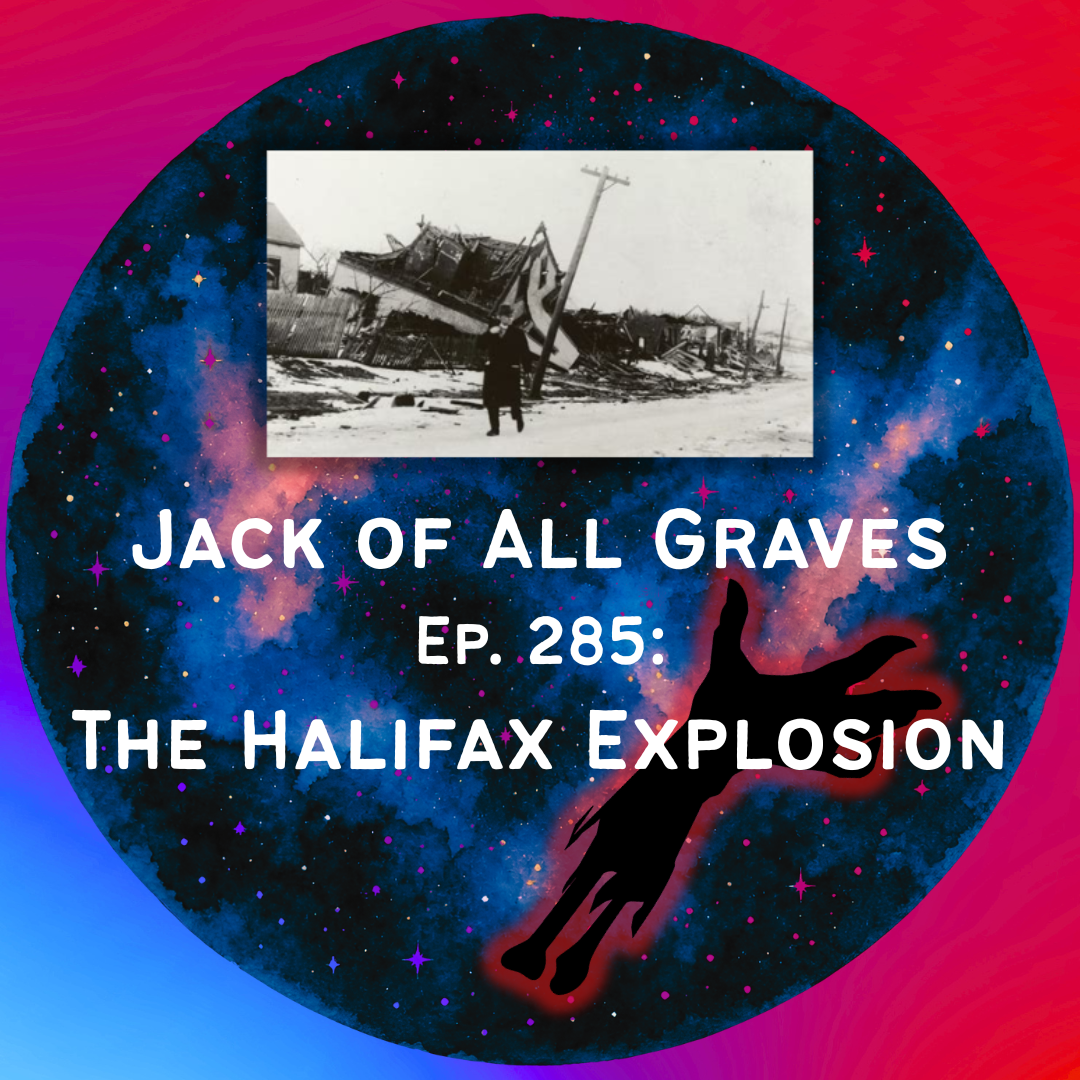
Today I'm going to tell you the horrible but fascinating story of the great Halifax Explosion of 1917.
[00:04:40] Speaker B: Horrifying but true, I hope.
[00:04:42] Speaker A: Oh, Mark. Mark Lewis.
[00:04:44] Speaker B: No, obviously not to want to insult you or do you dirty, but I just, you know, we
[00:04:50] Speaker A: deal
[00:04:51] Speaker B: in absolute fucking binaries here. We deal in facts here in Jack of all
[00:04:58] Speaker A: things. That's what we do.
[00:04:59] Speaker B: Science and truth.
That's what binds us all together. That's what this journey is all about.
[00:05:05] Speaker A: Yes. And in this case, history, of course.
And as such, it's 1917. Mark, what's going on in the world?
[00:05:13] Speaker B: Fuck me. Woof. Boom. Let me just say that. Let me just say. Bang. Yeah.
[00:05:18] Speaker A: And bang.
[00:05:19] Speaker B: Yep. Let me just say.
Yeah.
[00:05:24] Speaker A: Is this your way of telling me you don't know what was happening in 1970? Let
[00:05:27] Speaker B: me say. War.
[00:05:29] Speaker A: War. There we go.
[00:05:30] Speaker B: Yeah.
[00:05:31] Speaker A: War.
Yes. Snell.
Let
[00:05:38] Speaker B: me say.
You say that kind of.
[00:05:42] Speaker A: Yes. It's. It's 1917. It's World War I,
[00:05:46] Speaker B: of
[00:05:46] Speaker A: course.
And during the First World War, Halifax, Nova Scotia became a hub of wartime shipping and other activities for Canada.
And just to give you a picture of how Halifax harbor is set up to understand how things are going to unfold in this. What are you laughing at?
[00:06:05] Speaker B: I'm just. I'm enjoying the story, and I'm enjoying you and how into it you are.
[00:06:13] Speaker A: You can already see that I'm excited to tell you this
[00:06:16] Speaker B: story. Yeah. Yeah, yeah.
[00:06:17] Speaker A: Well, so how Halifax is set up, right, there's basically this long, thin inlet. Long, thin body of water that comes in from the Atlantic Ocean.
[00:06:28] Speaker B: Let me just. Just for the Brits here. Right, Just for the Brits, if you don't mind. Give me some. Not me, the other Brits.
Geographically, whereabouts is Nova Scotia?
[00:06:40] Speaker A: Fair question.
[00:06:41] Speaker B: Yeah.
[00:06:42] Speaker A: Nova Scotia is basically northeast of where I am. So if you go up the, like, eastern coast of North America, Right, So you got, like, Maine in. Is, like, our north point here of the United States. And then just past that, you pass through New Brunswick and then into Nova Scotia and what they call the Maritimes. Okay. Like, the seaworthy area of Canada right there. Okay, so it's actually kind of directly across from you.
[00:07:19] Speaker B: Fine. That's exactly. That's perfect. I can visualize that. That's great.
[00:07:23] Speaker A: Good. Yes. That's where Nova Scotia. Nova Scotia is.
Great question. I hadn't considered that part.
[00:07:29] Speaker B: Yeah, don't. Don't assume, you know, transatlantic geographic familiarity from us. Yeah. Just be inclusive. That's all I'm saying.
[00:07:37] Speaker A: I'm sure there's a lot of Americans who couldn't point to Nova Scotia on a map, either, so. Great question.
[00:07:42] Speaker B: Known for being stupid, aren't you?
[00:07:46] Speaker A: Okay. Wow.
All right.
School shooting. Point
[00:07:53] Speaker B: your gun, can you? I
[00:07:54] Speaker A: bet you all
[00:07:54] Speaker B: point to your dearest gun shop, eh?
[00:07:57] Speaker A: I told you before that Kio is in the living room going through various boxes that came from our storage unit many days.
[00:08:03] Speaker B: Did he find a gun?
[00:08:05] Speaker A: No, but he found this timeline. So the storage unit, it was my mom's stuff. Largely he found this project of my sister's from 1999. It was like Aaron's timeline. It's like important events from Aaron's life.
[00:08:21] Speaker B: Yep.
[00:08:23] Speaker A: It says on it, like, 1997, learned how to load a gun. 1998, snowboarded.
[00:08:33] Speaker B: Yeah.
[00:08:35] Speaker A: This is the most American timeline. Yeah. You. You can possibly imagine. Kia was like, the next year was Columbine. If she had done that, then they'd be like, huh.
But that's the important events in my sister's life. Learned to load a gun, snowboarded
[00:08:51] Speaker B: how?
Maybe even as I'm asking this, this feels like it might be a different conversation for a different time, but is Columbine still.
Where. If 9, 11. Right. Is like the. The 10 of cultural disaster impact. Where is Columbine?
[00:09:13] Speaker A: That's a good question. Yeah. Maybe for another day. In general, it's a thing we should talk about at some point. Definitely. It's up there.
[00:09:19] Speaker B: Yeah,
[00:09:20] Speaker A: I think. Yeah, I think Columbine is pretty up there because it ushers in, like, the era of school shootings. Like, now it's like, you know, whatever happens every other day.
But it was like, this is a. Something has gone horribly awry.
[00:09:35] Speaker B: Okay, so it's like an 8.
[00:09:38] Speaker A: Yeah, it's. It's probably a 7 or an 8 somewhere in that vicinity.
[00:09:41] Speaker B: Okay.
[00:09:42] Speaker A: Anyways, back to Nova Scotia,
[00:09:43] Speaker B: back to Halifax.
[00:09:46] Speaker A: So thin inlet. Right. Coming off the Atlantic Ocean.
And then we get the city of Halifax on one side and the town of Dartmouth on the other, and they are very close together.
The bridge that connects the two sides, Dartmouth to Halifax, is less than a mile long. We took a ferry back and forth because we were staying in Dartmouth, and it takes about 10 minutes.
So just consider the closeness of these. I
[00:10:14] Speaker B: see
[00:10:14] Speaker A: two towns visible
[00:10:16] Speaker B: within eyeline, of course.
[00:10:17] Speaker A: Very visible.
[00:10:18] Speaker B: Okay.
[00:10:18] Speaker A: Yeah. Oh, absolutely. Like I said, less than a mile. So, you know, if you were looking straight out across water, a mile is nothing. Of
[00:10:26] Speaker B: course.
[00:10:28] Speaker A: And Nova Scotia had been an important. I
[00:10:29] Speaker B: can imagine fog maybe rolling across it of a morning. Oh, yeah, yeah. Beautiful sun rises and. And,
[00:10:37] Speaker A: yeah, it's absolutely gorgeous
[00:10:39] Speaker B: flying over the surface of the water.
[00:10:41] Speaker A: Canadian geese. Yeah,
[00:10:42] Speaker B: yeah. They
[00:10:43] Speaker A: are known for that. I'm
[00:10:44] Speaker B: into this.
[00:10:44] Speaker A: Yeah. This is. This is why this was like a lifelong dream to go here.
[00:10:48] Speaker B: So salmon,
[00:10:49] Speaker A: but. Yeah, salmon live in rivers, don't they?
I mean, probably. I mean, we have bears in my town, so I assume they must have bears in Nova Scotia.
[00:11:02] Speaker B: Picture painted. Why don't we just say that?
[00:11:04] Speaker A: Yeah, right. You get the idea. And this is. This is a city right here. So we're not talking about like the wilderness at this point. We're not like Canadian wilderness. We're talking about two.
A city and like a suburb.
[00:11:17] Speaker B: Even in 1917,
[00:11:18] Speaker A: each other in 1917. So we'll get into like the construction of that and whatnot. It's not. It doesn't look like New York City. Right. But it is populated. There's about 60,000 people who live there. So
[00:11:30] Speaker B: again,
[00:11:30] Speaker A: in 1917,
[00:11:32] Speaker B: just to check in on my mental picture here, wood logs, log buildings.
[00:11:38] Speaker A: Yes, yes, Wood, absolutely.
[00:11:41] Speaker B: Locally hewn wood, perhaps locally chopped, locally
[00:11:43] Speaker A: sourced
[00:11:44] Speaker B: wood from the mill
[00:11:45] Speaker A: for sure.
[00:11:45] Speaker B: You know, just down the coast.
[00:11:47] Speaker A: Yes, definitely. You're. You're spot on in your picture of what this is. So wooden city, right. With a suburb directly across this little inlet from each other.
And Nova Scotia had been an important hub for a while before this. It's not only located in a great place when it comes to getting stuff from Europe to North America, like I said, straight shot across.
But when sailing into Halifax harbor, the water is really deep. And you also don't have to deal with ice. It very rarely ices over, which is pretty rare for like a northern area like that. So this makes it like an extremely choice place for boats to come and go.
[00:12:28] Speaker B: I see.
And a beautiful place to live, I would imagine.
[00:12:31] Speaker A: Yes, absolutely. I mean, and obviously in 1917, it's not what it is now. Now it's like, yeah, it's gorgeous, but yeah, it would have been a really nice place to live. And of course, like this area of Canada at this point and to this day is pretty sparse, Right. They don't like over develop everything. So you're talking about a place that's largely like where everyone lives at this point, right? The industries coming up here, all that stuff. So it's like this is the hub. This is where you would want to live, to like work and go to school and all of that kind of stuff. I always think that, like, you know, when you travel to a place like that, you're just like. It's crazy that they get to just like go about their day living here, you know, just like walking out and being like, there's the most gorgeous sight I've ever seen in my life. And they see it every day. I
[00:13:22] Speaker B: completely get that. And that actually came home to me just a couple of fucking days ago, right?
[00:13:28] Speaker A: Oh, yeah.
[00:13:29] Speaker B: We had the quickest flying trip to Wales.
[00:13:33] Speaker A: You flew?
[00:13:34] Speaker B: Flying as in quickly?
[00:13:35] Speaker A: Oh, flying as in
[00:13:36] Speaker B: flew.
[00:13:37] Speaker A: I see. Got
[00:13:37] Speaker B: it. Wales. You mad?
[00:13:40] Speaker A: I don't know,
[00:13:41] Speaker B: no fair.
[00:13:42] Speaker A: Listen, you're slang threw me.
[00:13:44] Speaker B: Yeah, that's fair enough.
[00:13:45] Speaker A: Go ahead. You drove to Wales.
[00:13:47] Speaker B: We drove. And remember ye the summer UK wildfires?
Yeah.
Well, we drove through the site of one of them. Okay.
And firstly, my God, the, the, the bruised, bleak beauty of that neck of the woods is just so fucking just. It. The skies always seem to be the same, just this mottled kind of powder blue and just gorse and grass and ponds and sheep and you know, people walking hikers, dogs, you know, mud. Proper hillside.
[00:14:35] Speaker A: Yeah.
[00:14:35] Speaker B: But this time for mile after mile after mile, charred black remnants of peat fires, you know.
[00:14:44] Speaker A: Yeah.
[00:14:45] Speaker B: And we were astounded at just how far and broad and widely spread this fire damage was. It went on for mile after mile after mile like a, like a scar, like a scar on the landscape. It was incredible. And I, I very clearly remember thinking to myself, hell, 18 odd years I lived here, literally fucking here.
And you know what the fuck man?
[00:15:19] Speaker A: Didn't, didn't appreciate the beauty.
[00:15:22] Speaker B: I was about to say something similar. Right. But I like to think I did.
[00:15:27] Speaker A: Right. Yeah.
[00:15:28] Speaker B: I can't remember a single time going over there when I didn't take a second and think to myself, this is world class, right?
[00:15:36] Speaker A: Yes.
[00:15:37] Speaker B: Show me, show me globally your fucking amazing landscapes and your beautiful, rugged, outdoorsy beauty and I will show you that more overflank Canada in Wales because it's, it's, it's world class. And I like to think I never took it for granted. But after a break, after a few years away, without seeing it particularly seeing it, you know, hurt like it was by that fire, it was, it was really something. It was really wild.
[00:16:05] Speaker A: Yeah, I know what you mean. There's something of, you know, not only the absence. Right. Like I always appreciated San Francisco and like, you know, how incredible it was to live in a place like that and everything when I was growing up. But you know, when something happens to a place too, that definitely the mix of absence and seeing a change like that really makes you go, holy shit.
[00:16:28] Speaker B: Yeah.
Again, fires were all over the news and they burned for weeks and weeks and weeks.
And I knew that they were really close to my home. I remember talking, talking to my mother for sake. And she could smell the smoke. She could. The smoke was coming through her kitchen window. But seeing the remnants, the wounds of it.
[00:16:47] Speaker A: Yeah,
[00:16:48] Speaker B: pretty wild. Pretty wild.
[00:16:50] Speaker A: And that'll connect pretty well to what we're talking about here, honestly. Yeah. Kind of on the same track with what happens here because obviously life tends to sort of Spring up around ports, right? Halifax's population had exploded. I am
[00:17:07] Speaker B: so sorry to keep interrupting. Right. But that. That reminds me of something super interesting that I read in the past week or so as well. And I promise I will stop interrupting and let you finish the story after this, right?
[00:17:20] Speaker A: Sam is sitting there like, come on, get it together, Lewis.
[00:17:23] Speaker B: Fucking story, man.
I can't remember who or where indeed I saw this, but it was an economist, or I think it was on Question Time, and a guy says that you can make a pretty reasonable kind of scratch assessment of the economy of a nation by looking at its roads and where they fucking point towards.
And if you've got a country where all the roads are either pointing down towards one big capital city or down towards the port, that is probably gonna be a country that's up shit creek because its entire economy is talking about funneling wealth or resources to another place.
Whereas if you've got a country where the transport links and the motorways connect to other fucking towns around that country, that is a sign of a thriving economic base as opposed to a place that just wants to get all the shit somewhere else.
[00:18:23] Speaker A: Extraction.
[00:18:24] Speaker B: Yes, an extraction economy. That's exactly how we put it. In fact,
[00:18:29] Speaker A: that is very interesting, isn't that. That's the thing. I would.
[00:18:32] Speaker B: And again, I
[00:18:33] Speaker A: would read about that.
[00:18:34] Speaker B: And you look at Wales, right?
You look at Wales, all the fucking roads lead pretty much in one direction out of Wales,
[00:18:43] Speaker A: right?
[00:18:43] Speaker B: Right.
[00:18:43] Speaker A: Yeah.
[00:18:44] Speaker B: If you want to get a train from the north to the south of Wales, where have you got to go? You've got to go into England and back into Wales again,
[00:18:49] Speaker A: right?
[00:18:49] Speaker B: All the roads will lead to the dock in Cardiff and the place is up shit creek.
[00:18:56] Speaker A: Yeah, well. And your Prime Minister wants to keep it that way, apparently, as it turns out, from discussions this week. So that's fun.
[00:19:06] Speaker B: Yeah,
[00:19:06] Speaker A: we'll
[00:19:06] Speaker B: talk about that later. But now, Corrigan audio.
[00:19:10] Speaker A: Now you're in.
[00:19:11] Speaker B: Yes.
[00:19:12] Speaker A: Okay, so ports. This. Honestly, this feels like you like getting on my level, to be honest. This is the kind of thing that I would excitedly tell you. I learned a thing about
[00:19:21] Speaker B: where roads point. Yeah, it just. It makes such sense. It makes perfect sense, doesn't it?
[00:19:28] Speaker A: So life springs up around ports. So Halifax population explodes in the 1800s is a combination of shipping and industry and trains, making it a hot spot. So, like I said, there's about 60,000 people who live here in 1917. But also because of the wartime industry and shipping, soldiers, all of that kind of stuff, there's about 15,000 people a month who just kind of pass through as well. So it is a bustling area for this point.
So During World War I, ships from countries that were either neutral or were allies would pop in there for supplies, and then they'd head back across the Atlantic Ocean escorted by armed warships that they didn't get fucked up by the Germans on their way back to Europe.
And Halifax was also where Canadian and even some American soldiers would deploy to wherever they were stationed overseas, a lot of them in France.
So in both world wars, the war effort relied on Halifax harbor to carry troops, animals, munitions, and other supplies, according to Smithsonian. And it was the most important naval base in Canada.
And the British had actually taken back control of the Canadian Navy during the war and rescinded the civilian prohibition of ships with dangerous cargo to be in the harbor, which is foreshadowing.
[00:20:50] Speaker B: Just sketch this out to me a little bit clearer, if you don't mind. So up until this point, there was a ban on hazardous cargo in the Strait of Halifax.
[00:21:04] Speaker A: Right.
[00:21:04] Speaker B: Okay.
[00:21:05] Speaker A: And then the United Kingdom is like, we need to be transporting that shit in and out of here. So we're gonna rescind that and allow that stuff for in war because
[00:21:15] Speaker B: it benefits us directly. Yes,
[00:21:17] Speaker A: yes, exactly.
So that super thin strip I was telling you about is appropriately known as the Narrows.
And then it empties into the Bedford Basin with those two cities, Halifax and Dartmouth, on either side of it.
On December 6, 1917, two ships were passing through the. The French cargo ship SS Mont Blanc and the Norwegian ship, the SS Imo, which was being used by the Commission for relief in Belgium and was moored in the basin while awaiting a late coal delivery, and the military convoy that would take them safely back across the Atlantic. So a lot of times, the ships would kind of like, just be sitting there waiting in the harbor until, like, a military convoy could assemble and take everybody back across the ocean.
And at the entrance to the port, there were these two sets of underwater nets that were meant to protect the harbor from U boats.
And neither the AIMO or the Mont Blanc could get in or out of the harbor until those were lifted in the morning.
I'm pretty sure I've mentioned on numerous occasions the museum that first really ignited my interest in maritime museums as a thing, which was one on the Columbia, Columbia river, that talked about bar pilots, these specialized guys who were trained specifically to navigate one particular treacherous part of the river that had a tendency to sink the fuck out of the ships that passed through unprepared harbors actually always have specific rules regarding Ships being piloted into them because all of them are different. They all have their own hazards and things like that. They all have their own quirks.
And so each harbor requires that ships have local pilots on board them so that they don't get themselves into trouble in unfamiliar waters.
There's lots and lots of rules and regulations were obviously suspended during this time. And so this was not the case with these ships. Although from everything that I've read, the captains themselves were like extremely experienced. You know, it wasn't like they were like just throwing anybody on there and being like, hey, pilot these ships. But they didn't have someone who was super familiar with the harbor specifically.
And the Aimo, perhaps trying to make up time after the late delivery, headed out of the harbor too fast.
And as it entered the narrows, it hugged the left to let a ship entering the harbor pass, as well as to avoid a tugboat.
And honestly, this whole thing sounds like a mess.
In avoiding these two hazards, the Aimo ended up in the path of the Mont Blanc as it entered the harbor.
When the captains realized they were about to collide, they both tried to swerve to avoid it, but unfortunately they both swerved the exact same way. We've
[00:24:01] Speaker B: all done
[00:24:02] Speaker A: it.
How many times have we been walking towards someone
[00:24:05] Speaker B: in a corridor,
[00:24:06] Speaker A: Right?
Yeah, exactly.
On foot, fine. In a boat, little more of a problem because you can't stutter, step out of the way. And so they both just crashed straight into each other.
Now, two ships colliding is bad news, bears. Yeah, of course, but it's not necessarily catastrophic.
Right. Especially when you're right in the harbor where there's lots of ships that could potentially carry out a rescue, like of all places. Lots of
[00:24:35] Speaker B: water. Lots of water.
[00:24:37] Speaker A: Lots of water. Yeah.
But here's the thing about the Mont Blanc. I told you it was a cargo ship, right?
[00:24:43] Speaker B: No,
[00:24:45] Speaker A: it's cargo. Don't
[00:24:46] Speaker B: tell. Can I guess?
[00:24:47] Speaker A: Go for it.
[00:24:50] Speaker B: So wartime.
[00:24:53] Speaker A: Yeah,
[00:24:53] Speaker B: bombs,
[00:24:56] Speaker A: I mean, almost.
Basically its cargo was tnt, a fuel called benzol, an explosive called picric acid, and a propellant called gun cotton.
So it wasn't carrying a bomb mark. This ship was a three kiloton bomb.
The atomic bomb dropped on Hiroshima was about five times this size for scale. So that's how big this is.
[00:25:27] Speaker B: Wow.
[00:25:27] Speaker A: It's one fifth of the atomic bomb we dropped on Japan in boat form.
[00:25:35] Speaker B: That's incredible.
[00:25:35] Speaker A: Sailing through the narrows.
[00:25:37] Speaker B: Incredible.
[00:25:39] Speaker A: Yes.
So the Collision occurred at 8:45am and immediately the Mont Blanc caught fire while drifting towards a pier. I believe it was Pier 6
[00:25:49] Speaker B: incredible. This is one of those tales, right? And they're think back to the molasses flood.
[00:25:59] Speaker A: Right,
[00:25:59] Speaker B: right. Think to the Bhopal chemical factory disaster.
Numerous tales that yarns that we've spun during this podcast and this is one of them where I cannot believe this is not more widely known,
[00:26:20] Speaker A: right? Yes, exactly. Yeah. As much as I joke about being a basic and picking the, you know, well known Nova Scotia story, it's if you asked any American about this, they would not know.
But
[00:26:33] Speaker B: a Nova
[00:26:33] Speaker A: Scotian this in school Nova Scotia, they would probably anywhere in Canada. But yeah, outside of Canada you're unlikely to know this story and that is bonkers because it's gonna get wilder. Mark, let me tell you.
So the Collision occurs at 8:45am Montblanc Mont Blanc catches fire while drifting towards a Pier.
At 9:04am the largest man made explosion until the use of nuclear weapons would occur when the Mont Blanc fully blew up in Halifax Harbor.
Now we've talked about several shipwrecks that have happened in view of the shore, right? Like the SS Eastland in Chicago, the SS Morro Castle in Asbury Park.
What do people tend to do when something startling happens in plain view of the water? Mark?
[00:27:25] Speaker B: What in 2026?
Take a
[00:27:28] Speaker A: photo. Really?
Take a photo? For sure, yeah. That's the idea. They gather.
[00:27:34] Speaker B: Yeah, yeah, yeah, yeah, yeah, yeah, for sure. Point.
[00:27:37] Speaker A: Yeah. It's 8:45 in the morning when this fire starts. There are people on their way to work, kids on their way to school, sailors, dock workers, factory workers, folks who just live near the water.
Tons of people either just going about their day or congregating to watch as the ship burned. And in fact, one element of this that's unfortunate is that normally school would start at 9, but because of the winter hours they actually started at 9:30 so there'd be a little more light.
[00:28:07] Speaker B: Tell me,
[00:28:08] Speaker A: when the kids were walking to school,
[00:28:09] Speaker B: which side did this sailing fucking deadly clusterfuck plow into? Was it the city side or the suburb side?
[00:28:22] Speaker A: So it didn't, the ship didn't hit.
[00:28:25] Speaker B: I see
[00:28:25] Speaker A: the either side. It's
[00:28:27] Speaker B: going into a pier
[00:28:28] Speaker A: in the water, right? But it's drifting. That's what I'm talking on fire.
[00:28:31] Speaker B: Yeah, yeah, yeah, yeah, yeah.
[00:28:32] Speaker A: And it is drifting towards the piers on the Halifax side.
[00:28:35] Speaker B: Okay, okay,
[00:28:37] Speaker A: great question.
But like I said, so the kids who would normally like be in school or like just about to school are walking right now to school. So they are lining up on the shore here like, ooh, what is this?
Because School started late in the winter, so all these people start lining up. And as the crew from the Mont Blanc hopped onto lifeboats, ran ashore and headed for higher ground while yelling at everyone to get the away. Most people were unmoved by that.
In fact, those crewmen were only able to save two people standing on the shore.
One crew member saw a stunned indigenous woman holding a baby. And when she didn't respond to his pleas to like, get the fuck out, he actually grabbed the baby out of her arms and started running.
And that actually jolted her into action. She's like, where's he going with my baby? And she ran after him. And both that woman and the baby survived. What would happen next?
[00:29:36] Speaker B: That does
[00:29:36] Speaker A: not bode well
[00:29:37] Speaker B: for everyone else.
[00:29:39] Speaker A: No two people left, and one of the crew members had to steal a baby to make that happen. Everyone else was like, what are they on about?
And I guess there's. They may have been yelling in French. That may have been part of it, but
[00:29:53] Speaker B: they might have said,
[00:29:54] Speaker A: yeah, but nobody seemed to know that this was as dangerous as it was.
[00:30:00] Speaker B: Well, how could they?
[00:30:01] Speaker A: Yeah.
You've seen fires. You know, I'm sure this wasn't the first time something caught fire.
[00:30:07] Speaker B: They didn't know that this was the biggest explosion.
[00:30:10] Speaker A: Right. They had no clue
[00:30:11] Speaker B: that point in all of recorded human history.
[00:30:15] Speaker A: They didn't know until Hiroshima 30 years later that this was going to be the biggest explosion.
[00:30:22] Speaker B: Let me say this out loud again, because I don't. I don't know if I believe it. Until that point. What occurred there was the largest explosion made by human hand ever.
[00:30:34] Speaker A: Yes.
[00:30:35] Speaker B: Wowee. That's cool.
[00:30:37] Speaker A: Yeah. Crazy, right?
Yeah. So when the Mont block exploded, it created a fireball and a shockwave that, quote, flattened a 1.5 square mile area, killing approximately 2,000 people and injuring 9,000. 25,000 were left without shelter. And again, as I said, 60,000 people live in this city.
[00:31:02] Speaker B: Yeah.
[00:31:03] Speaker A: 25,000 are homeless, 2,000 are dead, 9,000 injured. That's colossal. Right. Like, when you're talking about recovery efforts and things like that, and half of the city is dead, injured, or homeless.
That's a problem, obviously.
Debris was scattered over three miles away and windows shattered up to 60 miles away.
The explosion was so intense, it blinded many of those in its path, which we will come back to.
So let's talk about how all that happened.
[00:31:37] Speaker B: And that's gonna blind you in a pretty fucking grim way as well, isn't it? That's gonna fucking.
[00:31:42] Speaker A: Yeah, we'll. We'll come back to
[00:31:44] Speaker B: that.
[00:31:46] Speaker A: The explosion caused, with the Maritime Museum refers to as a quote, roiling cloud of hot gas which threw hunks of the ship and debris across a range of FL5 miles.
Like, there's one that I think is it was somewhere between three and five miles away that was like this huge hunk of metal, looks like a cannon that's just sort of drooping because it burned so hot and it just landed, you know, Miles, they have hunks in the museum. They
[00:32:12] Speaker B: have chunks.
[00:32:13] Speaker A: Yeah, they have chunks of all. They have lots of stuff from the shipwreck in the museum. But this is like in the place it landed a few miles away. They just put it on, like a little pedestal thing.
[00:32:22] Speaker B: Yeah.
[00:32:23] Speaker A: So you can go and see it. Like, things flew forever here.
The chemicals and the fuel that were vaporized in the blast fell back down as rain and covered people with an oily film.
And in vaporizing all those chemicals and fuel, it also vaporized anyone who was anywhere close to the ship, which included the first batch of firefighters who had come to respond to the fire, not realizing that it was going to explode. Explode.
Bodies that weren't vaporized were tossed like ragdolls, some landing as far as half a mile away from the harbor.
Just crazy.
And bodies weren't the only things being shot across the landscape immediately in the explosion. As I said, debris and projectiles were scattered for miles. Shit shot through homes and storefronts like torpedoes, basically exploding the structures on impact and collapsing them onto their occupants.
The shockwave that came after was registered as moving at a speed of 13,000 miles per hour.
So after the initial storm of shrapnel, you got another devastating wave of stuff flying at you, along with the blasted out windows that I mentioned.
Most of the buildings and homes in Halifax were wooden constructions, as you mentioned earlier.
And inside, they, of course, had things like oil lamps and stoves for cooking and heating.
So when the homes collapsed, the lamps and the stoves caught that wood on fire, causing more conflagrations to pop up all over the place. You've got a city with just like stacks of burning, you know, piles of what once were homes all over the place.
And keep in mind that many of the people inside the places that had collapsed or had the windows blasted out had no idea there'd been a fire. This came as a complete surprise. One second they're, you know, doing stuff in their home, and the next thing it's just collapsed on top of them. And they have no idea why that happened.
Nearby,
[00:34:31] Speaker B: deboning a salmon one day.
[00:34:35] Speaker A: So Big on their salmon there and
[00:34:37] Speaker B: all of a sudden
[00:34:38] Speaker A: their salmon based economy. And then all of a sudden this comes through.
[00:34:42] Speaker B: Honestly, no fucking jesting here. This is huge.
[00:34:47] Speaker A: Yes, it is,
[00:34:49] Speaker B: isn't it?
[00:34:51] Speaker A: Nearby the Wellington barracks, which was full of ammunition, was one such wooden structure that had begun to burn.
But one quick thinking soldier managed to douse it and prevent another giant catastrophe from occurring.
The result though, was a giant plume of ash that rose way up into the sky and looked to the now terrified survivors and rescue workers like there had been another explosion.
[00:35:16] Speaker B: Oh, I see.
This was the vortex of debris filling the vacuum left by the shadows.
[00:35:25] Speaker A: Well, and basically this is like, you know, this place was catching fire. They doused it and you know, if you like when you put out a campfire, right, you get smoke coming up from it. But this coming from this barracks looked like, you know, almost like a miniature mushroom cloud.
[00:35:41] Speaker B: That's exactly
[00:35:42] Speaker A: where my head was.
Yeah, rising into the air. And so being in the middle of a war and now we've got what looks like two explosions. They thought, holy shit, the Germans are attacking us and surely they're not done and we got to get out of here before they hit another target.
So this actually ended up hampering some of the initial relief efforts because folks scattered to avoid what they were sure was going to be the next blast that would hit them from a German attack.
This blast also, and this is crazy to me, fully blew the water out of the narrows.
You could see the seafloor because it blasted the water out and it created a 20 to 30 foot tsunami that rushed Halifax and Dartmouth right after they'd already been hit by the blast.
So basically washed up, grabbed people from collapsed houses and things like that and pulled them back into the inlet where they then drowned.
It actually also wiped the entire Mi' Kmaq first nations settlement of Turtle Grove completely off the map. Just absolutely nothing left of it after this tsunami.
And then what's worse, the day after the explosion, a blizzard came through, severely hampering recovery efforts and burying would be survivors in a foot and a half of snow.
[00:37:10] Speaker B: Snow,
[00:37:12] Speaker A: snow.
Super great timing on, on that communications also went down as obviously roads, rails, telephone and telegraph lines were destroyed.
And so this meant of course, that the initial stage of rescue and relief had to be carried out by folks from the immediate vicinity, mostly soldiers and sailors who had been on U.S. british and Canadian ships in the port nearby.
It was a disaster on about a bajillion different fronts. A bomb like explosion, chemicals raining on people, a tsunami, fires springing up all over the place, panic, thinking it was a German attack, destruction of lines of communication, a colossal amount of people standing by to gawk, leading to even more
[00:37:55] Speaker B: man, kids, Further kids,
[00:37:58] Speaker A: kids. Tons of kids.
And further, at the time this occurred, a lot of the medical and nursing staff from the area had actually been deployed to France and were not there to aid the rescue efforts. Meaning that Halifax had to wait past the blizzard for help to arrive from other parts of Canada and from the northeastern United States.
So if you were Germany and wanted to set up an attack, you'd be hard pressed to manufacture a situation that is as catastrophic as this one was.
[00:38:29] Speaker B: Isn't that a fascinating way of thinking of it though,
[00:38:33] Speaker A: right?
[00:38:33] Speaker B: Like the fifth biggest or the biggest explosion in humanity up to that point was an accident.
[00:38:41] Speaker A: Total accident in wartime.
[00:38:43] Speaker B: Yeah,
[00:38:44] Speaker A: total accident.
[00:38:45] Speaker B: Had, you know, had none of the greatest, quote unquote, greatest minds of war ever thought to combine all of the materials that were on that ship,
[00:38:55] Speaker A: right, and
[00:38:55] Speaker B: hurl them at someone, put them in a trebuchet,
[00:38:58] Speaker A: completely devastate an entire city just like that.
[00:39:03] Speaker B: Isn't that, isn't that just like us, huh?
[00:39:09] Speaker A: It is, it is. Yeah.
But one of the only things that hindered this from being any worse than it already was was the actions of a dispatcher named Vincent Coleman, who, seeing what was happening on the harbor, sent out a message saying, hold up the train, ammunition ship, a fire in harbor making for Pier 6 and will explode.
[00:39:31] Speaker B: The story as it all
[00:39:32] Speaker A: be.
[00:39:33] Speaker B: The story has it all.
[00:39:36] Speaker A: I know, I'm telling you.
[00:39:38] Speaker B: The story has it all.
[00:39:41] Speaker A: His message went on. Guess this will be my last message. Goodbye, boys.
He successfully stopped the trains for coming into Halifax and being immediately blown to smithereens as he was.
His message also alerted doctors and nurses from around Nova Scotia to the fact that something terrible had occurred and hundreds made their way over to help once they were able.
So one crisis averted in all of this and the secondary effect of bringing in more help as a result.
But the explosion also had some really interesting long term impacts, and one in particular stands out.
As I mentioned, the shockwave following the blast caused windows to shatter miles away from the harbor. And while some folks were completely surprised by this, others had been actively looking out their windows, watching the fire.
Now, what do you suppose happened to those people when the shockwaves blasted their windows out?
[00:40:38] Speaker B: Very painful and quick.
Retinal glass interface situation.
[00:40:47] Speaker A: Yes, exactly. It sent glass projectiles straight into their open eyeballs, permanently blinding hundreds of people in an instant.
1 Dr. George H. Cox described glass being driven clear through the eyeball and eyelids cut into literal fringes, which, the more you think about that, the worse that gets.
Cox didn't even bother counting how many eye surgeries he performed because there were so many. He was operating day in and day out on all kinds of horrific injuries. And most of these surgeries were what's called the enucleation of the eye.
That is surgery to completely remove the eyeball and part of the optic nerve, leaving the bones of your eye socket intact so that you can then get a prosthetic eye implanted.
A lot of the surgeries Cox performed required him to do a lot of sort of finagling in there to get people's eye sockets intact enough to even take a fake eye.
[00:41:49] Speaker B: I wonder if the.
The skin tube technique was used at any point.
[00:41:58] Speaker A: Yeah, that's a good question. That didn't come up in anything
[00:42:01] Speaker B: because it was the First World War where that was innovated.
[00:42:03] Speaker A: Yeah. Where that was a thing. I don't know that the kinds. I mean, I guess probably the kinds of injuries,
[00:42:10] Speaker B: burning, scarring, need, grafting needed,
[00:42:13] Speaker A: would absolutely be part of it, but eyes were the big one here.
And so he and 11 other surgeons managed to perform around 249 enoculations, enucleations, including 16 double enucleations, meaning people got both
[00:42:31] Speaker B: eyeballs scooped,
[00:42:32] Speaker A: taken out.
This mass blinding event, combined with similar injuries occurring in Canadian soldiers who had returned from the war, resulted in the creation of the Canadian National Institute for the blind CNIB in 1918. Yeah. And those rendered blind in the explosion were given a pension funded by the Halifax Relief Commission.
These pensions were distributed to people all the way through the 1970s.
But the institute for the Blind in particular became an incredibly important organization that still exists to this day.
At the time, the school offered services like teaching braille, basketry, typing and cooking for the lady folk and leather work and piano tuning for the guys.
[00:43:16] Speaker B: Beautiful.
[00:43:18] Speaker A: Further, the Massachusetts Halifax relief committee provided 25,000 towards services for the blind, including fitting houses with blind friendly cabinetry appliances and things like that. So making the places they lived livable with a disability instead of putting them into like a group home somewhere and taking away their autonomy.
Canada ended up being a model for how to deal with the loss of sight as opposed to blindness from birth, and focused on helping people to live independently, giving them the resources to do so.
The CNIB has now been around for over a hundred years and is Nova Scotia's largest provider of vision rehabilitations, serving 13,000 blind or partially sighted people. In the region.
So out of the absolute horror show of this devastating accidental explosion in 1917, Canada ended up with a beloved and important institution that has helped blind and partially sighted people to live full lives with proper resources for over a century.
[00:44:20] Speaker B: Well, bravo.
Right? Bravo.
[00:44:24] Speaker A: Thank you.
[00:44:25] Speaker B: Not to want to get in, you know, not to want to be too congratulatory or smug or anything like that, but that was a real home run. That was fantastic.
[00:44:33] Speaker A: It does have everything. It doesn't it? I mean,
[00:44:35] Speaker B: it does.
[00:44:36] Speaker A: Again, to your point of, like, why isn't this common knowledge? Like, I'm sure there have been movies made about this or whatever. I'm sure there's watch a movie made about that all day. But
[00:44:45] Speaker B: tell me again.
[00:44:46] Speaker A: Yeah. That there hasn't been the Titanic of this experience is kind of crazy.
[00:44:52] Speaker B: Yeah. Yeah. To be honest, Disaster.
This needs.
This needs a high profile, high budget, high.
[00:45:03] Speaker A: Yeah.
[00:45:04] Speaker B: You know, high visibility movie treatment. Surely the
[00:45:09] Speaker A: right. This can't just be for maritime nerds like me. You know, everyone should have access to a real big version of this story. I mean, it's. It's obviously like a very depressing one. But what I didn't really get into as well is that this became like.
Like the first. It was like the first organized relief effort in Canada and like, completely changed the way that they deal with emergencies across the board. There's like terrible levels of this that have changed Canada.
[00:45:41] Speaker B: Shattered city, The Halifax Explosion, 2003. A TV miniseries.
Come on. City of Ruins, the Halifax Explosion, 2003. Yeah. TV movie. God, no, no, no.
[00:45:53] Speaker A: 2003.
[00:45:54] Speaker B: 2003.
[00:45:55] Speaker A: Come on. What are we doing? What are we doing?
[00:45:59] Speaker B: What are we doing?
Who do you attach to this?
[00:46:04] Speaker A: Like a director?
[00:46:06] Speaker B: Go for it.
[00:46:08] Speaker A: Oh, that's a tough one.
[00:46:10] Speaker B: It is a tough one. We'll think, we'll see.
[00:46:11] Speaker A: We'll think on it.
[00:46:12] Speaker B: Yeah, yeah, yeah, we'll think.
[00:46:13] Speaker A: Who would you attach? Listener.
Let us know.
[00:46:18] Speaker C: Let me quote directly from my notes, if I may.
[00:46:20] Speaker A: Yes, please do.
[00:46:22] Speaker C: Look at these nerds.
[00:46:24] Speaker B: Oh, mise en scene.
[00:46:25] Speaker A: I don't think anyone has ever said mise en scene in such a horny way before.
[00:46:29] Speaker B: The way I whispered the word sex. Cannibal receiver.
[00:46:32] Speaker A: Worst comes to worst. Mark, I'm willing to guillotine you for science.
[00:46:36] Speaker B: Thank you.
[00:46:36] Speaker C: That's really, really sweet. It's
[00:46:38] Speaker B: cold
[00:46:38] Speaker C: outside, but my pancreas is talking to me. I'm. And I'm gonna let it.
[00:46:42] Speaker A: You know how I feel about that, Mark?
[00:46:44] Speaker B: I think you feel great about it.
Wow. Reeling left. Reeling from that.
[00:46:55] Speaker A: I love when that happens.
[00:46:57] Speaker B: Yeah. So good. All right. Good. Good day, just. Good morrow, good afternoon, good morning. Wherever however this may find you, I hope you're good. I hope you're feeling optimistic, particularly about the next few months.
It's.
We'll. We'll. We'll chat more of GTA as the time goes on. Right.
And I won't overdo it because me. Me. Has the media been feasting on GTA this week like mainstream outlets have been talking about it? Yeah,
[00:47:27] Speaker A: just normal evening news.
[00:47:28] Speaker B: Yeah. Like three days worth of news they've got out of that. And it's incredible. I am. I feel grateful that it's come along when it did. Right.
[00:47:36] Speaker A: Oh, yeah.
[00:47:37] Speaker B: Because what this is, this is my.
This is my ticket to easy street through the dark months, isn't it? That's what this is.
[00:47:44] Speaker A: That's a valid point. You're gonna need this.
[00:47:47] Speaker B: That's exactly what this is. The timing of this could not. And listen, I'm sure not for nothing, I'm sure it's been, you know, worked through in meetings for years, but the timing of this release is absolutely brilliant for me personally.
[00:48:02] Speaker A: As if they were like, Mark Lewis is gonna need this.
[00:48:04] Speaker B: Anyway, more on that in a bit. Welcome to you. Great to be back after a week off, Corrigan. Here's how I'm gonna start this week. I.
[00:48:13] Speaker A: Okay.
[00:48:13] Speaker B: Gonna challenge you right off the bat. I'm gonna challenge you to tell me something about yourself that I do not yet know after six years.
[00:48:26] Speaker A: Oh, my goodness.
[00:48:26] Speaker B: How do you think of that? How do you feel about that?
And you've got.
[00:48:30] Speaker A: How do you not? Five seconds after I came in fifth place out of 15 in a geography bee once.
[00:48:37] Speaker B: Fifth place, that's very average, isn't it? Right there in the middle.
[00:48:42] Speaker A: Very average.
[00:48:43] Speaker B: There you go. And I didn't know that, so thank you, friends. What
[00:48:46] Speaker A: about you? What do I not know about you?
[00:48:48] Speaker B: What about me?
I was scheduled to be on.
Yeah. United Airlines Flight 175 on September 11, 2001. How about that?
[00:48:59] Speaker A: Liar.
[00:49:00] Speaker B: No, I'm not.
[00:49:01] Speaker A: Liar.
[00:49:02] Speaker B: Not a liar.
[00:49:04] Speaker A: There's no way that would have
[00:49:06] Speaker B: not come up. That's
[00:49:07] Speaker A: true. Until now.
[00:49:08] Speaker B: That's the fucking truth.
[00:49:10] Speaker A: Okay, Seth MacFarlane.
[00:49:11] Speaker B: And do you want to know something else? Do you want to know something else while we're on the subject? I was going. You know what my destination was? I was going to the World Trade Center. What do you think of that? Just
[00:49:21] Speaker A: straight into it.
[00:49:22] Speaker B: What do you think of that? I had a work thing and it was in the South Tower and everything.
And I think about it every day.
Right.
[00:49:32] Speaker A: Yeah.
[00:49:33] Speaker B: And you might think.
You might think that I would feel lucky to have not been on there, but no, I feel regret. I wish I had been on the flight as planned.
[00:49:46] Speaker A: Well, yeah, you and Mark Wahlberg. Things would have gone down
[00:49:49] Speaker B: different. Think I could have changed events.
So there you go, listeners. Something a
[00:49:55] Speaker A: little.
[00:49:56] Speaker B: Little something about Corrigan. Or not. You might not know.
[00:50:02] Speaker A: All right.
Anyways, Mark, how you doing?
[00:50:05] Speaker B: I'm really good, thank you. Well, what I did there was I gave you the stock response, didn't I?
[00:50:11] Speaker A: You did, yeah. Just didn't.
[00:50:13] Speaker B: I
[00:50:13] Speaker A: spat it right back out.
[00:50:14] Speaker B: I gave you the two o' clock on a weekday response. How you doing, Mark? Yeah, good. Anyway, you know, that's not.
That's not the response that you deserve, and it's not the response that this podcast is all about.
However, fortuitously, the answer is pretty much the same. Pretty good. Thanks.
You know, it's
[00:50:32] Speaker A: good even with a little thought. Yeah,
[00:50:33] Speaker B: yeah, not
[00:50:33] Speaker A: bad.
[00:50:34] Speaker B: Pretty good, thanks.
At the peak of my physical fitness and strength, you know, physically, just. I remain a specimen. Right,
[00:50:44] Speaker A: True.
[00:50:48] Speaker B: And, you know, life's a roller coaster mentally. Of course it is. Of course it is. But equilibrium. Equilibrium is good. There's lots going on in life right now with work, a great. Family's great, potentially up, you know, life events going on in the family. Maybe a house move coming up in the next few weeks. Really cool.
[00:51:11] Speaker A: Nice.
[00:51:11] Speaker B: So no particular complaints here. What about you?
[00:51:17] Speaker A: No complaints here either. It's the holidays, you know, I've been just sitting around watching Hallmark movies, largely, and wasting time on that, which I always enjoy. I'm really. Listen, I think I've said before that, like, for some reason, Kyo got in his. In his head that I enjoy traveling at the holidays, and he's been, like, doing it for me all these years, and I don't. I want to be home at the holidays. And so he's like, oh, you know, we've got some expenses and stuff like that. I don't think we can, like, go anywhere this year. And I was like, I cannot express to you how much I don't want to go anywhere. I don't. I would like to stay here. And so how
[00:51:56] Speaker B: did this come to light? How did you work out that he'd been doing it for you and you didn't enjoy it?
[00:52:00] Speaker A: Well, when he said that, when he was like, oh, you know, financially, maybe we don't go anywhere this year, and I was like, did you think I wanted to do that.
[00:52:07] Speaker B: Good. Yeah, thanks.
[00:52:10] Speaker A: I do not. I don't want to go anywhere at Christmas. I want to be here in my home, like really nesting during this point. And so that is what I've been doing is just like,
[00:52:20] Speaker B: oh, it's a lovely feeling
[00:52:21] Speaker A: in the Christmas spirit. Getting cozy, you know, being warm, watching Christmas movies.
[00:52:26] Speaker B: When it's, when it's this side of January, when it's this side of December 31st,
[00:52:32] Speaker A: this is the good stuff.
[00:52:33] Speaker B: This is the sowing. Right.
[00:52:36] Speaker A: Yeah, that's what it is,
[00:52:38] Speaker B: you know.
[00:52:39] Speaker A: Yeah. On
[00:52:40] Speaker B: January 1st, we reap.
[00:52:42] Speaker A: This is the fat of the foe.
[00:52:44] Speaker B: That's it exactly
[00:52:44] Speaker A: going on here, beginning of January.
[00:52:48] Speaker B: Oh, we reap.
[00:52:49] Speaker A: Yeah. Definitely in fuck around mode at this point and, you know, deal with whatever consequences later on. And I'm in. I'm enjoying that whole thing. But to your point about being, you know, a specimen of physical health and whatnot, this week is.
[00:53:02] Speaker B: I jest, of course. You know, this,
[00:53:05] Speaker A: this week at the gym. Of course, Thursday is a holiday. It's Thanksgiving. Then going into like Black Friday, on Friday, all that kind of stuff. And so they always. They go down to two classes a day at the gym. And I have never felt more autistic than last year.
[00:53:21] Speaker B: They've started that
[00:53:22] Speaker A: already, have they? On Thanksgiving.
It's Thanksgiving. It's a holiday.
[00:53:25] Speaker B: Okay. Okay.
[00:53:28] Speaker A: Yeah.
Everyone's gonna be home while you eat dinner at like 3 o' clock in the afternoon on Thanksgiving. You can't be at the gym all day.
So they're
[00:53:38] Speaker B: not open
[00:53:39] Speaker A: at all.
This not. So the gym that I regularly go to has classes.
[00:53:46] Speaker B: Yeah,
[00:53:47] Speaker A: so they have two classes and that's it. And then they shut the gym as opposed to like, you know, the anytime fitness or whatever. Yeah, that's I assume is open.
[00:53:55] Speaker B: Oh, when the ever you want to go.
[00:53:58] Speaker A: Yeah, they, they might not have anyone in there, but you can go tappy tap and
[00:54:02] Speaker B: then you. And you breeze.
[00:54:03] Speaker A: Yeah, yeah. But no, this only has classes. There's no like rest of the gym. It's just classes in it. And so they do the two. But I went last year and I basically like kind of Abe Simpsoned in and out of that because I walked in and like it's. It was super packed because everybody who would normally be there all day is in the class. But. And then I realized that the people who are in like the really like the like 6:30, 7:30am Classes or 6 or 7am Classes are like too upbeat. And so they had a habit of like screaming while they worked out and not like in a like, like not a grunting way, but in a like kind of way. That
[00:54:47] Speaker B: is fucking
[00:54:48] Speaker A: disgusting.
[00:54:49] Speaker B: Get away from me.
[00:54:50] Speaker A: Overstimulated that. I just like walked in. I like, you know, got in my place, stood there for like three minutes, went and put my sticker on the board for having gone and left. So it's like the nice thing is they do like a video version so you can do it at home too. And I'm like, I'm not fucking around with this this year. I am just gonna do the workout from home and put my sticker on when I get back on Monday.
[00:55:14] Speaker B: Ah, fuck, man. I hate performative anything.
[00:55:17] Speaker A: Yeah. Like, I played a lot of sports, right? And so I like, I'll be. I cheer people on. You know, things like that. You know, if someone's on the skier and they're struggling, struggling, I'm like, all right, pull it out, pull it out. You got this. Things like that.
A targeted like, like an athlete kind of thing is fine. I don't feel like screaming and just like just being loud.
[00:55:41] Speaker B: No.
[00:55:42] Speaker A: For no reason. It's
[00:55:42] Speaker B: horrible.
[00:55:43] Speaker A: I don't. Performative and
[00:55:45] Speaker B: even what you just said there. But about, about offering well intentioned gassing up of a gym mate of a fellow gym goer. Oh, I can think of nothing worse.
[00:55:56] Speaker A: If you're in a class.
I think it's an important part of it.
[00:56:00] Speaker B: Okay.
[00:56:00] Speaker A: You know, like the sense that you're on a team in a class. Like, I wouldn't like if you were just some guy at the gym, be like, let's go. Pull it out. That's kind
[00:56:09] Speaker B: of. That's where my head went. That's kind of what I thought you were talking about.
[00:56:11] Speaker A: Not to a stranger. We all know each other because we go to the same class every single day with each other.
No, I, I would, I would absolutely be bothered if someone came up to me.
One more rap machine.
The.
But when we're doing something and it's together, cheering each other on is like part of why you take classes, right? But yeah, that to me is very different than just like screaming for no reason. And I just, I've like, I hadn't, I hadn't felt that kind of overstimulation in a long time. You know, it's like you manage your triggers. You don't go places that are gonna like stress you out and cause you that feeling. But there's this like level of overstimulation where I can feel that if I don't immediately extricate myself from the situation, I Will sob.
You know, it's like. It's just. It's just my body, like, trying to, like, get the. The overstimulation out. I will just, like, start bawling to, like, deal with it. I'm like, I'm not doing that at the gym.
[00:57:13] Speaker B: Yes. And I've. I've felt that. Not to the. Not to the brink of sobbing. That's not how I react. But there
[00:57:20] Speaker A: have been
[00:57:21] Speaker B: more than one. There have been three occasions this week, one of which was for two solid days, where I've been placed in unavoidable social situations with, you know, acquaintances.
[00:57:36] Speaker A: Yeah.
[00:57:36] Speaker B: And strangers in some cases. And me. It's so difficult. It is so hard and so exhausting.
[00:57:44] Speaker A: Yes, exactly.
[00:57:46] Speaker B: And I.
The. The last of these. The last of which totally brought into focus. I've. I know exactly what my trigger point is now. And it's the feeling of knowing that I want to leave but not being able to leave.
[00:58:03] Speaker A: Right. Yes. Yes, absolutely. That's definitely a big one for me too.
[00:58:07] Speaker B: And it doesn't manifest itself in. In the. The cry response for me, the sobbing response, but it just. It. My mood becomes like.
Just clouds roll of my mood and I lock in wood and become angry and just.
[00:58:21] Speaker A: Right. Yeah.
[00:58:22] Speaker B: I kind of don't know what to say. I don't know where to look. Oh, it's disgusting.
[00:58:27] Speaker A: I have this thing where oftentimes I have, like, in a situation like that, I stop being able to, like, process.
[00:58:35] Speaker B: Yeah.
[00:58:36] Speaker A: Anything. And so I like. I. It's a very weird feeling, like, almost like I can't hear.
And so people will be talking to me or whatever, and I just don't hear it.
And I get this in, like, small doses. Like, if I walk into a room where a lot of people say hi to me at once, my, like, entire brain just shuts off and I can't hear anything. Or like, if a group of kids comes in on Halloween at the same time, I can't. I can't hear them.
Just kind of like my brain. Just like. You're like one of
[00:59:09] Speaker B: those fainting goats.
[00:59:11] Speaker A: Yeah,
[00:59:12] Speaker B: that's what you
[00:59:13] Speaker A: are. Fainting goat.
I have two modes. Either just. Yeah. Faint or cry. Basically human form. I
[00:59:22] Speaker B: love a fainting goat video, by the way.
[00:59:23] Speaker A: They are the best. Fainting goats. Screaming goats. I like when goats do weird shit.
I'm into that. But yeah, I think both kinds of reactions are like, the different, like, levels of things. Like, you hear a lot about people getting, like, rage and, like, screaming and melting down because of, like, over stimulation and Things like that, you know, both, I think, are kind of normal responses. I mean, like, not neurotypical responses, but normal, neurodivergent responses.
[00:59:54] Speaker B: It was literally this week where that. That kind of light bulb went off when I had that revelation. That is the exact set of circumstances that I cannot leave. And I hate this fucking situation and I can't deal with it. But. But I can't. Normally I would simply walk out,
[01:00:11] Speaker A: right? Yeah. But I am. I can't based on the expectations of this. I remember when I was in fifth grade, I had this, like, very progressive teacher, you know, and she would do a thing where if a girl in the class had her period, that girl was to write a little, like, red dot in the corner of the whiteboard.
[01:00:30] Speaker B: I see.
[01:00:31] Speaker A: And then all the girls knew that during gym class, they would stay inside and have a little party for that girl while the boys went out to gym. But like I said, I loved sports, I was a jock, and I really wanted to go to gym class and not sit inside and talk about periods. And I remember having that, like, feeling like I was melting down because I was in that situation and I could not leave. I could not just go outside and go to gym. The expectation was for me to stay here and be a part of this.
Yes. Thing that was happening. And that. Yeah.
That internally roils up is.
Yeah. Hard to deal with.
[01:01:17] Speaker B: What is the answer, you know, to not be ever in a social situation. That sounds pretty good to me.
[01:01:24] Speaker A: Yeah. Yeah. Right. If we had our way.
Don't stop inviting me.
Yeah. Right. I want to be included.
[01:01:33] Speaker B: Yeah.
[01:01:34] Speaker A: But, yeah, it's the. It's the thing of, like, either just not be in social situations or not be required to mask to be able to be like, I do not want to do this anymore.
[01:01:44] Speaker B: There was a fantastic. I used to have a fantastic way of dealing with it called six pints.
[01:01:50] Speaker A: Right.
Yes, exactly.
[01:01:53] Speaker B: This method, let me tell you, super reliable.
[01:01:56] Speaker A: Yeah. Works every time.
[01:01:57] Speaker B: Six points.
[01:01:59] Speaker A: Yeah. But then you have to deal with the next day when you're convinced on the six pints, you must have said something that everyone hates you for or something like that, you know? So then you start a whole new anxiety cycle afterwards and there's really no winning. So I think we should be allowed to say, I have no more and I would like to go now.
[01:02:21] Speaker B: Anxious. Even
[01:02:22] Speaker A: if it's a work.
[01:02:23] Speaker B: Six points.
[01:02:27] Speaker A: Every anxious person is like, yes, yes, I have. I have indeed tried six pints.
We do not recommend that here on Jack of all Graves, but we know. Speak
[01:02:40] Speaker B: for yourself.
[01:02:40] Speaker A: Everyone has done it.
[01:02:42] Speaker B: Speak for yourself. Speak for yourself. If you are lucky enough to be someone who can use the six points technique.
[01:02:52] Speaker A: I don't. I think this clashes with your general values.
[01:02:57] Speaker B: Go on.
[01:02:58] Speaker A: Because you tend to feel like people should confront things head on and deal with whatever the thing is that's actually the root of a problem. Like I was thinking about. We. I re. Listened to one of our old episodes because I wanted to.
[01:03:14] Speaker B: Great, great, great point. Right.
[01:03:16] Speaker A: Process something. Wait, hold on. It was about. It was the one on ghost science. And I was like, oh, I wanted to listen to this, remember some point that we made in it. But you were talking about like one of the things with ghosts, right, Is that you're like, you know, technically, fine, whatever. But isn't it unhealthy to have a belief in something to deal with it instead of just dealing with death?
Right. Like, yeah, I can believe in ghosts and feel better about it, but wouldn't it be better to actually deal with that? The trick.
[01:03:45] Speaker B: Yes. My prescribing the six pints technique, right.
Is as I. As I thought would be implicit under the proviso that it is a technique which you arrive at completely intentionally and in knowing thyself.
Firstly, only then can you use the six points method. If you have. If you have it in you to do that.
Right.
It's not for the first timers. It's not for. Oh, don't like the way this feels. I'll. Oh, what was it Marco said about the six points technique? I'll start that. No,
[01:04:26] Speaker A: yeah, I'll give that.
[01:04:27] Speaker B: You have to go through it first. Of course you have to. It's the process first. You have to go through the process. Come on. Of course.
And then if at having opened the door, opened the box, rummage through the contents, moved your furniture around, you know, if you then arrive at. Well, look, there's a. There's. I have a way of dealing with this six points. Then go, Go to it.
Right,
[01:04:52] Speaker A: all right.
I
[01:04:54] Speaker B: don't think that
[01:04:54] Speaker A: half of this podcast recommend that.
That approach.
[01:05:00] Speaker B: I think that's very much in line with my values.
[01:05:05] Speaker A: If you say so.
[01:05:05] Speaker B: Yes.
Plus values are fluid, right?
What if I say that?
[01:05:15] Speaker A: All right. It's a cognitive dissonance.
[01:05:20] Speaker B: No, no, no, no.
[01:05:21] Speaker A: Situation.
[01:05:21] Speaker B: Moral fluidity.
[01:05:23] Speaker A: Moral fluidity. My goodness.
Anyways, friends, we have a few things that you should know about that are available to you, particularly if you subscribe to our KO Fi.
Well, first of all, a big thanks to Ryan Clark, bookseller Ryan, for arranging for book club this month. We read Breathe In, Bleed out by Brian McCauley and she got Brian to join us in our discord, which was wonderful. We had a few people who were missing who really wanted to join, like Alicia, who is out. Eileen. I don't know why Eileen missed it, but she wanted to be a part of it and wasn't there.
Andy. Andy was sick. Hope you're feeling better, Andy. But those of us who were there had an amazing time picking Brian's brain about the book, about his writing process, his history as a writer of Lifetime movies and all kinds of fun things like that. That was just such a wonderful time. Yeah, it was amazing. He just jumped right in and it felt like he was just one of us. It was great. So
[01:06:33] Speaker B: beautiful.
[01:06:35] Speaker A: A million thanks to Ryan for setting up that delightful situation. And Ryan and I are working on the book club calendar for next year.
So now's a great time to jump on board if you'd like to enter your book era. Jackofallgraves.com book club we'll post next year's reads up there soon.
And you know, it's every third Saturday unless something comes up. But every third Saturday of the month, 7pm Eastern time, we get together, we chat about books, we make each other laugh. All kinds of stuff and big recommendations.
[01:07:11] Speaker B: Listen, flippancy about six pints notwithstanding, what I can.
What it takes, no moral fluidity to recommend is starting a book hero.
[01:07:22] Speaker A: Yes.
Yeah, that's an addiction that pays off.
[01:07:25] Speaker B: So rewarding.
[01:07:26] Speaker A: Tell ya. Yep.
I've been very interested in all the kind of things that are, you know, ideas about like the literacy illiteracy epidemic and things like that that are kind of going around and attention spans and AI and, you know, cognitive offloading and all these kinds of things. And one way that we can all kind of combat all of that, we get stuff back as soon as we log off and we start reading and focusing our attention elsewhere for a period of time.
[01:07:57] Speaker B: It's all literature, isn't it just. It's all fucking literature.
The words on your screen, the fucking writing in an instruction manual. The fucking. It's all words, isn't it? It's all fucking literature.
Just read through them.
Who knows? Who knows? Who knows? Who knows where it would lead?
[01:08:17] Speaker A: Go read your microwave manual. See what it. See what it does for you.
[01:08:20] Speaker B: We used to
[01:08:22] Speaker A: did. I've never read my microwave manual.
[01:08:25] Speaker B: Shout out to anyone who has sat on the lav reading the back of a shampoo bottle.
[01:08:31] Speaker A: Oh, sure, right. That's fair. It's
[01:08:33] Speaker B: all literature, isn't It.
[01:08:38] Speaker A: I don't know if I'd put it that way, but hey, it's probably better for you than scrolling through Tic Tac.
[01:08:44] Speaker B: That's what I'm saying. Tic Tac. Oh, my God, how old
[01:08:46] Speaker A: am I?
[01:08:47] Speaker B: Yes. Oh,
[01:08:48] Speaker A: no,
[01:08:48] Speaker B: listen, go. Let's rewind a few minutes. There. Right. You use the term.
And I know it isn't like you to be sensationalist. I know you wouldn't have said it without being able to back it up. You use the term illiteracy epidemic. Corrigan.
[01:09:05] Speaker A: Right. Yeah.
[01:09:07] Speaker B: And
[01:09:08] Speaker A: it's a thing that we are acknowledging exists now due to a combination of factors.
I don't, I don't know what it's like in the uk, so I'm not speaking for that.
But here in the U.S. you know, kind of starting with no Child Left behind under the Bush administration and the switch to the way that students are tested on things that basically since then has made it so that it is very hard for teachers to at any point teach literal literacy skills in schools.
And teachers are really kind of banding together to talk about this now that they're kind of banned from like having kids read books in school and stuff like that because it's like, it's not an efficient use of the time. It's not the curriculum. You know, so students having a really hard time understanding really basic concepts and being able to like take a paragraph and extract what it means, things like that they can kind of, if they can read something in the first place, they often can't tell you what that then means. Right. If they're tested on that, they can't interpret things. And it's like basically a whole bunch of structural issues that have led to this. And then paired with things like the rise of AI and phones and things like that that take your attention away from, you know, things like reading and whatnot. And it's now largely led a lot by teachers as this kind of move to say, like, this is.
This is a real problem. My students simply cannot read. You know, they're reading at a much lower level than they should be.
And it's time that we actually, like, tackle that. This is a real problem at this point.
[01:10:54] Speaker B: Incredible.
Feels like a long term risk, doesn't it? It feels like a.
It feels again, it's. It's something that we will reap in years to come.
[01:11:10] Speaker A: Well, that's what's, yeah, really interesting about it. And I have a thing saved from like, it's a New York Times podcast that was talking about this as well, but it's a scary thing to think about in terms of like, just losing these skills entirely, you know? And I mean, obviously there will always be people who love to read. Yeah. It's never gonna like completely get phased out, but as like a cultural thing to sort of accept, like, oh, we just. We just don't do that anymore.
[01:11:38] Speaker B: Please don't for
[01:11:38] Speaker A: a second
[01:11:39] Speaker B: confuse this with optimism of any kind.
[01:11:41] Speaker A: Right.
[01:11:42] Speaker B: Because it is not.
But I.
I would need primary evidence of this. I would need before I. Before I buy into it.
[01:11:52] Speaker A: I love how you always say that, but then I can't get you to like, read something on it.
[01:11:58] Speaker B: How ironic.
[01:12:01] Speaker A: Right? Yeah.
Appropriately.
[01:12:03] Speaker B: Yeah.
[01:12:04] Speaker A: I need
[01:12:05] Speaker B: evidence.
[01:12:06] Speaker A: It's out there.
[01:12:07] Speaker B: Primary evidence, please.
What I'm saying is that, like, it's served to me conveniently.
[01:12:12] Speaker A: Right, Exactly.
[01:12:14] Speaker B: Yeah.
[01:12:17] Speaker A: Right.
[01:12:17] Speaker B: You know, read between the lines here.
[01:12:20] Speaker A: But yeah, I don't remember why we were talking about that. But anyways, book club is good for your brain is all I'm really saying.
On the Kofi, there is Kristen and I talking about Paranormal Activity, her first found footage film.
So it got kind of into the history of found footage and whatnot. So that is up the fan cave. We have a let's play of Mark playing GTA 6.
[01:12:47] Speaker B: Yep.
[01:12:48] Speaker A: From this week for those of you who are great bunch of lads supporters.
The Christmas cards are at the printers.
So they will be sweet on their way to you before long.
[01:13:01] Speaker B: Very, very sweet.
[01:13:02] Speaker A: So look out for all that stuff. And if you are not a part of all of that and you want more content and you're like, why do I not have all of this stuff? K-O-FI.com jackofallgraves and YouTube. It's
[01:13:15] Speaker B: all there.
[01:13:16] Speaker A: And get Christmas cards and GTA 6 let's plays. And
[01:13:19] Speaker B: it's all there.
Joag
[01:13:21] Speaker A: Radio, there is a new one of those and I haven't like made a post for it. If you have the RSS feature feed of Joag Radio, you got a new one like a week or two ago and I just didn't make a post.
But I will do that eventually.
[01:13:35] Speaker B: And of course, what you can't read or what you can't listen to or watch but you know it's there nonetheless.
If you join our Ko Fi and throw us a little something, you know that it's doing the right thing.
[01:13:51] Speaker A: That's right.
Yes. You
[01:13:53] Speaker B: can't put a price on it.
[01:13:54] Speaker A: Most importantly,
[01:13:55] Speaker B: you can't put a price on nice
[01:14:00] Speaker A: on nice, can
[01:14:01] Speaker B: you?
[01:14:03] Speaker A: I guess not, no.
That's
[01:14:05] Speaker B: what I'VE always said.
[01:14:07] Speaker A: I was gonna say, isn't that that quote from Troll 2 and. No, it's not. That's. You can't piss on hospitality.
[01:14:13] Speaker B: It works. Also,
[01:14:16] Speaker A: you also can't piss on hospitality, FYI.
So. Also. So GTA 6, you've been in the zone on that. Well,
[01:14:27] Speaker B: look, right, let's get out of the
[01:14:28] Speaker A: way. Let's get
[01:14:28] Speaker B: it
[01:14:28] Speaker A: out of
[01:14:29] Speaker B: the way. Let's get out of the way.
And the only reason I say let's get out of the way is because as I said at the start there, the media has feasted on it and
[01:14:37] Speaker A: it has. Yes,
[01:14:38] Speaker B: I, you know, woe betide we fall afoul of any accusations of succumbing to a bandwagon or.
Because that's. That's not what.
[01:14:51] Speaker A: Heaven forbid.
[01:14:52] Speaker B: No.
The very thought is like ashes in my mouth. It's disgusting to me. Right. We've built a fierce reputation and following as talking about topics which interest us.
Plowing furrows which fascinate us and us alone.
And people respond to that.
[01:15:15] Speaker A: True.
[01:15:16] Speaker B: GTA has got me bad though.
[01:15:18] Speaker A: Yes.
And we knew it would.
[01:15:21] Speaker B: It's got me in its grip. It's got me in its grip.
But what a. What a testament that is though, to promise fulfilled, you know, anticipation rewarded.
Because me, the best way I can think to describe this and this, this came to me earlier on as I was playing a mission or two. It is so extra. This fucking game.
[01:15:45] Speaker A: Yeah.
[01:15:46] Speaker B: This fucking game doesn't know when to stop serving you up.
[01:15:52] Speaker A: Yeah.
[01:15:53] Speaker B: Just the highest quality experience.
Right. There is no experience as high a quality as this one.
It is a.
In gaming. Right. I don't mean like in humanity.
[01:16:08] Speaker A: Yeah. Just like in the. There's
[01:16:10] Speaker B: no other gaming experience. I, I believe that is as just.
[01:16:15] Speaker A: Oh, I don't know.
I've played a lot of Disney Dreamlight, Valley,
[01:16:19] Speaker B: rubber stamped, high quality. There's happening systems happening, emergent events happening in this piece of work that I. The, you know, you don't even notice they're happening.
[01:16:34] Speaker A: Right.
[01:16:35] Speaker B: But a team of 200 people spend eight years on a leaf. You know what I mean? Probably.
[01:16:43] Speaker A: Right? Yeah. I saw a video where some guy on
[01:16:46] Speaker B: a cloud.
[01:16:46] Speaker A: This must be his expertise.
But he went and he was looking at the way that like the, like some sort of like electrical tower or something was set up in it. And he was like, now you can see that they've got like this kind of bolt here and this is a. You know, and he's like going through and explaining. He's like, they really, they put in. This is how this works. You know, it's like, this is something that
[01:17:11] Speaker B: I'm saying,
[01:17:12] Speaker A: you know, that's
[01:17:12] Speaker B: what
[01:17:12] Speaker A: I'm saying. It looks cool, but like, nobody but someone who does that for a living would ever notice that level of detail that they put into this.
[01:17:21] Speaker B: And of course, you might ask. All right, great. But is it. It's a game, Mark. Is it fun?
You know what I mean?
[01:17:28] Speaker A: That is important. Is
[01:17:29] Speaker B: it enjoyable? There's, you know, animal.
Animal hair physics and weather patterns, you know, and engine mechanics and.
But is it fun, Mark? Yes, it is
[01:17:43] Speaker A: nice.
[01:17:44] Speaker B: And, and just.
You can't fuck with this game. It's just a solid fucking 10 and so good that it came when it did. And so fucking delicious and experience to be tasting it and, and eating it at the same time as everyone else. God, I love that so much.
[01:18:08] Speaker A: Did
[01:18:08] Speaker B: I talk about that on the last time we Joe Agdo. Was that on the let's Play
[01:18:13] Speaker A: about doing, like, about
[01:18:15] Speaker B: the communal.
[01:18:17] Speaker A: Yeah, I think it was on the let's Play that you were talking about.
[01:18:19] Speaker B: I'll. I'll just recap here. Right.
There's, there's. There's nothing more rewarding to me than the feeling of experiencing something that is shared among an entire set of a population. Right,
[01:18:36] Speaker A: Right.
[01:18:37] Speaker B: And I, I can't remember a better example than GTA of that feeling because the, the world, man, the Western world, the world is experiencing this as one.
[01:18:52] Speaker A: Yeah.
[01:18:52] Speaker B: You know,
[01:18:53] Speaker A: Absolutely.
[01:18:54] Speaker B: Ah. And I, I love it. I love discovering it. I love seeing others discovering it.
That is one of the most valuable experiences I think, that you can have as a person is in just seeing other people discovering something at the same time as you and seeing your emotions and your feelings reflected back at you by millions of other people at the same time. Wow.
[01:19:23] Speaker A: I think this is just interestingly, kind of in some way tangentially connected to the literacy crisis issue that we were talking about. But
[01:19:31] Speaker B: it makes me think I'm going to do that. Literacy crisis. Is it a thing?
[01:19:35] Speaker A: Sure, that's fine. Yeah.
But, you know, one of the things that we talk about with like, AI, right, Is this idea of everything being tailored to you, which has been a process that's been happening in many ways over years.
Interesting.
On Blue sky, right? About, like, we don't have, like, monoculture anymore at all. Right. So, like, I, I notice on Jeopardy, a lot of times they. They have contestants kind of skew younger than they used to. So a lot of them are like, kind of like Gen z ish, like 30 ish years old.
And already you can see that like pop culture questions stump them completely. Because they don't have that shared culture with like their parents and their grandparents and things like that when they were kids and you know, they didn't like what their parents listening to on the radio. Their parents gave them an ipod, some headphones were like, listen to that. Stop bugging me. You know, they were handed things that they could like, watch stuff that was completely targeted at them. And that has only increased over time as now it's like now you have a personal algorithm on everything that you use. You know, when you go on Spotify or Tidal or whatever else, it's like, here's a whole bunch of stuff that based on your listening habits, you like. So you might not have anything in common with your parents, with your friends, with anyone else. Everything is targeted specifically at you. And this, the promise of AI for a lot of these tech bros is like, well, now we're just gonna like make shit that is solely yours. You're the only person who has ever heard it. It is made for, for you. You're the only person who's ever watched this movie. It is made for you.
And one of the things I saw people talking about in the comments of this New York Times thing, someone was saying that in Chile, not only have they banned like phones from schools for teachers, students, administrators, everybody, nobody's allowed to have them. They reinstituted like at the beginning of the day, an hour of play. Because children have basically gotten to the point where they don't like, play with each other as much in school and stuff like that. And so, like, you know, when recess hits, they all go on their phones, they go to different areas, they do their own thing. They're like at the beginning of the day, they just start with play.
[01:21:47] Speaker B: Yeah, I would.
[01:21:49] Speaker A: And all of this
[01:21:50] Speaker B: enthusiastically pretend to be a Transformer.
No.
[01:21:55] Speaker A: Sure, why not?
[01:21:57] Speaker B: Fucking Megatron.
[01:21:58] Speaker A: That feels like a thing you'd do.
[01:21:59] Speaker B: Yeah,
[01:22:03] Speaker A: but like all of this kind of, when I think about this, I think of liveness like you're describing, right? And that I have always. Me and my friend Mac talk about this a lot. Like watching live streams, shout out to Mac commercials. Good old Mac. We love Mac.
We like love watching tv like live with commercials and everything like that. Because, you know there's other people watching the same thing, right? And this like, sense of community that you get simply from absorbing the same cultural thing at the same time, right. It gives you a sense of being connected to something larger than you sitting in your Living room. It's
[01:22:41] Speaker B: why it's such a rarefied atmosphere at a gig.
And I intentionally. Not a festival, a gig, because let's say you've got 3,000 people in a room, all of whom have different stories to tell, different lives to lead, different jobs, different fucking interests, educations, passions, vulnerabilities.
But every one of you, you could start a conversation with any of them by going, what a fucking band. Am I right? And they'd go, right, Yep. And
[01:23:12] Speaker A: you've
[01:23:12] Speaker B: got one thing in common with all of those fucking various stories in that room. And it's like that.
[01:23:18] Speaker A: And I see that a lot with, you know, in one of the courses that I teach, one of the, like, little reflections that they write about, you know, they. A lot of them talk about that going to a gig, you know, going to a show and being like. When everyone was singing along to the same song, I realized that, like, we may not have the same thought in mind, you know, where we may not be reminiscing about the same moment in our life or things like that, but that we're all experiencing this and it means something to all of us in this room, you know, is it creates this real bond, the sense of, like, understanding of humanity, empathy out of that, that I think, you know, we risk losing the more that we, you know, lose some element of monoculture. That's not to say that, like, you know, these, like, five record labels having us all listen to the exact same thing, or, you know, these five studios having us watch the same thing is necessarily good. But the idea that we have stuff that isn't only tailored to us and that we share intergenerationally and across cultures and stiff stuff like that is, like, so important, I think. And that's what I think of when you talk about, like, everyone playing this game at the same time. Like, you know, that's important to keep us connected to each other.
[01:24:34] Speaker B: I could not agree more. I tell you what else you might be enjoying, listener.
I wonder if it's come through because it's showing up on the waveform on my garageband here. Right. I've been making some quite loud stomach.
[01:24:48] Speaker A: Oh, are you Gurgling
[01:24:49] Speaker B: rumblings over the past hour and they're spiking my waveform, so hopefully they'll come through
[01:24:54] Speaker A: sometimes.
[01:24:54] Speaker B: Hopefully you can enjoy
[01:24:55] Speaker A: that. Sometimes I can hear it through the zoom. Like, it comes over the zoom thing, but you're not so loud that you're
[01:25:01] Speaker B: like, whale song
[01:25:02] Speaker A: coming through the zoom. This time
[01:25:04] Speaker B: I'm hungry.
[01:25:05] Speaker A: So that. That's a Special for all you over there. Should we talk about what we watched? Well,
[01:25:11] Speaker B: why don't we first talk about what we haven't watched? Because if you look at my letterboxd, right, look at it really closely.
Hold up, just glasses. Let me just look at this thing here. What you won't see is you can see everything. You will not see it there. Yeah. Right. Now that's not through lack of trying on my part. Or maybe it is. I gotta tell you something. Up to. Up to now you Can See Everything is the second most expensive movie I've never seen. Right.
[01:25:44] Speaker A: What's the first?
[01:25:45] Speaker B: First is Deadpool and Wolverine. Glad you asked.
[01:25:48] Speaker A: Okay. I'm assuming maybe. Okay, go ahead.
[01:25:51] Speaker B: Let me just. I'll briefly talk to you about Deadpool and Wolverine.
Paid to see it with Peter. Got turned away because he was 14.
[01:25:59] Speaker A: Right, okay, I remember that, yeah.
[01:26:02] Speaker B: Paid again to see it myself.
Had a thing, couldn't go.
Paid a third time, went to see it, but forgot to pay for my parking and got a 200 pound parking fine.
[01:26:14] Speaker A: Jesus Christ.
[01:26:15] Speaker B: Right. Deadpool and Wolverine cost me in the region of 240 quid.
Right?
But at least I saw it at time of recording.
You can see everything has cost me, I think like £16. And I haven't seen it.
[01:26:29] Speaker A: Yeah.
[01:26:30] Speaker B: Having booked a ticket for earlier in the week, but I forgot we were going to Wales. Couldn't go. Bought another ticket for today and went along.
Ready to go at 3 o'. Clock. Check my ticket, it was for two. So.
I have twice failed to see this fucking film. I'm gonna try again.
[01:26:49] Speaker A: Yeah, this is really. You're killing me with this one.
Because obviously I have been waiting for the past month for this to come to the UK for you to watch. Because all I want in the world is to talk to you about,
[01:27:02] Speaker B: yeah,
[01:27:02] Speaker A: this movie.
[01:27:03] Speaker B: I am morally perfectly cool with stealing it at this point because I have funded it.
[01:27:10] Speaker A: Yes, I think that's fine. I mean, as much as I'm like the theater experiences necessary, I at this point, yeah, steal. But it's not available. Right, like.
[01:27:20] Speaker B: No, no, it isn't.
[01:27:21] Speaker A: You can't.
[01:27:22] Speaker B: No, you can't.
[01:27:23] Speaker A: Which this is, this is baffling to me because, you know, I, I use your plex, I use my friend Kyle's plex,
[01:27:28] Speaker B: I use my
[01:27:29] Speaker A: brother's plex. It's not
[01:27:30] Speaker B: my plex you're using. You're using
[01:27:32] Speaker A: Kyle's plex.
But usually I ask you to put things on it for me and with, with Kyle's, he has this thing Set up where I can actually like go on like a website and like request the thing and it just like automatically approves it if it's available, which, you know, sometimes it is, sometimes isn't. And it'll be something that's like fresh, right? Like some things are like, it just got in the movie theater today and I can request it and it's bam, it's there. And other times not so much. And in this case, this has been out here for ages. And it's not a vi. Like what is the secret
[01:28:08] Speaker B: to
[01:28:10] Speaker A: when something shows up?
[01:28:11] Speaker B: If you are asking
[01:28:13] Speaker A: what I
[01:28:13] Speaker B: think you're asking here, what a great question.
Because
[01:28:18] Speaker A: yeah,
[01:28:19] Speaker B: this is a question that speaks to the old Internet, to message boards and you know, use net groups and shit like that. File sharing, peer to peer file sharing.
What determines when.
How does a movie release get pirated? What is its method? What is its route to popping up on Plex?
[01:28:49] Speaker A: Right, Because I understand how like a cam one will end up on something that's not a mystery.
[01:28:54] Speaker B: Lots of different. How
[01:28:55] Speaker A: does a full flick get.
[01:28:56] Speaker B: There have been lots of different eras, right? And all I'm speaking from here, there's no insider knowledge here. This is just my understanding of reading and being a part of the piracy as a
[01:29:05] Speaker A: lifelong pirate for
[01:29:06] Speaker B: so long as you've said the. You still get cams of movies, right? You'll still. And as everybody is carrying around a fucking 4K
[01:29:17] Speaker A: 60
[01:29:18] Speaker B: frames per second camera in their pocket. Cams are.
If you are desperate to see a fucking a movie and you don't want to pay for it, I.
A cam is all right these days a cam is fighting, right?
[01:29:30] Speaker A: So I said that I wanted to see something the other day and I can't remember what it was, but it felt like something that like needed to be on the big screen. If someone was like, well, there's already a cam, you know, version out. And I was like, I. I don't want to watch it like that.
[01:29:43] Speaker B: But right, I'm gonna, I'm gonna take up a little bit of time here because those cams in the early online piracy days were so fascinating.
They were so interesting because they were recorded with what would at the time have been quite bulky tape equipment or like a digital camera, TV camera.
[01:30:02] Speaker A: Yeah, like a camcorder or something
[01:30:04] Speaker B: of that nature. Hear the audience.
[01:30:07] Speaker A: Yeah.
[01:30:07] Speaker B: And you'd see
[01:30:08] Speaker A: MSTK, MST3K, you know, there's heads. But
[01:30:13] Speaker B: as a consumer of these, watching one of these in my living room in Abuvail or Aberystwyth or whatever from a vcd, from a video compact disc.
It was almost a dotted line into a fucking. A cinema in fucking Arkansas or wherever.
Like a 3 o' clock matinee showing in Tampa, you know, New England, where somebody had sneaked in a camera under their coat and they'd made this heroic sacrifice, their effort to steal this movie and get it out to the masses. And I love that.
[01:30:54] Speaker A: Yeah,
[01:30:55] Speaker B: just. It was, it was, it was exotic, almost dangerous, almost.
[01:31:00] Speaker A: Right,
[01:31:01] Speaker B: so. Okay,
[01:31:01] Speaker A: yeah,
[01:31:02] Speaker B: that,
[01:31:03] Speaker A: that felt like piracy.
[01:31:04] Speaker B: That absolutely felt like piracy. Yeah. Yeah.
Let me see then. For the longest time, for a few years, for maybe three, four, five years, the quickest route that a movie release would have to getting on the web is a.
A Korean web rip.
[01:31:29] Speaker A: Yes, right, Absolutely.
[01:31:30] Speaker B: I don't ask me what the laws were or the copyright machinations were, but it. It seemed that movies would debut in on Korean streaming services before the rest of the world. So you would get a Korean.
[01:31:44] Speaker A: I remember getting things with the like, files that said Korean web rip. Korean,
[01:31:47] Speaker B: Exactly. That's exactly in
[01:31:49] Speaker A: the file name.
[01:31:49] Speaker B: They would all have hard coded Korean subs.
I would sometimes joke that I think I've got pretty good written Korean by now with the amount of Korean subs that I've read through my time.
But now, of course, because streaming is so quick after the theatrical window, nobody tends to bother with Korean fucking web rips anymore. Or can I think I
[01:32:16] Speaker A: did watch one of those of Street Fighter the other night with Kyo,
[01:32:19] Speaker B: but definitely
[01:32:20] Speaker A: had the hard Korean subs on it.
[01:32:21] Speaker B: There you go, there you go.
[01:32:23] Speaker A: But yes, no, yeah, it comes to VOD and it's pretty quickly.
[01:32:26] Speaker B: There you go. So to answer your question, as soon as a movie gets a streaming release, like in the 24 hours or so before it lands on Amazon or Netflix or whatever, it'll be on a piracy site.
[01:32:42] Speaker A: Interesting.
Like when? I don't know. I guess it's just that sometimes you get the ones that are like still in the theater, but you think that's basically the same thing. It's still like, it's the Korean web rip. Essentially. They just didn't, you know, put the subtitles on something like that.
[01:32:57] Speaker B: I believe if. If you've got a 4K fucking copy on Plex, it would be because it is streaming somewhere or there is a disc of it.
[01:33:08] Speaker A: Interesting.
Very interesting.
[01:33:12] Speaker B: Fascinating. Oh, the piracy community is always. There's.
If there isn't a book about it, please. There has to be at least, or.
[01:33:22] Speaker A: Yeah, because I know people who did like dissertations on piracy and Things like that. There's definitely a lot of like academic writing.
[01:33:29] Speaker B: Don't tell me
[01:33:30] Speaker A: how this works.
[01:33:31] Speaker B: Don't tell me. That would make a great six part docudrama. Right. And it starts maybe with the guy in Tampa, you know, who's gone to see. Yeah, fuck knows, the Phantom Menace or whatever.
[01:33:46] Speaker A: Yeah.
[01:33:46] Speaker B: And he's. He's got a fucking suspicious hump under his coat. Excuse me, sir, you forgot your popcorn. Oh, sorry. And he's got a fucking, he's got a tripod down his trouser leg, you know, and.
[01:34:01] Speaker A: And then it goes to the kid in Wales getting assistance. That's right.
[01:34:05] Speaker B: You zoom into the screen of the Phantom Menace and it cuts to like Matrix code.
Yeah. Zoom out. And it's some kid with his nose pressed against the screen of his CRT telly on In Albania or whatever.
[01:34:19] Speaker A: I was thinking specifically of Al getting in trouble for.
[01:34:22] Speaker B: Yes.
[01:34:23] Speaker A: Having his pirated collection.
[01:34:26] Speaker B: Yep, yep, yep, yep.
[01:34:28] Speaker A: Yeah, you're right. There's
[01:34:29] Speaker B: a great idea. There's
[01:34:30] Speaker A: a lot there that's fertile.
[01:34:31] Speaker B: Yes, it is.
[01:34:35] Speaker A: We will. Hopefully Mark will see this soon. I have. Thankfully Richard saw it so before this podcast. I was just talking with Richard about it, but hopefully you'll see it soon and we can, we can actually talk about it because it's. Yeah, it's really getting me.
[01:34:53] Speaker B: Yes.
I haven't ruled out a third attempt at seeing this movie this week.
[01:34:59] Speaker A: It's one of those ones. It's so tough because it is so worth seeing in the theater because it really. You get just such genuine reactions from people. Things are so surprising or funny or, you know, make you gasp and all of this. And it's just being in a theater of people experiencing it together again. Experience, you know, communal experience is one that I haven't had. Like another movie that felt like that in a minute, you know.
[01:35:27] Speaker B: Yes, yes, yes, yes. Worth
[01:35:30] Speaker A: trying if you can.
[01:35:31] Speaker B: It isn't lack of agency on my part, it's just I've failed somehow to connect the dots and to make this one happen. But it's ongoing.
[01:35:40] Speaker A: Yes, indeed.
Let's see, what have we actually watched since the. Since last time? I think I looked at your letterboxd and it doesn't look like you've watched anything new in the past week that we did. Well, I'll
[01:35:54] Speaker B: speak. I forgot to put primetime on. I did watch primetime a couple of days ago.
[01:35:58] Speaker A: Oh, you did watch Prime Time. Very interested in, in your take on that. As a non American viewer.
[01:36:03] Speaker B: As a non American viewer. But you know, somebody who's Reasonably online knowing of To Catch a Predator.
[01:36:11] Speaker A: Yeah,
[01:36:12] Speaker B: it's. It's. It's just a solid, if a little pointless
[01:36:18] Speaker A: movie,
[01:36:19] Speaker B: isn't it?
[01:36:20] Speaker A: It's. That's exactly it. It's like I. I'm having a good time, I guess, but I don't know what this is about.
[01:36:28] Speaker B: Yes, it is a perfectly competent, perfectly interesting movie with characters in it that change and evolve in situations that occur, you know.
[01:36:38] Speaker A: Yeah.
[01:36:38] Speaker B: And everyone there is acting, aren't they? Robert Pattinson acts.
[01:36:43] Speaker A: Yep, absolutely. Skyler Gisondo, who I always like acting.
[01:36:47] Speaker B: Yeah.
Again, just to talk about Robert Pattinson, once again, he does a voice which people do when they're at Tangle. He's clearly put some work in, watched his. His subject, his character, and tried to emulate them through dramatic arts and techniques.
And, you know, from a filmmaking point of view, techniques are employed, aren't they?
[01:37:07] Speaker A: Yeah. A lot of
[01:37:08] Speaker B: styles are used. There is music and it just leaves. Leaves one feeling a little hollow. This.
[01:37:20] Speaker A: Yeah.
[01:37:20] Speaker B: What this could have been, right, is a Boogie Nights. Or it could have been a real ensemble piece that zigs and zags and twists and turns because all of the pieces are in place for some real.
[01:37:36] Speaker A: Right.
[01:37:39] Speaker B: You know, there's lots in there that.
Could it have been a little more sensationalist? I wonder. Could it have been a little more lurid?
[01:37:50] Speaker A: Yeah, it feels like the ending of it should have been the middle.
[01:37:54] Speaker B: Yeah.
[01:37:54] Speaker A: Of it.
[01:37:55] Speaker B: I like that.
[01:37:55] Speaker A: You know what I mean? Like, where. And, you know, I won't. I mean, it's obviously, it's a quote, unquote true story. So, you know, technically it's not spoiling anything. But you know what the end of this movie feels like. It's the, like, where the action should have started. And that's what we.
[01:38:11] Speaker B: There you go.
[01:38:12] Speaker A: Where we get into. Like, what. What was the deal with this? What are the repercussions of. Of this show? I
[01:38:19] Speaker B: think that's the best way I can put
[01:38:20] Speaker A: it. Real people involved.
[01:38:21] Speaker B: If everybody involved had been a bit less worried about not being sensationalist and just been lurid as fuck. I know. Let's. Can we dial this. Let's make this a little bit more interesting, shall we? That would have been a great movie. Do it again.
Have another go. Right.
[01:38:42] Speaker A: Yeah.
[01:38:42] Speaker B: A24.
[01:38:43] Speaker A: The. The interesting thing about, like, that show and, you know, it's Chris Hansen and all that kind of stuff is not like, that he was maybe having an affair or whatever or, you know, any of the, like, nobody cares.
[01:38:57] Speaker B: Boring.
[01:39:00] Speaker A: Interesting. I don't. I Don't care about any of that. But, you know, there's a lot you can do with what. Or like, just like going up against Lost or whatever for ratings. Like, who cares? I don't. I understand they're doing some sort of character study of Chris Hansen, but because this isn't. He's not acting like a real person.
[01:39:19] Speaker B: Do
[01:39:19] Speaker A: that. Do that for a couple of minutes.
[01:39:20] Speaker B: But I mean,
[01:39:21] Speaker A: yeah, like, give us the, you know, what are the stakes here?
[01:39:24] Speaker B: Yeah,
[01:39:25] Speaker A: but maybe, yeah, do a bit
[01:39:27] Speaker B: more on some of the pedos.
[01:39:29] Speaker A: Yeah, well. And I mean, unfortunately, the way that it does play out and where they do focus, it almost kind of the one thing you can kind of take from it is like, well, pedophiles are human too. You know, like, it really kind of like ends up being like, oh, I feel bad for these people, especially with where it ends, because they're, I mean, they're actors. You like playing these characters and whatnot. And so it ends up like the one thing you get out of it is like, humanizing pedophiles.
[01:40:01] Speaker B: Have another go at
[01:40:02] Speaker A: this point. Oh, no.
[01:40:03] Speaker B: That's all I'll say.
We'll all collectively agree to forget this one, but the idea is solid. So have another go. That's what I say. Recast Chris Hansen. Maybe make it like Batman,
[01:40:18] Speaker A: right? Yeah. Like
[01:40:19] Speaker B: every few years, have another crack
[01:40:21] Speaker A: at prime time
[01:40:22] Speaker B: and we'll get it right. Come on, team. We got this.
[01:40:26] Speaker A: Yeah, I feel good about that.
I just
[01:40:32] Speaker B: super briefly. I'll tell you what else I'm really getting into. Right? And this is another thing that's gonna see me through the dark months.
[01:40:38] Speaker A: Okay.
[01:40:39] Speaker B: Super deep into the band Tool. Right.
Let me fucking tell you this.
[01:40:46] Speaker A: Oh,
[01:40:48] Speaker B: they. They will reward you, Tool. The music of Tool will reward you.
The further down the fucking hole you go, the.
The greater the treasure on the other side. Right? Just. I'm gonna say that
[01:41:03] Speaker A: as long as you don't look up anything personally about Tool and just listen to the music.
[01:41:11] Speaker B: It will. It will reward you. It will. It will buffet you against the storms. It's wonderful.
[01:41:18] Speaker A: Fair enough.
Let's see. I watched. This isn't a horror movie, but worth pointing shouting out. I watched Tenzing because, you know, I love, like an adventure, high stakes outdoor kind of film. And Tenzing, of course, is about Tenzing Norgay, who. Along with Hillary. Edmund Hillary. Sir
[01:41:40] Speaker B: Edmund Hillary, of
[01:41:41] Speaker A: course, his name, Sir Edmund Hillary. They were the first to summit Mount Everest. And so this is a movie that is from Tenzing's point of view, because obviously all these years you hear about, oh, you know, Hillary was the first to climb Mount Everest, as if like the other guy didn't matter. Right? Like, and you know, they were equal partners in doing this. You know, he wasn't just helping him. You know, he wasn't like, you know, oh, some guide to get him up this. They were equal partners in getting up to Everest as part of like a big party.
And it is very cool to see this story told from that angle.
And it is also just beautifully shot. It's just one of those movies where you watch it and you're just like, I, I couldn't believe this only got limited theatrical release and at the same time was released on Apple. And I just, the whole time I was watching this, I was like, I should not be in my living room right now. I should very much be in a movie theater watching this movie because it's just so freaking beautiful.
So, yeah, I actually, I recommend Tenzing as like, you know, it's, it's not a life changing movie or anything like that, but if you like a kind of outdoor adventure movie like this and, and kind of taking this from the, the point of view as the, of the non white character in it, Tenzing is a good time.
[01:43:08] Speaker B: Phenomenal.
It's, it's, it's not a genre that calls out to me, you know.
[01:43:14] Speaker A: Sure, yeah.
[01:43:16] Speaker B: But I love, I love that it's there.
[01:43:19] Speaker A: You'd love the cinematography. Yeah, yeah,
[01:43:21] Speaker B: yeah.
[01:43:21] Speaker A: I will tell you that for sure.
[01:43:22] Speaker B: Yes, yes,
[01:43:23] Speaker A: yes.
Very worthwhile.
[01:43:25] Speaker B: Yeah, real nice.
[01:43:26] Speaker A: Ooh.
I got a while ago a DVD of an Australian film that I have.
It's not that Australian. It's Australian, but it's not that Australian. But it was a film that was on Netflix back in the day, like 2009.
And I watched it constantly back then and I think this along with Triangle were my gateway drugs, like into Australian horror. So this was Noise from 2007. There's another movie from 2007 called Noise starring Timothy Hutton. Totally different movie and this one is a lot harder to find. But I managed to get a DVD of this or of this noise. And it is about a police officer, an Australian police officer who has taken tinnitus.
[01:44:19] Speaker B: Oh. I.
[01:44:19] Speaker A: Dealing with various.
[01:44:20] Speaker B: Okay, okay, okay.
[01:44:21] Speaker A: Have you seen this?
[01:44:22] Speaker B: I know of it.
[01:44:23] Speaker A: Okay.
But yeah, he's dealing with like various life trauma things and stuff like that. And meanwhile, there is a mass murder on a train and he is sort of set up in this watch caravan where he's kind of on the lookout and people come in and he interviews people and talks to them about, you know, what did you say? See, do you have any, like, ideas about things and whatnot? And amongst the people who come into that caravan actually is the killer who, you know, comes in and, you know, while he's just kind of like, whatever, these people are all wasting my time. And one of those people is actually the guy he's looking for, but he doesn't know it.
And so it's this very, like. It's not quite horror. It's more of like a little like kind of a procedural slash drama.
But of course, in Australian faction, it is very kind of brutal and just this really interesting little like a character study kind of thing while also being a bit of a thriller. So noise, if you can find it, is so great. I was. It was just so happy to finally watch this again after it's been off of anything streaming for 15 years or whatever.
[01:45:32] Speaker B: What kept it in your mind after owning it on DVD so long ago?
[01:45:36] Speaker A: I didn't own it on DVD before. I watched on Netflix and then they eventually took it off Netflix and I never had access to it again. But there's some sort of like, some group in Australia does like a Movie of the Month club where they do like a DVD of just like a. An indie movie, an Australian movie, and they put it out.
And so I got this like, Movie of the Month club.
[01:46:01] Speaker B: Nice
[01:46:01] Speaker A: Blu Ray of this movie that I hadn't seen in ages.
And it holds up. I enjoyed it.
[01:46:07] Speaker B: Beautiful.
We shall speak of In Cold Blood.
[01:46:13] Speaker A: Yes. I. You had a day to yourself and I was like, when will I get him to watch a movie that is both old and long.
[01:46:20] Speaker B: Yeah. That you certainly delivered.
If those are your measures of success, then mission accomplished, right?
[01:46:29] Speaker A: Yes.
[01:46:30] Speaker B: For what we have here is an old movie that is you. You feel. I felt every one of those two hours and seven or so minutes.
Right. I felt them all.
Now, that isn't to say that it wasn't something I enjoyed because it was. I love a crime thriller. I love a procedural.
Right.
I love a ambiguity, a moral ambiguity in my films. Right.
[01:47:01] Speaker A: Yeah.
[01:47:01] Speaker B: I enjoy.
I enjoy the view of the person behind the crime, the atrocity, the bad decision, the people that make those bad decisions of people. Also the pedos are people too, aren't they, Corrigan?
[01:47:17] Speaker A: That's what I learned from Prime Time.
[01:47:19] Speaker B: Maybe that's not yet. Maybe that's not the episode title this week. I don't know. I dare you.
[01:47:24] Speaker A: No, I don't think
[01:47:25] Speaker B: so. Dare you.
But In Cold Blood. What we have here is a.
A movie that takes its time telling us the story of two ex cons, friends from prison, who scope out a heist that obviously goes south, results in. In killings and they flee and they're on the lam and the cops are fucking on their heels. And. And I've described their movie that I would love to watch.
I've described there a movie where we get. It's almost beat poet kind of territory in their journey in box cars.
[01:48:04] Speaker A: Yeah.
[01:48:04] Speaker B: You know, swigging from bottles of whiskey, strumming on a guitar in cowboy boots, in back roads and rural towns and cities. You know, it's. There's something. There's romance to it.
It's kind of like a beat poet. Henry Portrait of a serial killer. It's a beat poet. Man bites dog. That's what In Cold Blood is.
[01:48:26] Speaker A: Yeah. Nice. I like that.
Does
[01:48:28] Speaker B: that work?
[01:48:29] Speaker A: Yeah,
[01:48:32] Speaker B: but it doesn't take its time. Wrap it up, lads. Wrap it up.
[01:48:38] Speaker A: Sure,
[01:48:39] Speaker B: Wrap it up.
You could have wrapped that up. And is it.
It's also not just talking to us about the people behind the crimes. It's talking to us about the system that then swallows the people behind the crimes. It has.
It has something to say of capital punishment. It has something to say of institutionalization.
This phenomena of having spent a career in and out of prison.
Why might somebody be so, you know. Recidivism. Why is recidivism so rife? Why are people so ready to go back to prison? The relationships one forms with their own freedom. You know, all fascinating and fertile ground.
That last part about hanging, about capital punishment. It accounts for quite a lot of the film's runtime. The last kind of. The last kind of third of the movie is spent on this consideration of death as a consequence, as a penalty, as a deterrent.
We came away from this with different views. I felt this was a movie in support of capital punishment, of death as a consequence.
[01:49:59] Speaker A: Yeah. Which I thought was interesting because, you know, the guy who kind of at the end of it speaks with this sort of moral authority, explicitly calls it murder. You know, one murder that, you know, stems more murders and nobody learns anything. And, you know, we continue this cycle, you know, and. And you're spending this movie really humanizing.
[01:50:22] Speaker B: Yes.
[01:50:22] Speaker A: These guys, especially not Dick, but the other one, I can't think of what his name is at the moment. But you're like, particularly that character kind of really getting into, like, what drives him into this place and his, like, you know, what he experienced that brought him here. And I know the emotions behind this and the
[01:50:43] Speaker B: language that it uses there at the end. You're quite right, maybe that passed me by, but that that framing of it certainly leads you to take that away. I refer to the kind of the inevitability of death penalty, the law and its consequence.
Felt as though.
I never wondered during this film if these two guys were gonna get caught. It was
[01:51:08] Speaker A: when
[01:51:09] Speaker B: they get caught, you know, from that, the second that robbery goes, ends in a murder, I kind of knew that it was gonna end with them.
[01:51:22] Speaker A: Of course it's a true story. So like, you know, I don't think they're trying to like hide that that's where it's going. They kind of are under the assumption because In Cold Blood was like. The book was obviously such a huge thing. And it's considered to be the thing that like started true crime.
[01:51:37] Speaker B: Yeah.
[01:51:38] Speaker A: Essentially, you know, as a, as a genre to do like a novelization of like a real crime that happened and kind of get inside the heads of these guys and. And into what like their thoughts might have been as they carried this out and whatnot. So. So, you know, I think in the scheme of this, they're not necessarily trying to like make you think they're gonna get away, but more that knowing where this is going, you know, Then what does that make you feel about these characters as you learn who they are, you know, so, you know, I think
[01:52:14] Speaker B: it's a
[01:52:15] Speaker A: stylish fucking film, let me tell you that. Very stylish. Absolutely. Absolutely.
[01:52:20] Speaker B: As someone who loves a De Palma, you know there is DNA in this fucking film.
[01:52:27] Speaker A: Absolutely. This is one of the reasons that I was like, you need to see this because I think it's going to.
You're gonna see where people have been copying this.
[01:52:36] Speaker B: And I
[01:52:36] Speaker A: decade since
[01:52:37] Speaker B: massively appreciated you thinking of me in that term because I. I got a massive kick out of that. The non chronological storytelling.
Conversations taking place between two people, but not necessarily with one another, you know.
[01:52:52] Speaker A: Yeah,
[01:52:53] Speaker B: really, really, really stylish stuff that that seems. Seems out of keeping with a monochrome movie from the. What we talking, early 60s, is that correct?
[01:53:05] Speaker A: Yeah, I think it's 1960 or 61.
[01:53:07] Speaker B: Very ahead of its time, maybe in that sense.
[01:53:12] Speaker A: Yeah. A lot of times when I think of like an old movie that I want you to watch, like, that's often more of the thing I'm thinking about is I'm like, oh, I know that, like you're gonna love seeing the roots of techniques or stories or things like that. Like, you know, tropes, all of that, that are in things that later on.
[01:53:28] Speaker B: Yeah.
[01:53:29] Speaker A: You're a big fan of, you know, so. Well,
[01:53:31] Speaker B: I'm
[01:53:31] Speaker A: all for that. I'm all for
[01:53:32] Speaker B: that. Keep that coming.
[01:53:33] Speaker A: Yeah. It's like this is obviously something that you watch it and you see the influence on like so many different things. You know that this was like you said, feels ahead of its time because it was setting the standard that everyone else was gonna make stuff. Yes. Like afterwards, which I always think is fun.
[01:53:50] Speaker B: Terrific.
Oh, and ah, man. And I will talk of Sky King.
[01:53:58] Speaker A: Oh yes, that's right. Yeah.
[01:54:01] Speaker B: A recent Disney plus or Hulu or whatever documentary about Bebo about Sky King, the guy who jumped into a private jet during his job as ground crew in Washington Tacoma Airport, I believe in Seattle, is that correct? If I got that right.
[01:54:22] Speaker A: Yes. SeaTac.
[01:54:23] Speaker B: That's it. Seattle, New England.
And the conceit of the film, the framing of the documentary in a very similar fashion to my. One of my other favorite documentaries of all time, Grizzly Man. This documentary, she has a lot in common with that the narrative is friends and family and co workers of Bebo listening to his entire conversation with the ground crew,
[01:54:50] Speaker A: traffic control,
[01:54:51] Speaker B: military, later on headphones, we hear them, we see them, listen to the entire thing.
It contains dialogue that I, I've never heard before, that I've never heard on YouTube. And interspersed between these sections of dialogue from the day from the incident are photos of the guy, photos of his life, interviews with his family about him.
And it's wildly affecting. It is so affecting.
[01:55:22] Speaker A: Yeah,
[01:55:22] Speaker B: right. Like I listen no, absolutely no qualms about admitting that it on many, many times during this film, four or five times I was just racked with sobs. It's so affecting because the story one hears is that of just the.
Everybody loved this guy,
[01:55:43] Speaker A: right?
[01:55:44] Speaker B: Everyone loved the work he did, his wife sports, the community that he was in. He helped his wife set up a bakery.
And we are led to kind of wonder, did you know his job wear him down? Was it, was it part of the working practices at the, the airline that he worked for? Was it just chipping away at him inch by inch over years?
Because no one saw it coming. And to everybody's fucking shock, this good natured, good humoreducated guy made that decision that he made to nick our plane and go on a fucking ride.
[01:56:32] Speaker A: Right?
[01:56:32] Speaker B: And it's yeah, very, very, very affecting.
[01:56:37] Speaker A: Yeah, definitely got to get to that one.
[01:56:39] Speaker B: You should, man. You should. You know, having ex. Having quite close exposure to, to a suicide in my family in the past and yes.
Seeing the. The truth of the matter. Right. Is right there in this movie that when someone is committed to doing that, you probably won't find a note, you know.
[01:57:08] Speaker A: Right. You
[01:57:09] Speaker B: probably won't see the signs.
You might. The first you might learn of it is when it's happened already.
[01:57:19] Speaker A: Right. Yeah.
[01:57:22] Speaker B: That's all I'll say about that. Deeply affecting
[01:57:26] Speaker A: Sky King.
[01:57:27] Speaker B: Yes,
[01:57:28] Speaker A: indeed. Yeah, that's definitely been on my list. I think we were, you know, thinking when it came out, we were thinking about watching it, but you were kind of in a spot where you're like, you know what? I want to watch a movie
[01:57:37] Speaker B: about suicide. Right. Frame of mind and pulls on threads of how, you know, the online gripers or those knob tried to almost.
What's the word I'm looking for?
Seize the moment and. And you know, use his death for their own purposes. He made an off color comment on. On the, on the radio about missing out on a job because he was a white guy.
[01:58:11] Speaker A: Right. Which
[01:58:11] Speaker B: was, you know, very poorly phrased and very misjudged.
[01:58:17] Speaker A: Sure.
[01:58:18] Speaker B: But got
[01:58:19] Speaker A: not exactly in his right state of mind. Well,
[01:58:21] Speaker B: exactly. And
[01:58:23] Speaker A: you know,
[01:58:24] Speaker B: you know, of all of the things that people said about him in that movie, racist wasn't one of them.
[01:58:29] Speaker A: Right.
[01:58:30] Speaker B: But yet, of course, the online. Right.
[01:58:33] Speaker A: Yeah.
[01:58:34] Speaker B: Sold fucking T shirts
[01:58:36] Speaker A: driven to it.
[01:58:36] Speaker B: Sky King T shirts by dei. Yeah, exactly. That's it. Exactly. That is it. Exactly. Pretty repugnant.
[01:58:43] Speaker A: Yeah.
Well, let's see.
We watched in the Scream and Chat a movie called Escape from Camp Blood, which was one of those movies that this happens occasionally where the only people who have logged it are the Scream and Chat. Nobody else has watched this movie. In fact, John Latour had to put it into the like TMDB or whatever in order for it to show up on letterboxd.
[01:59:11] Speaker B: Oh, that is incredible.
[01:59:14] Speaker A: Yeah.
Unfortunately it was very bad. I do not recommend Escape from Camp Blood.
[01:59:20] Speaker B: It's a
[01:59:21] Speaker A: Friday the 13th fan film which are always hit or miss. Some of them are really great, some of them not so much. And this one, just a bunch of boring characters doing boring things and all the kills happen off screen.
So what's the point of watching a Friday the 13th movie where you don't see anyone die?
[01:59:41] Speaker B: Well, that won't be an issue for much longer.
What if, because we missed last week, we didn't even talk about Friday the 13th, did we? I watched part seven on Friday the 13th. Because you have to.
[01:59:52] Speaker A: Yes.
[01:59:53] Speaker B: Super, super entertaining. Don't give a fuck. All right. Yes. One feels the blade of the sensor More than one feels the blade of Jason.
Everything's a reaction shot. Everything is a cutaway. There's no juices, no, you know, fucking meat.
But in what can only be described as huge baller move, right?
They announced a new Mainline Friday the 13th movie on this past Friday the 13th.
[02:00:23] Speaker A: They sure did.
[02:00:23] Speaker B: Bravo.
[02:00:27] Speaker A: Yes,
[02:00:28] Speaker B: bravo.
Even more so. They've got their mask designed, they've started photography, they've got distribution lined up.
[02:00:38] Speaker A: We
[02:00:38] Speaker B: are
[02:00:38] Speaker A: good.
[02:00:39] Speaker B: We're gonna. We're gonna fucking see this Friday the 13th movie before Elm street is in the cinema. You know that, right?
[02:00:46] Speaker A: Yeah, yeah. No, it does look that way. But at least now, like, they have one studio doing Elm street, not too. Yeah, that's
[02:00:53] Speaker B: true, that's true, that's
[02:00:54] Speaker A: true. Lee
[02:00:54] Speaker B: Cronin's A Nightmare on Elm street is no more.
[02:00:57] Speaker A: Yeah, so. Hey, there. There is that.
[02:01:00] Speaker B: Chin up, Lee Cronin. What next for Lee Cronin? Perhaps he could direct Nova Scotia Disaster, the movie. Lee Cronin's the Nova Scotia Disaster Movie.
[02:01:09] Speaker A: Maybe we just get Lee Cronin's Scrooge or whatever, seeing as all the. All the horror directors are taking a stab at that one right now.
[02:01:19] Speaker B: I tell you what, hell, I'm racking my brains, like, right now at the end of 2026, is there a movie I'm gonna see less than I'm gonna see Ebenezer with Johnny Depp.
[02:01:31] Speaker A: Yeah,
[02:01:31] Speaker B: okay.
[02:01:32] Speaker A: It's already, you know, peaked, you know, was number one at the box office for one week with, like, 9 million, which is nothing to write home about. And then this week just got absolutely smashed by the Hunger Games movie and is already on its way to obscurity. So.
[02:01:49] Speaker B: Good.
[02:01:50] Speaker A: Good riddance to that.
I watched Verity this week, which is.
Listen, it had Josh Hartnett, so of course I was gonna watch it.
[02:02:03] Speaker B: Hasn't it got one of my favorite nervy white women in it?
[02:02:08] Speaker A: Is that what's her face? Anne Hathaway.
Anne Hathaway. Oh, okay, yes, it has Anne Hathaway. I thought you meant
[02:02:16] Speaker B: no Natalie
[02:02:16] Speaker A: Portman.
[02:02:18] Speaker B: Natalie Portman, Anne Hathaway or Anna Kendrick.
[02:02:23] Speaker A: Okay, I like. I like
[02:02:25] Speaker B: three edgy, nervy white women.
[02:02:28] Speaker A: I can get on board with Anne Hathaway and Anna Kendrick. It's not that I have anything against Natalie Portman. It's just, like, she's the wrong kind of nervy white woman for me to enjoy. But, yeah, it's her and Dakota Johnson who clearly hates acting.
And unfortunately, Dakota Johnson is the lead. And. And Anne Hathaway spends most of this like comatose in a wheelchair and not doing any of the acting in this movie. And it's about a woman who is hired to ghostwrite a last book because for this author, played by Anne Hathaway, who has been in a car accident, but they haven't told anybody because they want to finish selling this series that she's been working on. So they hire this girl to write like the last three books in the series as Anne Hathaway's character. And so she comes to stay in their house. She can go through the notes of this woman.
But of course then there's like sexy things with her and Josh Hartnett and you know, all that kind of stuff. And it is. The twist in it is so deeply dumb
[02:03:36] Speaker B: on
[02:03:37] Speaker A: top of it being mostly boring.
[02:03:39] Speaker B: Is he much like Brendan Fraser? Is Josh Hartnett coming back? Is he having a moment?
[02:03:45] Speaker A: Yeah, he's definitely having a moment, for sure.
Yeah. And I think he's talked a bit about, you know, basically he's said that when he was like big and famous back in the day, what he really wanted do to do was like small indie movies. But the obviously like your agents and managers and things like that don't want you doing weird shit because it doesn't make money.
And thus he kind of dropped off the map or whatever because he wasn't interested in like the movie star things and whatnot. He wanted to make things he liked. And now he's kind of coming back around and being in like the kinds of projects he largely wants to be in at this point.
But yeah, Verity is, is not, not good and I do not recommend it. And if you're looking for Anne Hathaway, you'll be sorely disappointed watching Verity.
[02:04:32] Speaker B: Fair enough.
All right, anything more to add then? Because it is UK time, 25 to midnight and I think I've got a mission in me.
[02:04:43] Speaker A: Oh my gosh. Yeah, one more thing. The only other thing that I is worth mentioning is that I watched a movie called the okay Room with RJ Mitty, Rest in Peace.
And it's like not it's start basically. It feels to me like almost like an anthology film where the first two vignettes don't work and then it becomes a very interesting story from there where it's basically about, you know, RJ Mitty's character comes and walks into this bar when it's closed and the guy, he knows the guy there and there's clearly history behind him and he owes him something, but he offers him a story in sort of in exchange for Whatever it is that he's supposed to be paying him for. And the guy's like, what the fuck? What am I gonna do with the story? But fine, tell me the story.
And so you're getting these, like different pieces put together in like, he's telling a story and there's a story within that story. And at the end of it, this all comes together and this very sort of complicated way.
And it gets very interesting from like the third, the Oak Room.
[02:05:50] Speaker B: You got me kind of reeled in a little on this one.
[02:05:53] Speaker A: Yeah, it's. It's interesting. But like I said, like the first two parts of it will have you sitting like, why the fuck am I watching this movie?
And then it hits Swim Fart and you're like, okay, things got a little more interesting here. And I think it gets, you know, I enjoyed it. Kiyo felt that it didn't have a, like, ending enough for him. He wanted more catharsis out of it where it's a little open ended. I enjoyed the Oak Room.
Your mileage may vary, but it very much. I guess it's based on a play and it feels like one. It definitely has, like a stage play feel to it.
[02:06:24] Speaker B: Good hole.
[02:06:25] Speaker A: So I will leave it, huh?
[02:06:26] Speaker B: Good hole,
[02:06:28] Speaker A: yeah.
Great work, team friends.
Thanks for letting us chat at you for, you know, our regular two hours in change. Especially after, you know, a week off, which makes us extra chatty. Go check out all of that stuff on the Kofi that is there waiting for you to enjoy. If two hours of us this week was not enough and somehow you need more, we've got plenty for you there. We still have to talk about Ghost in the Cell. We'll get there. It'll happen.
[02:06:57] Speaker B: Yeah, yeah. Signs are really good for getting that done this week.
[02:07:01] Speaker A: Well, hey,
[02:07:03] Speaker B: watch along would be a great idea, wouldn't it?
[02:07:05] Speaker A: A watch along along would be very fun. Maybe a Thanksgiving weekend. Watch along we can happen. Watch the Discord. You know where to find us. We'll let you. We'll let you know what's going on.
Anything else they should know? Mark,
[02:07:16] Speaker B: we love you, each and every one. And please stay spooky.