Episode Transcript
[00:00:04] Speaker A: Before you start. Before we start. All right, if I may, I know this is, I know it's your opening tonight and just to set the scene, just if you, if you're jumping in on the Joag journey tonight. Very pleased with that Triple J that I just broke out on that sentence. If you're jumping into the Joag journey. Do you like that?
[00:00:20] Speaker B: That is good. Yeah, that's, that's quite nice alliteration. Professional.
[00:00:24] Speaker A: But it's even better when it's kind of in the moment. Alliteration, when it happens out of nowhere.
That is very pleasing to me.
I'm happy if you are. If this is your first Jack of all Graves, welcome, obviously.
Let me just tell you what happens here weekly, right? What happens is I'll do the opening bit one week and then Corrigan will do the opening bit the next week.
And this is a, this, this podcast is a safe space for you to come armed with your anxieties, bring your little anxiety back with you, right?
Bring your little case of worries and pop the clasp and open it up and look at your worries and let them radiate out at you. You know, think of when I carry my worries about, right, which I do everywhere, we all do, I think of my worries as like a little bit of like uranium or polonium in like a lead lined safety case, you know what I mean? I keep them locked up and they can't harm me when they're in the case.
But when you're listening to Jack of All Graves, you can open, open up the chamber and release the fail safes and let the radiation of anxiety just infect you and become saturated in it, right? So that's what happens every week. I'll do an opening, something anxiety inducing or something weird or something horrible that speaks to the world around us, you know, and then Corry will do on the week after, and then I'll do on the week after all. So, so fun.
But we don't know in advance what the other is going to be talking about, right? True.
And sometimes, sometimes. Oh, when it happens, sometimes the stories that I hear from Corrigan just almost like a telepathy, almost like a pan global meeting, mind meld, kind of Vulcan style, right?
Almost across across the globe, Corrigan will come out with a tale that just sleeps the thirst I have within me that just almost embraces the anxiety I'm carrying around with me on that particular week.
And it's so beautiful in the hand and I don't know what Corey has about sleep, right? But I will, I'll say right now what I want to hear.
I'm. I'm very locked in right now to global turmoil. Right. I'm very locked in right now to war.
[00:02:58] Speaker B: Yeah.
[00:02:59] Speaker A: And how the ineptitude of the powerful has a domino effect on the lives of the staunchly working class like me. Right.
[00:03:11] Speaker B: How do you do this? Like, this is like some mentalist that you, you do this, you, you, you say exactly what it is you want. And that is the thing that I have written, I think.
[00:03:25] Speaker A: Well, that's incredible. I mean, what you could call it, what is it? Is it chemistry?
[00:03:28] Speaker B: Corey, perhaps. So we're like just on the same wavelength. We're.
[00:03:33] Speaker A: Is it, is it vibes? Is it a wavelength? What is it? I, you know, I'm, I don't believe in. I don't believe in.
[00:03:38] Speaker B: No, no.
[00:03:39] Speaker A: Certainly not the, you know, pre, pre cognition or anything like that.
So how, how are you able so often to speak to my very core? How are you able to look at. Almost look into the case. Yeah. Look into the anxiety lead line box.
[00:03:56] Speaker B: Yeah.
[00:03:56] Speaker A: And whisper, whisper to the, to the corruption that I carry around with me. How are you able to do that? But that's where I want to hear from you this week. And I hope, I hope you've got something that speaks to me. I want to know, I want to know.
I want to know that the time that we're living in right now isn't a freak occurrence. I want to know that this has been going on always. Man.
I guess I want another.
[00:04:16] Speaker B: Unfortunately.
Yes, yes, we will see just that. And yeah, it always blows my mind when you do this. Every time you start, you're like, oh, I want to hear X. And I'm like, oh, no, no, no, what if I didn't do that? But it, I always have.
So, yeah, whatever, whatever mind meld is going on here stays intact because we are going to talk about the working class. We are going to talk about what war does to the world, and we are going to talk about shit that just keeps happening over and over and over again.
[00:04:49] Speaker A: I often, I often talk about it. I often talk. I use the word playbook. I often talk about playbook. How individuals, those with power, those with influence, those with cash, those with connections, use the same strategies and the same techniques to spread their tendrils and to corrupt the world according to their design.
I don't know where I was going with that.
[00:05:18] Speaker B: Well, then, let's begin, shall we?
[00:05:22] Speaker A: Ah, yes, here we go. It's. It's only a playbook when it works. You Know, if it didn't work, then people would try something else. Surely that's a good point, you know, so talk. Talk to me. Over to you.
[00:05:34] Speaker B: Well, let's. Let's go and look at the playbook when it comes to organized labor, shall we? All right, Marco.
[00:05:45] Speaker A: Unions.
[00:05:46] Speaker B: Unions.
You come from working class stock, right?
[00:05:51] Speaker A: Right. I do. And I will. And I. I was born working class. I shall die working class.
[00:05:56] Speaker B: And your family's Welsh? As far back as you're aware, Right?
[00:06:00] Speaker A: Yeah.
Now, interestingly, my dad's mother, Violet.
[00:06:08] Speaker B: Violet, good. Good old lady name.
[00:06:10] Speaker A: No longer with us.
And this whole thing, Violet, what a character. What a character. She claimed once to me as a. As a small child, that you could trace the Lewis side of the family back to Russia.
[00:06:30] Speaker B: Russia. Those Russian Lewis's.
[00:06:33] Speaker A: Yes, that A generation. Three, four, maybe five generations in the past, we were of Russian ancestry.
Now. I don't believe her.
I didn't believe her then, I don't believe her now.
[00:06:48] Speaker B: She didn't run it through 23andMe.
[00:06:50] Speaker A: No, I'm. I'm also never going to do that either. Like fuck am I Giving my genetic material to some fucking Internet knob. I'm not doing that.
[00:06:58] Speaker B: Sure, but. So as far as you know, despite what Violet says, you're. You're pretty much all the way Welsh. I ask because I'm curious. Wales is a big mining area. Were any of your forebears people who worked in mines? Were they miners? Any of them?
[00:07:16] Speaker A: So.
What a fascinating question.
I don't know.
Okay, maybe. Did my mother's. Now my mother's brother, again, died quite young. I believe he was in the military. I want to say he was in the army.
[00:07:36] Speaker B: Okay.
[00:07:38] Speaker A: Did my granddad on my mother's side, Ray, did he have a mining background?
I couldn't tell you off the top of my head. Obviously I know how important mining is to my people, you know.
[00:07:51] Speaker B: Yes, absolutely.
[00:07:53] Speaker A: I couldn't.
A couple of phone calls and I could clear this up for you, but off the top of my head, I'm not sure.
[00:07:58] Speaker B: I can't think of anyone you didn't grow up with. Someone talking about like, oh, great, granddad was in the mines doing blah, blah, blah.
[00:08:04] Speaker A: No, not really.
[00:08:06] Speaker B: Fair enough. Just curious, I'm sure.
[00:08:08] Speaker A: I know we've spoken about the profession.
[00:08:10] Speaker B: Yeah. And I'm sure you knew people who either were minors or had family members who were.
[00:08:15] Speaker A: Yeah, it was. It was certainly a part of our primary school education.
[00:08:22] Speaker B: Right.
[00:08:22] Speaker A: We would be taught at length, in fact. Many a school trip. So many school trips. Were to Big pit. Mining museum.
[00:08:33] Speaker B: Big pit.
[00:08:34] Speaker A: Yeah, yeah, yeah, yeah, yeah.
In Blaineaven.
[00:08:39] Speaker B: That's. That's good. I really like that.
[00:08:41] Speaker A: And they. They. It's. It's. It is. It is fascinating. Like maybe the first time you go, sure. Talk about a job, you know. And yes, just go back.
We've done episodes on. On mining disasters before, so do. Do, please, if you'd like a little. A little bit more of us talking about that, do. Feel free to search the archives.
But yeah, Big pit paints the picture really viscerally. And you go down in the lift and they turn the lights off. You know what I mean?
[00:09:09] Speaker B: Ab. Absolutely not.
[00:09:10] Speaker A: Yeah, yeah,
[00:09:12] Speaker B: yeah. I think someone recently had, like, said, oh, you should go to like, some museum, you know? Oh, there was like. I was reading about, like, some mining museum because we're going to Nova Scotia. And it's like, oh, yeah, you can go. And then it's like, they just. FYI, there's like parts of this that, like, you can't stand up in it because the, like, clearance goes down to like, three feet. And I was like, you. No, I'm not doing that.
Not going on that. Mines are terrifying.
It's like if you combined all of my biggest phobias and put them in one place.
I don't like small spaces. I hate tunnels. I don't like fire.
I freak out at the mere thought of being trapped.
We were a couple weeks ago in a tiny elevator in Portugal and it took way too long to, like, start moving and to move between floors. And I suddenly, like, I just felt this panic rising in me and my heart was going a mile a minute. My breath was catching in my throat and I was like, trying to work through in my head what I could do to make the space feel bigger if it stopped and how I could keep myself from, like, dying of a heart attack from fear.
[00:10:26] Speaker A: I'd like to think I've never been stuck in a lift for any length of time. But I like to think I would pop the. Pop the fucking hatch in the top of the lift and find the ladder. You know what I mean?
[00:10:36] Speaker B: Right. Move out.
[00:10:37] Speaker A: Torture my mouth.
[00:10:41] Speaker B: I feel like they make those pretty difficult to like, just pop open now.
[00:10:45] Speaker A: Yeah. Oh, yeah, probably. But I. I like to think that's what I.
[00:10:48] Speaker B: Sure. Yeah. I wouldn't. I would panic.
I would just be crying, sweating, you know, all that kind of stuff. I would make a really shitty minor.
And while quite short, I am quite short. But not like, I don't think anyone is short. You're Short for minds.
[00:11:05] Speaker A: You're short and you're powerful.
You could swing a pickaxe.
[00:11:10] Speaker B: I could swing a pickaxe, yes. I might be okay at working in a mine.
[00:11:15] Speaker A: Yeah. You're like a Tolkan dwarf, aren't you? That's what you are.
[00:11:18] Speaker B: Wow.
[00:11:19] Speaker A: But in a good way. In a good way. In a. In a. In a feminine kind of good way. Yeah.
[00:11:25] Speaker B: This is get. This is getting away from me here. This has gone south.
[00:11:29] Speaker A: Car in the mimes of Moria.
[00:11:32] Speaker B: The Gimli. Oh, no, in a good way.
Like in a hot, sexy way.
[00:11:37] Speaker A: Yeah, like Gimli, but, you know, in a good way. Sorry.
[00:11:42] Speaker B: Sure. Well, while my fear of a perhaps too small Portuguese elevator is fairly disproportionate to the danger being stuck in one actually presents, mines are exactly as dangerous as they are terrifying.
And in the days when labor laws were even worse than they are now. Oh boy. Few things were more likely to kill you than mining. Save for like being a British chimney sweep.
[00:12:05] Speaker A: Yep.
[00:12:07] Speaker B: So let me take you back to the 1910s in America.
As tended to be the case for us in the first half of the century, war industries were a huge boon to our economy.
And amongst those war industries was copper. You needed a lot of copper to fight a war.
So World War I caused a boom in demand for it. And Butte, Montana was a major hub for the mining of this copper.
[00:12:35] Speaker A: Butte.
[00:12:35] Speaker B: Butte, Montana.
[00:12:39] Speaker A: Ah, yes.
[00:12:40] Speaker B: But if you will, good old Butt Montana.
It brought in people from all over the United States as well as many immigrants.
And according to the Visit Southwest Montana Tourism website, in 19. By 1917, Butte had a population of some 91,000 people who spoke at least 30 different languages.
And nearly 15,000 men worked in its mines.
Of course, when you hear stats like that, including a massive ramp up of copper mining and an influx of immigrant labor, it pretty much goes without saying that that means the conditions were not great.
[00:13:22] Speaker A: Yep.
[00:13:23] Speaker B: While Butte had been up until 1914, a pretty heavily socialist town with a socialist mayor, issues between competing unions put a hitch in the solidary solidarity. Giddy up. And in 1914, the mine owners rejected the unions outright.
And to be clear, that's not me saying that the unions were the problem here. Rather that the politics and riots that resulted from the unions not getting along gave mine owners who already wanted to bus the unions an easier way to do just that.
Thus, by the end of the 1910s, Labors was. Labor was unprotected by unions. And without unions, companies will always exploit their workers.
[00:14:02] Speaker A: Kurd, I don't know if you're gonna get there or if you know this off the top of your head. But what.
How does one come into ownership of a mine? How does one open a mine? Who's the first person to be like, check it out, I got a mine. How. What's the kind of.
[00:14:20] Speaker B: Because, Right.
[00:14:20] Speaker A: You know what I'm saying?
[00:14:22] Speaker B: Yeah. I mean, this is sort of a larger story of westward expansion. Right. When it comes to any kinds of like, as the. As America expanded west bit by bit, it was kind of in many ways a who got there first? Situation. And when it came to who got there first. Well, the myth that we like to tell about that is often like, like individuals, scrappy individuals, pioneers going across the country and. And making their way. Often it was just well funded people. Right. People who had like, say a corporation back east, sent a group of people out and were like, find the best possible place for us to prospectors, you know, exactly. That. Go out there, find what resources there are, plant our flag and let's go. So while I don't know necessarily in, but particularly who was the first to land here and open up a mine, my assumption is like most things, it was probably a company that sent people out to go look for somewhere to. To open up shop. And they found this. This area was rich in these resources.
And there you go.
Because these mines were not owned by individuals for sure. They were owned by corporations, which we will get into.
And like I said, they. The corporations will exploit workers if there are no unions. If they didn't want to exploit them, they'd simply let them have unions. There is only one reason to not want unions.
Just want to get that out there. And they were. I watched a documentary about this particular area and the companies that these people were working for. And like, when I talk about treating them like shit and not giving a shit about these people, one of the things that they talked about in this documentary was that miners were worth less than mules to these companies.
Because a miner is free, essentially. Right. Like you pay them to work, but the person coming to work is free. You have to pay for a horse, you have to pay for a mule. And so if a mule died, it was worse for them than if a human being died. That was how they weighed out, you know, the cost of doing business. Yeah, we can kill a whole bunch of people. It just makes sure that the mules don't get hurt.
So really sucky times.
[00:16:45] Speaker A: Excellent context though.
[00:16:47] Speaker B: Yes.
So it's 1917 in a copper mine run by the North Butte Mining Company.
It was early June and the company was actually making a move to try to make the super dangerous mine a little less dangerous.
Crews were installing a fire suppression system in Granite Mountain mine, An important safety precaution in an environment that is real prone to blowing up.
[00:17:12] Speaker A: We're mining copper here.
[00:17:13] Speaker B: Yes, Copper, yes.
[00:17:14] Speaker A: Okay.
[00:17:16] Speaker B: So around 11:30pm On June 8, the workmen lowered electrical cable intended to power the sprinkler system into the mine's 3, 500 foot shaft.
The cable itself was 1200ft long, 5 inches thick, and weighed 6,000 pounds. Tons.
Do you guys use tons?
Yeah. Yeah. So three tons.
Three tons. Is how much heavy this weight? Yes, extremely heavy. That's like several elephants. I think maybe just one elephant. I don't know how much they weigh.
At least an elephant.
[00:17:55] Speaker A: Let's stick to tons.
African or Indian elephant.
[00:17:59] Speaker B: Okay, let's not, let's not get in the weeds.
But yes, that three ton cable slipped, falling a thousand feet down the shaft and being stripped of its lead sheeting sheathing along the way.
And that lead sheathing served the purpose of covering up the cable's insulation.
And at this point now if you were to like pull the protective off the outside of a cable. It's plastic, right? Plastic wrapped around your wires and things like that.
It's not what insulated them at the time. What insulated these cables at the time was cloth soaked in oil, which is.
Yeah, that's about the worst possible thing I can imagine as a protective layer inside of something that is going to have like electricity running through it. Just.
But that's what they had at the time.
[00:18:58] Speaker A: Christ.
[00:18:58] Speaker B: Yes.
So the workers were.
Oh, sorry, I think I missed a part. Oh, no, no, no, that's fine. The workers were like, oh, oops, obviously. And they informed insistent assistant foreman Ernest Salao of the accident.
And he and shift boss John Collins then went down to the bottom of the shaft to assess the damage.
[00:19:22] Speaker A: Did I ever tell you about the time I electrocuted myself?
[00:19:25] Speaker B: I think you did, yes. I think we talked about this because I have also electrified myself.
[00:19:31] Speaker A: I.
Plenty of times on the podcast I've said about how pain has no memory. Right?
[00:19:38] Speaker B: Yeah. Which is so false.
[00:19:42] Speaker A: I don't agree.
I don't think it's possible to physically recall the sensation of pain.
[00:19:48] Speaker B: Silly.
[00:19:49] Speaker A: I don't believe that it is.
[00:19:51] Speaker B: But it's like saying you can't recall like the sound of something or a smell of something. Sense.
[00:19:56] Speaker A: No, it isn't like that at all. It isn't like that at all.
Because what, so you're telling me that if you think back to a time when you stubbed your toe, it will hurt again.
[00:20:06] Speaker B: I'm not saying it'll hurt again, but you can remember what it's like. Just like.
[00:20:09] Speaker A: Yeah.
[00:20:09] Speaker B: If I say I'm listening to us. If I, like, think of a song, I can't actively hear it, but I can hear it because my brain knows what that sound is. It fires the impulses or whatever.
I can remember what a thing feels like.
[00:20:25] Speaker A: I think maybe we're kind of at cross purposes. You can obviously remember the time that you did it and how you can kind of describe to yourself how it felt, but you can't physically conjure up the sensation.
[00:20:36] Speaker B: I disagree. But I do think maybe it's a semantic issue because I think all senses are working the same way. But anyways, go on. Not.
[00:20:46] Speaker A: The only. The only exception to that is that one time I electrocuted myself. And wherever I fucking think about it, I get goosebumps, like on my. On my neck. It's happening right now. All I've got to do is think about the time it happened and the sensation of what I was doing. And I get the physical sensation every single time. It is so fucking cool.
It's wild. All I've got to do is think about reaching out and grabbing the cable and grabbing the plug and bang, it's happening right now. I get my hair stand on end wild. Why is that a memory that'll trigger a physical response in me. It's incredible to me. Yeah.
[00:21:23] Speaker B: I don't know, I'm not sure, but interesting.
Very cool.
[00:21:29] Speaker A: And this idea, this idea that a. An elephant's worth of cable was insulated by oil is crazy.
[00:21:38] Speaker B: Yeah. Not great. Electric.
[00:21:41] Speaker A: How many times have we said issues here?
Health and safety regulations are built on the bones of the dead.
[00:21:50] Speaker B: I feel like people usually say written in blood, but yours more.
[00:21:54] Speaker A: I prefer mine. Yeah.
[00:21:57] Speaker B: So anyway, they call Ernest Salao and shift boss John Collins. They go down to the bottom of the shaft to assess the damage and see what could be done here.
And they did this with Salao toting a lantern, a lantern filled with open flame oil.
[00:22:15] Speaker A: Yep.
[00:22:17] Speaker B: And being a little bit of a klutz, apparently while walking, he accidentally set a piece of the oil soaked cloth aflame with the lantern.
It immediately ignited, startling him into backing up and setting another section of cloth on fire.
And it'd all be a real comedy of errors situation if everything didn't go horribly and tragically awry. From there, the fire quickly leapt through the tangled cables. All of Those, you know, thousand feet of cable there.
[00:22:50] Speaker A: Why are you going to soak them in oil? Why the. Would you.
[00:22:53] Speaker B: I.
I don't know. Maybe it keep. Maybe it's a friction issue or something like that to keep the.
[00:22:58] Speaker A: Oh, yeah, yeah.
[00:22:59] Speaker B: Cables from running a. Yeah. Against the clothes because cloth cause sparks. I don't know.
That would be my guess, but yeah. The fire leaps through the cables. Then the timber in the mine, which had also been treated with chemicals, also ignited and sent smoke and gas through all of those interconnected tunnels that mines are known for.
And in another just deeply unfortunate and tragic circumstance, there was a mine nearby called the Modoc mine, where a fire had been burning for two months, and twice smoke alerts in that mine had driven workers into the granite mine shaft, which was a downcast shaft that brought fresh air into the mines from the surf surface.
This would enable them to get away from the smoke.
When the granite mountain fire started, many of the workers assumed that it was another incident at the Modoc mine. So instead of running away from the fire, they ran towards the source of the fire, because that was normally where they would have gone to get fresh air.
That ventilation system that spared them from those other times during the Modoc fire was this time a factor in their doom.
As the big sky journal explains, huge fans sucked fresh air down the shaft of the granite mountain and across the crosscut tunnels to the speck, where it was pulled up and out of the mountain.
On an ordinary day, the ventilation loop brought a welcome breeze to miners slaving away in narrow tunnels more than a half mile underground in temperatures that could easily exceed 90 degrees.
[00:24:37] Speaker A: Oh, underground.
[00:24:38] Speaker B: Underground, yeah.
But now that ventilation system blasted the flames like the blower in a blacksmith's forge.
So now you've got fire winds, chimney basically coming through this whole thing. What used to be like, oh, good, fresh air instead is just full of flames, gas, and smoke running through here.
As the fire raged and smoke poured from the shaft, hoist operators brought the cages that transported the miners to the top as quickly as they could, only to discover that the cages had burst into flames and cooked any man who was inside of them.
Within 20 minutes, smoke from the granite mountain mine was pouring out of the shaft of the speculator mine, which was over an eighth of a mile away.
This indicated to those above ground that anyone who was anywhere in those tunnels in that eighth of a mile span was getting choked out by smoke, and they were running out of ways to escape.
Down in the mine, it was like going through a deadly labyrinth. They couldn't communicate with the surface. So they were just running through tunnels by trial and error, Trying to find any path that wasn't blocked for them.
Ways out included the high ore shaft, Connected to the granite shaft at the 2,400 foot level, and the badger shaft, connected at the 2,000 foot level.
But the only way to escape through those shafts Was by climbing wooden ladders While being choked by the encroaching gas and smoke.
And listen, Scaling a rickety ladder Hundreds to thousands of feet Is an insane ask on your best day.
These aren't olympic athletes here. These are just guys at work.
And so the effort to climb the ladder that high Was exhausting in and of itself. It already would have been a really difficult task. And then fighting their lungs to do it as they filled up with smoke and gas Made it impossible for many of them. So many of them died before ever reaching those other parts of the shaft.
A few men figured out ways to survive without leaving the mine.
Manus Duggan saved 25 of his colleagues when he realized there was no fucking way that they were getting out of that mine. And instead convinced them to seal themselves off by building a bulkhead in a dead end tunnel. To hold back the deadly gas and smoke, they put together wooden walls, which they stuffed with clothing and dirt, and they waited.
And while this effectively held off the toxic air, they also knew that they only had so much time before being sealed into a mine Meant that they would run out of clean air.
And indeed, 36 hours later, the men who sealed themselves in Burst out, nearly suffocated.
Three of the men died as they made their way out. And Duggan himself, Rather than hitch a ride up with the men he'd saved, Went back into the mine and died searching for any other survivors.
Pretty heroic. There's a couple of these guys who there are stories about and whatnot in this that, like, they could have gotten out.
They were on their way, and they were just like, nah, I'm gonna go back for my boys. And they ended up dying in there.
So props to them for their sacrifice.
Other groups of miners had similarly sealed themselves behind bulkheads. Some survived, but not all were so lucky.
In the end, nearly 250 miners managed to escape the mine and live, while 155 men died in the mine and 13 others died after escaping. So a total of 168 people died inside of this mine.
Now, as I said, the organized labor movement in butte had lost power a few years earlier, but that didn't mean that laborers Just rolled over and were like, okay, this is fine.
In fact, just three days before the Granite Mountain tragedy, 2,500 people had marched in protest of the draft, and their reasons were inextricably tied to labor.
The marchers, many of whom were Finnish and Irish, saw the war as, quote, the latest example of property owners using the laboring class as cannon fodder in a war that would serve no purpose but to enrich capitalists. According to the Big Sky Journal.
And boy, glad that's not how the world works anymore. Right.
Anyway, that march became a riot and the National Guard was called in to put the kibosh on it.
Ultimately, they were ready to inflict the violence of their bayonets upon the crowd, but the people dispersed peacefully.
[00:29:16] Speaker A: That is something that we have to talk more about in the future. Is the National Guard.
[00:29:21] Speaker B: Oh, yeah, yeah.
[00:29:24] Speaker A: Definitely not really a term.
Well, I'm not sure, you know, how other Brits or non Americans might understand that. It isn't. It isn't. I don't think we have an equivalent over here.
[00:29:38] Speaker B: Sure.
[00:29:39] Speaker A: You know.
[00:29:39] Speaker B: Yeah, you have like.
Yeah, a military adjacent group that is supposed to be deployed in the case.
[00:29:49] Speaker A: Military.
[00:29:50] Speaker B: I mean, they are military, but they're not like army, marines, like, things like that. They're like a group of people that are specifically meant to deal with domestic issues. Specifically things like, like natural disasters and things like that.
[00:30:04] Speaker A: Okay. A response. An emergency response, Right, Yes.
[00:30:08] Speaker B: However, they are often also deployed against our own people in situations like this or, you know, Kent State and stuff like that.
So theoretically they're here to like maintain order when something goes horribly awry.
But they're also deployed, you know, in order to suppress protest and things like that, even though they are not supposed to necessarily be used that way.
[00:30:33] Speaker A: Okay.
[00:30:34] Speaker B: Yeah. So you don't have anything of that?
[00:30:36] Speaker A: I don't think so, no.
[00:30:37] Speaker B: Okay, interesting. I mean, that makes sense. We're very militaristic society. But anyways, so march becomes a riot, but disperses pretty peacefully. But the tension there.
[00:30:51] Speaker A: Young country, aren't you?
[00:30:55] Speaker B: Yeah, you know, colonially. Yes, indeed.
[00:31:00] Speaker A: You know, more. More than once I've wondered if that isn't a kind of a big factor in some of your foibles.
[00:31:13] Speaker B: Well, here's how I would think about it, because we're not, certainly not the youngest country out there. And the reason why we are a young country and why others are our young countries is colonialism. Right.
And so I think it is less youth of a country than countries were set up to serve empire.
And when that is how countries are set Up.
They're set up to fail.
Right. So we were set up for Britain to use us, you know, as many countries in Africa were set up for Portugal, the Dutch and the British and whoever else to, you know, for them, to serve them and things like that. And I think that's what a lot of the problem is, is that when everything is. Is the remnants of colonialism, which is an inherently classist, racist, bigoted structure with hierarchies and all of these kinds of things, like, yeah, this is. This is what happens.
Yeah, the country.
[00:32:14] Speaker A: Okay.
Again, future discussions.
[00:32:17] Speaker B: Yeah, yeah, Lots. Lots to talk about. Lots to unpack here.
[00:32:22] Speaker A: Yeah, I'm. I'm. I'm. Again, apologies for the diversion, but I'm. I'm so keen to talk about Vietnam. I really want to talk about that soon. I really.
[00:32:29] Speaker B: I will move this up then. I don't want to be leaving you hanging here.
[00:32:33] Speaker A: No.
[00:32:36] Speaker B: Okay. So tensions are still high after this. This riot.
And, you know, so they're protesting the war, the pro protesting the draft, all that. And then this disaster happens three days later, which caused all of that tension to bubble up even further.
These same men who wanted to send the poor to the front lines of the war were now responsible for the Deaths of over 150 people in those mines. And labor was pissed about it.
Three days after the fire on June 11, miners at Elm Orlu went on strike. And this began to catch on.
As I said, the labor movement had been squelched in 1914 after the bombing of a union hall. The Anaconda Company, which comes to just be called the company in Butte.
[00:33:24] Speaker A: Oh, God.
[00:33:25] Speaker B: That's innocent, right? It's like. Jesus Christ. It's so evil.
The company forced the unions.
[00:33:32] Speaker A: Under the union, even the full name, the Anaconda Company. That's sinister. Anyway, there's no way of a company.
[00:33:38] Speaker B: Yeah, yeah, a big snake.
[00:33:41] Speaker A: Just very sinister.
[00:33:43] Speaker B: Real evil undertones. Serpents have always been considered like, an evil emblem. You know, it's a very bizarre choice for the name of a company. Maybe they were thinking, I don't know. I'm like, is it because of, like, mines and tunnels? And. I don't know. I don't know why they call themselves that, but they forced the unions under the imposition of martial law to back down and disband the Industrial Workers of the World, or IWW or the Wobblies, as they were often called.
Nobody knows. I didn't look into this, and I was like, no one knows who started calling them that. But they just became the Wobblies but yeah, they didn't stop attempting to organize. But by the time of the fire in 1917, it was literally considered seditious behavior to participate in union activity.
And the IWW was labeled seditious, meaning, sorry to be dense, meaning like basically like treason. Like, you know, it is illegal because you are working against the government if you are a part of a union.
[00:34:45] Speaker A: Usurpers.
[00:34:46] Speaker B: Yeah, exactly. So in wartime, you really don't want to be considered a seditious enemy of the state. Well, not ideal.
So the fire had caused the workers to basically go your sedition. And 15,000 of the 16,005 miners in Butte ended up walking off the job, halting operations entirely.
And this is where a man named Frank Little comes in.
While everything about Frank Little's biography has a bit of an asterisk next to it because it's hard to know facts about minor historical figures of the day, it's thought that he was born in Oklahoma in 1879, allegedly part Cherokee and born to a Quaker father.
He worked as a minor for a time and then ended up joining the iww.
And you might know this already, Marco, but the IWW is known for being pretty damn leftists. A real radical organization.
Yes. For your married Marxists and your anarchists.
[00:35:52] Speaker A: Solidarity types.
[00:35:53] Speaker B: Yes.
So you can see why the government and the corporations would have been like, they're enemies.
But obviously their goal was to educate laborers to advocate for themselves and to use solidarity with one another to achieve aims that they would never be able to achieve as individuals.
We did a video for Wisecrack about the Supreme Court, and one of the things that we talked about in the video was class action lawsuits. Do you have those over there, class action lawsuits?
[00:36:19] Speaker A: Do not. We do not.
Do we? Well, not on. Not with the. The scale and the frequency with which you seem to.
There are, for example, credit and insurance, miss Selling student loans is getting a lot of scrutiny right now whereby anyone who feels as though they may have fallen under a particular time scale or bracket of something would be invited to apply for compensation. Yeah, yeah, yeah. But yeah, just on, you know, on holidays where I've been lucky enough to be able to watch American tv like
[00:36:56] Speaker B: every fucking bunch of them. Yeah.
[00:36:59] Speaker A: So no, not. Not on the scale and frequency with which you do. But I know the concept. Yes.
[00:37:05] Speaker B: Yeah. So it's the same principle as like what unions do. Right.
[00:37:09] Speaker A: Have you ever benefited from a class action lawsuit? Have you ever.
[00:37:11] Speaker B: Every now and again, like, you know, sometimes you'll just get in the mail that it's like you got six bucks because Best Buy soldier information to Russia or something like that, you know, like.
[00:37:20] Speaker A: And you don't have to do anything necessarily. You'll get, you'll get, you just.
[00:37:24] Speaker B: Yeah, you can opt out, but usually you're kind of automatically opted in if
[00:37:28] Speaker A: you're a part of our equivalent. There's a whole kind of cottage legal industry that has been built up around this kind of thing in the UK whereby a claims company, you'll go to them and share your documentation with them and they'll apply for recompense on your behalf and take a third, you know.
[00:37:44] Speaker B: Sure. So you got to do a little
[00:37:46] Speaker A: bit of the work yourself.
[00:37:47] Speaker B: Yeah. This goes along with what I'm about to explain. So say, you know, 50,000 people are mistreated by their mega corporate employ employer. Yeah, right.
If 50,000 people individually try to sue that corporation, the corporation has enough money and power to defeat each of those people individually. It's expensive, like you said, for you to go and, you know, and try to fight this thing and they'll take a chunk of it and all that kind of stuff.
So whether you see any restitution is based on whether you can afford to fight that battle, whether you individually have enough evidence to prove this happened to you, and whether you individually have a judge that sees things your way or not.
But if all 50,000 people file a suit together, it presents a stronger case and the burden of the financial cost isn't placed on a single individual.
Patterns can be presented mountains of evidence. It's hard for the corporation to squash the complaint.
They still do. This happened with Walmart a while back, but it's more difficult.
And it's the same with labor organizing.
Sometimes Starbucks is still bigger, but the pooling of energy and resources makes it so a group of employees has a better chance at taking down Goliath. Frank Little was tasked with spreading the gospel around the US Traveling anywhere where anywhere there were workers, fields and farms where people harvested crops, forests where lumberjacks chopped down trees, oil fields, mines, anywhere like that.
And at all of these places, he would encourage strikes and even sabotage whatever it took for the workers to get their power.
And he wasn't discriminatory about it. He riled up men and women, whites, blacks, Latinos, Irish, anyone who would listen as he'd stand on street corners reading out the Declaration of Independence and gathering crowds.
As you can probably imagine, business owners did not like him.
They did everything they could to try to shut him up from publishing articles denouncing him in newspapers to Having him arrested to having him beaten up by hired muscle.
He became known as the hobo agitator, a huge pain in the ass for businesses all over the United States.
And while the iww, already branded pro German, tried to avoid making any big statement statements about the war, Frank Little could not be tamed.
Despite the espionage act making his anti war speech treasonous, he would speak out loudly about the war only existing for the capitalists to lead workers to the slaughter.
He told workers that none of them should die for that cause. He called soldiers who helped arrest striking laborers scabs.
And naturally he ended up in Butte, a city full of workers with that heavy socialist background that happened to be now under the thumb of corporations who gave zero fucks about the people who worked for them.
He arrived a little over a month after the tragedy on July 18, 1917.
[00:40:50] Speaker A: Was Frank very much a one man band? Was or did he have, was he part of a wider organization? Did he have a.
[00:40:58] Speaker B: Well, he was part of the iww and in fact by the time that he came here, he was actually on the board of the iww, which is very funny that like he was a little bit of a loose cannon for them. Like they were trying to be like, hey, let's not draw like a ton of attention to like anti war activism and things like that. Like that's not.
We are already under fire from the government for that. Let's keep it on the DL. And he's just going to everyone like, do not stop this fucking war.
[00:41:25] Speaker A: It's Frank Tyne.
[00:41:28] Speaker B: So you know, he was part of a larger organization, but he went out in this like almost like a circuit riding preacher at the time. You know, there's a Pentecostal feeling to all of this stuff that he's doing going by himself. He didn't go with a team or anything like that. He just went by himself, set up, read his Declaration of Independence, gave speeches to whoever he could sort of round up to listen to him. A really interesting character like that.
So he arrived, he was 38 years old, sickly, with a broken leg in a cast.
But that did not stop him from blowing the absolute lid off the place with his speeches which were reported to have been this close to calling for open revolution against the government.
And he went on doing this for two weeks echoing the refrain, fight the capitalists, not the Germans.
It's just asking for trouble here, you know, not, not to victim blame as we're about to get into it. But he was certainly pushing the boundaries here and he knew that he absolutely knew that. He quickly became public enemy number one. And while he was kind of used to that, he probably wasn't prepared for how far the company pro company, public enemy number one?
No, I guess not. I guess what, what would you call that?
[00:42:44] Speaker A: Private enemy number one?
[00:42:45] Speaker B: Private and yeah, I guess private enemy number one. It's just because the government is against him. Right. So it's kind of he's getting it from the like the corporate and the so called, you know, public.
[00:42:59] Speaker A: I imagine public sentiment would be right behind him.
[00:43:02] Speaker B: Yeah, I think, I mean, of course there's propaganda is really the thing here. Right. So like I said, the newspapers and things like that, the stories they were telling of him were different than what was actually happening. Right. Or exaggerating, making it sound worse than it was it. I was reading earlier on Blue Sky, PBS News posted an article and PBS has become, I don't know why, because like Trump defunded PBS and NPR and stuff like that. But they've become absolute like right wing shills since then. And I don't understand why they're sucking up to a president who already defunded them. But regardless, they posted an article about the, the Knicks, right. And the celebrations in the wake of the Knicks game and their take on it was like, you know, people are being violent and attacking police and breaking windshields and shit like that. And it's like there's like 10 people who did that and there's like, you know, 30,000 people on the street celebrating
[00:44:08] Speaker A: and it's fucking videos from New York last night are unhing.
Absolute mayhem.
[00:44:15] Speaker B: Yes, absolutely. But good natured mayhem for the most part, you know.
[00:44:20] Speaker A: Yes, yes, yes.
[00:44:21] Speaker B: It is crazy.
Everybody's in the streets and that's like, the thing is like the story here is actually good natured mayhem. You know, everybody celebrating, revelry, whatever. If they stand on some buses, who cares, it's fine.
But the story that PBS put out made it sound like, like it was a riot that happened here. And it's like that's how, you know, you paint a picture for people that is like, did that happen? Did some windows get broken and like that? Sure, yeah, they're telling the truth, but they're not telling the truth of what actually happened.
And that's a lot of what happens with, with little is like, you know, he says something that's anti war or whatever and they twist that into him being like a part pro German or you know, stuff that would turn public sentiment against him. So in Bute, like I said, it's a Socialist place.
And I think people really warmed to him and that was a problem because they were losing track of that narrative where in other places they might have been able to sort of control the narrative around what he was saying. Now he gets to this place of 91,000 people who are, you know, largely socialists and they're like, we like what he's saying. And they were like, the propaganda is not working here the way that it would normally do in other places.
So they went to extremes here.
They skipped over the whole arrests and beating things that he had experienced in other places and just went straight to lynching.
He was taken from his boarding house in the middle of the night, beaten and tortured.
While no one can know for sure what happened that night, it's thought that he may have been dragged through the street behind a car.
His peeled back knee skin and autopsy photos suggesting this. And in fact I can send you. It is like weirdly available. There's like, I think it was the Guardian that I was reading in and it's just like without any warning, like oh, here's his corpse.
So I just, I will take a look. I just sent that to you in signal and you can see indeed some pretty raw looking knee skin happening there.
[00:46:40] Speaker A: Oh Frank.
[00:46:42] Speaker B: Pretty gnarly right there.
So they think that might have been what happened. It's then thought that they put him on top of a car and tied him up with a noose by the neck and then drove the car out from under him.
But he was likely already unconscious when hanged. There's no sign of a struggle and his neck didn't break, rather he was strangled. So they clearly tortured him to the point where by the time they hanged him he was pretty much already gone.
[00:47:13] Speaker A: And you say they who was making the calls here exactly?
[00:47:20] Speaker B: His great grand niece Jane Little. Botkin, who wrote a book about him, says that it's pretty well agreed upon among historians that he was likely killed by men hired by the company, which could have included anyone from regular hired thugs that they did all the time to the police officers that they kept on their payroll to private investigators. The company was known for hiring whatever heaviest paying off the government, local law enforcement, whatever, in order to get people to do their bidding. So could have been any number of people. But it is very likely that it was the Anaconda Company that was in charge of this happening.
Crime writer Dashiell Hammett even claimed throughout his life that he was offered $5,000 to murder Little.
He had worked for the Pinkertons. Obviously that's what he basically, you know, Sam Spade off of and was involved heavily with strike breaking, which made me very angry.
But apparently he felt so guilty about this, he later became a communist and ended up on the blacklist.
So I'll take that penance. And he did not kill Frank Little.
[00:48:34] Speaker A: Tell me something. Does any guise or any remnant of the Anaconda Company still exist today?
[00:48:42] Speaker B: That's a really good question. And I don't know, have to, have to put that one in my pocket because I have no clue. Or I mean you could look it up now, but yeah, I don't know.
But yes, to this day we have no idea who specifically murdered Little, but why he was murdered is certainly crystal clear.
And unfortunately the strategy worked. Like you said, Marco, it's only a playbook if it works right? Otherwise they would do things differently.
And this worked. While thousands of people, some estimates say up to 14,000 people, were in attendance at Little funeral where they joined together to sing La Marseillaise and various protests popped up all over the western United States.
The government used this unrest as pretense to further crack down.
IWW members, or even folks thought to be, were arrested and put in jail for periods of 5 to 20 years.
[00:49:44] Speaker A: What if I told you that the Anaconda Copper Mining Company went defunct in 1983?
[00:49:56] Speaker B: Wow. I actually think I might have seen that in something now that I think about it.
[00:50:00] Speaker A: But yep, they were bought out by a rival mining company which is now a subsidiary of BP. But Anaconda were around within our lifetimes. Just 20 odd years.
[00:50:12] Speaker B: Well, not mine, but 40 odd years ago. Yeah, I was not born yet in 1983, but close.
[00:50:20] Speaker A: Wow.
[00:50:22] Speaker B: So yeah, IWW members were thrown in jail, members of Little's own family were arrested and having a photo of him was considered seditious, according to his grand niece who wrote the book. She was saying that because of this, like his family threw out any pictures of him and they just stopped speaking of him because it was so dangerous. If you mentioned him in the wrong company, someone saw a photo in your house, you could be thrown in jail for it. So he just became like this lost relative that nobody talked about.
So in killing Little, the company and the government had fairly effectively killed the iww and unions in general suffered as a result as well. Where the IWW had tried to include everyone, regardless of race, gender or other distinctions, and they wanted class consciousness at the center of the movement, labor movements began to splinter. They had narrow membership, they had narrower goals. They fought for themselves, not for everyone. So that put them in conflict between each other, Right? Like they aren't all, you know, joined up because we have one class conscious goal together. It was like, this union wants this one, this one wants this one, and then we do not help each other with these things.
This lack of solidarity, like I said before, makes it really easy to squash unions. And over time, anti union laws stripped away much of their power, leading to now only 1 in 10Americans belonging to a union and wealth inequality at levels we haven't seen since the Gilded Age.
I'm gonna go ahead and send you one more picture here, Marco, please.
[00:51:56] Speaker A: I love it.
[00:52:03] Speaker B: There's that.
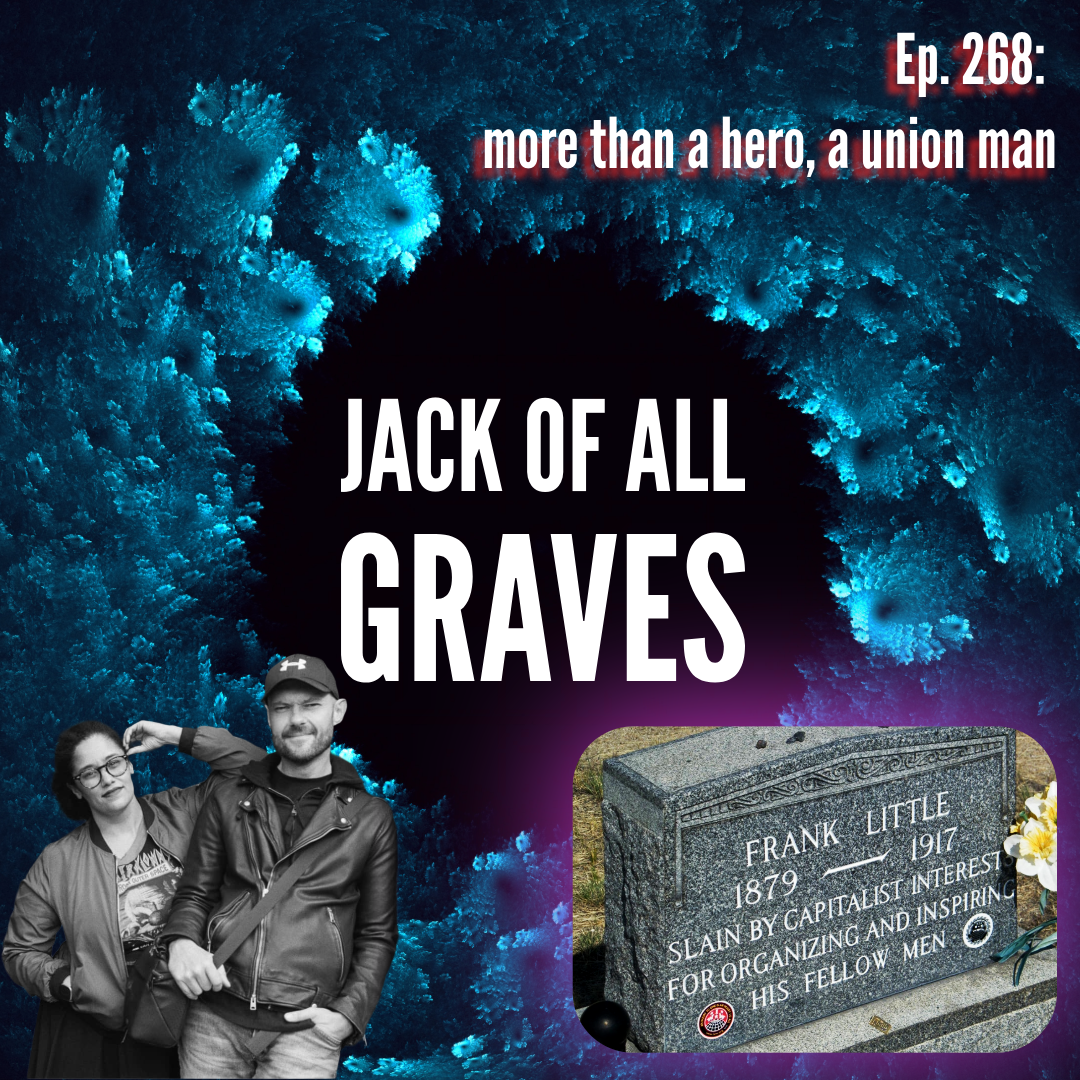
This is the picture that inspired this. I saw this on.
On Blue sky the other day randomly and was like, I need to know more about where this came from.
[00:52:15] Speaker A: What an epitaph.
[00:52:16] Speaker B: Do you want to go ahead and read what that says?
[00:52:19] Speaker A: Ah, Frank, we have you an unassuming headstone, small, with bouquet of what look like daffodils. Beautifully next to it, simply with the white on gray inscription, Frank Little, 1879-1917.
Slain by capitalist interests for organizing and inspiring his fellow men.
[00:52:44] Speaker B: Mm.
Yes, and may we all remember this because like I said, Mark, it is what shapes the world that we live in today.
And it will take all of us to fight that fight.
[00:53:00] Speaker A: So bring.
[00:53:02] Speaker B: Mm, indeed.
[00:53:05] Speaker A: Let me quote directly from my notes, if I may.
[00:53:07] Speaker B: Yes, please, Dale.
[00:53:09] Speaker A: Fucking look at these nerds.
Oh, mise en scene.
[00:53:12] Speaker B: I don't think anyone has ever said mise en scene in such a horny way before.
[00:53:16] Speaker A: The way I whispered the word sex cannibal.
[00:53:18] Speaker B: Recently. Worst comes to worst, Mark, I'm willing to guillotine you for science.
[00:53:22] Speaker A: Thank you. That's really, really sweet. It's cold outside, but my pancreas is talking to me. I'm fucking. I'm gonna let it.
[00:53:29] Speaker B: You know how I feel about that, Mark?
[00:53:31] Speaker A: I think you feel great about it.
Hey, what about those nicks, huh?
Listen.
[00:53:42] Speaker B: Nixon 5. Nixon.
[00:53:44] Speaker A: What the does that mean? I have no idea.
Like I.
Like I said to you just before we started recording, it's a difficult time, man. Every year.
Every year it's a difficult time to not give a. About Eurovision. When Eurovision is happening and every however many years it is, it's a very difficult time to not give a. About football or basketball. Was it basketball?
[00:54:05] Speaker B: It was basketball, yes.
[00:54:06] Speaker A: Very difficult.
It makes one feel alienated, you know, it makes one feel kind of out out there.
[00:54:15] Speaker B: I think this is the thing, Marco, is that you don't feel. It makes me jealous. Well, yeah, that's I think that's the thing is that what is important about sports, you know, why we keep going back to them. And in fact, sports have been important to unions for ages. My friend James Robinson wrote a book on the connection between baseball and labor unions and things like that. Super important is indeed about the community surrounding them.
And so I feel like the angle of entry here is not the sport, but the celebration. Like, I'm not a huge basketball fan. It's fine as a sport, you know, it's not a thing that I like, get super into, but I can get into the celebration of this. You know, everybody being so excited about this was so fun. When I did. I went to karaoke the other night and it was like, you know, as soon as I got up there and like, Nixon 5. And everyone's Nixon 5, you know, and it's like starts chanting, Nixon 5, Nixon 5. Everyone was doing it. It was like, that's, that's our chance.
[00:55:22] Speaker A: Yeah, that's very cool.
[00:55:24] Speaker B: It brings people together.
Do you really not know what Knicks in five means, by the way?
[00:55:27] Speaker A: Nah, it's.
I, no, I don't know what those words, in that order.
[00:55:32] Speaker B: It just means the Knicks will win in five games in the series. Right. Because the series. Best of seven.
And so they were up in the series three to one. So they'd played four games. They needed to win one more in order to clinch it.
Knicks in five games. Knicks in five.
[00:55:48] Speaker A: Okay, but even you seem incredulous that. I don't know what that means. I don't know what it means.
[00:55:52] Speaker B: No, no, no. I just wasn't sure if you were doing a bit or if it was. I'm not incredulous in the way that I'm like, how could you not know what that means? It was more of like, I can't tell if you're.
[00:56:01] Speaker A: No, I don't know what the sports ball is.
Please. I'm above that.
[00:56:07] Speaker B: Yeah, I know.
[00:56:10] Speaker A: But, yes, it, it does. It makes me kind of feel a little jealous and a little isolated and a little excluded.
[00:56:21] Speaker B: Sure.
[00:56:22] Speaker A: But I, I, I am, I'm not without. My life isn't completely barren of that sense of inclusivity. I have my things, you know.
[00:56:29] Speaker B: Yeah, exactly. I just watched Evil Dead with a whole bunch of people the other day, you know?
[00:56:34] Speaker A: Exactly. And I, I know, I know something of how it feels when a thing you love explodes and does well. Something that you've invested in through thick and thin, through tough times.
It is. I, I know what that feels like. I know how validating it feels. I know the, this. The warm embrace of just a thing. You like being great. There's nothing like it. So I do get.
[00:57:01] Speaker B: And I think there's a, you know, there's a fake it till you make it thing that I think works with this kind of stuff. You know, like if you sit down with Owen and you watch the soccer, I mean the football, and you just start like acting like you know what's going on, making comments, you know, about.
About what a player just did or things like that and it becomes a back and forth. It starts to become a thing that. It's like, yeah, do I really know what's going on?
Vaguely. But it gets more fun that way. It's just, it's just a social.
[00:57:31] Speaker A: I've been doing a little bit of that. I have been doing a little bit of that. Obviously I'm not going to be the dad that goes, ah. Oh, shut up, boy. I don't know what that is. Right.
[00:57:38] Speaker B: Yeah, you try.
[00:57:39] Speaker A: He's super into it.
[00:57:42] Speaker B: Loves it. He's an English boy.
[00:57:44] Speaker A: He very. He's. He just to pull you up on that. Welsh by birth. Let's just get nice and straight. But yes, he's super into it. He's asking if you can stay up and watch the game. The answer is no. It's a 1am don't be ridiculous.
[00:57:57] Speaker B: Oh, that's too late.
[00:57:58] Speaker A: I mean, in fact, this is interesting. His school, his school have instituted that when there's an England game on in the evening, school start time has been pushed back half an hour so you can come to school late and stay up and watch it. How interesting is that?
[00:58:16] Speaker B: That is wild. See that's. I mean that is what is so fascinating about sports. You know, like I will. I've been a jock and a sports fan my entire life and I very much like, oh, that kind of thing is great. Like I've seen the. The Knicks parade Mamdani announced is going to be on Thursday and like people are saying like, oh, my boss has already given us all the day off and things like that, you know, like, oh, you just don't get that with a lot of things. And in a time of turmoil especially, it's like it's really nice to welcome.
[00:58:49] Speaker A: Yeah, yeah.
Absolutely fucking unhinged.
[00:58:53] Speaker B: Yeah. Oh, absolutely.
[00:58:54] Speaker A: However did you watch that side talk video I sent you?
[00:58:58] Speaker B: Which one?
[00:58:59] Speaker A: I responded to a story of yours earlier with a link.
[00:59:04] Speaker B: I have not gotten there yet.
Me
[00:59:09] Speaker A: just apps. Just hilarious chaos all through the place.
[00:59:15] Speaker B: I did enjoy it.
[00:59:16] Speaker A: Do please take a look.
[00:59:16] Speaker B: I'M excited about it. My favorite that I've seen so far is someone hurling a cone into the air and it landed on someone else's head.
[00:59:22] Speaker A: Perfectly on someone's head. Beautiful. Yeah. The video that I linked you to is they're chucking around a fish. They've got a dude that's got a
[00:59:28] Speaker B: fish, so why not, like, a fish? Usually more of a Seattle thing, but, yeah, we can. We can do that. Yeah. I've seen, like.
[00:59:36] Speaker A: And this is, like, in times where we're seeing, like, what I've bitten. You know what I mean?
[00:59:40] Speaker B: Right. You've walked through there and people are throwing fish.
It's crazy. I did want. I wanted to go out last night and, like, you know, experience it, but, like, the people that I was gonna go out with kept changing, like, the venue that they were going to watch it at. And at a point, I was like, this has become tiresome. And I didn't go. But then as I watched the end of the game alone in my bed, I was like, oh, I do kind of wish that I was somewhere screaming with everybody right now.
[01:00:07] Speaker A: It's a very peculiar kind of fomo, isn't it?
[01:00:08] Speaker B: It's fear of.
[01:00:10] Speaker A: Fear of missing out on mayhem and just joy.
[01:00:15] Speaker B: Joyousness, you know? Like, it's a missing out on a whole bunch of people, like, filled with happiness.
[01:00:24] Speaker A: Yeah.
[01:00:25] Speaker B: That's a great place to be, you know?
[01:00:27] Speaker A: Yeah. Yeah. And like you said, there needs to be more of it.
[01:00:31] Speaker B: There needs to be more of it. Yeah. So I don't know, maybe I'll. Maybe I'll be crazy and Kyo. And I'll go to the city on Thursday and see the parade.
The train might be insane, but I don't know.
[01:00:42] Speaker A: I'd love to see some photos from ground level of that.
[01:00:45] Speaker B: Maybe I can convince them to get, like, a hotel Thursday night so we don't have to come back afterwards.
[01:00:50] Speaker A: See, and I think that way, the very opposite of what you're describing there, I think, is going to take place at UFC Freedom tonight.
[01:00:58] Speaker B: Jesus Christ. Have you read about the weather conditions here, which conservatives are very mad at the Weather Channel about?
[01:01:06] Speaker A: Oh, no. Is it going to be awful?
[01:01:08] Speaker B: Oh, yeah.
Yeah. I mean, do you know about the climate of Washington, D.C?
[01:01:14] Speaker A: go on.
[01:01:16] Speaker B: It's a swamp. It's a literal swamp, and it is absolutely terrible. This is the warmest place I have ever been, aside from Japan. I. The funny thing is, one year I was in D.C. for a weekend and then went to Japan, like, two days later, and I was like, this is this is the hottest I've ever been in my life. Just crispy, horrible. Worst weather you've ever experienced, like 100 billion percent humidity. Everything is awful. So it's incredibly hot today.
Also there are thunderstorms that are rolling in. Like I said, we're getting them to here, but not as badly as they're supposed to to get them down there.
And so the Weather Channel posted this Tweet. They said UFC Freedom250 is facing a chaotic weather setup on the White House south lawn with a 60% chance of thunderstorms. Heavy downpours and wind gusts up to 34 miles per hour threatening to delay the outdoor fights.
On top of the storm risk, brutal DC humidity is driving a triple digit heat index.
Hide massive swarms of mosquitoes and gnats that fighters will have to battle inside the cage.
While the venue's massive 92 foot overhang will keep the octagon dry. A single lightning strike within 8 miles will trigger an automatic 30 minute freeze on the entire event.
Just like going to the community swimming pool.
[01:02:45] Speaker A: Phenomenal. I cannot fucking wait until the morning.
[01:02:49] Speaker B: Conservatives on the other website are like pissed at the Weather Channel for this because they think this is like a partisan thing to say. Like as if they're like wishing it.
[01:03:00] Speaker A: Yeah.
[01:03:01] Speaker B: Upon this event or something like that.
[01:03:03] Speaker A: Fake weather, fake news.
[01:03:04] Speaker B: Fake news. So, yeah, the great thing about this is, best case scenario is that it doesn't. The storms don't come through, but it's still going to be triple digit heat with the mosquitoes and the gnats and the humidity and everyone there is going to be fucking.
[01:03:21] Speaker A: I love to hear that because that strikes me as being a joyless event, you know, 100%.
[01:03:27] Speaker B: It's like an event manufactured purely for the aesthetic of owning the libs.
[01:03:33] Speaker A: Exactly, exactly, exactly.
Just how grim.
[01:03:37] Speaker B: Yeah, absolutely. I.
It's insane. You know, I've said, I've said before that the movie Idiocracy is eugenics and I do not like it. However, it would be nice if we stopped doing things that were exactly from Idiocracy from time to time. You know, like I haven't seen it
[01:03:58] Speaker A: in the longest time. I think I've only seen it once. A lot of people love it.
[01:04:02] Speaker B: Yeah, well, a lot of people don't realize they're eugenicists.
I think that's part of the, the issue here. It's like how, you know, we had to go through this with you in the early days of this podcast.
A lot of people don't know they're doing a eugenics in their day to day lives.
[01:04:20] Speaker A: In, in my defense. Right.
I have always more so in the early days than now. But I very much would use Jack of all Graves as a space to explore ideas that I probably knew were a little bit shaky and if anything,
[01:04:36] Speaker B: it's a sounding place.
[01:04:38] Speaker A: Exactly, exactly. And in you and in this, this kind of weekly appointment that we have, I knew that I had a space where I could safely.
Right. And in the interests of inquiry and science and becoming better myself, talk these ideas through with somebody whose opinion I know had credibility. Right.
[01:04:59] Speaker B: Yes, yes, yes. So I appreciate as well, at no
[01:05:02] Speaker A: point was I a eugenicist.
Let's just.
Well, but I got to bed. Let's fucking lay that to rest.
[01:05:10] Speaker B: Right. But I do think, I mean it is a key thing to sort of understand how like common eugenicist thought is in society. And like the popularity of a movie like that shows that because people don't think through that. Like what this is really about is like selective breeding and like letting the wrong people, people breed so that then they become, you know, this terrible version of humans and that, that is tied up with class. You know, there's like, oh, well, the poor people are the ones who like aren't smart enough and they keep on breeding. And so, you know, it's like the whole thing like these are all eugenics ideas. RFK Jr would be very comfortable with the ideas that are being expressed in that movie. And a lot of people just don't realize that like when you, when that's the joke, you are signing on to eugenics ideas, you know.
But we do definitely do some of the things that are in that movie and it has nothing to do with breeding.
We're just in a country, basically.
[01:06:14] Speaker A: Yes, I less to do with breeding and more to do with populism and more to do with the, the toehold and, and ever tightening grip that populism seems to have on, on certainly on this nation.
[01:06:31] Speaker B: Yeah. And I think, you know, this is another thing that is interesting to like. So like you said, you know, there's all the sports stuff going on and whatnot.
And there's been a lot of like really great stuff of like Europeans and people from other countries coming to America and realizing actually Americans are like great.
Like as a people, Americans are largely like very nice and cool and chill and things like that.
But that like infuriates a certain like kind of European who immediately their first thought is like, yeah, but look who they voted into office or whatever.
[01:07:09] Speaker A: Yeah, sure, sure. Sure.
[01:07:10] Speaker B: And that's fair as a critique. But also other places tend to assume that our system works like theirs and doesn't realize like most our votes don't count in like 75% of this country. Things like that. Like most of us did not vote this guy in. It's just that only like seven states count in our presidential election and things like that, you know.
And so, you know, as much as like the populism taking hold thing, like is a thing, I just, I think it's exaggerated in how much people think that is a thing in the United States. It is, don't get me wrong, it's rampant. But I do think that the perception of it, as opposed to people not having any say in what government represents us, is a bigger part of that.
[01:07:59] Speaker A: Tell you what is fun currently at the minute in the UK is seeing the England flags hanging from windows. Right, okay. And asking myself football final racist or both.
Or both.
[01:08:20] Speaker B: Yeah, it's. That is tough. I mean, I think of that here too. Like as much as, you know, I enjoy watching sports and, and rooting for things, like it's real hard to be like usa, you know, but then it feels performative to pick some other country as well, you know, Like I'm now rooting for X country. That has nothing to do with me because I performatively don't want to support my own country.
I don't know, it puts you, puts you in a weird place. But the American flag, largely usually standing for racism does make it a little rougher. I think when I see someone, a flag hanging is always racism.
A flag worn maybe just into sports.
I think that's the, that's the case.
[01:09:14] Speaker A: It's certainly, it's certainly a very interesting time to be hosting a World cup.
[01:09:17] Speaker B: Isn't really. Is. Yeah, it is absolutely bizarre. But I'm really glad that like the worst things aren't largely happening. It's like.
Well, yeah, but it feels like, you know, they denied visas of people and stuff like that before they got here.
And people who are here seem to be having largely good interactions with people and stuff like that. And it hasn't been the horror show that I thought it was going to be. I'm sure there's like things happening that they're not putting in the news and like that to people. That's probably awful. But I was really worried that like on a like mass level people were gonna come here and like end up in ice custody and like that. And you know, so far that does not seem to be happening.
[01:10:06] Speaker A: Well, May it continue. News is coming in thick and fast. Apparently there's been a deal agreed for Iran, which is interesting in the last few years.
[01:10:14] Speaker B: Oh, really? It actually happened this time. Allegedly.
We'll see tomorrow. But, you know, right now there's one I'm.
[01:10:23] Speaker A: It's. It's one of those Sundays where when you. When you're as hooked and addicted to the news cycle as I am, there are some Sundays when you just can't wait to wake up on Monday and just catch up on everything. And this is one of those Sundays. There's so much coming tomorrow.
We've just had a. A senior labor politician die in the last hour. A guy called as Lee, he was like part of the labor old guard dead.
Our prime minister apparently is due to announce a ban on social media right tomorrow. So. That's gonna be hilarious.
Oh, it is. It's stupid as, but. Oh, it's gonna be hilarious. Watch Owen try to wrap his head around that because talk about a kid who loves his YouTube shorts. Oh, man.
[01:11:11] Speaker B: Would that count under this?
[01:11:14] Speaker A: I think. Well, I'm gonna make it count under that. I'm gonna use this as an excuse to rest it from his grip.
Both Laura and I.
[01:11:23] Speaker B: Sorry. Oh, and illegal.
[01:11:24] Speaker A: Yeah, we're gonna, we're gonna, we're gonna enact this.
[01:11:27] Speaker B: Wow.
Yeah, that is rough.
[01:11:29] Speaker A: We're gonna use it as a turning point because, you know, I've said plenty of times, he's very much at a fork in the road here with his synapses developing the way they are and with his attention being mind the way it is.
[01:11:42] Speaker B: Yeah.
[01:11:43] Speaker A: Interesting moment. Earlier on, he was kind of leaning on me while I was on my MacBook and he put his fucking. I was on Reddit. Right. And there's ads on the left hand side of Reddit. Click here to play this game. Click here to play that game. And while I was just chatting, just reaching, just clicked on the ad for the game. Dad, play that game. Fucking mad. Fuck off. I actually told him to fuck off.
So I will be absolutely with an iron fist in forcing that social media ban in this house. Yes.
[01:12:17] Speaker B: What about like, you know, Pete loves his, his video games. Does that count under this, Friends, we'll
[01:12:25] Speaker A: have to see how it pans out. But apparently live chat might be restricted.
[01:12:30] Speaker B: Oh, that'll be so rough. Because it's just. I mean, I think about that kind of stuff from when I was a teenager, right. And obviously it's completely different than at the time, but like my social life was on AIM and Live Journal and Forums and things like that. You know, I didn't really. I had friends, obviously, plenty of friends. School wasn't like I was like, oh, I was an outcast. But it was like the people that I felt like I had things in common with were all online and, you know, it was so important to have that connection to people who like, just were on my level on things, had the same interests, had, you know, stuff that I just couldn't find in my day to day life. And the idea of just like pulling that out from under kids.
[01:13:18] Speaker A: Yeah.
[01:13:19] Speaker B: Oh, that just seems so incredibly rough. And they'll get around it, obviously, because this is stupid and unenforceable, but you know, it's just as a concept, it's just such a misunderstanding of like the teenage mind and so unempathetic in its,
[01:13:38] Speaker A: you know, in the way that they're approaching that I can't think of another example within, you know, another relevant example of direct interventionist government like this just directly deciding. Right, we're taking that off you.
[01:13:56] Speaker B: Right? Yeah, it feels, I mean, don't you also, like you have the, the smoking ban for like anyone born after a certain time or whatever, whether or not that shakes out?
[01:14:09] Speaker A: Yeah, but I mean, again, I'm, I'm perfectly cool with that. That's fine by me.
[01:14:13] Speaker B: I mean, obviously, you know how I feel about smoking and things like that, but the idea of being like, hello, you who are about to turn 18, you specifically will not be able to do this thing is so dumb and like, just was a silly way to. Because they're going to do it regardless. And also because it's like, it's just, it's arbitrarily saying that because you are in this little bracket, you do not have the same rights as everybody else does, which doesn't work. Right. They're forever in that bracket. It's not like until they're 25. And then they'll be able to do that because you were born in this window.
Everyone who was born a day before you has a right that you don't have. That doesn't make sense, you know, I
[01:15:07] Speaker A: mean, doesn't any initiative or any change of policy have to by, by definition start somewhere? Does it not have to.
[01:15:16] Speaker B: Right. The banner for everyone.
See, it's a bad idea.
[01:15:23] Speaker A: I don't know if it's a bad
[01:15:24] Speaker B: idea specifically for kids born on December 31, 2010 or whatever, then it is.
[01:15:33] Speaker A: Does it not make sense? Does it not make sense to remove it from somebody who has never had it?
[01:15:39] Speaker B: So why not say Anyone born in 2026 will not be able to have it. You know, so it's never been a thing in their life, you know, like, or what. Make it prohibitively expensive.
Don't ban.
[01:15:51] Speaker A: Well, they're doing that as well.
[01:15:53] Speaker B: So just do that. Make it. If a pack of cigarettes costs you 500 quid, $50 every time you buy one or 50 pounds, then kids are not gonna smoke.
You've solved the problem because it is too expensive for someone to spend 50 pound a day on cigarettes. It simply makes no sense to make a ban that only applies to certain people, which means you create a black market for the thing which is always. What happens with prohibition is someone will sell it to your child and it's not going to be the corner store, it's going to be some who, who knows where they got these things from.
[01:16:33] Speaker A: Yes, I'm, I'm massively, massively anti tobacco though, so.
[01:16:40] Speaker B: Agreed.
100. I just think that this is not the approach because it has never worked in the history of time and it's not going to suddenly work now.
[01:16:51] Speaker A: Okay.
[01:16:53] Speaker B: England in 2026 is not the first society that is suddenly going to create prohibition and it's going to work.
[01:17:01] Speaker A: But you'll, you create that black market through making it, like you said, ratcheting the price up as well, you know, that just opens the door to cheaper non retail alternatives, doesn't it? You can buy, you can buy cheap cigarettes now.
[01:17:17] Speaker B: Sure, I guess you know that. And they're always, I think there, you have a point there, there's always a black market. But I think it's a different kind of thing to say everyone else has access to this thing except this group of people, which is just an impossible, an impossible way to do things.
So I don't know. And like, obviously if say they're prohibitively expensive, then for people who do want to have a black market for it, they're going to ratchet their prices up eventually. It may be less expensive, but it's not going to be dirt cheap.
[01:17:49] Speaker A: I don't know, I'm not sure I'm convinced. Not in this instance at least.
What is, I mean the idea being that you're going to stop a generation of kids from starting to smoke, right? You're not going to suddenly decide like,
[01:18:05] Speaker B: but you're not going to period.
They're going to smoke and it's going to be more appealing to them because someone a day older than them can and they can't. So now you've incentivized the idea that smoking shows that I'm older and I'm cool and things like that. Like, oh, I break rules, you know, I'm like someone who is older than I am. So you've brought back.
[01:18:28] Speaker A: That exists in smoking anyway, though. That, that, that.
[01:18:32] Speaker B: Sure. But now you've created a legal incentive for that. What we're saying here is it's not going to work. Right. These things already exist.
It simply will not work.
You will not see a reduction in use as a result of this. You may see an increase of underground use, but you will not see a reduction in use for this.
It's just not how it works.
[01:18:55] Speaker A: No, I'm not sure I agree. Not in this instance. And we will, yes, we will definitely back in on this in five minutes. Not to dwell on this, but if you put an age limit on, again, these tobacco, as an example, surely you've already got that issue where, oh, a guy older than me can pick up a cigarette, but I can't because his birthday is tomorrow. You already have that.
[01:19:18] Speaker B: You're 18. Right. But it's not a forever ban. When you turn 18, you also will have the ability to buy that. Not when you turn 18. You will never be able to have that because you were born on this day.
[01:19:33] Speaker A: So, as I often do, then I would ask, what. What's your solution? What would you do? Public health, just outright slang it, ban it.
[01:19:40] Speaker B: And no, I don't think I caused underground black markets. Just like prohibition in America. Did you cause organized crime just like drug prohibition does? Right.
[01:19:53] Speaker A: Yeah. And I was like, exactly my thoughts there. Where, although, weirdly, I am pro decriminalization. Right. Of narcotics.
[01:20:03] Speaker B: Yeah. You know, this in other situations. And cigarettes are not the one area of life where suddenly this is going to work and not cause the same problems that prohibition causes in every other field of life.
However, Millennial, American millennials, because I think UK Millennials smoke. Right? Like, that's still a thing. But American millennials don't really smoke.
And so it is possible through other means to make it less cool, make it less appealing to, you know, remind people, you know, we took it out. What we did was largely tackling advertising here.
So, you know, there's.
[01:20:44] Speaker A: You can still advertise cigarettes, can you, on tv?
[01:20:48] Speaker B: No, you cannot advertise cigarettes anywhere, basically.
So, you know, there's no more Joe Camel. You can't have, like, mascots, Marlboro man for cigarettes. No Marlboro man, any of that kind of stuff. So all those places, like, you know, they try to discourage, you know, TV shows and things like that from showing it as cool having your characters in high school smoke stuff like that. And bit by bit, it stops being associated with, you know, cool things. Along with, like, we had terrifying commercials. Like, there's one that if you ask any millennial about, they will shudder at the thought of a woman who was smoking through a hole in her neck.
Things like that.
Things that reminded you that it smells bad and everybody hates you. When you walk into a room smelling like cigarettes, you're a pariah. Stuff like that, like, make it. It awful like it is.
[01:21:42] Speaker A: It's. Yeah, it's my. It's my number one cause of complaint. When Laura's mum and dad come around here, they smell like cigarettes and they stand up garden smoking and it is vile.
[01:21:54] Speaker B: So it's like, you're so used to it when like. Or you were so used to it back in the day. Right. Like when I was growing up, I grew up in a house. Like, both my parents smoked and like, you went to restaurants and people smoked and like, yes, I have asthma as a result of this. But like, the smell and things like that were like, not a thing I noticed. And then once they got rid of it in the 2000s, as now, it's like,
[01:22:18] Speaker A: yeah, with the only exception being four pints. If I have four pints, that you
[01:22:27] Speaker B: become immune to the smell of cigarettes.
[01:22:30] Speaker A: No more. So it's delicious.
[01:22:33] Speaker B: I want that.
Maybe the cigarette itself can be excused, but when it's lingering on someone else's body, I just was never, never a good odor.
[01:22:45] Speaker A: Four pints, though.
[01:22:48] Speaker B: And that's why you can't have four pints. It's one bad decision after another.
[01:22:53] Speaker A: Four pints. And yeah, I'm gonna get that look in my eyes, smoking.
[01:22:59] Speaker B: But I don't know, friends, do you have ideas for how we solve the smoking issue? What's. What's going on with that? How do we. How do we deal with it?
[01:23:07] Speaker A: It's an issue that's. That's, you know, smoking rates in Britain are as low as they've ever, ever, ever been, and they are plummeting just within my lifetime, you know.
So is it. Is it a problem that is already being fixed?
[01:23:23] Speaker B: Right. Yeah. Is it basically being able to put their stamp on something that's already solved?
Yeah.
[01:23:30] Speaker A: This social media thing is. Is certainly what that is because, you know, plenty of people have said this and it's. It's eminently true that we have a government right now, a Prime Minister who is in office but not in power, you know, is simply coasting until the Machine removes him from office, which is, you know, imminent.
[01:23:52] Speaker B: Right.
[01:23:54] Speaker A: The fact that he's hemorrhaging ministers and has, you know, by all accounts the, the completely lost the backing of it of, of his cabinet.
So this social media thing is obviously a swing at some kind of.
[01:24:12] Speaker B: Look, I'm doing something.
[01:24:14] Speaker A: Yeah, yeah, yeah, yeah.
But it's gonna be, it's gonna be very fun in this house at least.
[01:24:23] Speaker B: Yeah, you're taking advantage of the situation. Cannot wait.
[01:24:28] Speaker A: In fact, I'm going to be scrolling my socials in front of Owen like this.
Just enjoy.
[01:24:34] Speaker B: Yeah, that poor kid.
He can come stay with me and use all the social media he wants.
[01:24:39] Speaker A: Yeah, and buy him a pack of cigarettes as well.
[01:24:42] Speaker B: Yeah, exactly. I'm gonna get him a pack of cigarettes and a lotto ticket to have a good old time.
[01:24:49] Speaker A: Can you imagine
[01:24:52] Speaker B: Playboy? Playboy? Owen, you want a Playboy?
Actually Playboy got like a new editor in chief or something like that like not too long ago.
And like they're genuinely, their articles have been incredible.
[01:25:13] Speaker A: I seem to remember them always being quite good.
[01:25:15] Speaker B: I mean, because that was like the joke, right? Was of course, you know, I read it for the articles or whatever, but I think it was because like they did try to make them like a little highbrow or whatever. But now these have like a lot of more focus on like leftist kind of stuff and you know, diversity, sex workers rights, you know, trans rights, all kinds of things like that. And so they've got some really interesting stuff. I follow them on, on Blue sky, so. Oh well, when they have some free articles and things like that that look interesting, I'm like, huh? What do they got to say about this?
[01:25:51] Speaker A: Well, well, yeah, so there you go.
[01:25:53] Speaker B: If you, if you've been wondering whatever happened to Playboy? Pretty interesting right now.
[01:25:57] Speaker A: Fascinating.
Did not expect that. Didn't see that coming.
[01:26:02] Speaker B: Full of surprises.
So hey, great time watching Evil Dead with everybody. Oh, this weekend.
[01:26:15] Speaker A: Ah, all I'll do, right. Listen, if you, you will have, you will have hear us in the past talking about watch alongs and about how we host semi regular kind of Discord Watch parties, right.
I will simply read from our Discord right now. I'll keep the name anonymous just in case but have a listen to this. This was, this was today. This was the day after we all got together and watched Evil Dead.
Quote. Still absolutely humming with energy at how exciting the watch along was. Last time I saw the Evil Dead, I distinctly remember thinking that I would probably never watch it again because I could watch Evil Dead 2. Was I ever wrong that film reaches the line so many times and jumps right over it, laughing the whole way. 10 out of 10 experience.
Thank you, you wonderful spookies.
[01:27:05] Speaker B: I love that.
[01:27:05] Speaker A: Isn't that fucking beautiful?
[01:27:08] Speaker B: That is amazing.
[01:27:10] Speaker A: Beautiful words, beautiful listeners. So grateful.
[01:27:14] Speaker B: Excellent.
[01:27:16] Speaker A: And it's almost scientific to me. Right. You can reproduce the joy of watching a movie in a room full of people who, you know, you're on a wavelength with and who, you know and who are going to enjoy the experience.
It isn't landlocked. It isn't physical.
[01:27:34] Speaker B: Right.
[01:27:36] Speaker A: Connection is just as powerful and just as tangible whether it's across the world. All that matters is the intent and the movie that you're watching. And it just. The magic radiates out across the globe.
[01:27:53] Speaker B: Yeah.
[01:27:53] Speaker A: And you can be a toddler.
[01:27:54] Speaker B: Yes.
No, I was just gonna say I find it funny whenever, like, you know, I'll like, laugh out loud at something from the discord and just realize I'm just, like, sitting alone in my living room. I love it, watching this. But, yes, you too can be a part of the magic because we're. We're moving on to Evil Dead 2 coming up.
[01:28:12] Speaker A: Let's talk. Let's just talk about Evil Dead a little bit because, I mean, you know, we've seen it, so we shall discuss it.
You think you know how good it is.
Yeah.
[01:28:25] Speaker B: Yeah.
[01:28:26] Speaker A: And you can be forgiven for maybe shunting the og sure. Maybe to the middle of your definitive Evil Dead ranking.
[01:28:37] Speaker B: Right.
[01:28:38] Speaker A: Because you think, oh, There's Evil Dead 2, which is an impeachable, perfect piece of work.
And there's 2013, which, again, is just a reinvention and a reinvigoration. Not like it needed it. And there's the silliness and la la la. So amongst all of what came since, you can be forgiven for kind of maybe just taking the Evil Dead for granted, you know, until you watch it for the first time in a while.
Yeah. And you realize how well put together a movie that is.
[01:29:10] Speaker B: Yeah.
[01:29:11] Speaker A: It's not a fluke. Right. It's. It's. Yes. It's a product of its era.
[01:29:15] Speaker B: Right.
[01:29:16] Speaker A: And it goes there. It pushes it. Not just if you. To release that movie as is now, it would still be like, whoa, yikes.
But, well, startlingly well put together, man framed. Stunningly. Sound design. Oh, my God. The sound is fantastic. It really is creative.
Ah, just a. Just an absolute pleasure. I. I think.
[01:29:47] Speaker B: And everyone was, like, in the zone for that yesterday to, like, really appreciate it. It's like, you know, just almost like seeing it for the first time and it hasn't even been that long. Very much watched it together. Like we did a watch along with this like two years ago, but yesterday it just felt like everyone was like, really? Like, am I tripping or is this like insanely good? Like insanely well put together. So well made.
And yeah, if you haven't watched it in a minute, watch the Evil Dead.
And yeah, just have your sit there ready to have your mind blown by it.
[01:30:20] Speaker A: Almost. Just try and put it. Yes, yeah, let it in, Let it in.
[01:30:26] Speaker B: It's so great aside from the scene, but other than that it is so
[01:30:31] Speaker A: great we can move past that.
[01:30:34] Speaker B: I just, you know, I feel like. Yeah, it just needs the caveat that, you know, we, we know does happen. We do know, we know that the thing happens.
[01:30:44] Speaker A: Yes.
[01:30:44] Speaker B: That sucks.
[01:30:45] Speaker A: I'm delighted, delighted to have got tickets this week to a preview of Evil Dead Burn.
So a few days before public release, going to the Prince Charles cinema in London with Sebastian Vanek in attendance. I think there's a Q and A afterwards. That's gonna be sweet.
[01:31:06] Speaker B: I think you tried to mention this last week and then I got so distracted by the Prince Charles thing that I don't even know if you
[01:31:15] Speaker A: ring a bell. Yeah, I remember.
[01:31:16] Speaker B: I really don't think that you ever said like what was actually going on. I was just so hung up on why they named a movie theater after a 13 year old that I couldn't move past it.
[01:31:29] Speaker A: Have you seen the video that's doing the rounds of the Brazilian bungee jump gone wrong?
[01:31:37] Speaker B: I don't think so.
How wrong is it like Fresh Prince of Bel Air?
[01:31:42] Speaker A: Wrong, Corrigan.
Fuck me, Corrigan. Two people raise a woman aloft over their heads and fucking yeet her off a cliff, right?
[01:31:57] Speaker B: Uh huh.
[01:31:58] Speaker A: And the second they let go and throw her over the edge, you can see him look on the floor and realize they haven't fucking connected the rope.
Like they have not connected her at all to any kind of safety measures. And they've literally just yeeted some fucking woman off a cliff to her death.
[01:32:17] Speaker B: How, how does that happen?
[01:32:19] Speaker A: Brazil?
[01:32:20] Speaker B: I don't know, I don't listen there. Also in Brazil today, some singer, I think named Oliver Tree died in a helicopter crash.
[01:32:33] Speaker A: I was literally just looking at that on my screen now. Somebody just shared it with me.
[01:32:37] Speaker B: I just. You don't need to bungee jump. You don't need to jump out of planes. You don't need to helicopters. None of these things need to happen.
And they are death traps. You just Don't. You just don't need to do these things.
[01:32:52] Speaker A: I. I can't really even call it a bungee jump video, because that's not what it is, right?
[01:32:55] Speaker B: Yes. No, that's.
It's just.
[01:32:58] Speaker A: It's a death by misadventure.
[01:33:02] Speaker B: Ow. That's crazy.
[01:33:04] Speaker A: Yeah, the. The. There are angles of it and everything. There are different angles of. And they. They're just holding her aloft and just cast her to a death.
[01:33:15] Speaker B: My thought process, too, is like, she must have done this a lot, because as a person who, like, has not bungee jumped, but I have gone with my friends in South Africa when they bungee jumped. Like, the degree of times you, like, check.
[01:33:31] Speaker A: Yeah.
[01:33:31] Speaker B: Is like through the roof, you know, like, how nervous you are. You're like, are you sure I'm clipped in? Like, I can't imagine just, like, having people throw me and not being like, now you clipped that, right? Yeah, you clipped that off.
[01:33:45] Speaker A: It is. It is like within a second of them launching her, they both look on the ground and see the rope.
[01:33:51] Speaker B: Three people and no one notices.
[01:33:53] Speaker A: Two. Two people. Well, and.
[01:33:55] Speaker B: And her.
[01:33:56] Speaker A: Yeah. Yeah. Oh, man.
[01:33:58] Speaker B: Oh, that's terrible.
[01:34:00] Speaker A: That is pretty wild.
[01:34:01] Speaker B: Nightmarish. I hope she didn't realize it. I hope, you know, she was just having a fun time. And then splat.
You know, because that's dark, isn't it?
[01:34:11] Speaker A: When you notice there's nothing connecting you on your way down to you.
[01:34:15] Speaker B: Like, that would be horrific. And I hope she just never noticed. I hope she just was like, well, that's the end.
[01:34:23] Speaker A: Let's choose to believe she didn't.
[01:34:25] Speaker B: That's. Yeah. I'm gonna. In my headcanon. She never knew.
[01:34:30] Speaker A: She had a great time.
[01:34:31] Speaker B: She was like, this is the great. I've never felt so free in my life. That's. That's how I'm reading this.
Anyways, watch Evil Dead with us Saturday. Second one.
[01:34:43] Speaker A: Do I need something cute? Do you hear something funny?
[01:34:46] Speaker B: Sure.
[01:34:47] Speaker A: So this week, and this is from that nightmare thought as they occurred to me.
[01:34:51] Speaker B: Okay.
[01:34:53] Speaker A: You know how I. I have a long standing issue with sleep. Yeah.
[01:34:58] Speaker B: Yes.
[01:34:58] Speaker A: Yes.
Currently, I'm in a wonderful kind of zone of equilibrium in that the medication regime I'm on is just working and is stable and I'm going to sleep at the right time, and I'm waking up at the right time, and things are cool, Right?
[01:35:15] Speaker B: Yeah.
[01:35:16] Speaker A: One night this week. Laura informs me that in my sleep.
And I'll also preface this by saying that I'm known in the past to, like, Thrash about in my sleep and kind of angry sleeper, angry proclamation.
Chucking my arms and legs around wildly. Apparently, earlier on this week, in the middle of the night, I turn to Laura. I have no memory of this. None at all. And I start singing to her. Taylor's oldest time.
I stop.
I give her some Beauty of the Beast.
I'm asleep.
[01:35:55] Speaker B: Oh.
[01:35:56] Speaker A: Stroke my head and just shut up.
[01:36:02] Speaker B: Oh, I would have had my phone out so fast.
Oh, that's amazing.
[01:36:09] Speaker A: I thought you'd enjoy that.
[01:36:11] Speaker B: I'm a creepy giggler while I sleep, apparently. This is what Kyo tells me. Like, I sometimes get, like, very, like, mumbly and like I'm having, like, really heated glee. Like, not heated, but, like really in conversation with people. And then I like, laugh. I do a lot of laughing in myself.
That is.
That's my thing, apparently.
[01:36:34] Speaker A: Oh, man. No, a couple of things have helped.
The mask, the sleep mask that I wear with a podcast on the go. Yeah, that really helps. But a big problem is Laura jiggles her fucking leg around.
[01:36:48] Speaker B: The old restless leg.
Yeah.
[01:36:50] Speaker A: Just as she's descending into sleep, she'll just.
Just flick her legs around.
[01:36:55] Speaker B: Yeah.
[01:36:56] Speaker A: Wildly. And it's terrible.
[01:36:58] Speaker B: Did she use the. The magnesium and whatnot for that?
[01:37:01] Speaker A: Oh, no. Oh, what? Do something to change her behavior?
[01:37:07] Speaker B: It's only bothering you.
[01:37:10] Speaker A: She's fine. She's asleep.
[01:37:13] Speaker B: See, I had the problem with, like, the restless legs while I'm awake and that, like, drives me up the wall.
So, you know, I take magnesium and whatnot. That helps with the. The restless legs.
But yeah, once you're asleep, guess who cares?
Not my problem.
Yeah.
Yes.
[01:37:37] Speaker A: Interesting.
[01:37:38] Speaker B: Also, fan cave coming out on Tuesday.
We are.
[01:37:42] Speaker A: What are we watching?
[01:37:43] Speaker B: Discussing Sissy, the Australian film. You've seen it? You enjoyed it?
[01:37:48] Speaker A: Wait, wait, wait. Have I?
[01:37:51] Speaker B: Yes. The gal who is an influencer who runs into an old friend who invites her to her bachelorette getaway weekend.
[01:37:59] Speaker A: Yes.
[01:37:59] Speaker B: Good movie. Good movie. Yes, good movie. And for this week, I will be explaining the history of Oscar Ozploitation. You know, all that, why Australian movies go so goddamn hard.
[01:38:14] Speaker A: They do.
[01:38:15] Speaker B: So if you're interested in that $3 and up on our Kofi to listen to why Kristen be forced into watching these movies.
[01:38:24] Speaker A: If. If you want Kristen to feel Oscar, you gotta go Wolf.
[01:38:28] Speaker B: Well, because this. This was very intense for her.
She was like, jesus, is this what Australian movies are like? And I'm like, usually more hard. This is the Bloom house of Australian horror.
[01:38:40] Speaker A: Yeah.
[01:38:41] Speaker B: But it is extremely gory like. It is. There is so much close up grass
[01:38:48] Speaker A: it should Kristen by now not have developed, you know.
[01:38:50] Speaker B: No. The Palace.
[01:38:52] Speaker A: Does she not. Come on, Kristen.
[01:38:54] Speaker B: Because it was. I can't remember what it was that I had her watch a couple months ago that she was like you for this. I hated this so much. Come on.
No, she does not. She does not like, like I've got the gym callous.
[01:39:06] Speaker A: Come on.
[01:39:07] Speaker B: We determined, you know, because all of this is exploration, right? If you've never seen the Fan Cave, the whole premise of this, that Kristen did not watch horror movies before. And so I'm introducing her to horror movies as a non horror fan. And largely she's liked most of these things. But one thing that we realized recently, she doesn't like bleak horror really does not. Like when it doesn't have like some sort of hopeful ending to it and when things are just like dark, dark, dark, dark, dark all the way through.
Which definitely means most Australian horror is off the table because it's bleak as fuck.
And so Sissy is incredibly bleak, but it has a light enough tone that even though it ends on bleakness, it doesn't make you feel hopeless about the world when you watch it.
[01:40:00] Speaker A: I'd, I'd, I'd love to talk to an Australian at some point.
[01:40:06] Speaker B: Just in general.
[01:40:07] Speaker A: Yeah, I'd love to. I'd love to be a mom.
[01:40:10] Speaker B: Listens to this podcast.
[01:40:11] Speaker A: I know, I know Dan, I'm. And I've got Dan in, in mind here.
I'd quite like to explore, you know, what, what it is.
What is the Australian condition?
[01:40:26] Speaker B: Well, you can find out when I talk about it on the Fan Cave on Tuesday.
But also, yes, it would be nice to hear Dan's take on such things.
[01:40:35] Speaker A: Why is your horror quite so fucking relentless and unforgiving?
[01:40:40] Speaker B: Yeah, it is quite a phenomenon. So Tuesday you can hear me talk about it as we discuss Sissy Wednesday.
Oh, go ahead.
[01:40:50] Speaker A: Ideas are coming to me.
[01:40:51] Speaker B: I know you seriously, this.
[01:40:55] Speaker A: Maybe we won't see this through, but I think there's a snack series in World Horror.
[01:41:01] Speaker B: Oh yeah, that's a pretty good idea.
[01:41:04] Speaker A: I can't believe we haven't done that yet. I can't believe we've not done that before.
[01:41:06] Speaker B: You're a little hard to track down for a, for a snack.
[01:41:09] Speaker A: I am quite difficult to pin down. Yes. Elusive.
[01:41:12] Speaker B: You're a little elusive. But I, I do think that's a really good idea.
[01:41:16] Speaker A: Isn't that a good idea?
[01:41:17] Speaker B: Yeah, absolutely. World Horror for snacks on the.
On the old Kofi k o f I.com Jack of all graves.
So Wednesday we're gonna have a. Let's play.
We're gonna do that action. Tuesday you get fan kit. Wednesday you get let's play. I'm sending out mailers this week, so everybody who's on that tier.
No, no, no.
You shall see.
But. So there's that. And then Saturday we've Got Evil Dead 2 and book club where we're reading Silence of the Lamb, so you can spend the whole day with the Joag family if you so choose. God, I know everyone is thrice blessed,
[01:42:06] Speaker A: as maybe you might say blessed for sure. You know, you.
You get such a lot from us, don't you? And are we consistent? Maybe not. Am I. You know, we. You might get a little dry royal we there.
[01:42:20] Speaker B: But.
[01:42:21] Speaker A: But God damn it. When we deliver here, here.
And I'll tell you something else.
The IRL Joag meetup just drifts ever closer. Corey and I were doing some planning before we recorded tonight.
[01:42:37] Speaker B: Yes.
[01:42:40] Speaker A: You're gonna see some.
[01:42:41] Speaker B: Let me tell you, it's gonna be
[01:42:43] Speaker A: so you're see some.
[01:42:45] Speaker B: Make your arrangements, friends. It's all happening.
[01:42:48] Speaker A: Put your affairs in order. Yeah.
[01:42:51] Speaker B: Tell you that we are going to kill you.
[01:42:54] Speaker A: That's literally you will die.
So, you know.
[01:42:58] Speaker B: So in a good way I'm gonna look forward to.
Should we talk about what we watched, Marco?
[01:43:04] Speaker A: We can continue that.
[01:43:05] Speaker B: Yes, I was trying to do announcements and you were on another plane there, so. Yes. Let's talk about what else we have watched besides the Evil Dead this fine week. We've both dipped into the Texas Chainsaw Massacre universe this week.
[01:43:25] Speaker A: Oh, yeah. You did watch it, did you? You went.
[01:43:27] Speaker B: I did. I watched the Return of the Texas Chainsaw Massacre, also known as aka Texas Chainsaw Massacre Next Generation, starring Matthew McConaughey and Renee Zellweger.
[01:43:41] Speaker A: Take it away.
[01:43:42] Speaker B: Honestly. Listen, the movie makes no sense. I'm. I, I am with everyone else. There it is.
It makes absolutely zero sense whatsoever. That said, I do feel like the hate is disproportionate for it because. Was I entertained? Yes. Did I know what was going on? No. Did Matthew McConaughey sell it? Absolutely. It's Renee Zellweger. Cute as a button. Uh huh. I mean, there is a lot to just kind of get into if you turn your entire brain off and just like let it happen to you.
So, you know, I'm not mad at it. That's all.
[01:44:22] Speaker A: I take some swings. It certainly takes some swings.
[01:44:24] Speaker B: It takes some swings. I really like the, like. Matthew McConaughey's mechanical leg can be Controlled by any remote control box of remotes.
Why not?
It's the universal remote controlled leg.
Never considered that before. He's just. He really. He goes all in in this. Also, he says the all right, all right, all right. Which I nearly lost it.
I was like, surely he's not gonna. Oh, yup, he said it. He said, all right, all right, all right. Oh, what a. What a weird film.
Return of the Texas Chainsaw Massacre.
[01:45:05] Speaker A: I grudging respect for the kind of. The secret society angle that it brings in.
The entire thing is being orchestrated by a cabal. Very interesting choice.
[01:45:17] Speaker B: Again, makes no sense, but why not?
And it's. It's the original, like, writer from the first one, isn't it? Which makes it really fascinating in and of itself. Like, why. Why is this with it?
[01:45:30] Speaker A: I love a franchise with flavors. I really do.
[01:45:34] Speaker B: Right? Yes, exactly.
[01:45:36] Speaker A: And again, Texas is the same in that every single chapter is unmistakably Texas.
[01:45:41] Speaker B: Right?
[01:45:42] Speaker A: Yeah, but they're all very different. Very, very different movies with that same essence.
[01:45:46] Speaker B: I quite like them. Hell, Rankers. Did you know Texas Chainsaw Massacre a few months ago and largely thought that most of the series is. And I get it.
But for me, I enjoy most of them, honestly. Like, I think largely I can sit down and watch just about any one of them at any given time and, like, have fun with it.
[01:46:11] Speaker A: That's the closest I get to having a team is loving a particular franchise when it sucks. I'm gonna watch it anyway. But when it rocks, I will share in that.
[01:46:22] Speaker B: Yeah, that's a good, good call.
But you. You went even more obscure with your Texas Chainsaw Massacre this week.
[01:46:30] Speaker A: I did.
So thanks to the Chain Reactions bonus disc, I.
And I want to tell you right fucking now, I watched the entire thing and I did not. I did not use my phone. I didn't. I didn't dual screen it. Yeah, it is. It's a. It's a Betamax dub as well. It's a Slovakian Betamax bootleg with. Fucking hell. Awful. Just completely perfectly reproduced video and audio quality. Right.
So the entire thing, the colors are all to. The picture is blurry as hell. Every second or two, you get kind of tape lines across the screen and the whole thing is translated by the same woman reading the dialogue.
[01:47:25] Speaker B: And you sent me like a little. A little bit of this the other night. And I love that. It's like it's over the original.
[01:47:34] Speaker A: Yeah, the original soundtrack is playing still
[01:47:37] Speaker B: there, the volume down, talking over it,
[01:47:39] Speaker A: reading the lines as each character speaks.
And so there's a couple of things here, right?
Firstly, this is it. It's a really nice connection to the past. It's a wonderful connection to how a completely different territory will have discovered this movie for the first time, right?
[01:48:00] Speaker B: Yes.
[01:48:01] Speaker A: I really felt as though I had an absolute solid connection to fucking Slovakia in 1980.
[01:48:09] Speaker B: Yeah.
[01:48:10] Speaker A: Watching, you know, I felt as though I was hunched over a tiny TV with some friends who'd fucking come across this tape and we'd found a way to watch this fucking movie. Jesus Christ.
And it, it retains, absolutely retains its power.
[01:48:29] Speaker B: Even.
[01:48:29] Speaker A: Even in 2026, watching it in that kind of format with all of those caveats and trade offs, it retains its power.
It's still as beautifully put together as ever.
And you know, when Leatherface comes through that fucking door with his hammer and when he's having his. His kind of anxiety attacks about, about the people and the chicken noises and, you know, the chef beating Sally with a broom, you know what I mean? All of that stuff just holds its power. It's brilliant.
But it, in that format, it really connected me with the heritage of that film, with how it, how it gained its notoriety and how it gained its almost, you know, power is given by those who speak it into existence. Almost. You can, you can imagine rumor about this film and hearsay about this film. Wonderful, wonderful, wonderful. The other, the other thing that kept me gripped the entire way through because it did. I couldn't look away. It was phenomenal.
Almost like a remix of the film. Almost. It felt, you know, like when you listen to like a remix album of a song that you think, you know, right?
[01:49:40] Speaker B: And it's like, oh, it didn't do anything I expected.
[01:49:43] Speaker A: Yeah.
Almost as though it had been revised, rethought, reconstituted, and it, it became an exercise in endurance and kind of engaging with the art of, of how.
Of looking at it through 2026 eyes.
It would just. Just a really fun way to spend a Wednesday evening.
[01:50:10] Speaker B: Nice.
I love that for you. Yeah, wonderful.
[01:50:15] Speaker A: I actually know a Slovakian, Right. I have access to a Slovakian in Bicester. A friend of ours has a Slovakian wife and they come, they come to us from time to time when we go to theirs. And I intend to put it in front of her and just get her view on it.
[01:50:34] Speaker B: Get her thoughts.
[01:50:34] Speaker A: Yeah, yeah, get her thoughts.
[01:50:36] Speaker B: I love it. Please report back. I shall.
I watched on your recommendation. I mean, I would have watched it anyway, but you knew that I was going to love Hokum.
Oh, yeah.
[01:50:51] Speaker A: Nailed in.
[01:50:52] Speaker B: Fucking loved it. This was it's.
[01:50:54] Speaker A: Good. It's a good movie.
[01:50:55] Speaker B: It was perfect because this is like. This is just made in a lab for me, right? I'm always saying that I love ghost movies. As we talked about a few weeks ago when I'd watched 1408. I love the unpredictability of ghosts because they don't have set powers or limitations or whatever. It's up to whoever's writing that ghost to decide what they can and cannot do.
And so you're never entirely sure of what level of danger someone is in when they are around them.
They, you know, aren't constrained by time and space, by the way other things are. They can appear to you anywhere. I just love a ghost movie. I find that that is scary to me.
And so watching Hokum, I, like, turned out all the lights and, you know, me and Walter sat in bed and, you know, watched the whole thing. No phone, anything like that. Just sat there fully focused on it and I was terrified.
It's like genuinely like, heart racing. I at times, like, you know, talked back to the television. It's like I became very black while watching this. That side of me emerged as I was watching this.
Fully reacting to everything that was going on in it. Fully sucked in. After it was over, I wanted to watch it again.
I loved Hokum. I just had such a good time with that movie. It also. I think what was really fun with it is I. I like a movie that just kind of buys in, you know, talk about this, like, with obsession and things like that. But I think we often become sort of obsessed with things like twists or obsessed with novelty, obsessed with the idea of things being unpredictable, obsessed with, like, sort of everything needing to be new. Everything needed to be explained perfectly, things like that. And I really liked the way this movie leaned into, like, you know, if Adam Scott asked a question of somebody, they would give him a straight answer. They didn't talk around it, you know, and all these kinds of things. It's like an understanding in this world that people just kind of like, say everything. And it's very folklore y, right? Oh, it is a folklore story. Everyone will, like, give you the information you seek, right? They don't act like, oh, people are cagey about shit or whatever. Like, so this story moves along so much in just genuinely people having conversations that tell them what happened, you know, And I just really like this. How simple that is is, you know, people sharing their ghost story, passing it along, all these kinds of things, until they follow it up and end up, you know, where it goes but, yeah, Hokum was a blast. And if you do like ghost movies, you will enjoy it. There's certain plenty of people who will not enjoy what's going on here. But if you're like me and like this kind of tale, if you liked 1408, you're gonna enjoy Hokum.
[01:53:49] Speaker A: I think you've. You've certainly hit upon something very interesting about the genre and the way it's grown and evolved.
I wonder where. I wonder what this. The kind of seed of that. That starting point was that led to kind of novelty being something that's chaste and being caught. I didn't see that. Is it the sick sense, do you think? Maybe it started there?
[01:54:15] Speaker B: Yeah, I feel like maybe there's something.
Yeah, right. Yeah, totally. This idea that everything is supposed to surprise you in some way, you know, you're not supposed to see where things are coming and, like, spoiler culture and things like that, you know, was one of the things that I said about obsession was you can't really spoil obsession. It's not that kind of movie because it's a monkey's paw story. It's a tale as old as time kind of situation where it's like, we know what this is, how the beats are going to play out. It's just about how they execute it.
[01:54:51] Speaker A: You can't spoil an honestly sincerely told genre movie.
[01:54:56] Speaker B: Right? Yeah. But if it all depends on a twist, you know, something like that, where there's mystery in Hokum, to be sure.
But, like, I think, Yeah, I think we do have sort of an over reliance on the idea that in order for a movie to be good, I should not be able to see any archetypes, I should not be able to see any tropes, I should not be able to see anything that I recognize in this, which is not how people have told stories throughout time.
[01:55:23] Speaker A: Having your movie hinge on a. On a reveal is as much a point of failure as it is an asset. Because when. If. If you have that, when that's gone,
[01:55:35] Speaker B: right, and now what do you got? Yeah, yeah, this is. And that's similar with yesteryear that I was reading, you know, that I was talking to someone about this the other day, that it's like you kind of build up all these ideas of, like, what could be happening in this book, and then the. What really is happening is very grounded and makes perfect sense in it. But if you're so prepped for, like, oh, there has to be, like a giant twist in this, then that's, like, disappointing.
However, as actually telling the story in a way that makes sense, this is has much more like staying power than just like, I was shocked that this is what was going on, you know, which only works once. You can only be surprised once.
I mean, unless you have a memory like either of us. But generally you can only be surprised once. Your movie needs to hinge on more than that.
[01:56:26] Speaker A: Yes, beautifully put.
Should we talk about Natchez?
[01:56:32] Speaker B: Yes, please. I'm so glad I post about this on the Discord that I was just so incredibly pleased to see how many folks listened to us listen to me talk about this last week and then immediately went and watched it. I got texts about it. I saw it pop up on letterboxd. I saw people post about in Discord. People were watching Natchez. If you didn't hear me talk about it last week. It is a documentary with no narration. Just lets the people who are the subjects of the story talk for themselves. And it presents kind of how white people have mythologized the south in a way that completely is divorced from its actual history and the experiences that people of color, especially black people, have there.
So, Marco, tell me about your experience about this, especially as a non American watching it.
[01:57:24] Speaker A: Is it a new movie? Yeah, from the Sierra. Okay.
So it's super eye opening and astounding to me, frankly, that this is a factual telling of real fucking people in 2026.
[01:57:48] Speaker B: Yeah. It almost feels like a mockumentary, doesn't it?
[01:57:50] Speaker A: It completely.
If. If I'd watch that. And you told me that this was scripted and that these were characters because it, It's. It's. It's a horror movie in many ways.
[01:58:04] Speaker B: Yeah, very much so. Absolutely.
[01:58:06] Speaker A: You know, yeah.
Incredible, that.
Rational, To a point. Intelligent. I guess people, right, will dedicate so much of their life and their worldview in the pursuit and the clinging on to memories and ways of life which are objectively disgusting.
[01:58:43] Speaker B: Yes, absolutely.
[01:58:45] Speaker A: Yeah.
[01:58:47] Speaker B: And that their version of it never existed.
[01:58:50] Speaker A: Yes, yes, yes.
Through choosing their language and through dancing around the facts and painting a picture of, you know, of slavery almost being a mutual agreement between people, you know, which they.
[01:59:14] Speaker B: They call them servants the whole time. They don't call them slaves.
[01:59:18] Speaker A: Yeah, yeah, yeah, yeah, yeah, yeah.
It's. It's very difficult for me to overstate just what a splash of cold water to the face this movie is.
[01:59:35] Speaker B: Right. Yeah.
[01:59:36] Speaker A: You know, and how many kind of Natchez are there out there, Corrigan?
[01:59:42] Speaker B: Exactly. Right. Like, this is a microcosm of one particular, you know, community, but it is, by no means the only one like this. You know, it's looking at a mindset that exists in many ways amongst a lot of the. I mean, I don't want to say the majority of white people in the south, but I don't think it's a minority necessarily. Right.
You know, they're quirky about it, they're quaint about it, they're in costume about it or whatever.
[02:00:10] Speaker A: That's it. You know, that is it. Yeah, that is it. That's part of the deception. It's couching the repugnance of their views.
In Fun day Out, you know.
[02:00:24] Speaker B: Right. Hoop skirts play. It's so cute.
[02:00:26] Speaker A: Cocktails.
Yes, yes, yes, yes, yes. This is how we used to live. And we would pull the bell, you know.
[02:00:32] Speaker B: Right.
[02:00:33] Speaker A: Would you like a goat? Putting the bell.
[02:00:34] Speaker B: Look.
[02:00:35] Speaker A: Come on, pull the bell. Yeah.
And it's all a.
Almost. It's. It's a container, a sugar pill, a dog whistle. Almost bringing people in to share those views and to let them know, the customers, the people who tour your little house, your garden club. Don't worry, we still feel that way too.
[02:01:01] Speaker B: Right. Yeah, exactly.
[02:01:03] Speaker A: We're cool here. You can, you know, it's fine. It's fine. Pay the money and walk around.
You know, we're all. We're all in on it. We're all in the club.
[02:01:11] Speaker B: Yeah. By the end of this thing, you know, it kind of works its way up to where it really goes. And, you know, you start seeing like, actively the tourists coming to these homes, like sharing in extremely racist jokes, using the N word and things like that, and just laughing along. And it just really shows you how you make comfortable with as a documentary,
[02:01:36] Speaker A: the pacing of it, the way that it builds towards the masks just fully dropping right at the start. When you've got that opening guy who.
You can tell that on camera, he's dancing around the woods and he's trying not to talk about how they've removed the rights of us to own people.
Maybe I shouldn't say that.
[02:01:56] Speaker B: Maybe I shouldn't put it this.
And then he still says something super racist when it would have been easy to say something that wasn't.
[02:02:07] Speaker A: Was bowled over. The Reverend, the. The. The guy who runs, you know, the tours, the truth tours of. Of the area.
And you get more and more insight into just what's underneath this garden society. And then the last 10 minutes is. Is just. You're a gape.
[02:02:29] Speaker B: Yes. Yeah. 100%
[02:02:37] Speaker A: How this hasn't been stamped out.
Why is it. How. How could it be Legal man, spouse, that kind of viewpoint publicly and to profit from it.
In 2026. I don't know.
[02:02:57] Speaker B: Yeah, yeah.
[02:02:59] Speaker A: Very powerful.
[02:03:00] Speaker B: Yeah. Agreed. So if you haven't watched Natchez yet now I think, Mark, you give the, the seal of approval. Tell people to watch this.
[02:03:08] Speaker A: Oh, yeah, yeah, yeah.
[02:03:09] Speaker B: I mean, yeah, it's, it's a lot packed into 90 minutes, but it will, it's eye opening, that's for sure.
[02:03:18] Speaker A: Yeah. And like I said, you know, for the, for the, for the longest time, for the open in 15, 20 minutes, you could be forgiven for thinking you're watching like a really dark kind of Christopher Guest. Exact documentary. It's like a mighty wind or something, you know.
[02:03:36] Speaker B: Yeah. Very waiting for Guffman. You know, this is very much. Yeah.
[02:03:40] Speaker A: Quirky characters.
[02:03:42] Speaker B: Yeah.
[02:03:42] Speaker A: In their little clubs, going to their church until you, until it's real sinister. It sets in that this is. No, no, no. This is, this is a real way of life for some people who are dedicated to preserving and keeping profitable the legacy of slavery, of chattel ownership.
[02:04:10] Speaker B: Yep. So watch Natchez. N A T C H E Z.
Interesting times.
[02:04:16] Speaker A: Incredible.
[02:04:17] Speaker B: Yeah.
Let's see. Did you watch anything other than that?
[02:04:23] Speaker A: No, I didn't. Peter and I are enjoying Spider Noir.
[02:04:26] Speaker B: Oh, nice. I forgot about that.
[02:04:29] Speaker A: You should, you should.
[02:04:30] Speaker B: Gotta get back into it. I just, I finally finished the boys. Caught up on the last two seasons of that. So that's what I've been TV wise watching.
I will say I watched.
I watched Insomnia the other day which has weirdly been coming up a bunch
[02:04:48] Speaker A: like Christopher Nolan movie.
[02:04:49] Speaker B: Christopher Nolan movie.
Which looked on the surface like something that I would like and is.
I can't believe this is a Christopher Nolan movie. It's so boring.
So weirdly acted and directed.
I don't know what Hillary Swank is doing in that movie. And it feels like she's just there because they were like, we do need a woman at some point to enter this conversation.
But yeah, whatever Al Pacino is doing throughout that is bizarre.
It's not Robin Williams best, best performance. And it's just, oh my God, I was bored out of my mind.
[02:05:32] Speaker A: It's a strange entry in, in his career.
[02:05:35] Speaker B: It's like, I mean, maybe perhaps this is part of the, you know, thing of like we expect a movie to do something, you know, but it doesn't do anything. Which is weird for a Christopher Nolan movie. Like you're waiting for like the twist or something really interesting to happen or whatever. And this is probably in part because it's a remake too. So it's a little more grounded as a result of that. So it's not. It doesn't have the freedom to get Christopher Nolan with it.
But yeah, Insomnia was a very strange experience for me.
[02:06:08] Speaker A: Is that having a moment then? Because I've not seen it mentioned anywhere. What led you to watch that?
[02:06:13] Speaker B: I think someone else had watched it and so it came up on Letterbox and I was like, oh, you know, I was like, it's 2000. It's a little past my like, 90s thriller phase. But it looks 90s thriller esque. So I was like, I'll watch that. And then it was like, after that, I saw like other people were watching it. And then I saw it come up on people's blue sky. And then someone responded to my post about it and was like, man, why is everybody dogging on Insomnia lately? I'm like, I don't know. Why is everybody watching Insomnia lately? I did not know it was the Zeitgeist. I just. Just saw it on.
On letterboxd.
[02:06:51] Speaker A: Well, you can go your entire life now without having watched it again. You can.
[02:06:54] Speaker B: You can. Yeah. No, I think that's probably the last
[02:06:56] Speaker A: time you'll ever watch that movie.
[02:06:57] Speaker B: I've worked through it.
I think I'm set. I think now I've. I think I just. The only Christopher Nolan movie I haven't seen is Following. I think. I think I've seen all the other.
[02:07:08] Speaker A: Yeah, same. I've not seen following either.
[02:07:12] Speaker B: Maybe that's a movie night sometime.
[02:07:13] Speaker A: Yeah, maybe. And I'm in zero rush to watch the Odyssey.
Yeah.
[02:07:20] Speaker B: No, not at all.
No, no, I don't think I'm gonna be seeing that in the theater. Honestly, I was like, thinking about it, like, will I.
No, no, I don't think I will.
[02:07:35] Speaker A: No, I can, I can. I'm really giving it some thought right now. I can think of no reason why I'm gonna spend four hours of my life watching that movie.
[02:07:42] Speaker B: Absolutely not. It's not going to happen. And it's. Well, oh, I just realized there's another Christopher Nolan movie that I haven't seen, per se.
I have not watched Oppenheimer. And I think that's what informs this is just being like, I watched half of it in my living room and was like, I. I just. There's so much life to live that I could be living instead of watching this movie right now.
[02:08:08] Speaker A: And I seem to remember I enjoyed Oppenheimer a great deal, actually.
[02:08:11] Speaker B: Did you? Did you?
[02:08:11] Speaker A: Yes.
[02:08:12] Speaker B: Yes, I remember you really mentioning it all that much, but your. Your little thinky bubble disagrees with you. It's like, you did not.
But no, I was.
[02:08:23] Speaker A: I.
[02:08:23] Speaker B: No room for that nonsense. And I don't think that this is gonna be any different for me. Realistically.
[02:08:33] Speaker A: I'm. I'm still. I'm still on his team. I'm still Team Nolan.
[02:08:37] Speaker B: I don't know. I think I'm Nolan neutral because there's movies that I like, really love, like Inception and things like that and then others. I think I'm not like, into, like, his historical.
I think I like, like, out there. Interesting.
[02:08:55] Speaker A: Yes.
[02:08:56] Speaker B: Stuff. Although I didn't like Tenet either. But, like, at least it's more on the right track. Whereas, like, when he does historical stuff, I'm like, yawn, buddy.
You and Peter Jackson are just.
I don't know.
[02:09:07] Speaker A: Yeah.
[02:09:10] Speaker B: Mindset here.
[02:09:11] Speaker A: I'm. I. I'm. I'm. If. If he. If he carries on doing historical epics, maybe I'll. I'll tune out.
[02:09:18] Speaker B: Yeah.
[02:09:18] Speaker A: For now. For now, I'm still Team Nolan. He's. He's given me more than he's taken from me.
[02:09:24] Speaker B: That's fair.
I ain't mad at him. I just don't want to sit in a theater for four hours, watch a. A film that I. I made my own, like, action figure version of when I was in seventh grade with my friend Gerber already. So I don't need to.
[02:09:41] Speaker A: Gerber. Shout out to Gerber.
[02:09:43] Speaker B: Shout out to Gerber, who. He spent all day in the park staging elaborate battles with action figures and using things like blackberries for blood and stuff like that for our Odyssey project. So nice.
[02:09:56] Speaker A: Should have filmed.
[02:09:58] Speaker B: Is filmed. It's just on a VHS somewhere in 1997.
Long lost to time at this point,
[02:10:09] Speaker A: which I think about wraps this up.
[02:10:11] Speaker B: I think it does indeed. Thanks, friends, for hanging out with us as we just bullshitting about whatever comes to Mark's mind today.
Yeah.
[02:10:21] Speaker A: Were it not for the fact that it's late and I've got work tomorrow, I could easily have done another hour.
I'm very, very.
[02:10:27] Speaker B: Yeah, like, going. Yeah, indeed. Which is a wonderful place to be in.
And we're just gonna use that energy to do some let's playing to hang out with our friends, watching some Evil Dead and all of that stuff. So, you know, hop on the discord. Give us your opinions.
[02:10:45] Speaker A: The ever growing discord. By the way, we welcomed a new member this week.
[02:10:49] Speaker B: Did we really? Or did you make that up again?
[02:10:50] Speaker A: No, we absolutely did. If I was gonna make it up, I'd say we welcomed, like, 500, 000 new members.
[02:10:54] Speaker B: Well, last week, you were like. Like, oh, we have a new member. And then you looked and you're like, no, we don't.
[02:10:59] Speaker A: No, but we actually do this week. And I will call them out by name.
Allow me to welcome.
[02:11:08] Speaker B: I actually do remember this happening now, and I was trying to figure out if I. If we know this person or not, because the name sounded familiar, but I couldn't connect it with an individual.
[02:11:19] Speaker A: Stone Age Lux. Great to see you.
[02:11:21] Speaker B: There we go, Discord.
Welcome, welcome, welcome, welcome.
[02:11:24] Speaker A: Bright. Blessed indeed.
[02:11:26] Speaker B: And until next time, one thing to do.
[02:11:30] Speaker A: Stay spooky.